

Meghalaya
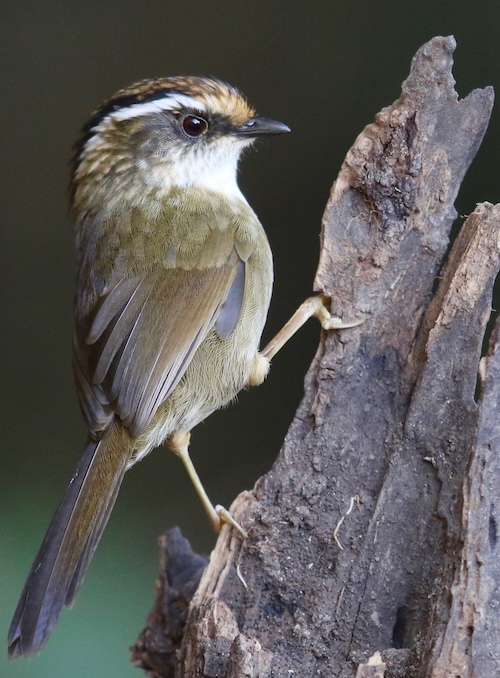
Meghalaya translates as ‘the abode of clouds’ and is a state in northeast India. Its capital is Shillong. The estimated population of Meghalaya is around 3.5 million people occupying an area of approximately 22,429 km2, with a length-to-breadth ratio of about 3:1. Meghalaya is one of the Seven Sister States of northeast India and is bounded to the south by the Bangladeshi divisions of Mymensingh and Sylhet, to the west by the Bangladeshi division of Rangpur, and to the north and east by India’s State of Assam. About 70 per cent of the state is still forested. The Meghalaya subtropical forests ecoregion encompasses the state; its mountain forests are distinct from the lowland tropical forests to the north and south. The forests are notable for their biodiversity of mammals, birds, and plants. Meghalaya has a predominantly agrarian economy with a significant commercial forestry industry. The important crops are potatoes, rice, maize, pineapples, bananas, papayas, and spices. The state is geologically rich in minerals, but it has no significant industries. There are about 1,170 km (730 miles) of national highways. It is also a major logistical centre for trade with Bangladesh.
The state of Meghalaya is mountainous, with stretches of valley and highland plateaus, and it is geologically rich. It consists mainly of Archean rock formations. These rock formations contain rich deposits of valuable minerals like coal, limestone, uranium and sillimanite. The elevation of the plateau ranges between c.500 feet to c.6,400 feet. The central part of the plateau comprising the Khasi Hills has the highest elevations, followed by the eastern section comprising the Jaintia Hills region. The highest point in Meghalaya is Shillong Peak, which is a prominent IAF station in the Khasi Hills overlooking the city of Shillong. It has an altitude of 6433 feet. The Garo Hills region in the western section of the plateau is nearly plain. The highest point in the Garo Hills is Nokrek Peak.

Laitmawsiang – ©Rajesh Dutta CC BY 2.0 via Wikimedia Commons
With the average annual rainfall as high as 470 inches in some areas, Meghalaya is the wettest region of India, with the wettest areas in the southern Khasi Hills that are the wettest on the planet! The western part of the plateau, comprising the Garo Hills region with lower elevations, experiences high temperatures for most of the year. The Shillong area, with the highest elevations, experiences generally low temperatures. The maximum temperature in this region rarely goes beyond 28 °C, whereas sub-zero winter temperatures are common. The town of Cherrapunji in the Khasi Hills south of capital Shillong holds the world record for most rain in a calendar month, while the village of Mawsynram, near Cherrapunji, holds the record for the most rain in a year. Meghalaya has many rivers, most of which are rainfed and seasonal. The important rivers in the Garo Hills region are Ganol, Daring, Sanda, Bandra, Bugai, Dareng, Simsang, Nitai and the Bhupai. In the central and eastern sections of the plateau, the important rivers are Khri, Umtrew, Digaru, Umiam or Barapani, Kynshi (Jadukata), Umngi, Mawpa, Umiam Khwan, Umngot, Umkhen, Myntdu and Myntang. In the southern Khasi Hills region, these rivers have created deep gorges and several waterfalls.
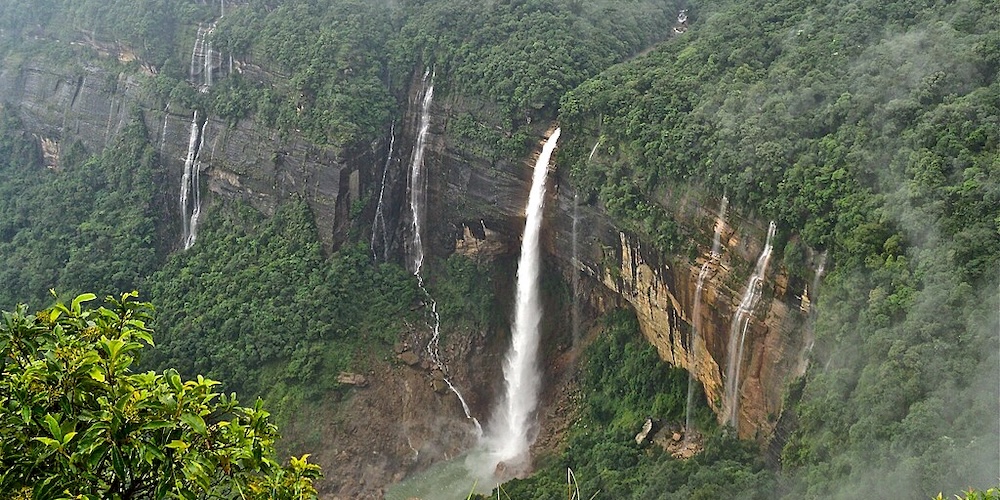
Nohkalikai Falls, Cherrapunji – ©Kunal Dalui CC BY-SA 3.0 via Wikimedia Commons
About 70% of the state is forested, of which 9,496 km2 (3,666 square miles) is dense primary subtropical forest. The forests are considered to be among the richest botanical habitats of Asia. They receive abundant rainfall and support a vast variety of floral and faunal biodiversity. A small number of the forest areas are what are known as ‘sacred groves. These are small pockets of an ancient forest that have been preserved by the communities for centuries due to religious and cultural beliefs. They are reserved for religious rituals and generally remain protected from any exploitation. Consequently, they harbour many rare plant and animal species. The Nokrek Biosphere Reserve in the West Garo Hills and the Balpakram National Park in the South Garo Hills are considered to be the most biodiversity-rich sites in Meghalaya. In addition, Meghalaya has three wildlife sanctuaries. These are the Nongkhyllem Wildlife Sanctuary, the Siju Sanctuary, and the Baghmara Sanctuary, which protects the home of the insect-eating pitcher plant Nepenthes khasiana. Two of the most important tree varieties are Shorea robusta (sal tree) and Tectona grandis (teak). Meghalaya is also the home to a large variety of fruits, vegetables, spices, and medicinal plants and is also famous for its large variety of orchids — nearly 325 of them. Of these, the largest variety is found in the Mawsmai, Mawmluh and Sohrarim forests in the Khasi hills.
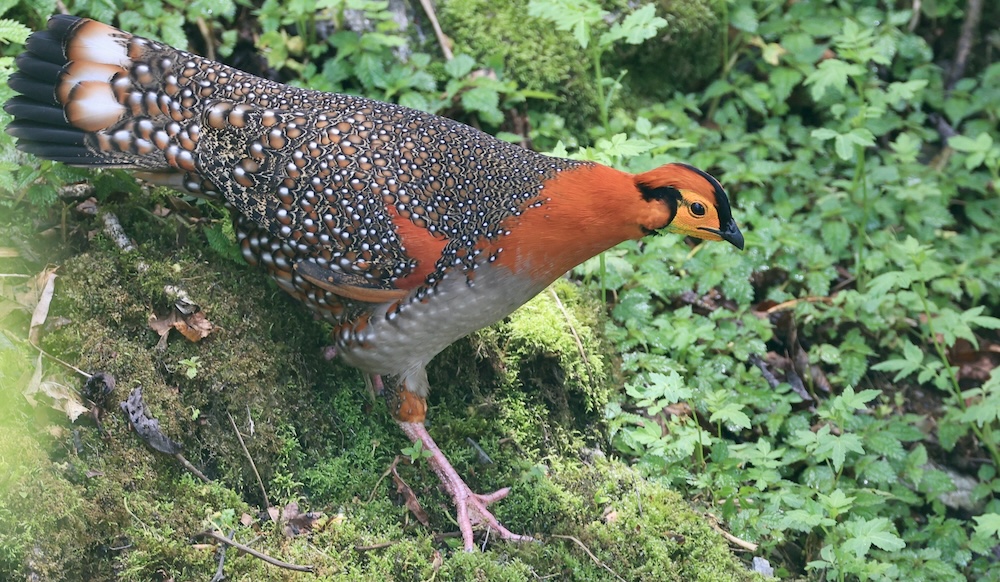
Blyth’s Tragopan Tragopan blythii – ©Bird-Photo-Tours ASIA
Important mammal species include elephants, bear, red pandas, small Indian civets, mongooses, weasels, rodents, gaur, wild buffalo, deer, wild boar and a number of primates. It also has a large variety of bats. The limestone caves in Meghalaya such as the Siju Cave are home to some of the nation’s rarest bat species. The hoolock gibbon is found in all districts of Meghalaya. Common reptiles include lizards, crocodiles and tortoises and the state has a number of snakes including the python, copperhead, green tree racer, Indian cobra, king cobra, coral snake and various vipers.
Meghalaya’s forests has recorded over 700 species of birds, many of which are endemic to Himalayan foothills, Tibet and Southeast Asia. Of the birds found in Meghalaya forests, 34 are on worldwide threatened species list and 9 are on the critically endangered list. Meghalaya is also home to over 250 species of butterflies, nearly a quarter of the butterfly species found in India as a whole.
Birding Meghalaya
Birding in the Clouds – Who is wearing a green coat, sitting on a clouded hill? Well, she’s Meghalaya, one of India’s greener states and popularly known as ‘Home of the Clouds’. Being comparatively wetter and colder than its neighbours in the North Eastern corner of the Republic of India, has brought distinction to this hilly province as the Scotland of the East. From lush green coniferous forests to bamboo thickets, from limestone caves to rippling waterfalls, from miles of hilly croplands to forbidden jungles the very diversity makes this a unique realm. This fog-shrouded land is also home to the wettest place on earth (Mawsynram), besides sheltering a plethora of wonders. The conjunction of three distinct hill ranges Khasi, Garo and Jayantia, amid forests, scintillating streams, untamed hills, mountain lakes, tree covered slopes and green valleys, make it a panoramic destination that has a bewitching appeal. The undiscovered delights of Meghalaya are divine blessings for both its guests and host.
With a geographical area of 22,42,900 hectares, Meghalaya harbours diversity in all senses, be it topography, be it vegetation, be it climatic condition or be it people & their cultures. The forests of Meghalaya – Sub-Tropical Pine, Sub-Tropical Broadleaf, Tropical Wet Evergreen, Tropical Semi-Evergreen and Tropical Moist Deciduous Forest fall under two different Bio-geographic zones. Sacred groves of both the Khasi and the Garo hills areas are yet another significant forest type, which is a haven for a variety of life forms. Meghalaya in simple words can be called nature’s treasure house; the variety in life forms that it houses and the exquisite landscape is self-explanatory. Be it orchids, be it mammals, or be it birds, the diversity is unparalleled. Mammals include; Lesser Panda, Indian Bison, Serow, Sloth Bear, Binturong, Clouded Leopard, Tiger, Leopard, Elephant, Slow Loris, Golden Cat, Hoolock Gibbon, etc. Of 1200 different species of orchids found in India, 300 types are only found in Meghalaya, besides hundreds of other wild varieties of plant including the rare insect eating Pitcher Plant Nepenthes khasiana.
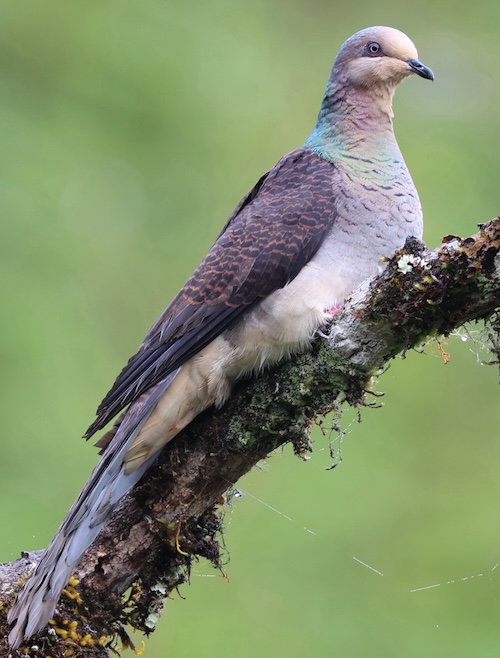
Barred Cuckoo-Dove Macropygia unchall – ©Bird-Photo-Tours ASIA
There are a number of protected areas in the state; out of which, two are National Parks and the others are Wildlife Sanctuaries. Which together with a few other relatively unexplored areas, provide shelter to a magnificent bird life. Ten such areas are rich with avifauna: Mawphlang Sacred Grove, Balpakram Complex, Nokrek Biosphere Reserve including Nokrek National Park, Nongkhyllem Wildlife Sanctuary, Norpuh Reserve Forests, Riat Khwan – Umiaum, Saipung & Upper Shillong, Cherapunjee cliffs. The Gorges and Sacred Groves have been identified by Birdlife International as Important Bird Areas.
A few of the most noteworthy bird species are: Palla’s Fish Eagle Haliaeetus leucorphus, Lesser Kestrel Falco naumanni, Swamp Francolin Francolinus gularis, Wood Snipe Gallinago nemoricola, Purple Wood Pigeon Columba punicea, Slender-billed Babbler Turdoides longirostris, Marsh Babbler Pellorneum palustre, Oriental White-backed Vulture Gyps bangelensis, Greater Spotted Eagle Aquila clanga, Rufous-necked Hornbill Aceros nipalensis, Tawny-breasted Wren Warbler Spelaeornis longicaudatus, Lesser Grey-headed Fish Eagle Ichthyophaga ichthyaetus, Red-headed Vulture Sarcogyps calvus, White-cheeked Hill Partridge Arborophila atrogularis, Blyth’s Trogopan Trogopan blythii, Great Pied Hornbill Buceros bicornis, Brown Hornbill Anorrhinus tickelli, Greater Adjutant Leptotilos dubius, Blyth’s Kingfisher Alcedo Hercules, Grey Sibia Heterophasia gracilis, Rusty-capped Fulvetta Alcippe dubia, Crested Finchbill Spizixos canifrons and more.
There is always the chance of a rare glimpse of White-winged Duck Cairina scutulata in the Balpakram area, although recent records are very rare. To watch Dark-rumped Swift (Khasi Hills Swift) Apus acuticauda, try trekking to the cliffs of Khasi hills, Cherapunjee, Lyetkynsew or the Nohkallikai waterfalls.
This page is sponsored by Bird-Photo-Tours ASIA

-
Number of bird species: 729
(As at July 2025)State Bird: Hill Myna Gracula religiosa
-
Avibase
PDF ChecklistThis checklist includes all bird species found in Meghalaya , based on the best information available at this time. It is based on a wide variety of sources that I collated over many years. I am pleased to offer these checklists as a service to birdwatchers. If you find any error, please do not hesitate to report them. -
Bubo Birding
PDF ChecklistThis checklist includes all species that have been reported in Meghalaya in eBird, but updated to IOC taxonomy, together with the likelihood of seeing each species for each month of the year. -
E-Bird
PDF ChecklistThis checklist is generated with data from eBird (ebird.org), a global database of bird sightings from birders like you. If you enjoy this checklist, please consider contributing your sightings to eBird. It is 100% free to take part, and your observations will help support birders, researchers, and conservationists worldwide.

-
A Pocket Guide to the Birds of Meghalaya
| By Anwaruddin Choudhury | Gibbon Books | 2014 | Paperback | 160 pages, 63 colour photos and colour illustrations, 60 b/w illustrations, 24 b/w maps | ISBN: 9789380652030 Buy this book from NHBS.com -
Birds of the Indian Subcontinent
| By Richard Grimmett, Carol Inskipp & Tim Inskipp | Helm | 2025 | Edition 2 | Paperback | 544 pages, 240+ plates with colour illustrations; colour distribution maps, b/w illustrations | ISBN: 9781472984777 Buy this book from NHBS.com
Birds of the Indian Subcontinent
Apple iOS | AndroidThe eGuide to Birds of the Indian Subcontinent is an interactive companion to Birds of the Indian Subcontinent – the definitive guide for birdwatchers visiting the region. It covers India, Pakistan, Nepal, Bhutan, Bangladesh, Sri Lanka and the Maldives. This application has specific features that will enhance your birding experience.
Indian Birds
Apple iOS | AndroidPioneers in bringing Indian Birding to the smart phone generation - Introducing Indian Birds, the time-honoured and cherished birding companion for India. Established in 2010, it proudly remains the sole mobile app available on App Store, offering bird enthusiasts the ability to explore bird namesReserves-
NP Balphakram
InformationSatellite ViewThis park has been established in the west Garo Hill district in an area of 220sq km. The nearest town is William Nagar about 15km… -
NP Nokrek
InformationSatellite ViewNokrek has a remnant population of the Red panda that has generated curiosity across the world and it is also an important habitat of the Asian elephants. -
WS Siju Wildlife Sanctuary
InformationSatellite ViewSiju Wildlife Sanctuary is situated in the South Garo Hills district of Meghalaya, India. It is the first and oldest wildlife sanctuary in Meghalaya. It is also known as Siju Bird Sanctuary as it is a home for many rare and protected birds such as the Grey Hornbill. Other migratory birds such as Siberian ducks and spoonbills are also sighted here
Sightings, News & Forums-
eBird
SightingseBirding This Month
Guides & Tour Operators-
Arunachal Birding Tours - Meghalaya Birding
Local Tour OperatorMeghalaya is situated in a transition zone with bird fauna composed of species belonging to several faunal elements. Many species belong to western Indian fauna, while others represent south-eastern, Indo-Chinese or Indo-Malayan fauna... -
Asian Adventures
Local Tour OperatorEndangered Birds And Wildlife of Manas and Meghalaya Tour -
Bubo Birding
Tour OperatorEndangered Birds & Wildlife of Manas and Meghalaya -
India Birding Tours
Local Tour OperatorBirdwatching and wildlife adventure are strung together in our Kaziranga and Meghalaya Short Birding Tour....
Trip Reports-
2019 [04 April] - Hannu Jännes
PDF ReportThe journey began with a pre-tour extension to the Khasi Hills of Meghalaya, where we based ourselves in a comfortable guest house close to Cherrapunjee -
2019 [10 October] - Thomas
ReportWhen we were planning our trip to Meghalaya, we looked through a number of sources before we finalised our itinerary... -
2023 [05 May] - Hannu Jännes
Report...Our one-day visit to the Khasi Hills of Meghalaya provided an ideal start with both Dark-rumped Swift and Tawny-breasted Wren-Babbler seen... -
2024 [05 May] - Dhiman Adhikari
ReportMonsoon Birding Tour in Meghalaya with Naba Choudhoury and Kamal Ingti -
2024 [10 October] - Birdwatchers Society
ReportDuring October-2024 while celebrating Durga Puja vacation, We went to Meghalaya for family vacation as well as Bird Watching.
Other Links-
The Birds of Meghalaya
Facebook PageIn the forests of Meghalaya, specially in lower altitudes, multifarious species of birds are found in abundance. Magpie-Robin is a favourite bird to be seen in this bird kingdom.
Fatbirder - linking birders worldwide...
Skip to content