

State of Eritrea
Eritrea is a country in the Horn of Africa region of Eastern Africa. Its capital and largest city is Asmara whose metropolitan area has a population of around 1.1 million people. It is bordered by Ethiopia in the south, Sudan in the west, and Djibouti in the southeast. The northeastern and eastern parts of Eritrea have an extensive coastline along the Red Sea. The nation has a total area of approximately 117,600 km2 (45,406 square miles) and includes the Dahlak Archipelago and several of the Hanish Islands. The population is estimated to be c. 3.9 million people. Contemporary Eritrea is a multi-ethnic country with nine recognised ethnic groups, each of which has a distinct language. The most widely spoken languages are Tigrinya and Arabic.
The country is virtually bisected by a branch of the East African Rift. Eritrea, at the southern end of the Red Sea, is the home of the fork in the rift. The Dahlak Archipelago and its fishing grounds are situated off the sandy arid coastline.
Eritrea may be split into three eco-regions. A hot arid coastal plain extends along the coast. The coastal plain is narrow in the west and widens towards the east. These coastal lowlands are part of the Djibouti xeric shrub-lands ecoregion. The cooler, more fertile highlands reach up to 9,800 feet and are a northern extension of the Ethiopian Highlands, home to montane grasslands and woodlands. Habitats here vary from the sub-tropical rainforest at Filfil Solomona to the precipitous cliffs and canyons of the southern highlands. Filfil receives over 44 inches of rainfall annually. There is a steep escarpment along the eastern side of the highlands, which is the western wall of the East African Rift. The western slope of the highlands is more gradual, descending to interior lowlands.
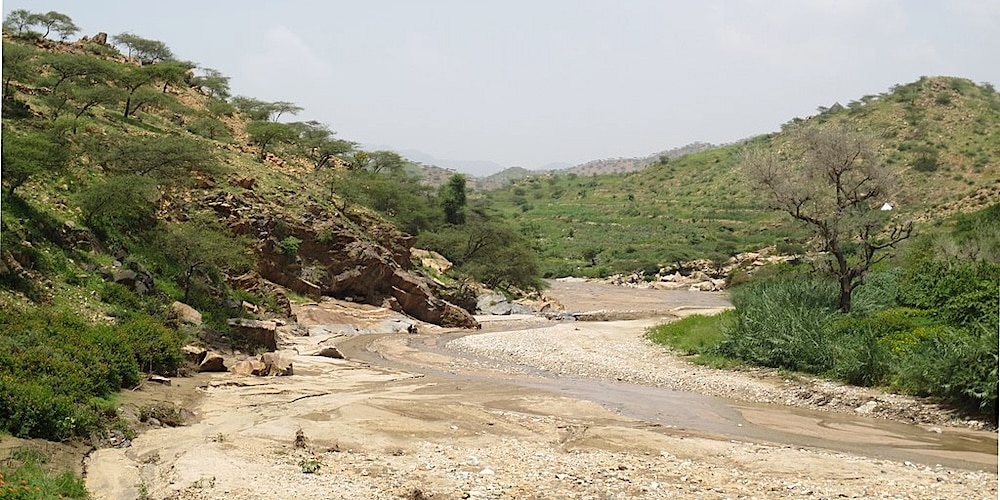
Anseba River – ©Grullab CC BY-SA 4.0 via Wikimedia Commons
Southwestern Eritrea is drained by the Atbara River, which flows northwestwards to join the Nile. The northwestern slope of the highlands is drained by the Barka River, which flows northwards into Sudan to empty into the Red Sea. Western Eritrea is part of the Sahelian Acacia savanna, which extends across Africa south of the Sahara from Eritrea to Senegal. Local variability in rainfall patterns and reduced precipitation are known to occur, which may precipitate soil erosion, floods, droughts, land degradation, and desertification.
Based on temperature variations, Eritrea can be broadly divided into three major climate zones: the temperate zone, subtropical climate zone, and tropical climate zone. The climate of Eritrea is shaped by its diverse topographical features and its location within the tropics. The diversity of its landscape and topography in the highlands and lowlands of Eritrea results in a diversity of climate. The highlands have a temperate climate throughout the year. The climate of most lowland zones is arid and semiarid. The distribution of rainfall and vegetation types varies markedly throughout the country.
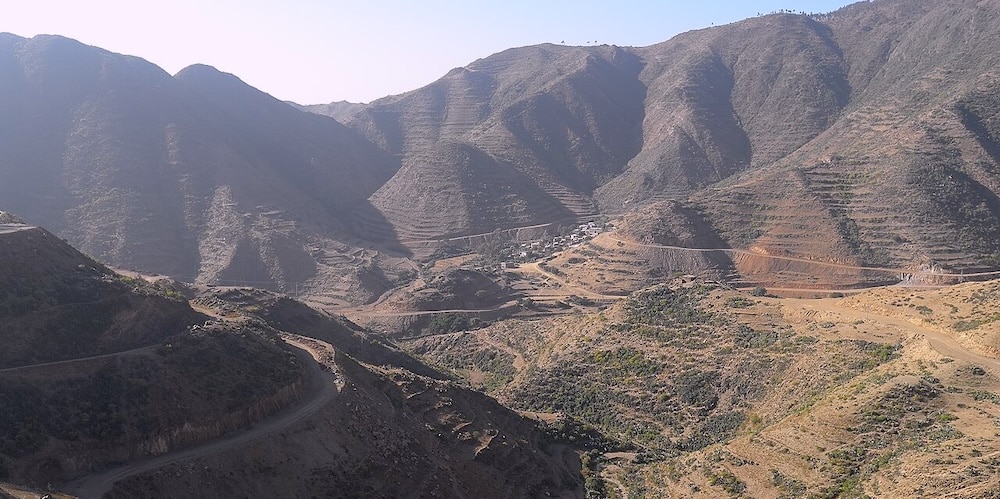
Mountains from road Asmara to Massawa – ©Martin Schibbye CC BY-SA 4.0 via Wikimedia Commons
Eritrean climate varies based on seasonal and altitudinal differences. In the highlands (up to 3000m above sea level) the hottest month is usually May, with temperatures reaching 30 C, whereas winter occurs during December to February when temperatures can be as low as 10 C at night. The capital, Asmara, has a pleasant temperature all year round. In the lowlands and the coastal areas, summer occurs from June to September, when temperatures can reach 40 C. Winter in the lowlands occurs from February to April, when temperatures are between 21 and 35 C.
Eritrea is home to a large number of mammals; 126 species of mammals, 90 species of reptiles, and 19 species of amphibians have been recorded. Mammals commonly seen today include the Abyssinian hare, African wild cat, Black-backed jackal, African golden wolf, Genet, Ground squirrel, pale fox, Soemmerring’s gazelle, and warthog. Dorcas gazelle are common on the coastal plains and in Gash-Barka. Lions are said to inhabit the mountains of the Gash-Barka Region. Dik-diks may be found in many areas. The endangered African wild ass may be seen in Denakalia Region. Other local wildlife include bushbuck, duikers It is estimated that there are approximately 100 African bush elephant left in Eritrea, the most northerly of the East African elephants. The spotted hyena is widespread and fairly common. Eritrea has diverse habitats, including Tropical and Subtropical Grasslands, Savannas, Shrublands, Deserts, Xeric Shrublands, Tropical and Subtropical Moist Broadleaf Forests and Mangrove forests. Enforced regulations have helped in steadily increasing their numbers throughout Eritrea.
In 2006, Eritrea announced that it would become the first country in the world to turn its entire coast into an environmentally protected zone. The 1,347 km (837 mi) coastline, along with another 1,946 km (1,209 mi) of coast around its more than 350 islands, will come under governmental protection.
Birding Eritrea
Eritrea is a wonderful birdwatching destination. Despite its small size and the relative scarcity of visiting birders, nearly 600 species have been recorded here. It shares nearly 20 of the prized Abyssinian ‘endemics’ with Ethiopia, including Wattled Ibis, Rouget’s Rail, Ruppell’s (Black) Chat, Ethiopian Oriole, Black-winged Lovebird, Abyssinian Woodpecker, Banded Barbet, Abyssinian Slaty Flycatcher, White-backed Black Tit and White-billed Starling.

Massif near Senafe – ©Sailko CC BY 3.0 via Wikimedia Commons
Eritrea also happens to lie on one of the major migration routes into Africa, guaranteeing excellent birdwatching in both spring and autumn, concentrated along the coastal plain, and the eastern escarpment edge of the highlands. Large numbers of raptors pass through Eritrea on their way to their wintering grounds in central and southern Africa. The country is poor, and bureaucracy is strict, but the people are kind and very friendly, and travelling within the permitted areas it is safe but do NOT venture off road or into other areas as there are still extensive minefields from the war. Crime is very low by African standards, as is street hassle. A good guide is necessary to get you to all the best locations and to help with the bureaucracy but in a week it is easily possible to visit the hotspots, see most of the endemics and take home about 200 species.
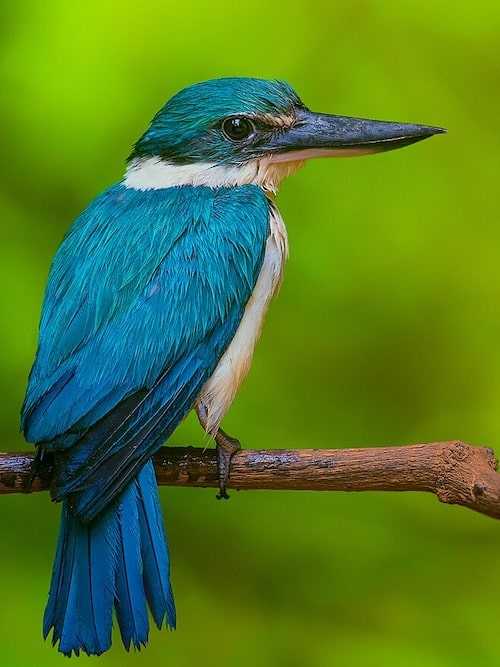
Key Species – Many Abyssinian ‘endemics’ can be found here. In the right habitat, Ruppell’s (Black) Chat, Wattled Ibis, White-cheeked Turaco, Black-winged Lovebird, White-billed Starling, White-collared Pigeon, White-throated Seed-eater, Abyssinian Slaty Flycatcher, Banded Barbet, Ethiopian Oriole and Ethiopian Cisticola Cisticola Lugubris are all common breeding species. Rarer, but still regularly recorded are White-winged Cliff Chat (Mocking Cliff Chat is common throughout the highlands), White-backed Black Tit, Abyssinian Woodpecker, Thick-billed Raven and Blue Saw-wing Psalidoprocne pristoptera. There are also a large number of near-endemics (birds which are native to the Horn of Africa): Erckel’s Francolin, Blanford’s Lark, White-headed (Cretschmar’s) Babbler, White-rumped Babbler, Abyssinian Black Wheatear, Somali Starling, Swainson’s Sparrow, Ruppell’s Weaver, African Citril and Brown-rumped Seed-eater. Eritrea’s extensive coastal mangrove forests are the only place in Africa where White-collared Kingfisher breeds, and the Eritrean Red Sea islands are of international importance as breeding sites for a number of sea and shorebirds, including White-eyed Gull (33% of the world population), Crab Plover (20% of world population), Lesser Crested Tern, Brown Noddy, Eurasian Spoonbill, Brown Booby, Greater Crested Tern, White-cheeked Tern and Bridled Tern. The threatened Socotra Cormorant is also suspected to breed on the southern islands.
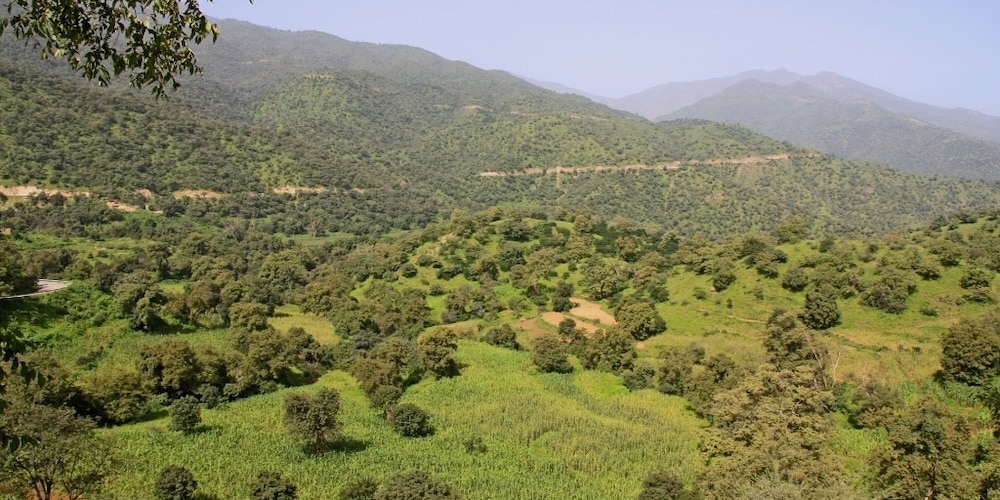
Fertile Coastal area – ©John Beso CC BY-SA 3.0 via Wikimedia Commons
Eritrea has plentiful raptor species (59 recorded). Lammergeier are still fairly frequent in the southern highlands, along with Ruppell’s Vulture and Griffon Vulture (winter). Verreaux’s Eagle, Tawny Eagle and Long-crested Eagle are resident, and large numbers of esp. Aquila eagle species can be found either on passage or throughout the winter, including Steppe Eagle, Lesser and Greater Spotted Eagle, Eastern Imperial Eagle and Wahlberg’s Eagle. Significant numbers of these migrating species can be counted along the eastern escarpment of the Abyssinian highlands near Asmara, especially at the Asmara rubbish dump in February/March. The rocky uplands in Adi Keih and Senafe Sub Zobas are particularly good for Wheatears (11 species in Eritrea), Chats (10 species in Eritrea) and Rock Thrushes.
Travel permits for all the locations listed below can be obtained from the tourist office in Asmara. Remember that the Eritreans are not used to people birdwatching in their country, and there is a large military presence in some areas. Always ask before getting out your binoculars if in doubt! However, if you explain to most people what you are doing they are nearly always amenable and interested. In two years living in the country, I had very few problems and converted several Eritreans to the hobby!
More on these sites and other locations can be found on the website Birdwatching in Eritrea
-
Adi Keih Sub Zoba:
WebsiteAdi Keih Sub Zoba is excellent for Abyssinian endemics and highland specialities: Several sites near Adi Keih provide good birdwatching, especially for the Abyssinian endemics: Hawatsu: is on the road between Segeneiti and Adi Keih, 41km after Segeneiti, 9km before Adi Keih. There is a dam here which is productive for waders and other waterbirds for most of the year. Just upstream of the dam is a grassy pasture where Wattled Ibis often feed in the thickest grass. Also, near here on the other side of the road is a small valley (near the Eucalyptus copse, behind the few houses. Walk up this valley to find several of the Abyssinian endemic species in the copse of native trees that still survive in a small gorge here. Highlight species include: Wattled Ibis, White-billed Starling, Abyssinian Slaty Flycatcher, Banded Barbet, White-cheeked Turaco, Erckel's Francolin, Northern Paradise Flycatcher, Klaas's Cuckoo, Brown Woodland Warbler, Tacazze Sunbird, Ruppell's Robin Chat, Long-legged Buzzard (winter), Maccoa Duck, Verreaux’s Eagle and Temminck’s Courser on the plateau above the copse.Safira/Qohaito & Karibossa: Qohaito is famous for its Auxmite archaeological remains, but birdwatching is particularly good here too. There are some steep cliffs to the east where Ruppell’s and Egyptian Vulture nest, and White-collared Pigeon roost, while Alpine and Mottled Swift hurtle past. Near the so-called ‘Egyptian Tomb’ is a steep valley where several other endemics can be found, including Ruppell’s Black Chat, Black-winged Lovebird, Banded Barbet and the rare White-backed Black Tit. If you have time to drive further along the road to Karibossa, this village has quite a few native trees and is very good for the Abyssinian endemics, including Abyssinian Slaty Flycatcher, Black-winged Lovebird, White-billed Starling, White-cheeked Turaco, Banded Barbet, White-collared Pigeon, Ruppell's Black Chat and White-throated Seed-eater. Other local delicacies include: Verreaux's Eagle Owl, Little Rock Thrush, African Olive Pigeon (newly discovered here), Red-fronted Tinkerbird, Brown-rumped Seed-eater, Slender-billed Starling, Erckel's Francolin, Lanner Falcon, Tawny Eagle, Ruppell's Vulture and Egyptian Vulture. -
Asmara for the eastern escarpment and waterbirds at surrounding reservoirs:
WebsiteThe escarpment edge is often productive for migrating species, especially raptors. The best places to see them are easily accessed along the Massawa road. The Asmara rubbish dump can be smelt to the left side of the road as soon as you start descending from Asmara, just past the customs checkpoint. From October to December, and especially from February to March large numbers of Aquila eagles congregate here along with other raptors and lots of Hamadryas Baboons (seen best early morning). A little further along the road is Bar Durfo, less smelly but often with good views of raptors cruising on the thermals nearby. To find other migrant species, park on the Asmara side of the checkpoint, and explore the bushes along the escarpment edge just below the orthodox church nearby. Species here could include: Steppe Eagle, Tawny Eagle, Eastern Imperial Eagle, Booted Eagle, Lesser Spotted Eagle, Wahlberg's Eagle, Verreaux's Eagle, African Hawk Eagle, Black Kite, Common Buzzard, Augur Buzzard, Lanner Falcon, Peregrine Falcon, Common Kestrel, Abdim's Stork, Nyanza Swift, White-rumped Swift, Alpine Swift, Mottled Swift, White-rumped Babbler, Banded Barbet. Smaller migrants that are seen in spring and autumn include Common Cuckoo, Ortolan Bunting, Wryneck, Golden Oriole, Eurasian Hoopoe, Eurasian Bee-eater, Red-backed Shrike, Woodchat Shrike, Isabelline Shrike, Whitethroat and several swallow species, including Red-rumped Swallow and House Martin.Several reservoirs ( -
Elabered for diversity and Hagaz for sub-Saharan savannah species:
WebsiteHagaz is the easiest town to get to in the western lowlands, and therefore is good for species associated with the Sudan-Guinea biome. Along the way, it is recommended that you stop off at the Elabered Agricultural Estate (between Asmara and Keren -
Filfil for rainforest species and Abyssinian endemics:
WebsiteFilfil is an amazing enigma in an otherwise fairly dry and sometimes barren country. There is extensive cloud rainforest here that benefits from the wet seasons of both the highlands and the lowlands, and attracts a lot of tropical forest species as well as several of the Abyssinian endemics higher up. It is sometimes called -
Massawa and the Dahlak Islands for seabirds, shorebirds and coastal migrants:
WebsiteSatellite ViewThe coastal town of Massawa is an incredible place to visit, for its history and architecture as much as for the birds. The best birdwatching sites are near the town, and include the small flats by the causeway to the mainland (at low tide), the beach at Gurgussum (10km north of Massawa), the shallow lagoons 4km north of Gurgussum and the mangrove forest on Green Island (boats can be hired from the Diving Centre or Mike’s Boats in Massawa). South of Massawa towards Foro there is more extensive mangrove forest, where the rare White-collared Kingfisher breeds, although birdwatching is not permitted around the Hirgigo power station. Exploring the Dahlaks takes longer, although boats can easily be chartered through travel agents in Asmara (Explore is one) or through the Dive Centre or Mike’s Boats in Massawa itself. 2 days are needed to visit the most interesting islands, and as well as the birds, there are plentiful dolphin species, dugong, leatherback turtle, whale shark and manta ray. Snorkelling and diving are both excellent here. Recommended islands include Dissei, Dahlak Kebir, Dahret and Dur ghella. Species at Gurgussum and the lagoons nearby include: Brown Booby, Pink-backed Pelican, Great White Pelican, Greater Flamingo, Lesser Flamingo, Green-backed Heron, Western Reef Heron, Grey Heron, Goliath Heron, Abdim's Stork, Sacred Ibis, Eurasian Spoonbill, African Spoonbill, Shoveler, Tufted Duck, Pintail, Teal, Osprey, Common Kestrel, Crab Plover, Black-winged Stilt, Avocet, Eurasian Oystercatcher, Ringed Plover, Three-banded Plover, Kentish Plover, Mongolian Plover, Greater Sand Plover, Grey Plover, Sanderling, Curlew Sandpiper, Dunlin, Bar-tailed Godwit, Black-tailed Godwit, Whimbrel, Curlew, Common Redshank, Wood Sandpiper, Marsh Sandpiper, Terek Sandpiper, Common Sandpiper, Ruddy Turnstone, Sooty Gull, White-eyed Gull, Common Black-headed Gull, Slender-billed Gull, Lesser Black-backed Gull, Heuglin's Gull, Caspian Gull, Gull-billed Tern, Caspian Tern, Greater Crested Tern, Lesser Crested Tern, Sandwich Tern, Common Tern, White-cheeked Tern, Saunders's Tern, African Palm Swift, Crested Lark, Black-crowned Sparrow Lark, Black Wheatear, Graceful Prinia, Yellow Wagtail, White Wagtail, Isabelline Wheatear, House Crow and Village Weaver. Green Island species include occasional White-collared Kingfisher, Osprey, Yellow-billed Kite, Lesser Black-backed Gull, Sooty Gull, Sacred Ibis (breeding), Brown Booby, Lesser Crested Tern, Greater Sand Plover, Pink-backed Pelican (breeding), House Crow, Kentish Plover, Curlew, Grey Plover, Crab Plover, Eurasian Spoonbill (breeding), Striated Heron, Purple Heron, Redshank, Ruddy Turnstone, Greater Flamingo, Western Reef Heron, Little Stint, Terek Sandpiper, Whimbrel, Gull-billed Tern, Slender-billed Gull, Greater Crested Tern, Greenshank, Common Sandpiper, Heuglin's Gull, Caspian Tern, Dunlin, Eurasian Reed Warbler, Senegal Thick-knee, Saunder's Tern and Graceful Prinia,Species in the Dahlak Islands include Brown Booby, Pink-backed Pelican, Green-backed Heron, Western Reef Heron, Great White Egret, Greater Flamingo, Abdim’s Stork, Osprey, Black Kite, Egyptian Vulture, Hooded Vulture, Sooty Falcon, Arabian Bustard, Crab Plover, Bar-tailed Godwit, Whimbrel, Eurasian Curlew, Common Redshank, Common Sandpiper, Sanderling, Little Stint, Lesser Black-backed Gull, Sooty Gull, White-eyed Gull, Slender-billed Gull, Lesser-crested Tern, Caspian Tern, Common Tern, Sandwich Tern, Chestnut-bellied Sandgrouse, Blue-spotted Wood Dove, Speckled Pigeon, African Collared Dove, Black-crowned Sparrow Lark, Somali Crow, Pied Crow, Blackstart, Common Fiscal and Southern Grey Shrike.
-
Jason Anderson
Eritrea
http://ibis.atwebpages.com/birdwatching_in_eritrea/index.htm
-
Number of bird species: 591
(As at February 2025)
- (But there are at least 14 species are shared ONLY with Ethiopia)
-
Avibase
PDF ChecklistThis checklist includes all bird species found in Eritrea , based on the best information available at this time. It is based on a wide variety of sources that I collated over many years. I am pleased to offer these checklists as a service to birdwatchers. If you find any error, please do not hesitate to report them. -
E-Bird
PDF ChecklistThis checklist is generated with data from eBird (ebird.org), a global database of bird sightings from birders like you. If you enjoy this checklist, please consider contributing your sightings to eBird. It is 100% free to take part, and your observations will help support birders, researchers, and conservationists worldwide. -
Wikipedia
Annotated ListThis is a list of the bird species recorded in Eritrea. The avifauna of Eritrea include a total of 587 species.

-
Birds of Ethiopia & Eritrea
by John Ash & John Atkins | Christopher Helm | 2009 | Hardback | 463 pages, 16p colour photos and maps | ISBN: 9781408109793 Buy this book from NHBS.com -
Birds of the Horn of Africa
[Ethiopia, Eritrea, Djibouti, Somalia and Socotra] | by Nigel Redman, Terry Stevenson & John Fanshawe | Christopher Helm | 2011 | Paperback | 512 pages, 213 colour plates, 1000+ colour distribution maps, colour & b/w maps | ISBN: 9781408157350 Buy this book from NHBS.com
-
African Bird Club
WebsiteEritrea has a bird list of over 500 species but there has been little ornithological activity for some thirty or forty years. Sadly, long running disputes with Ethiopia and political instability have impacted habitat and species adversely as well as limiting opportunities for visiting birders. With little tourist infrastructure, Eritrea is likely to appeal to the more adventurous or pioneering birder. This small country can however be a rewarding destination for birders who in just a few days could see a substantial number of species, including many near endemics and regional endemics as well as countless passage migrants.
-
NP Dahlak Marine National Park
InformationSatellite ViewMany of the uninhabited islands have become nesting areas for large numbers of seabirds due to their isolated nature and rich feeding grounds in the surrounding area. -
NP Semenawi Bahri National Park
InformationSatellite ViewMade up of massive mountains as well as valleys, it is located at an altitude of between 900 and 2400 meters. A diverse range of wildlife live there, including duiker, klipspringer, warthog, leopard and bushbuck. Many species of birds have also been discovered recently. -
WR Gash-Setit Wildlife Reserve
InformationSatellite ViewGash-Setit is a 709 km2 (274 sq mi) designated national wildlife reserve and historical area of western Eritrea where its considered to be the northern most point of Africa for elephant habitat. -
WR ob Wildlife Reserve
InformationSatellite ViewYob Wildlife Reserve is a protected area in the Northern Red Sea and Anseba regions of northern Eritrea. According to the Gazetta Eritrea, it was established on 16 March 1959 by the British, specifically to protect the significant populations of Nubian ibex in the area.
-
eBird
SightingseBirding This Month
-
Dawid Berhane
Local GuideDawit Berhane: Bird guide, naturalist, for those interested in wildflowers and guide for hiking, trekking, etc. -
Exploring Tourism Eritrea
Local Tour OperatorFour-day package
-
1998 [03 March] - Mike Rogerson - with Ethiopia & Djibouti
ReportThe following trip report covers a 4 week period in "Abyssinia" (3 weeks in Ethiopia, 1 week in Eritrea and 24 hours in Djibouti). The trip was done alone, and for reasons of expense (hire car rates, especially 4WD vehicles, being very expensive in Ethiopia), apart from some cheap internal flights inside Ethiopia, public land transport was used throughout with the odd bit of hitch hiking. The trip, although primarily aimed at birding, did include several days heavily biased towards visits of Ethiopia's outstanding historical sites specifically around Gonder and Lalibela which can to some extent be combined with birding. -
2005 [01 January] - Morten Brendstrup-Hansen
PDF Report...12 km N of Massawa at the Gurgusum Beach Resort, sea birds as well as waders are markedly more numerous than at Massawa. Several (remains of) gardens along the road between Gurgusum Beach Resort and the Hamasien Hotel also offer interesting bird-watching...
-
Asmara Palace
AccommodationHotel Asmara Palace for the occasion of 25th year Hotel Anniversary, we offer you our valued guests a 30% discount on all room types with the guarantee of a warm welcome and attentive service 24 hrs a day.
-
Birdwatching in Eritrea
WebsiteEritrea is not well known as a birdwatching destination. But it should be. Despite being one of the most 'underbirded' countries in Africa, it has an impressive checklist of over 560 species, which is increasing rapidly. Ethiopia is famous as one of the best birding destinations in the world. Most highly prized are its Abyssinian 'endemics', many of which are in fact shared with Eritrea, as the Abyssinian Highlands are split between the two countries… -
Eritrean Fauna
WebsiteEritrea's range of habitats is surprisingly diverse, and its birdlife is correspondingly rich. A total of 537 species of birds have been recorded, including the rare blue saw-wing -
Seawater Farms Eritrea
ArticleIn Eritrea, atmospheric scientist turned agricultural entrepreneur Carl Hodges developed a seawater farm which is an integrated multi-species complex system. This approach produces direct benefits in the form of protein and vegetable for local consumption and revenue generation; but importantly revitalises the environment and creates the enabling conditions for further economic activity.