

State of Alagoas
Alagoas is a state in the North East region of Brazil and is the second smallest of the twenty-seven states of Brazil. It covers an area of 27,845 km2 (10,751 square miles). The name comes from a profusion of tidal lagoons dotting the coastline of the state – the largest of which is Lagoa Mundaú. It is located on the south Atlantic coast, and was originally a part of Pernambuco separated in 1817. It borders Pernambuco to the north, Sergipe to the south, Bahia to the southwest, and the Atlantic Ocean to the east. Its capital is the city of Maceió, which is also the largest city. The state has a population of about 3.2 million people, almost one million of whom live in the capital.
As with the lakes along its coast near the city of Maceió, its coast is bordered by fringing reefs and many fine beaches. Behind the beaches, sometimes only hundreds of meters back and defined by steep scarps, lies a stretch of green coastal hills having enough rainfall for considerable agriculture and scarce remnants of the Atlantic Forest that now is largely limited to steep hill tops or steep valley sides and bottoms. This is the area long dominated by sugar cane.

Mundaú Lake – ©Daniele Gidsicki CC BY 2.0 via Wikimedia Commons
Further inland lies the Sertão of the Northeast region of the nation. The Sertão is a high dry region dominated by scrub that is often thorn-filled; caatinga. Some areas are given over to cattle ranching.
The São Francisco River forms the southern boundary of the state; the other large rivers are the Mundaú, Paraiba do Meio, Coruipe and Jequiá
Birding Alagoas
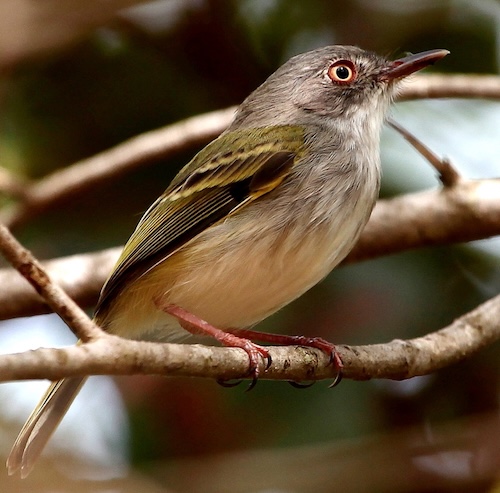
While nowadays Alagoas is heavily populated and a major producer of sugar and alcohol, it was originally almost entirely covered by the Atlantic Rain Forest. The remnants of this forest are where today can be found such rarities as the Seven-coloured Tanager Tangara fastuosa, and Sooretama Slaty Antshrike Thamnophilus ambiguous, which are nearly endemic to the state as well as a number of scarce Brazilian endemics such as Indigo Macaw Anodorhynmchus leari and Pearly-vented Tody-Tyrant Hemitriccus margaritaceiventer.
The nature reserve at Murici Ecological Station, located near the capital of Maceió, is one of the most important preservation projects in the country and is being sponsored by several important domestic and international conservation groups as it is ever under threat. Nevertheless, the higher elevations still have totally intact closed canopy forest. It holds species such as Orange-bellied Antwren Tenenura sicki and Alagoas Tyrannulet Phylloscartes ceciliae and, if they are still extant, Alagoas Foliage-gleaner Philydor novaesi.

Rio São Francisco – ©Marinelson Almeida CC BY 2.0 via Wikimedia Commons
The Reserva Fazenda Bananeiras, located in the interior features rich secondary Atlantic Forest trails and high species counts. It is still good for many Brazilian endemics.
Areas along the coast around the capital including local parks and mangrove areas are a good introduction to more widespread or commoner species, particularly those associated with water such as Egrets, kingfishers and tropical tyrants.
This may not be a prime birding destination, but there is plenty of interest to any birder who needs to be in state for any reason.
-
IBAMA Reserva Fazenda Bananeiras
Satellite ViewTo get to the IBAMA reserve, Fazenda Bananeiras, take a dirt road to the right off the BR104 (signposted Fazenda Serra Nova); 700m north of the entrance to Murici. The way is complicated with many tracks to the right and left. Keep to the main road. At a T junction with another main dirt road, turn left. Ask for Estreito and then Bananeiras. There is a small dam on the left at Bananeiras. The reserve is up the hill after the hamlet, forking left near the top. There is a chain (unlocked when we were there and no guard) at the entrance, 16.4km from the asphalt. There is another bit of good forest, slightly lower, beside the telecom. tower on the left of the BR101, 16km north of the junction with the BR104.
-
Number of bird species: 635
(As at August 2026)
-
Avibase
PDF ChecklistThis checklist includes all bird species found in Alagoas , based on the best information available at this time. It is based on a wide variety of sources that I collated over many years. I am pleased to offer these checklists as a service to birdwatchers. If you find any error, please do not hesitate to report them. -
eBird
PDF ChecklistThis checklist is generated with data from eBird (ebird.org), a global database of bird sightings from birders like you. If you enjoy this checklist, please consider contributing your sightings to eBird. It is 100% free to take part, and your observations will help support birders, researchers, and conservationists worldwide.
-
Universidade Federal de Alagoas
Website
-
IBA Murici - Chapada de Borborema and Serra das Guaribas
InformationSatellite ViewThe American Bird Conservancy describes Murici as probably the most important place for bird conservation in the Western Hemisphere due to its extraordinary density of unique birds, including six endangered and five critically-endangered bird species… -
NR IBA Murici Ecological Station
InformationSatellite ViewIt preserves a rugged area of Atlantic Forest that is important as a home for several species of rare or endangered birds.
-
eBird
SightingseBirding This Month
-
BirdQuest
Tour OperatorULTIMATE NORTHEAST BRAZIL – the most comprehensive itinerary for Brazil’s most endangered endemics -
Rockjumper
Tour OperatorBrazil - Northeast - Mega Birding Tour
-
2019 [03 March] - Eduardo Patrial
PDF Report...This day (specially the whole morning) was dedicated to the tough visit to Murici Ecological Station, one of the largest Atlantic Forest remnants in the region, sadly a forest fragment isolated from others for many years, being on another hilltop difficult to access even with 4x4 vehicles. Birding here is becoming harder at each visit and situation of the localized endemics is not good. And after our last visit two year ago, this time the session was very disappointing unfortunately. The forest was extremely quiet and bird activity was almost zero. None of the big targets seen last time (Alagoas Antwren, Alagoas Tyrannulet, Pernambuco Foliage-gleaner) were even heard this time. Of course we saw few things, to mention White-bellied TodyTyrant (a new one for the list), the endemics Scalloped Antbird and Silvery-flanked Antwren, Greyish Mourner and few more common species, but in general the session was sadly poor. We were lucky to find a pair Seven-colored Tanager back at the hotel’s garden in the afternoon. We got long and close views of them, being definitely a great reward for the day... -
2022 [12 December] - Josh Beck
PDF ReportThe good part was visiting a lek of the northern subspp of Margaretta’s (Great-billed) Hermit and seeing well Todd’s (Amazonian) Barred-Woodcreeper. Taxonomy of the Woodcreepers is far from settled but it definitely seems there will be more splits in the Barred-Woodcreeper complex so this is a good taxon to see. Margaretta’s Hermit sounds NOTHING like Amazonian Great-billed Hermit and seems to me like a mandatory split. As well there are vocal differences between the northern and southern populations of Margaretta’s itself, so I would say that this is a must see bird here. Fortunately Arthur can take you to a lek and the Hermit is reliable. After that, you can see Pernambuco Foliage-Gleaner here, and after a lot of effort I had a shitty split second look at a bird, but fortunately saw this species much better later at another location. -
2025 [10 October] - Rob Williams
PDF Report...A full day in the Pedro D’Antas reserve gave us good views of several of the world’s rarest birds. Sadly, the natural humid forest has been almost eliminated in northeast Brazil north of the Sao Francisco River, and a suite of endemics are now restricted to some of the tiny fragments that remain...