

Lanzarote
Lanzarote is the easternmost island of the Canary Islands, around 125 kilometres off the coast of Africa and 1,000 kilometres from the Iberian Peninsula. The island covers an area of 846 square kilometres or 327 square miles and is the fourth largest of the islands in the archipelago. It has around 165,000 inhabitants and is the third most populous Canary Island after Tenerife and Gran Canaria. One of the island’s main attractions is Timanfaya National Park, because of which the whole island was declared a biosphere reserve in 1993. The island’s capital is Arrecife, which lies on the east coast.
Lanzarote is 11 kilometres northeast of Fuerventura and just over a kilometre from La Graciosa. The island itself is 60 kilometres from north to south and 25 from west to east with 213 kilometres of coastline, of which only 10 kilometres is sand and the rest are very rocky. The landscape includes the mountain ranges of Famara in the north and Ajaches in the south. South of the Famara massif is the El Jable Desert, which separates Famara and Montañas del Fuego. The highest peak is Peñas del Chache at 670 metres or 2,200 feet.

Montaña del Señalo – ©MiljenkoSuljic CC BY-SA 4.0 via Wikimedia Commons
The island is often called the ‘island of eternal spring’ as it has a subtropical hot desert climate. The small amount of precipitation is mainly concentrated in the winter. Rainfall during summer is rare and often summers are completely dry without any precipitation at all. On average the island receives 16 days of rain between December and February. Sometimes the hot Sirocco wind prevails, which causes very dusty conditions across the island. Consequently, most of the water used by the populace and tourists has to be desalinated.
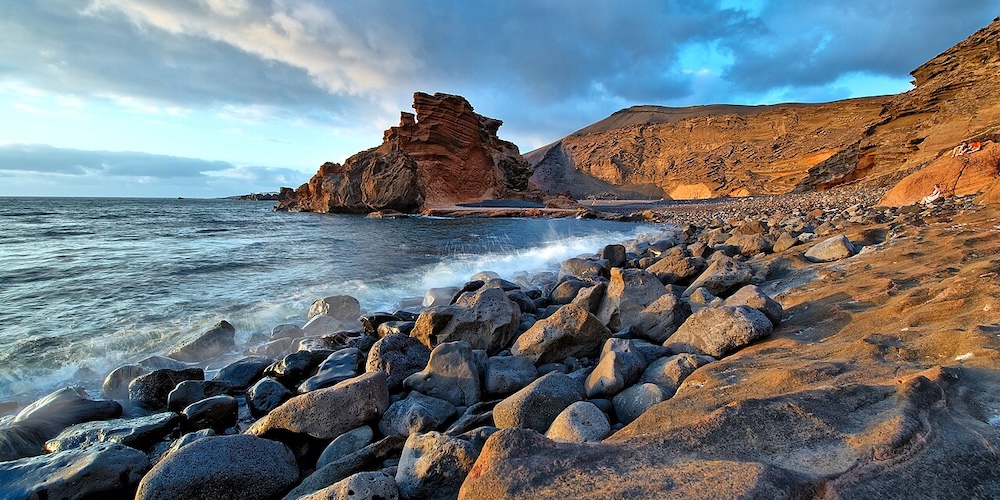
El Golfo Beach – ©Lviatour CC BY-SA 3.0 via Wikimedia Commons
There are over 500 different kinds of plant on the island, 17 of which are endemic. All have had to adapt to the relative scarcity of water. They include the Canary Island Date Palm, which is found in damp areas of the north, and the Canary Island Pine, along with ferns and wild olives, which once covered the highest parts of the mountains, but are rarely found today. There are vineyards on the island, although they are protected with small stone walls and grown in a sort of pit. This agricultural technique is designed to harvest rainfall and overnight dew, and to protect the plants from the winds.
Birding Lanzarote
I (Fatbirder) loved the birding here, but if you are one of those who must get a long list and many new birds then go elsewhere. Birding Lanzarote is subtler than that. Fifty different species may be expected, a full-on birder would expect 70- 80 and the very lucky few who work very hard, at the right time of year, with lady luck smiling on them might get the magic 100. However, they will see many ‘quality’ birds, many birds that are extreme rarities in the UK and probably half a dozen ‘lifers’. Moreover, many of the birds that are familiar at home or on trips to southern Europe will be different subspecies here.
Nor should you expect to see lots of birds. Most areas seem, at first sight, completely devoid of animal life, although villages will have plenty of Rock and Collared Doves. In a few places, on a few occasions you may get a whole raft of birds. We saw a flock of perhaps 200 Lesser Short-toed Larks flocking at dusk. Once we found a roost of gulls and terns and on one other occasion a small muddy inlet with good numbers and variety of waders and herons. Pick the right time (spring or autumn) and some places can be alive with off course migrants.

El Jable de San Bartolomé – ©IgnacioRomeroPerera CC BY-SA 4.0 via Wikimedia Commons
On one day at the poolside our tiny garden had a continuous stream of half a dozen warbler species and both Pied and Spotted Flycatchers etc. Despite the chlorinated water, many drank from the swimming pool. The edges of small towns were often the best place as some have lots of palms and cactus whereas most of the island is treeless and only supports low shrubs and crops. The patch of ‘waste’ ground behind our villa, which merged with the desert edge was sometimes completely dead and other times full of birds, especially migrant Chiffchaffs and Black Redstarts who cared not one whit that there were a couple of abandoned cars, builder’s rubble and litter. In fact, the old cars probably had trapped rainwater so were very attractive.
The Chinijo Archipelago to the North is the place to go for the Eleonora’s Falcon, Barbary Falcon and Barbary Partridges as well as recent colonisers such as Cattle Egret and Little Egret. It is quite spectacular with high hills and deep gorges with massive cliffs rising over 2000 feet from the ocean… here Cory’s Shearwaters breed as well as Barbary Falcons. Being high it is often misty, and being misty it is very green.
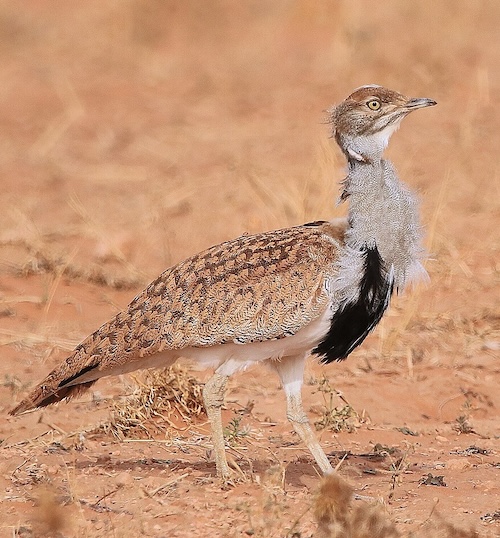
The biggest draw for many birders is the Houbara Bustard which can be found relatively easily in the El Jable Desert near to the village of Soo, as can Cream-coloured Courser, Lesser Short-toed Lark, Hoopoe, Stone Curlew and Trumpeter Finch. Sadly, the area is not protected and is often disturbed by all-terrain vehicles etc.
The island is also home to one of two surviving populations of the threatened Canarian Egyptian vulture.

Montaña Colorada in Los Volcanes Natural Park – ©MiljenkoSuljic CC BY-SA 4.0 via Wikimedia Commons
Timanfaya National Park is one of Lanzarote’s most emblematic natural treasures and is known for its surreal volcanic landscape and impressive fire mountains. Access to the park is restricted to protect its fragile ecosystem, but thereare bus excursions and guided walks. Adjacent to the Timanfaya National Park is the Parque Natural de los Volcanes. This extensive protected area covers a large part of the southwest of the island, between the municipalities of Tinajo, Tías and Yaiza. The waters surrounding Lanzarote are also home to some hidden treasures. The Reserva Natural Integral de los Islotes is located in the north of the island, made up of the islet of Montaña Clara, and the rocks of the West and East and is one of the most important enclaves for nesting seabirds in the eastern Atlantic.
Return to the Canaries page: Canary Isles Main Page
This page is sponsored by Eco-Insider & Lanzarote Active Club

-
Number of bird species: 341
(As at May 2026)
-
Avibase
PDF ChecklistThis checklist includes all bird species found in Lanzarote , based on the best information available at this time. It is based on a wide variety of sources that I collated over many years. I am pleased to offer these checklists as a service to birdwatchers. If you find any error, please do not hesitate to report them. -
eBird
PDF ChecklistThis checklist is generated with data from eBird (ebird.org), a global database of bird sightings from birders like you. If you enjoy this checklist, please consider contributing your sightings to eBird. It is 100% free to take part, and your observations will help support birders, researchers, and conservationists worldwide.
-
Top Five Reserves
WebpageSatellite ViewAccess to the park is restricted to protect its fragile ecosystem, but visitors can enjoy bus tours and guided walks to admire the beauty of this unique place.
-
eBird
SightingseBirding This Month
-
Eco Insider
ToursLanzarote birding tours are a unique experience for any bird watching enthusiast.
-
2016 [10 October] - Bo Beolens
PDF ReportFatbirder's own trip ...This trip was organised for us by Carmen Portella, leading light of Lanzarote Active Club and founder of Desert Watch Lanzarote. She invited us to the island to experience for ourselves the birding opportunities in this unique environment... -
2021 [08 August] - Matthew Mellor - Lanzarote ^ Fuerteventura
PDF Report...The first bird I saw on heading to pick up the car opposite the terminal was a lifer – a Plain Swift, darting and swooping quite madly about in a much less deliberate way than one might see a Common Swift do. A couple of individual Collared Doves made an appearance (little did I then know that this species would appear to outnumber humans on the island quite considerably!) and a flock of Feral Pigeons shot by... -
2022 [08 August] - Vasco Gonçalves-Matos
PDF ReportIn French -
2022 [12 December] - Christien D`hoore
PDF ReportIn Dutch
-
Birding Lanzarote
WebpageLanzarote is an ideal place for a family holiday during the winter months, temperatures are such that the beaches can be enjoyed for much of the winter. For the birder it is quality rather than quantity - one is unlikely to make it much over 50 species unless serious efforts are made to bird. However, a visit during a migration season may swell the number of species seen considerably. Hiring a car for at least a day or two is recommended to get around to all the sites with ease, try www.rhinocarhire.com -
Birdwatching Lanzarote
WebpageLanzarote, with its arid landscapes and strategic location, is an exceptional destination for ornithology. -
Lanzarote Nature
WebsiteBirds find refuge in the Chinijo Archipelago (the small islands to the north of Lanzarote) where several threatened species live (Osprey, Falcons, Petrels, shearwaters etc.) and in the arid zones where the Houbara Bustard, the Cream-Coloured Courser or the Stone Curlew are found -
Lanzarote Nature Walks & Birdwatching.
WebpageNaturalists, birdwatchers, ramblers, photographers and all other nature lovers, a warm welcome on this page about the nature and wildlife of the island of Lanzarote. -
Places of Ornithological Interest
WebpageIslets in the north of Lanzarote, some of them uninhabited, where the most important seabird colonies in the Canary Islands