

Entre Ríos
Entre Ríos is a northeastern province of Argentina, located in the Mesopotamia region and covers 78,781 km2 (30,418 square miles) with a population of around 1.5 million people. It borders the provinces of Buenos Aires to the south, Corrientes to the north, Santa Fe to the west and the country of Uruguay in the east. Its capital is Paraná with aound 270,000 inhabitants, and it lies on the Paraná River, opposite the city of Santa Fe. As part of the Mesopotamic region, the land is almost completely flat, with hills of around 100 meters in height. There are two main systems of low hills, called lomadas or cuchillas: the Cuchilla de Montiel in the west) and the Cuchilla Grande in the east, which are separated by the Gualeguay River, rather reflecting the meaning of the province’s name – ‘among rivers’.
Entre Ríos is limited by, and traversed by many rivers and streams: the Paraná River and its delta to the west and south; the Uruguay River and the Mocoretá River to the east; and the Guayquiraró River to the north.
The weather variates form subtropical in the north to temperate towards the Pampas in the south. The annual rainfall is about 1150 mm in average, and occasional pampero and other local winds bring storms to the area.
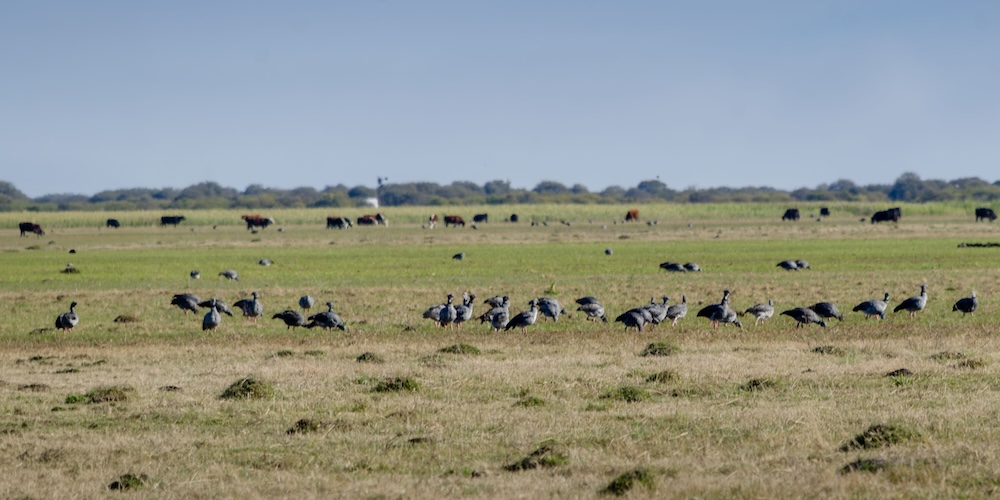
Southern Ente Ríos with Southern Screamer flock – ©Javier Pereyra
Two national parks are located within the province: El Palmar National Park and Diamante National Park. There are also hot springs in several locations, especially along the basin of the Uruguay River, located in cities like Federación, Villa Elisa, Colón, etc.
Much of the land is under agriculture with the production of cattle and sheep very prominent as are dairy, chicken and egg production, citrus, rice, wheat, soya and maize. There is a large manufacturing sector, mostly based on processing food. There is also significant forestry, and chemical and engineering.
Birding Entre Ríos
For many visiting birders, Entre Ríos is first experienced from Buenos Aires. Nearly all international travellers arrive there, and the southern part of the province offers the most accessible and rewarding first extension. That practical geography shapes many private itineraries and, to a large extent, the way visiting birders come to know Entre Ríos.
Entre Ríos brings together several of Argentina’s major birding landscapes within a single province. Espinal woodland runs through much of the centre and north, Pampas grasslands extend across the south and east, and the Paraná Delta enters from the south-west in a mix of islands, reedbeds, wet grasslands and gallery forest. That overlap of habitats, and the especially rich transitions between them, is what gives the province so much of its birding value.
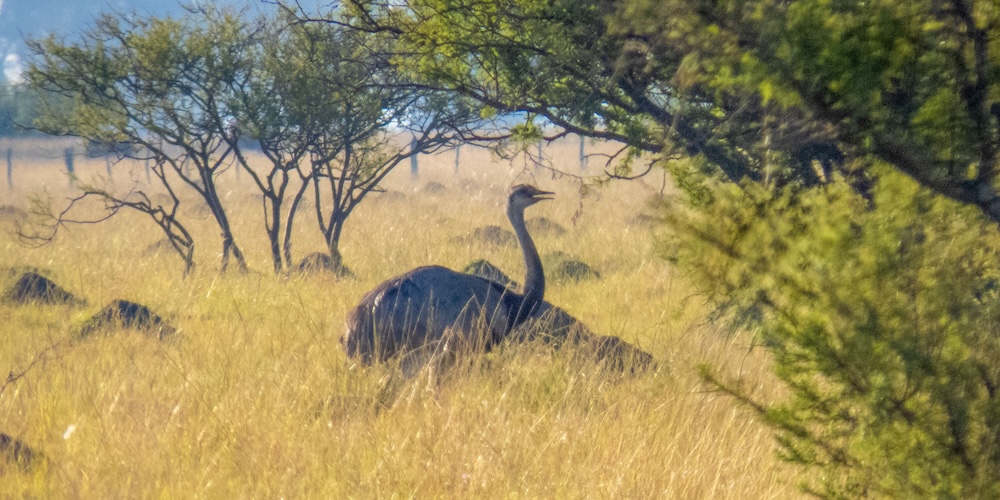
Greater Rhea Rhea americana – ©Javier Pereyra
The best-known birding is in southern Entre Ríos, centred on Ceibas, about two hours from Buenos Aires. Here grassland, espinal, seasonal wetlands and flooded fields come together in a working landscape shaped by water levels and the time of year. A full day often reaches around 100 species in good conditions, with more possible in summer and on longer routes.
For many visiting birders, the main draw is the concentration of threatened grassland species. Marsh, Chestnut and Rufous-rumped Seedeaters all occur in summer, and southern Entre Ríos is also one of the key regions for Saffron-cowled Blackbird. Reedbeds and marsh edges hold Curve-billed and Sulphur-bearded Reedhaunters, while Straight-billed Reedhaunter is closely tied to stands of caraguatá (Eryngium pandanifolium). Species such as Yellow Cardinal and Glaucous-blue Grosbeak add to the area’s appeal for target-driven visitors.
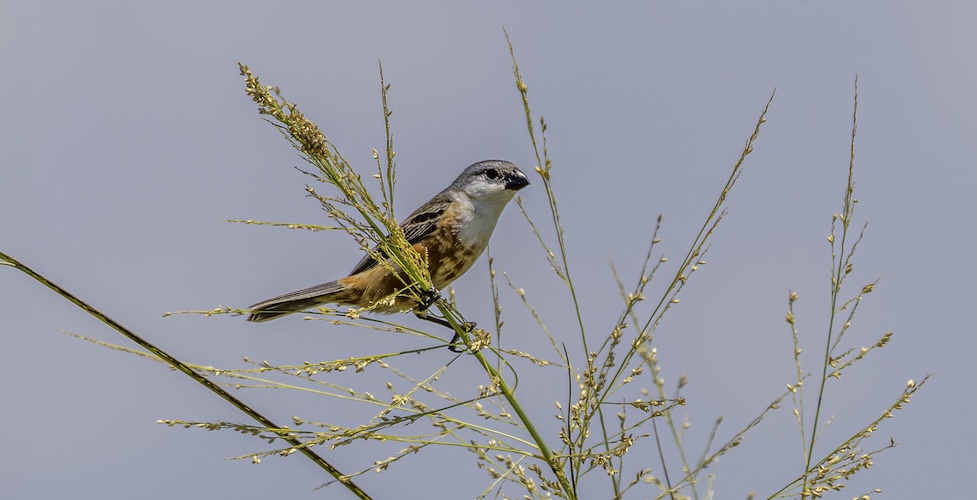
Marsh Seedeater Sporophila palustris – ©Javier Pereyra
The espinal holds some of the region’s most characteristic birds. Scimitar-billed Woodcreeper, Brown Cacholote, Lark-like Brushrunner, Little Thornbird, Chotoy Spinetail and Bay-capped Wren-Spinetail are all possible in the same general area, together with White-fronted and White Woodpeckers, Rufous-capped and Great Antshrikes, and White-tipped Plantcutter.
Open country and seasonal wetlands are part of what gives southern Entre Ríos its range. Depending on water levels, the same route may produce roadside White Monjitas, flocks of Southern Screamers over flooded fields, or grassland birds such as Greater Rhea, Red-winged Tinamou and Spotted Nothura. In summer, shallow wetlands can hold good numbers of migratory shorebirds, including American Golden Plover, Buff-breasted Sandpiper and Upland Sandpiper. Raptors are part of the day throughout, from Savanna and White-tailed Hawks to Long-winged and Cinereous Harriers, with Swainson’s Hawk in summer and Snail Kites especially noticeable in wetter years.
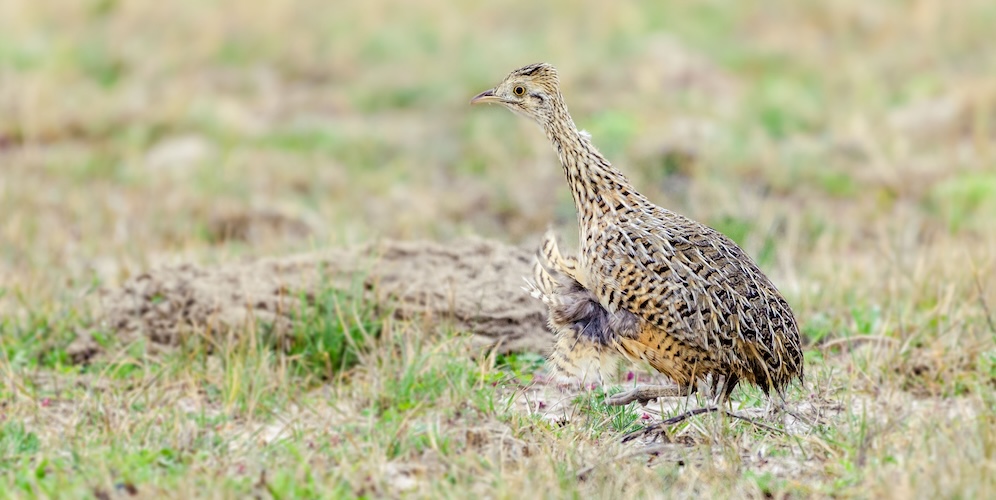
Spotted Nothura Nothura maculosa – ©Javier Pereyra
Beyond Ceibas, other parts of the province broaden the picture. Perdices expands the grassland story, with richer seedeater habitat and some of the province’s most important ground for Saffron-cowled Blackbird. The Gualeguay basin adds another dimension, with wet grasslands, marshy edges and riverine country that continue to produce threatened capuchinos and other grassland specialists.
Gualeguaychú, by contrast, belongs to a different landscape. On the eastern edge of southern Entre Ríos, where the landscape begins to connect with the Lower Paraná Delta, wetlands, levees and patches of gallery forest or monte blanco (native levee forest) bring in a more riparian set of birds and a subtle paranaense influence. Species such as Dusky-legged Guan, White-rimmed Warbler and Diademed Tanager fit that picture well, and locally Grey-throated Warbling Finch can also appear. In the same broader system, wet grasslands and marsh edges add species such as Long-tailed Reed Finch.
Late afternoon changes the feel of the route again. Nacunda Nighthawks may gather over the fields, Scissor-tailed Nightjars appear along the roads, and Short-eared Owls often perch on fence posts as the light fades.
Farther north, El Palmar National Park protects one of the most distinctive yatay palm landscapes on the Argentine littoral and offers a very different birding atmosphere from the southern lowlands.
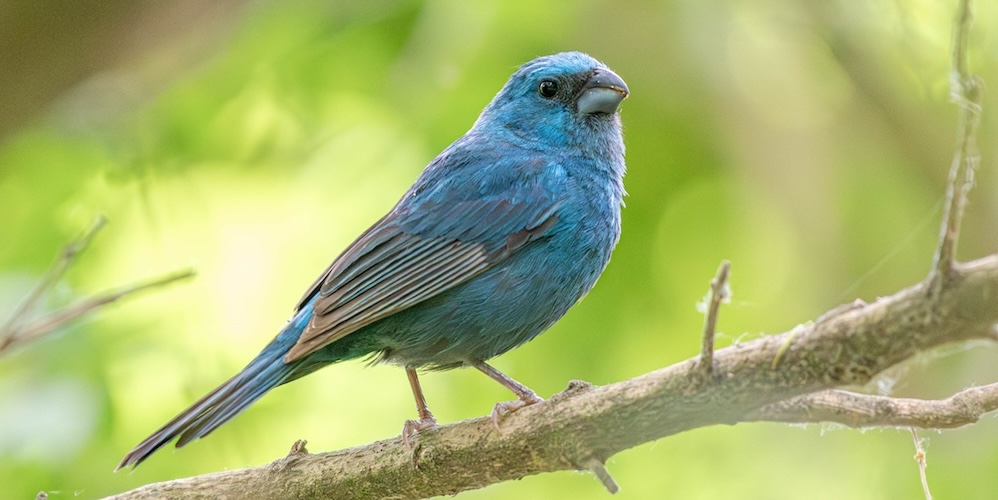
Glaucous-blue Grosbeak Cyanoloxia glaucocaerulea – ©Javier Pereyra
Beyond that, the Selva de Montiel, in the province’s centre-north, belongs to a different scale and character: inland Espinal, mixed palm savanna, and one of the least internationally known birding landscapes in the province. Although outside the usual Buenos Aires-based circuit, it points to a broader Entre Ríos that remains less explored by visiting birders, despite its importance as a conservation landscape and its rich birdlife.
For birders visiting the Buenos Aires region, southern Entre Ríos is one of the richest and most varied extensions available. For those with more time, the province as a whole rewards a longer look.
-
Southern Entre Ríos
InformationTwo hours north of Buenos Aires, Southern Entre Ríos opens into one of the richest birding landscapes in the Pampas. Grasslands, espinal woodland, seasonal wetlands, and flooded fields come together in a landscape shaped by water levels and the time of year.
-
Javier Pereyra
Buenos Aires | wildpampasbirding@gmail.com
https://www.wildpampasbirding.com
-
Number of bird species: 476
(As at March 2026)
-
Avibase
PDF ChecklistThis checklist includes all bird species found in Entre Ríos , based on the best information available at this time. It is based on a wide variety of sources that I collated over many years. I am pleased to offer these checklists as a service to birdwatchers. If you find any error, please do not hesitate to report them. -
eBird
PDF ChecklistThis checklist is generated with data from eBird (ebird.org), a global database of bird sightings from birders like you. If you enjoy this checklist, please consider contributing your sightings to eBird. It is 100% free to take part, and your observations will help support birders, researchers, and conservationists worldwide.
-
NP Parque Nacional El Palmar
InformationSatellite ViewThe 8500 ha of El Palmar National Park were set aside in 1966 to preserve a representative sample of the once-extensive yatay palm groves… -
NP Parque Nacional Pre-Delta
WebpageSatellite ViewIt has an area of 2,458 hectares and is located in the southwest of the Province of Entre Ríos, 6 km. south of the city of Diamante. -
NR Reserva Natural Otamendi
WebsiteSatellite ViewNot far over the border into Buenos Aires state…
-
eBird
SightingseBirding This Month
-
FEATURED
Wild Pampas Birding & Nature
Local Tour Operator...offering private and small-group tours across four destinations in the region: Costanera Sur Ecological Reserve, Isla Talavera in the Paraná Delta, Southern Entre Ríos (grasslands and espinal, based in Ceibas), and Samborombón Bay. I also offer a photo birding option for photographers at any level. -
Trogon Tours
Tour OperatorTrogon Tours is the official nature travel company of Birding Argentina, the leading birding and nature specialists for southern South America since 2001
-
Birding southern Entre Ríos
WebpageThe south of Entre Ríos province is a real birding hotspot and a paradise for birdwatchers. This is because of the very high diversity of birds that can be found in a one-day tour, the many rare species among them, and the abundance of some, which can be counted in thousands.