

Normandie
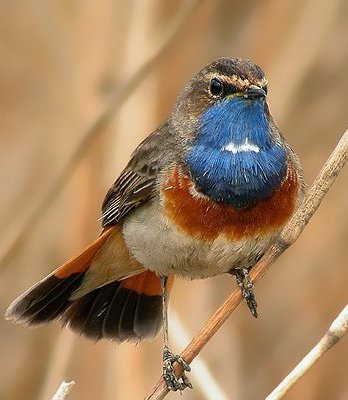
Normandy is one of the 13 geographical regions of France and covers roughly the same area as the historical Duchy of Normandy. The present-day region is bordered by Hauts-de-France to the northeast, Isle-de-France to the east, Centre to the southeast, Pays de la Loire to the south and Bretagne to the northwest. It also has a coastline on the English Channel. It covers an area of 30,627 km2 (11,825 square miles) and has a population of about three and a half million people.
The Seine and its tributaries the Andelle, Epte, Eure, Risle and Robec dominate the region. However, there are many coastal rivers such as the Bresle, Couesnon, Dives, Orne, Sée, Sélune, Touques, Veiles and the Vire. The climate is mostly moist and temperate.
From the Carentan Marshes to Mont des Avaloirs (the highest point in Normandy); this region is characterised by its greenery, although at under 13% forest it is a little better than half the average for France. Traditional practices, such as coppicing and pollarding, ensure the sustainability of the forest systems; whilst the traditional orchards ensure an abundance of cider and calvados.
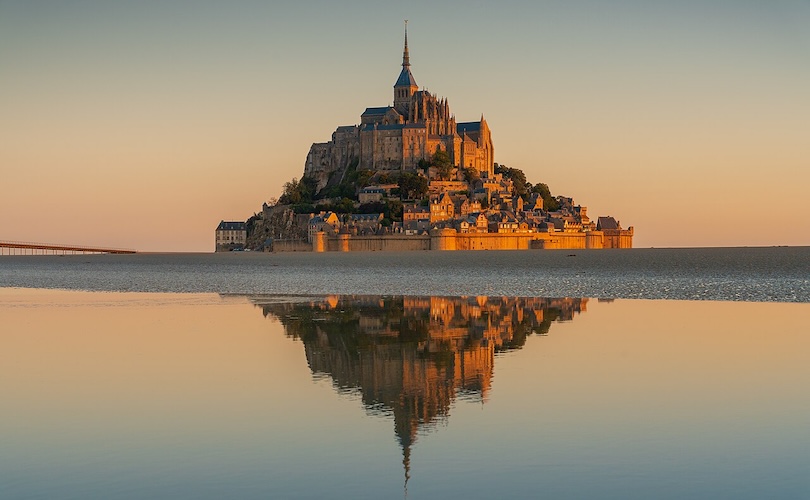
Mont St Michel -©Lynx1211 CC BY-SA 4.0 via Wikimedia Commons
Normandy also has extensive heaths and majestic, rugged cliffs – all ensuring the richest possible biodiversity. The economy of Normandy is centred around agriculture with cattle breeding dominating, followed by dairy and cider apple growing but it has a significant chemical and oil industry, and makes millions through tourism.
Birding Normandy
UK birders will be delighted with the birdlife a few miles across the water as it is still like birding southeast England how it was seventy years ago with birds like Nightingales still much easier to see there. That short sea crossing is still one many birds baulk at so UK birders can expect many species they rarely see at home; Black Kites, Black-winged Stilts, Black-necked Grebes, Bluethroats, Cirl Buntings, Kentish Plovers and Zitting Cisticola Basileuterus lachrymosus to name but a few. ‘Progress’ in farming is marching inexorably on despite conservationist warnings, and this will inevitably impoverish the avifauna.
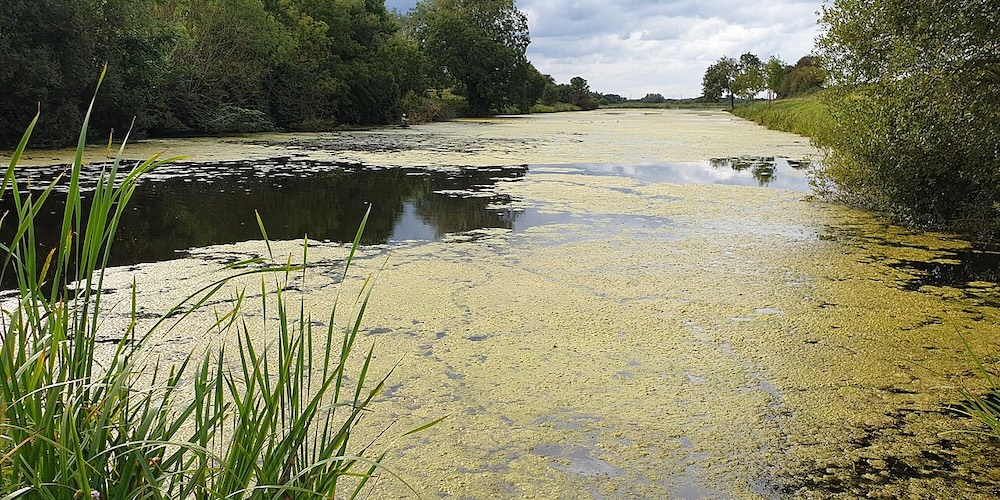
Canal du Gravier Carentan – ©Ptyx CC BY-SA 4.0 via Wikimedia Commons
Nevertheless, Normandy has a mix of habitats reflected in its diversity of avi fauna. There are coastal habitats including dunes and mudflats as well as the cliffs and sandy beaches. Low-intensity farmland, often with derelict buildings and a range of different crops. There are grasslands still full of wildflower species and native woodlands with a range of ages and species with plenty of standing dead wood for nesting. And of course, there are rivers and lakes, hedgerows and roadside villages, the outskirts of villages, all yielding interesting species.
White Storks are well established and apparently there are some Black Storks too, at the edge of their European distribution. Black Woodpeckers are also at the western limit of their distribution, but still findable in mature woodland. Hoopoes nest in mud banks of old farm ponds and Crested Larks in the coastal grasslands.
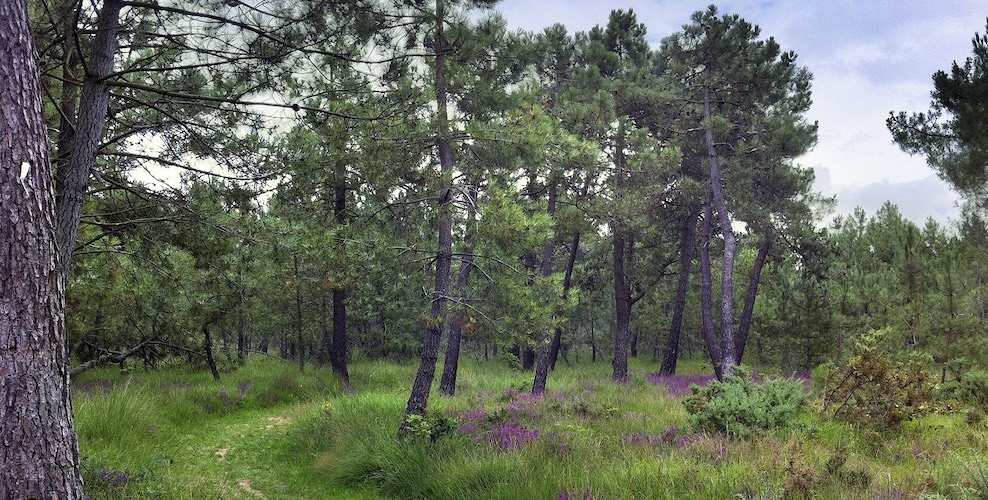
Forest in St-Germain – ©A Guy Taking Pictures from United Kingdom CC BY 2.0 via Wikimedia Commons
Perhaps the best habitat of all is the marshlands of the Seine estuary covering about 10,000 hectares with a number of well-established reserves. The subtidal environments of mud flats, salt meadows, ponds, reed beds and wet meadows; the interface between land and sea is a paradise for birds. Part of the estuary, that is very easy accessible for birders, is the area along the Normandy Bridge. Among the birds you can see here are breeding Bearded Tit, Wheatear, Bluethroat and Hen Harrier. There is even an observation deck among reeds where patience rewards you with Bearded Tits and Bluethroats.
-
Antifer Harbour
Satellite View(North of Le Havre/Seine-Maritime) is a good sea-watching spot. -
Baie d'Orne
InformationSatellite View(Salenelles to Ouistreham, North of Caen, Calvados) a nice place for wetlands and marinebirds, near the ferry's harbour. -
Baie du Mont-St-Michel
InformationSatellite View(SW, between Normandy and Brittany) & Baie de Seine (Le Havre) are the main sites (and extensive) for shorebirds and vagrants. The Baie du Mont St Michel is a wonderful birding place, almost anywhere will do - there is a first class visitor centre at Genets with a superb walk along the edge of the bay South from there, and the headlands at Bec d'Andain and Le Grouin either side of there. Then there are the marshy grasslands at the South end of the bay, North of Dol de Bretagne - go there in the autumn and winter especially. -
Falaise de Carolles
InformationSatellite View(South of Granville, Manche) regional (& national) spot for Passerines migration in autumn - among whom Tawny and Richard's Pipits, Ortolan Bunting, Finches, Larks…Baie du Mont-St-Michel (SW, between Normandy and Brittany) & Baie de Seine (Le Havre)are the main sites (and extensive) for shorebirds and vagrants. -
Foret d'Ecouves
InformationSatellite ViewPark at Carrefour de Rendez-vous and follow the forest trail. You will probably not see another soul. Black Woodpecker, Tree Pipits, and Hobby here. -
Gatteville Lighthouse
InformationSatellite View(East of Cherbourg/Manche) is a good seawatching spot. -
Pays d'Auge & Marais de la Dives (East of Caen, Calvados)
InformationSatellite ViewWhite Stork, Woodpeckers, Warblers… and a bastion for Red-Backed and Great Grey Shrikes. -
Southern Normandy
Southern Normandy is good for all woodland birds, Creepers, Warblers, Hoopoe, RB-Shrike (around Alençon/Orne); Stone-Curlew (Val de Seine); Crested Lark (South of Evreux/Eure)…
-
Roy Croucher
Averton, Mayenne | nfwt@online.fr
http://nfwt.online.fr/ -
Peter Wells
| p.wells@zen.co.uk
-
Number of bird species: 434
(As at June 2026)
-
Avibase
PDF ChecklistThis checklist includes all bird species found in Normandie, based on the best information available at this time. -
Bird
PDF ChecklistThis checklist is generated with data from eBird (ebird.org), a global database of bird sightings from birders like you. If you enjoy this checklist, please consider contributing your sightings to eBird. It is 100% free to take part, and your observations will help support birders, researchers, and conservationists worldwide.

-
Nouvel Atlas des Oiseaux de Normandie [New Atlas of the Birds of Normandy]
| Edited By Gérard Debout & Bruno Chevalier | OREP E£ditions | 2023 | Hardback | 496 pages, colour photos, colour distribution maps, colour tables | ISBN: 9782815106436 Buy this book from NHBS.com -
Où Voir les Oiseaux en Normandie? [Where to Watch Birds in Normandy]
| By Gérard Debout | OREP Editions | 2021 | Paperback | 96 pages, colour photos | ISBN: 9782815105941 Buy this book from NHBS.com
-
Groupe Ornithologique Normand
WebsiteÉtude et Protection des Oiseaux et de leurs Milieux en Normandie - Our association's main tasks are the study and protection of birds and their environments in Upper and Lower Normandy. -
LPO (Ligue pour la Protection des Oiseau) Normandie
Facebook PageOur objectives: preserving ecological balances, ecosystems, biodiversity (fauna and flora in Normandy). Our activities: surveys, public events, training and development sessions, assistance with the creation of LPO Refuges, expertise, events in companies, schools, holding of stands, etc . -
L’association CHENE - Centre d’Hébergement et d’Etudes sur la Nature et l’Environnement
WebsiteThe association CHENE has been working since 1980 for the respect and defense of wild fauna and flora.
-
Baie du Mont st Michel
InformationSatellite ViewThe Mont Saint-Michel Bay (French: Baie du mont Saint-Michel, Breton: Bae Menez-Mikael) is located between Brittany (to the south west) and the Normandy peninsula of Cotentin (to the south and east). The bay is part of the club of the world's most beautiful bays (fr) and is listed as a UNESCO world heritage site. Due to the significant tidal movements in this region (over 10 meters) a large part of the bay is uncovered at low tide. There are two granitic islands in the bay: Tombelaine and the Mont Saint-Michel. Many birds and harbor seal live in this area. -
NF Foret Domaniale de Belleme
WebpageSatellite ViewThe forest of Bellême is a remnant of "sylva pertica"; the wildwood of the Gallo-Roman era. Owned by the Counts of Perche, the forest of Bellême was a Royal Forest in the 13th century before becoming state property during the Revolution. -
NR Réserve Naturelle du Domaine de Beauguillot
WebpageSatellite ViewImplantée entre terre et mer, sur la commune de Sainte-Marie du Mont, site renommé du débarquement allié de 1944, la réserve naturelle du domaine de Beauguillot n’en est pas moins un haut-lieu de la découverte de la nature. Situé au cœur de la baie des Veys, le domaine appartient au vaste complexe des marais de l’isthme du Cotentin. -
PNR - Le Parc Naturel Régional ds Marais du Cotentin et du Bessin
WebpageSatellite View -
PNR Le Parc Naturel Régional Normandie-Maine
WebpageSatellite View -
PNR Le Parc Naturel Régional du Perche
WebpageSatellite View -
PNR des Boucles de la Seine Normande
WebpageSatellite View
-
eBird
SightingseBirding This Month
-
2024 [09 September] - Marie
ReportThe birds of Normandy put on a show in the Marais! -
Baie du Mont St Michel
ReportWe crossed by Seacat from Dover to head for Normandy and the Baie du Mont St Michel, which turned out to be a superb place, with two particularly fine interpretation centres. We had good views of a pale phase Arctic Skua on the crossing, and after an easy ride South, had a stop for lunch near to Yvetot . In some roadside woods just off the autoroute there were Nuthatch, Chiffchaff, and Great Spotted Woodpecker to admire. -
eBird
ReportsRecent Trip Reports
-
Eco-gites of Lenault
AccommodationA converted hay barn in Swiss Normandy in the Calvados region of Normandy France -
La Basse Cour, Ancinnes, Pays de la Loire
AccommodationThis XVIII century Normandy farmhouse has three beautiful en-suite guest rooms (chambres d'hôtes) approved by Gîtes de France. The guest house is in a lovely setting by a lake, surrounded by wooded and planted gardens on the fringes of the Forest of Perseigne, straddling the Orne (Normandy) and Sarthe (Pays de Loire).
-
Birding in Normandy & Pays de la Loire
ArticleSuffice it to say that wherever you go in the region, given time and patience you’ll see something interesting in the air or on the ground and covered in feathers, whether you are a devoted twitcher or an ordinary Joe like me who takes pleasure in watching whatever nature is offering around me at the time.