

Bretagne
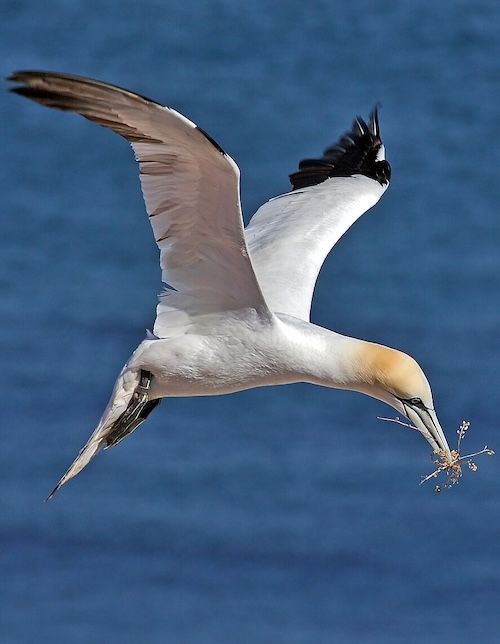
Brittany (Bretagne in French and Breizh in Breton) is the most westerly of the 13 regions of Metropolitan France covering an area of 27,208 km2 (10,505 square miles). It is bordered by Pays de la Loire to the east, a small part of Normandy to the northeast, and by sea everywhere else; the English Channel to the north and the Atlantic Ocean to the west with the Bay of Biscay to the south. Brittany is the traditional homeland of the Breton people and is one of the six Celtic nations retaining a distinct language and cultural identity that reflects this history. The region consists of four departments; Cotes d’Armor in the north, Finistere in the west, Ile-de-Vilaine in the northeast and Morbihan in the south. Known to the Celts as Argoat (the land in the forests); Brittany can today still seem distinct from the rest of France, although much of the former forests have disappeared.
It has a population approaching three and a half million people with Rennes as the largest city and regional capital. Brest is the second largest and the main naval port. Other notable cities include Quimper and the popular coastal resort of Saint-Malo, Lorient, Vannes and Saint-Brieuc.
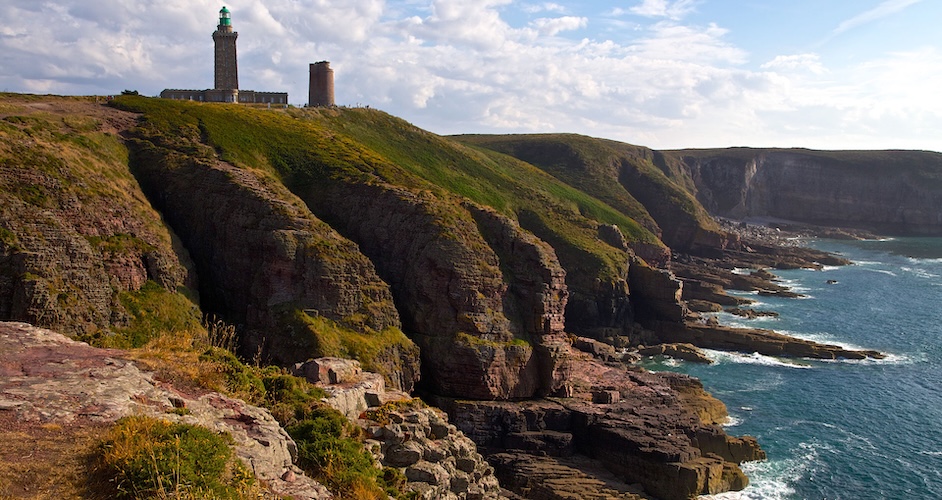
The Cliffs of Cap Frehel – ©Jmhullot CC BY 3.0 via Wikimedia Commons
The Atlantic Ocean and the English Channel give Brittany an oceanic climate. Prevailing northwest winds reduce variations of temperature across the region. The climate is drier in south and the extreme northwest has a few days annually with temperatures above 25 °C, while southeastern Brittany can have as many as 50.
Birding Brittany
The region has several major rivers and interconnected waterways, notably the Vilaine, Rance, Blavet, Aulne and Léguer. Many of these rivers are canalised to form historic inland waterways like the Canal de Nantes à Brest. The rivers are highly popular for yachting, angling, and boating holidays, although this does not detract too much from their worth to wildlife.
Lac de Guerlédan is the region’s largest lake spanning 400 hectares situated in the Quénécan forest. Other significant lakes include the 250-hectare Lac au Duc, Lac de Trémelin and Lake Saint-Aubin-du-Cormier, with the latter being the quietist and surrounded by a protected area.

Marais de la Grande Brière – ©Nono vlf CC BY-SA 3.0 via Wikimedia Commons
There are five national nature reserves, four regional parks and numerous nature reserves. The region still has places as diverse as La Grande Brière (the second largest marshland in France); Cap Fréhel and Cap Vauban, and Ile d’Ouessant (possibly better than the Scillies!)
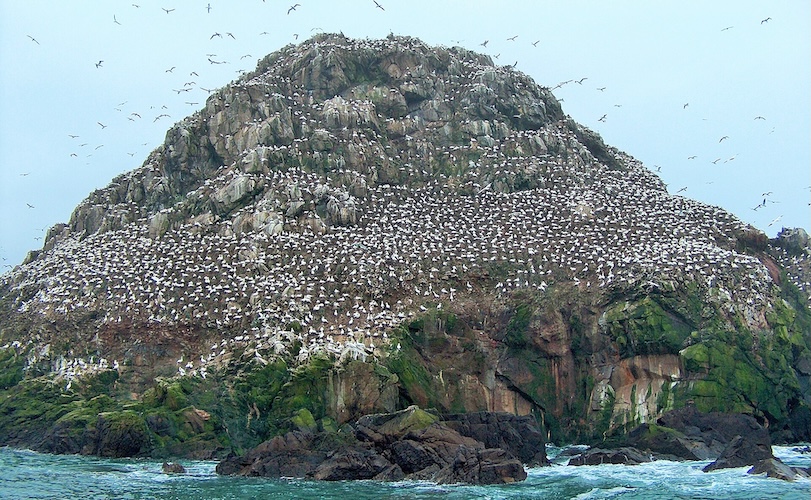
Fous de Bassan aux Sept Îles – ©Ibex73 CC BY-SA 4.0 via Wikimedia Commons
A mixture of forest and farmland, coastal cliffs, dunes, such as near Quiberon, and estuaries birding can be good any time of year. Sept-Îles has the largest seabird reserve in France, hosting over 25,000 pairs of birds, including puffins and gannets. Baie de Saint-Brieuc is a massive 1,140-hectare tidal bay that is a crucial stopover for tens of thousands of migratory birds. Marais de Sougéal is protected marshland in Ille-et-Vilaine, famous for its wintering and migratory bird populations and Landes de Cragou and le Vergam is a vast expanse of heathland and peat bogs; a vital habitat for northern harriers.
-
Guérand Salt Pans
WebsiteSatellite ViewTurn right at the roundabout just before the edge of the town down Rue de la Pigeonaire. Avoid working pans as this annoys the locals. Lots of Bluethroats, Avocets, Black-winged Stilts, etc. -
La Grande Brière
InformationSatellite View100,000 acres of marshland. Drive until you see a farm track, park the car and explore. Most of the tracks lead to good birding sites. The natives are friendly! From St Joachim take the D50 south. Take 2nd right to Parc des Animaliers. Slightly formal, but excellent birding including good numbers of breeding Bluethroats (there is a charge) -
Pointe de Croisic
WebsiteSatellite ViewFollow signs for Cote Sauvage and seawatch. Loads of shearwaters in August, perhaps just into September.
-
Roy Croucher
Averton, Mayenne | nfwt@online.fr
http://nfwt.online.fr/
-
Number of bird species: 530
(As at May 2026)
-
Avibase
PDF ChecklistThis checklist includes all bird species found in Bretagne , based on the best information available at this time. It is based on a wide variety of sources that I collated over many years. I am pleased to offer these checklists as a service to birdwatchers. If you find any error, please do not hesitate to report them. -
eBird
PDF ChecklistThis checklist is generated with data from eBird (ebird.org), a global database of bird sightings from birders like you. If you enjoy this checklist, please consider contributing your sightings to eBird. It is 100% free to take part, and your observations will help support birders, researchers, and conservationists worldwide.

-
Les Oiseaux Marins Nicheurs de Bretagne
| By B Cadiou | BIOTOPE | 2002 | Paperback | 138 pages, colour photos | ISBN: 9782951037960 Buy this book from NHBS.com
-
LPO Bretagne
WebsiteLe siège de la LPO Bretagne se situe à Rennes, Préfecture de la Région Bretagne. Le siège regroupe une équipe de salariés spécialistes (chargés d'études et des chargés d'animations naturalistes) ainsi que la direction et les fonctions supports de l'association. La LPO Bretagne dispose de deux autres antennes salariées : l'antenne Bretagne Sud basée à Vannes et l'antenne Bretagne Nord basée à Morlaix. -
LPO Finistère
WebsiteContactez-nous : finistere@lpo.fr includes: Liste des oiseaux observés en Finistère etc. -
La protection de la nature en Bretagne
WebsiteBretagne Vivante - 186, rue Anatole France - BP 63121 - 29231 Brest cedex 3 Mis
-
BR La réserve ornithologique de Careil
WebpageSatellite Viewover 150 different species of birds thanks to the Departmental Council which has made this site of 96ha, a bird reserve since 1988, or a bit the “village stage” on this migratory corridor. -
NNR La Réserve Naturelle Nationale des Sept-Îles
WebpageSatellite ViewLa première réserve ornithologique privée est créée en 1912. Elle devient réserve naturelle en 1976. Avec plus de 18 500 couples d’oiseaux marins et 11 espèces, c’est la plus importante réserve du littoral français. -
RNP Gulf of Morbihan
InformationSatellite ViewLe parc naturel régional du Golfe du Morbihan, en breton park ar Mor Bihan, est un parc naturel régional français... -
RNP Parc naturel régional d'Armorique
InformationSatellite ViewThere are sandy beaches, swamps, strange rocks, fast rivers and the hills of Monts d'Arrée, all blended into one landscape. The park also includes three islands: Île de Sein, Molène and Ouessant. There are sea birds on the islands, European otters and beavers in the rivers and swamps, and interesting birds of prey. In the marshes lives a species of rare carnivorous plant, the sundew, which captures unwary insects -
RNP The Brière Regional Nature Park
WebsiteSatellite ViewChaque jour, le Parc naturel régional de Brière s’engage à préserver et partager notre patrimoine en travaillant avec chacun des acteurs du territoire. -
RNR Réserve naturelle régionale du marais de Sougéa
WebpageSatellite ViewLe marais constitue l'une des 3 principales frayères à brochet de Bretagne, mais aussi un site favorable à l'accueil des oiseaux d'eau. La valeur ornithologique de la réserve est étroitement liée à la proximité de la baie du Mont Saint-Michel dont la capacité pour l'accueil des oiseaux d'eau est reconnue internationalement.
-
Bretagne Rare Bird Alert
SightingsThe report below shows observations of rare birds in Bretagne. Includes both unreviewed and reviewed/approved observations.
-
Birding Mont-Saint-Michel
Local Tour OperatorDiscover nature at its best Birdwatching stays and tours in the Bay of Mont-Saint-Michel and more widely in Normandy and in Brittany. -
Brittany Wildlife Tours
Local Tour OperatorBrittany Wildlife tours offer holiday and day tours to people who are interested in the environment and natural history, around the beautiful region of brittany -
NatureTrek
Tour OperatorA two-centre, 8-day holiday exploring Brittany in search of birds, butterflies and other wildlife between the glorious French seasons of spring and summer. -
Northern France Wildlife Tours
Tour OperatorNorthern France Wildlife Tours Ltd, based in Averton, Mayenne, was born when Roy and Shirley Croucher realised that breeding Black Woodpeckers, Little Bustards and White Storks were well worth stopping for. When they found country lanes lined with orchids and cowslips, over which danced Swallowtail and Clouded Yellow Butterflies and Hummingbird Hawk Moths, they were convinced!
-
Place de L'Eglise
AccommodationPlace de L'Eglise is a 12th century house with a fascinating history. It rests in the centre of the peaceful agricultural village of Averton in Mayenne and has been sympathetically refurbished to the highest standard. The base of your wildlife holiday will be our home where you will find peace and comfort during your stay
-
Best bird watching trails in Finistère
InformationExplore the most popular bird watching trails in Finistère with hand-curated trail maps and driving directions as well as detailed reviews and photos from hikers, campers and nature lovers like you. -
Best bird-watching sites in Brittany?
InformationBrittany is a paradise for ornithologists with the flight of migratory birds, the take-off of sea birds, the ballet of small wading birds on the coast or in natural reserves providing an ongoing spectacle. You will find below a list of the best lookouts. -
Where to go to watch birds in the Gulf of Morbihan?
InformationThe Gulf du Morbihan is one of the major sites for bird watching in France. Islets, mudflats, coastal marshes, bocages, moors and wooded areas are all natural environments that favour the abundance and diversity of animal and plant species. About 200 species of birds are counted each year. Between 80,000 and 120,000 water birds winter from October to February on the coastal fringe of the Regional Natural Park. -
inan Cap-Fréhel Tourism
InformationOn our territory, we have the extraordinary chance to count many spots where bird watching will make us grow wings. 1 Cap Fréhel Fauconnière island In spring, between April and June, Cap Fréhel is the scene of seabird reproduction and as such constitutes one of the most exceptional sites in France. Observers will be able to admire Black-legged Kittiwakes (penultimate colony in Brittany), Black-backed Gulls, Razorbills (40% of the French population), Common Guillemots (80% of the national population), Great-crested Cormorants, Northern Fulmars . Each species has its preferences and settles on the cliff according to its orientation, its shape, etc. The spectacle is captivating. Florence Brivot
-
Jardin Miranda
BLOGMiranda Bell - An experienced, RHS qualified gardener and garden designer. Passionate about the huge benefits of creating and designing gardens which not only encourage wildlife but enable you to garden a lot more organically