

State of Santa Catarina
Santa Catarina is one of the twenty-seven states of Brazil and is in the south of the country covering an area of 95,731 km2 (36,962 square miles) with a population of around eight and a quarter million people. Its capital is Florianópolis a city of over half a million people, which mostly lies on Santa Catarina Island, while Joinville is Santa Catarina’s largest city. It is bordered by the states of Rio Grande do Sul to the south and Paraná to the north; by the Atlantic Ocean to the east, and by the province of Misiones, Argentina to the west.
The rivers that flow through the state’s territory are part of both autonomous systems delineated by the Serra Geral and Serra do Mar mountain ranges. The South Atlantic basin is made up of the Itajaí-Açu, Tubarão, Araranguá, Tijucas, and Itapocu rivers. In the interior of the state, two basins come together to form the Plata basin: that of the Paraná, whose most important tributary is the Iguazu River, and that of the Uruguay River, which main tributaries the Pelotas, Canoas, Chapecó, and Do Peixe rivers.
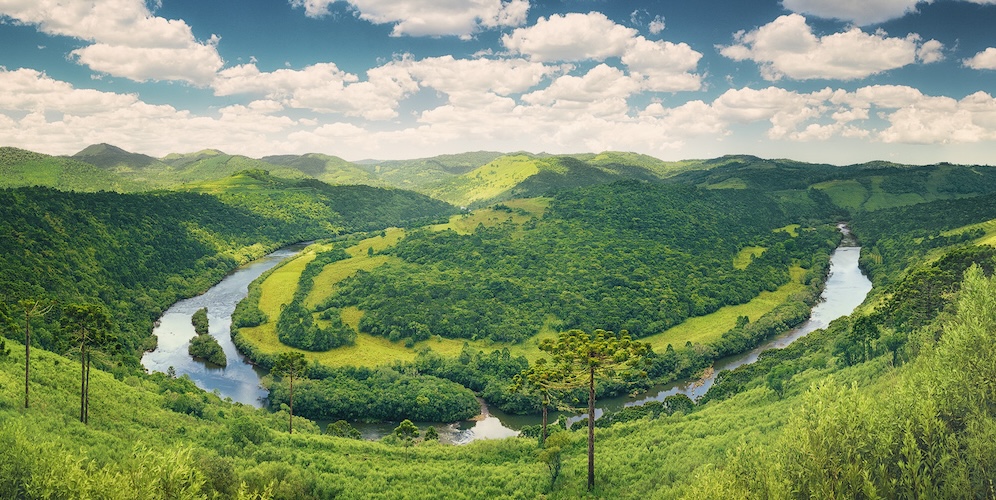
Rio Pelotas – ©Miguel Santos CC BY-SA 3.0 via Wikimedia Commons
Situated below the tropic of Capricorn the climate is mostly subtropical and humid in the coastal lowlands and other lower altitudes, the rest having an oceanic climate.
From the coast to the interior the land ranges from coastal lowlands, the Serra do Mar, a plateau which decreases in altitude from north to south divided by easterly flowing rivers.
Birding Santa Catarina
It is one of Brazil’s most mountainous states with more than half the land lying above 600 metres. The Serra Geral, a southern extension of the Serra do Mar, runs north and south through the state parallel to the Atlantic coast, dividing the state between a narrow coastal plain and a larger plateau region to the west. The Atlantic coast has many beaches, islands, bays, inlets, and lagoons. The humid tropical Serra do Mar coastal forests cover the narrow coastal zone, which is crossed by numerous short streams from the wooded slopes of the mountains.
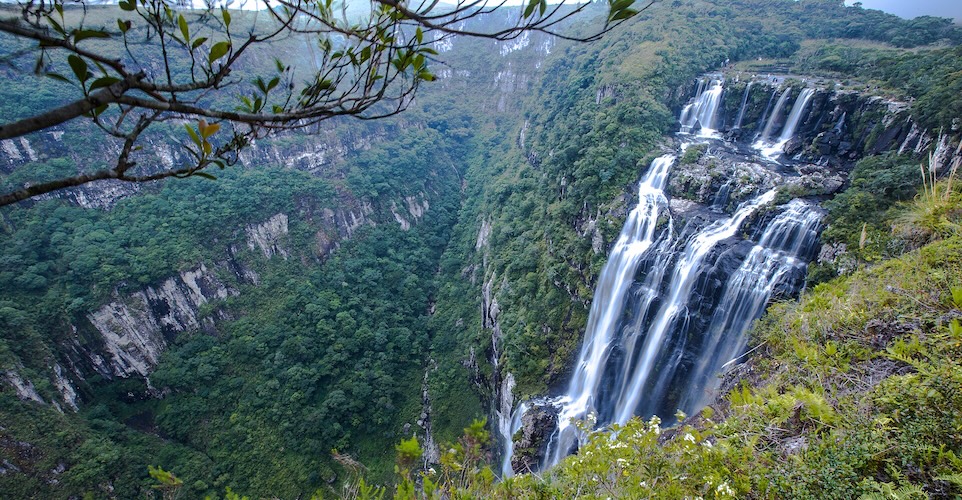
Serra Geral National Park – ©Rodrigo Kaspary CC BY-SA 3.0 via Wikimedia Commons
The central part of the state is home to Araucaria (Monkey Puzzle) moist forests, dominated by emergent Brazilian pines Araucaria angustifolia. The drainage of the plateau is westward to the Paraná River, the rivers being tributaries of the Iguaçu, which forms its northern boundary, and of the Uruguay River, which forms its southern boundary. The semi-deciduous Paraná-Paraíba interior forests occupy the westernmost valleys of the Iguaçu and Uruguay rivers.
Being in the Atlantic Forest biome, the original vegetation of Santa Catarina was made up of forests and grasslands. On the plateau, they occur in the form of mixed coniferous (Araucaria) forests with broadleaved trees and, in the lowland and foothills of the Serra do Mar, solely as broadleaved forest. The grasslands appear as scattered patches within the mixed forest; the main areas being São Joaquim, Lages, Curitibanos and Campos Novos.
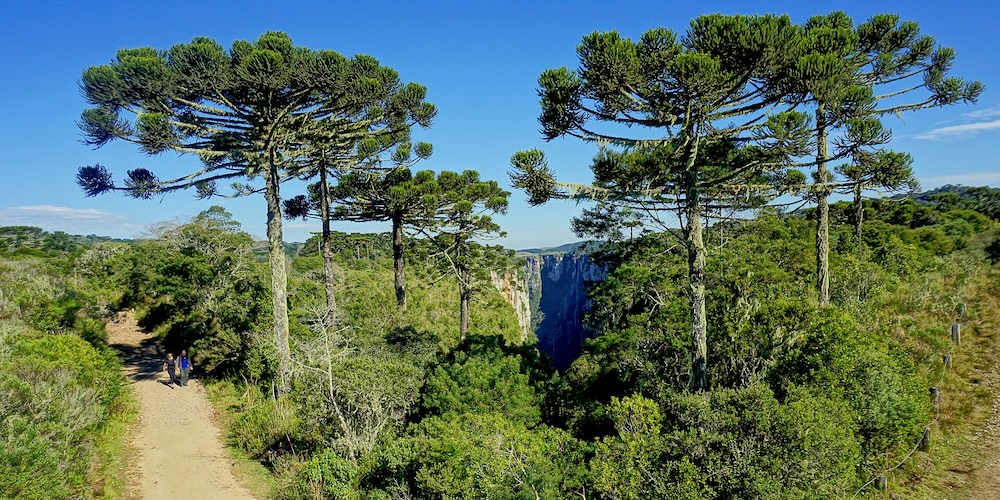
Aparados da Serra National Park – ©Germano Roberto Schüür CC BY-SA 3.0 via Wikimedia Commons
Over 800 species of birds have been recorded in the state along with 150 mammals and 140 amphibians. There are also well over 1,150 butterflies and moths.
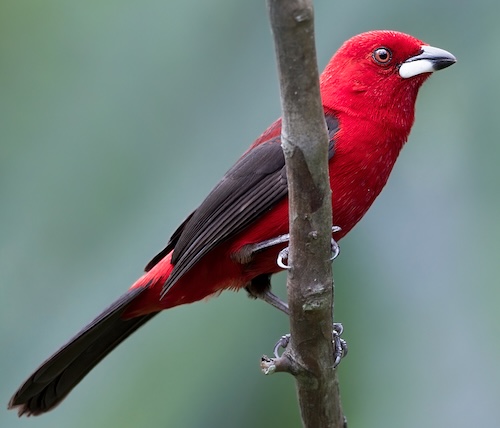
No birds are strictly endemic to Santa Catarina state. However, it is an important home for several rare birds that are endemic or localised to the broader Atlantic Forest biome of eastern Brazil. For example, Kaempfer’s Tody-tyrant Hemitriccus kaempferi, is found in bamboo thickets of northern Santa Catarina and neighbouring Paraná; Brazilian Laniisoma Laniisoma elegans, is found in lowland and mountain forests ranging from Alagoas down to northern Santa Catarina; Brazilian Tanager pbase.com/dubisha; this striking crimson-and-black bird is endemic to coastal eastern Brazil, reaching its southern limits in Santa Catarina and Azure Jay Cyanocorax caeruleus is only found in the Araucaria moist forests of southern Brazil, as is Araucaria Tit-spinetail Leptasthenura setaria.
-
Garuva
BackgroundSatellite ViewA very good site is near Garuva, 30km before Joinville. Turn left off the BR116 to Garuva and zero your odometer at the bus station (rodoviária). Turn left at the main cross roads, just after the bus station, and drive straight as a die out of town (not bearing left with the main road}. At km 15.5 there is a marsh good for Marsh Antbird Stymphalornis acutirostris & Restinga Tyrannulet Phylloscartes kronei.At km 17 there is another marsh also for both, as well as Spotted Bamboowren Psilorhamphus guttatus and Three-striped Flycatcher Conopias trivirgata. This is a good place to see forest birds with a scope as there are trees scattered about in the marsh and the forest edge is close. At km 26.3, turn left off the main road, doubling back somewhat, and at km 28.9 turn right over a low bridge over the Rio Cubatão. At km 31.6 a road loops up to the left through the forest to avoid a soft patch on the main road and you can walk this. Here you may see Kaempfer's Tody-tyrant Hemitriccus kaempferi. Other species include Saw-billed Hermit Ramphodon naevius, Sombre Hummingbird Aphantochroa cirrhochloris, Crescent-chested Puffbird Malacoptila striata, Spot-backed Antshrike Hypoedaleus guttatus, Squamate Antbird Myrmeciza squamosa, São Paulo Tyrannulet Phylloscartes paulistus and Yellow-lored Tody-flycatcher Todirostrum poliocephalum, all Brazillian endemics. -
Joinville
BackgroundSatellite ViewKaempfer's Tody-tyrant was rediscovered at Salto do Piraí, just north of Joinville. The site is at the Santa Catarina electricity board (CELESC) generating plant near Vila Nova, at the foot of the Salto do Piraí waterfall. You may need to get permission from CELESC in Joinville to go there. Another recently confirmed site for this species is the Reserva Volta Velha at Itapoá, on the coast north east of Joinville. -
São Joaquim
BackgroundSatellite ViewAs one drives south Field Flicker Colaptes campestris campestroides, the southern form of Campo Flicker, starts to appear here, as does Chimango Caracara Milvago chimango. In the town there have been Long-tailed Cinclodes Cinclodes pabsti and also beside the road to Bom Jesus.
-
Number of bird species: 860
(As at September 2026)
-
Avibase
PDF ChecklistThis checklist includes all bird species found in Santa Catarina , based on the best information available at this time. It is based on a wide variety of sources that I collated over many years. I am pleased to offer these checklists as a service to birdwatchers. If you find any error, please do not hesitate to report them. -
eBird
PDF ChecklistThis checklist is generated with data from eBird (ebird.org), a global database of bird sightings from birders like you. If you enjoy this checklist, please consider contributing your sightings to eBird. It is 100% free to take part, and your observations will help support birders, researchers, and conservationists worldwide.
-
Universidade Federal de Santa Catarina
Website
-
Clube de Observadores de Aves de Joinville (COA Joinville)
WebsiteCOA Joinville comprises a group of people from different knowledge areas interested in free-bird watching. Besides being a form of leisure, the idea is to sensitize people to the importance of birds and their role in ecological balance.
-
Alto Vale do Itajaí
BackgroundSatellite ViewThe Valley is based on an area formed by one of the most extensive volcanic spills of the Mesozoic period (about 250 million years) and is part of the Serra do Mar complex. -
NP Araucárias National Park
InformationSatellite ViewProtected species include maned wolf (Chrysocyon brachyurus), helmeted woodpecker (Dryocopus galeatus), ocelot (Leopardus pardalis) and cougar (Puma concolor). -
NP Serra Geral National Park
InformationSatellite ViewSerra Geral National Park is in the Atlantic Forest biome. It covers 17,302 hectares (42,750 acres). -
NP Serra do Itajaí National Park
InformationSatellite ViewThe park is in the Atlantic Forest biome. It has an area of 57,375 hectares (141,780 acres). Protected species in the park include cougar (Puma concolor), margay (Leopardus wiedii), vinaceous-breasted amazon (Amazona vinacea), white-necked hawk (Buteogallus lacernulatus), white-bearded antshrike (Biatas nigropectus) and Phylloscartes. -
NP São Joaquim National Park
InformationSatellite ViewThe park is in the Atlantic Forest biome. It covers an area of 48,300 hectares (119,000 acres). -
NR Reserva Particular do Patrimônio Natural do Caraguatá
Observatory WebsiteSatellite ViewThe ecological rainforest reservation has approximately 3.313 hectares of conservation easement around 1000 hectares of all-use area. -
NR Reserva Volta Velha
WebsiteSatellite View...more than 260 species of birds observed with 4 key species of high degree of endemism... -
SP Acaraí State Park
InformationSatellite ViewFauna identified to date include 337 species of birds, 35 of reptiles (5 sea turtles, 1 freshwater turtle, 1 crocodilian, 6 lizards, 1 amphisbaenid and 19 snakes). 17 of amphibians, 20 of non-flying mammals and 38 of fish in the Acaraí River. The park also includes the Tamboretes Archipelago, four islands that provide a breeding area for several species of birds. -
SP Rio Vermelho State Park
InformationSatellite ViewThe park contains 11% dense rainforest of the Atlantic Forest biome (in the Morro dos Macacos), 54% restinga with different heights and species, and 35% ecosystems altered by plantation and invasions of pine and eucalyptus trees. -
SP Serra Furada State Park
InformationSatellite ViewThe park is part of the core zone of the Atlantic Forest Biosphere Reserve. It protects rare and endangered forest species, unusual altitude vegetation, and primary forests of great importance for regeneration of the local forests -
SP Serra do Tabuleiro State Park
InformationSatellite ViewThe coastal area contains salt marshes and mangroves. The mountains are mostly covered in dense rainforest rich in epiphytes. The upper slopes, shrouded in fog from the moist Atlantic air, holds cloud forest. The highest parts hold rainforest with Araucaria and alpine meadows. -
SPFritz Plaumann State Park
InformationSatellite ViewThe park is on the north shore of the lake formed by the dam of the Itá Hydroelectric Power Plant on the Uruguay River, built between 1990 and 2000
-
Santa Catarina Rare Bird Alert
SightingsThe report below shows observations of rare birds in Santa Catarina. Includes both unreviewed and reviewed/approved observations.
-
Manakin Nature Tours
Tour Operator...But there’s still one more hotspot left before our birding adventure ends – the southernmost one in our trip: Volta Velha Reserve. Sitting just across Serra do Mar, in the lowlands of the State of Santa Catarina... -
Ornois Birding Expeditions
Tour OperatorDot-winged Crake (Eduardo Patrial) Saffron-cowled Blackbird (Donna Belder) Blue-bellied Parrot (Eduardo Patrial) Black-bellied Seedeater (Eduardo Patrial) Tropeiro Seedeater (Eduardo Patrial) South American Painted Snipe (Julien Mazenauer) Glaucous-blue Grosbeak (Eduardo Patrial) Marsh Antwren (Eduardo Patrial) Black-backed Tanager (Eduardo Patrial) Chestnut-headed Tanager (Eduardo Patrial) Diademed Tanager (Eduardo Patrial) Purple-crowned Plovercrest (Eduardo Patrial) Canebrake Groundcreeper (Eduardo Patrial) Long-winged Harrier (Eduardo Patrial) Scarlet Ibis (Eduardo Patrial) Dot-winged Crake (Eduardo Patrial) Saffron-cowled Blackbird (Donna Belder) Blue-bellied Parrot (Eduardo Patrial) Black-bellied Seedeater (Eduardo Patrial) Tropeiro Seedeater (Eduardo Patrial) South American Painted Snipe (Julien Mazenauer) Glaucous-blue Grosbeak (Eduardo Patrial) Marsh Antwren (Eduardo Patrial) Black-backed Tanager (Eduardo Patrial) Chestnut-headed Tanager (Eduardo Patrial) Diademed Tanager (Eduardo Patrial) Purple-crowned Plovercrest (Eduardo Patrial) Canebrake Groundcreeper (Eduardo Patrial) Long-winged Harrier (Eduardo Patrial) Scarlet Ibis (Eduardo Patrial) Dot-winged Crake (Eduardo Patrial) Saffron-cowled Blackbird (Donna Belder) Blue-bellied Parrot (Eduardo Patrial) Black-bellied Seedeater (Eduardo Patrial) Tropeiro Seedeater (Eduardo Patrial) South American Painted Snipe (Julien Mazenauer) Glaucous-blue Grosbeak (Eduardo Patrial) Marsh Antwren (Eduardo Patrial) Black-backed Tanager (Eduardo Patrial) Chestnut-headed Tanager (Eduardo Patrial) Diademed Tanager (Eduardo Patrial) Purple-crowned Plovercrest (Eduardo Patrial) Canebrake Groundcreeper (Eduardo Patrial) Long-winged Harrier (Eduardo Patrial) Scarlet Ibis (Eduardo Patrial) Brazil: Far South This tour covers the endemics and near-endemics of Brazil’s south-eastern border. Moving from the lush coastal Atlantic Forest to the impressive woodlands and grasslands of the Araucaria Plateau before visiting the amazing Lagoa do Peixe National Park, this region feels somewhat like a coastal Pantanal!
-
2024 [12 December] - Eduardo Patrial
PDF ReportThe trip begins taking parts of the Great Atlantic Forest Reserve (largest continuous AF remnant in Brazil) in Paraná and Santa Catarina states, going further south to the fantastic plateau of Araucaria forests and the threatened grassland habitats, to a great finale in the fantastic coastal Pampa in Rio Grande do Sul. -
2026 [01 January] - Bill Simpson
PDF ReportWe would start off in the state of Parana and head south through Santa Catarina to Rio Grande Do Sul. For me, this would add some great birds including; Sickle-winged Nightjar, Purple-crowned Plovercrest, Long-tufted Screech Owl, Mottled Piculet, Vinaceous-breasted and Red-spectacled Amazons, Russet-winged Spadebill, Restinga Tyrannulet, Kaempfer’s Tody-Tyrant...
-
EcoResort Vida Sol e Mar - Imbituba
AccommodationWe offer great lodging options, a panoramic event hall (ocean view) and a pleasant restaurant, all with a beautiful view of the paradisiac Praia do Rosa. -
Fazenda Boqueir
AccommodationSet in a region of surprising natural beauties and filled with centuries-old Araucária tree, the Boqueirão Hotel & Resort innovates by mixing the most modern concepts of hospitality with the rusticity of a typical brazilian south farm in operation.