

Republic of Mozambique
Mozambique is a country located in southeast Africa bordered by the Indian Ocean to the east, Tanzania to the north, Malawi and Zambia to the northwest, Zimbabwe to the west, and Eswatini and South Africa to the southwest. The sovereign state is separated from the Comoros, Mayotte and Madagascar by the Mozambique Channel to the east. At over 800,000 km2 (c.310,000 square miles), Mozambique is the world’s 35th-largest country. The capital and largest city is the port of Maputo and its suburb Matola followed by Nampula and Beira. Mozambique has a population of c.33 million people with around three million of those in and around the capital. Other cities are Tete, Quelimane, Chimoio, Pemba, Inhambane, Xai-Xai and Lichinga.
The country is divided into two topographical regions by the Zambezi River. To the north of the Zambezi, the narrow coastal strip gives way to inland hills and low plateaus. Rugged highlands are further west; they include the Niassa highlands, Namuli or Shire highlands, Angonia highlands, Tete highlands and the Makonde plateau, covered with miombo woodlands. To the south of the Zambezi, the lowlands are broader with the Mashonaland plateau and Lebombo Mountains located in the deep south.
The country is drained by five principal rivers and several smaller ones with the largest and most important being the Zambezi. The country has four notable lakes: Lake Niassa (or Lake Malawi), Lake Chiuta, Cahora Bassa and Lake Shirwa, all in the north.

Cahora Bassa Dam – ©EmjayE2 Public domain, via Wikimedia Comm
Mozambique has a tropical climate with two seasons: a wet season from October to March and a dry season from April to September. Climatic conditions, however, vary depending on altitude. Rainfall is heavy along the coast and decreases in the north and south.
Mozambique is endowed with rich and extensive natural resources, notwithstanding the country’s economy is based chiefly on fishery and agriculture with a growing industry of food and beverages, chemical manufacturing, aluminium and oil. The tourism sector is also expanding. South Africa remains Mozambique’s main trading partner, preserving a close relationship with Portugal with a perspective on other European markets. Since 2001, Mozambique’s GDP growth has been thriving, but the nation is still one of the poorest and most underdeveloped countries in the world, ranking low in GDP per capita, human development, measures of inequality and average life expectancy.
There are 740 bird species in Mozambique, including 20 globally threatened species and over 200 mammal species endemic to Mozambique, including the critically endangered Selous’ zebra, Vincent’s bush squirrel and 13 other endangered or vulnerable species. Protected areas include thirteen forest reserves, seven national parks, six nature reserves, three frontier conservation areas and three wildlife or game reserves.
Birding Mozambique
Renewed access to Mozambique after years of isolation by civil war, provided tremendously exciting possibilities for birders, and the central and southern parts of the country have become popular destinations for keen, Southern Africans and other birders.
In addition to numerous mouth-watering species that are peripheral and localised in more accessible Zimbabwe and South Africa, the lowland forests and miombo woodlands of central and southern Mozambique offer some of the best sites globally for such species as Olive-headed Weaver, Green-headed Oriole, Plain-backed Sunbird, East Coast Akalat, Chestnut-fronted Helmetshrike, White-chested Alethe, African Pitta and Locust Finch, and are the wintering grounds of the localised Mascarene Martin.

Mount Gorongosa National Park – ©Judy Gallagher CC BY 2.0 via Wikimedia Commons
Furthermore, the coast offers such tropical delights as wintering Crab Plover & Greater Frigatebird. The most popular areas for birding are, in central Mozambique, the highland forests of Mount Gorongosa, and the woodlands and lowland forests between Beira and the Zambezi. Further south, excellent birding is to be had in the woodlands around Panda and along the coast around Inhambane, Vilanculos and Bazaruto Island.
The vast area of Mozambique north of the Zambezi has remained virtually unexplored since Jack Vincent’s explorations there in the 1930s. Access to the region is however reasonably good, and a 1998 expedition to Mount Namuli near Gurue re-discovered the country’s only endemic, Namuli Apalis, hitherto unseen since its 1932 discovery and found to be still thriving in the forests of this truly spectacular massif. Other exciting species of the northern forests include the enigmatic and elusive Dapplethroat, Thyolo Alethe and, on Mount Chiperone further south, White-winged Apalis.
Birders travelling in Mozambique will need to be largely self-sufficient, and preferably travel in more than one vehicle, including at least one four-wheel-drive. Thankfully, all land mines have been cleared from the whole country so all visited areas are now well-established to be safe. The country still offers much untapped potential to adventurous birders, and every trip turns up many exciting species from both a southern African and global perspective.
This page is sponsored by Birding Ecotours

-
Claire Spottiswoode
University of Cape Town | claire@birding-africa.com
https://birdingafrica.com
-
Number of bird species: 789
(As at March 2024)
Number of endemics: 2
Mozambique Forest Warbler Artisornis sousae
Namuli Apalis Apalis lynesi
-
Avibase - The World Bird Database
PDF ChecklistThis checklist includes all bird species found in Mozambique , based on the best information available at this time. It is based on a wide variety of sources that I collated over many years. -
Wikipedia
List by FamilyThis is a list of the bird species recorded in Mozambique. The avifauna of Mozambique include a total of 788 species, of which 4 have been introduced by humans.

-
Birds of Inhaca Island, Mozambique
| By WF De Boer & CM Bento | BirdLife South Africa | 1999 | Paperback | 76 pages, colour photos, tables | Out of Print | ISBN: 9780620237116 Buy this book from NHBS.com -
Birds of the Maputo Special Reserve Mozambique
| By V Parker & F de Boer | Avian Demography Unit | 2000 | Paperback | 52 pages, colour photos, b/w illustrations, maps | Out of Print | ISBN: 9780620264792 Buy this book from NHBS.com -
Birds of the Niassa Reserve, Mozambique
| By Vincent Parker | Avian Demography Unit | 2005 | Paperback | 34 pages, colour photos, maps | Out of Print | ISBN: 9780620332774 Buy this book from NHBS.com -
Roberts Bird Guide
| By Hugh Chittenden, Greg Davies & Ingrid Weiersbye | Jacana Publishers | 2018 | Edition 2 | Flexibound | 570 pages, plates with colour illustrations; colour photos, colour distribution maps | ISBN: 9781920602017 Buy this book from NHBS.com -
Southern African Birdfinder
| (Where to find 1400 bird species in southern Africa and Madagascar) | By Callan Cohen, Claire Spottiswoode & Jonathan Rossouw | New Holland Publishers | 2006 | Paperback | 456 pages, 80 col photos, 100 maps, pull-out route map | ISBN: 9781868727254 Buy this book from NHBS.com -
The Atlas of the Birds of Central Mozambique
| By Vincent Parker | Avian Demography Unit | 2005 | Paperback | 321 pages, maps, tables | Out of Print | ISBN: 9780799222845 Buy this book from NHBS.com -
The Birds of Southern Mozambique
| By Phillip A Clancey | African Bird Book Publishing | 1996 | Paperback | 312 pages, 49 colour plates, 6 photos, 39 maps | ISBN: 9780620199186 Buy this book from NHBS.com
-
African Bird Club - Mozambique
WebpageList, sites, information
-
BirdLife International
WebpageThe Republic of Mozambique, once the African-Algarve where visitors relished the tropical summers of this former Portuguese colony, has since been ravaged by 15 years of civil war. With the war a memory, Mozambique is trying hard to shed the ominous label as one of the world's poorest countries. Despite its chequered history, Mozambique is an exciting destination for the intrepid birder wanting to find the many southern African specials that the region holds
-
FR Moribane Forest Reserve
InformationSatellite ViewIt is a natural forest in the buffer zone of the 640 km2 Chimanimani National Reserve, and is situated 24 km north of Dombé, in Sussundenga District of central Mozambique... -
IBAs
WebpageSatellite ViewTwo distinct bird communities exist in Mozambique with the boundary between them coinciding more or less with the Zambezi river. North of the Zambezi, birdlife is largely shared with that of -
NP Chimanimani
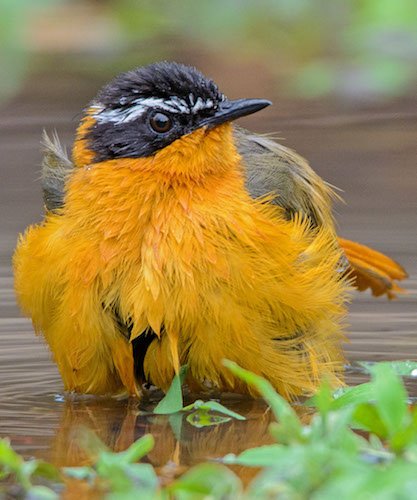
InformationSatellite ViewThe park contains rare species such as the Red-capped robin-chat and the Welwitsch's bat -
NP Banhine
InformationSatellite ViewThe park is 7,250 square kilometres (2,800 sq mi) in area and holds extensive inland wetlands, acting as an important source of water to the dry lands that surround it. The park is in an area that has annual rainfall of only 430 millimetres (17 in). However, over 1% of the park is wetland and there are also more than a thousand pans that range in size from a few square meters to hundreds of hectares. These pans may be very salty or "sweet" and drinkable. The water comes from the area to the northwest near the Zimbabwe boundary, flowing through many channels into the wetlands and then into the Changane River. The park is still home to endangered wattled cranes and to many migratory birds. Results of an aerial survey in October 2004 showed that the park had healthy populations of ostrich, kudu, impala, reedbuck, duiker, steenbok, porcupine, warthog and oribi. Predators such as leopards, lions, servals, spotted hyenas and even cheetahs are also found in the national park. -
NP Bazaruto
InformationSatellite ViewThe Bazaruto National Park was inaugurated in 1971, an archipelago of six islands off the Mozambican coast between Vilankulo and Inhassoro. The park was created to protect dugong and marine turtles, and their habitats. The islands' flora and fauna, coral reefs and marine birds were also included. -
NP Gorongosa
WebsiteSatellite ViewGorongosa ecosystem is larger than the area of the formal Park Boundary. The ecosystem is that hydrological area that drains into Lake Urema in the heart of the Park. The drainage to the lake is local from both sides of the rift valley in which the Park sits, and from three streams originating on Gorongosa Mountain. The Rift floor lake, Urema, is a basin that when filled overflows into the Pungue River which then empties into the Indian Ocean… -
NP Limpopo
InformationSatellite ViewThe Limpopo National Park came into being when an old hunting concession, Coutada 16, was declared a protected nature conservation area instead. The Limpopo National Park now forms part of the Great Limpopo Transfrontier Park, a transnational conservation area spanning the borders of Mozambique, South Africa and Zimbabwe… -
NP Magoe
InformationSatellite ViewThe park is 3,559 square kilometres (1,374 sq mi) in area and is situated on the southern banks of the giant Cahora Bassa Dam. -
NP Quirimbas
InformationSatellite ViewQuirimbas National Park is a true example of where bush meets beach. Elephants feed off mango trees just metres from the Indian Ocean and further inland - in the thick coastal forests - 4 out of the Big 5 roam… -
NP Zinave
InformationSatellite ViewThe park extends to the south of the Save River in Inhambane Province, covering an area of 4,000 square kilometres (1,500 sq mi). -
NR Maputo Special Reserve
InformationSatellite ViewThe reserve is located on Maputo Bay, approximately 100 kilometers southeast of the city of Maputo, Mozambique. The Reserve is 1,040 km2 (400 square mile) in extent and was originally proclaimed in 1932 to protect a small population of coastal elephants resident in the area. -
NR Niassa Reserve
InformationSatellite ViewNiassa Reserve is a nature reserve in Cabo Delgado Province and Niassa Province, Mozambique. Covering over 42,000 square kilometres (10,000,000 acres), it is the largest protected area in the country. The reserve is part of the Trans-Frontier Conservation Area and links to the Tanzanian Lukwika-Lumesule Game Reserve -
TCA Lubombo Transfrontier Conservation Area
InformationSatellite ViewThe Lubombo Transfrontier Conservation Area was born out of the Peace Park Foundation’s vision to establish a network of transfrontier conservation areas in southern Africa. It straddles the border between South Africa’s KwaZulu-Natal province, southern Mozambique, and Eswatini.
-
Birds Mozambique
Facebook PageDiscussio, sightings etc
-
Birding Ecotours
Tour OperatorMozambique in Summer/Winter (14 days) - Birding Mozambique in summer can be adventurous if it has rained a lot, but could yield African Pitta and other incredibly exciting species. Mozambique is a fabulous birding destination hosting many species not found elsewhere in southern Africa. Several species, such as Mascarene Martin are only seen in winter, while good numbers of intra-African and Eurasian migrants arrive are present only in the summer.
-
2016 [12 December] - Andre Bernon
PDF Report... A total of 7 days were spent here with a total of 254 bird and 29 mammalian species recorded. White-chested Alethe, Livingstone’s Flycatcher, East Coast Akalat, the second ever Grasshopper Buzzard for the subregion, Green Sandpiper, Pallid Honeyguide, Brown-necked Parrot, Rufous-bellied Heron, Black Coucal and Bohm’s Bee-eater are just a few of the mouth-watering specials that we managed to record... -
2016 [12 December] - Dylan Vasapolli - Zimbabwe & Mozambique
PDF ReportThis exciting tour takes us into the heart of Zimbabwe and Mozambique. While these countries possess very few truly endemic species, they provide relatively easy access to a number of species that are very difficult elsewhere in their range while remaining ‘easy’ here. Species such as Boulder Chat, Green-backed Honeybird, Cinnamon-breasted Tit, White-chested Alethe, East Coast Akalat, Lowland Tiny Greenbul, Chestnut-fronted Helmetshrike, and African Pitta, among others, are all prime examples... -
2017 [12 December] - Greg de Klerk
PDF ReportWithin the Zambezi River delta lie Coutadas 11 & 12. This roughly 1.2 million hectare wilderness is sovast and under-birded that it certainly warrants some serious attention on the avian tourism front.Upon arrival, one can truly see and sense the excitement that this area holds. This dynamic landscape,with huge tracts of sand forest, lowland forest, vast floodplains with papyrus swamps and a mosaic ofsmall seasonal pans, plays host to bird andmammal species that are simply mouthwatering. -
2021 [11 November] - Dylan Vasapolli
PDF ReportThis set departure tour was set up and timed specifically to maximize chances at finding one of Africa’s most sought-after birds, the African Pitta... -
2023 [12 December] - Dominic Rollinson - Zimbabwe and Mozambique
PDF ReportZimbabwe and Mozambique are incredibly bird-diverse countries and this set departure birding tour exemplified this avian diversity as we birded miombo woodlands, lush open floodplains, tropical savannas, highland and lowland forests and coastal mudflats, ensuring a good selection of highly desirable bird species. This Zimbabwe and Mozambique birding tour is timed to ensure that we have an excellent chance of seeing the mythical African Pitta... -
2025 [12 December] - Chanan Weiss
PDF ReportMozambique is home to nearly 800 bird species. Its only endemic bird, the Namuli Apalis, is found exclusively on Mount Namuli - the country’s second-highest peak in Zambezia Province. South of the Zambezi River lies Sofala Province, boasting Gorongosa National Park and the Marromeu Complex, and further south, forest patches in Inhambane Province host the region’s only sites for Green Tinkerbird and Olive-headed Weaver.
-
Morrungulo
AccommodationAn abundant variety of bird life thrives in this rich tropical habitat -the rare Green Tinkerbird has just been discovered in our area you can also see the collared palm thrush, green coucal, European crab plover, malachite kingfisher, hammerkop, fish eagles, paradise flycatcher, redfaced mousebirds to name a few