

Xinjiang Uygher Autonomous Region
Xinjiang, officially the Xinjiang Uygur Autonomous Region is an autonomous region of the People’s Republic of China, located in the northwest of the country at the crossroads of Central Asia and East Asia. Being the largest province-level division of China by area and the 8th-largest country subdivision in the world, Xinjiang spans over 1.6 million km2 (620,000 square miles) one sixth of all China. It is sparsely populated having about 25 million inhabitants. The capital Ürümqi is by far the largest city with a population of about four million people. Xinjiang borders the countries of Afghanistan, India, Kazakhstan, Kyrgyzstan, Mongolia, Pakistan, Russia, and Tajikistan. The rugged Karakoram, Kunlun and Tian Shan ranges occupy much of Xinjiang’s borders, as well as its western and southern regions. Xinjiang also borders the Tibet Autonomous Region and the provinces of Gansu and Qinghai. The most well-known route of the historic Silk Road ran through the territory from the east to its northwestern border.
The region is mostly covered with uninhabitable deserts and dry grasslands, with dotted oases that are conducive to habitation accounting for under 10% of Xinjiang’s total area. They are mostly at the foot of Tian Shan, Kunlun Mountains and Altai Mountains, respectively. The east-west chain of the Tian Shan separate Dzungaria in the north from the Tarim Basin in the south. Dzungaria is a dry steppe and the Tarim Basin contains the massive Taklamakan Desert. In the east is the Turpan Depression. In the west, the Tian Shan split, forming the Ili River valley, which flows into Kazakhstan’s Lake Balkhash; an even smaller wedge farther north is the Emin Valley. Other major mountain ranges of Xinjiang include the Pamir Mountains and Karakoram in the southwest, the Kunlun Mountains in the south (along the border with Tibet) and the Altai Mountains in the northeast (shared with Mongolia). The region’s highest point is the mountain K2, at 28,251 feet, in the Karakoram Mountains on the border with Pakistan. Much of the Tarim Basin is dominated by the Taklamakan Desert. North of it is the Turpan Depression, which contains the lowest point in Xinjiang and in the entire PRC, at 509 feet below sea level.
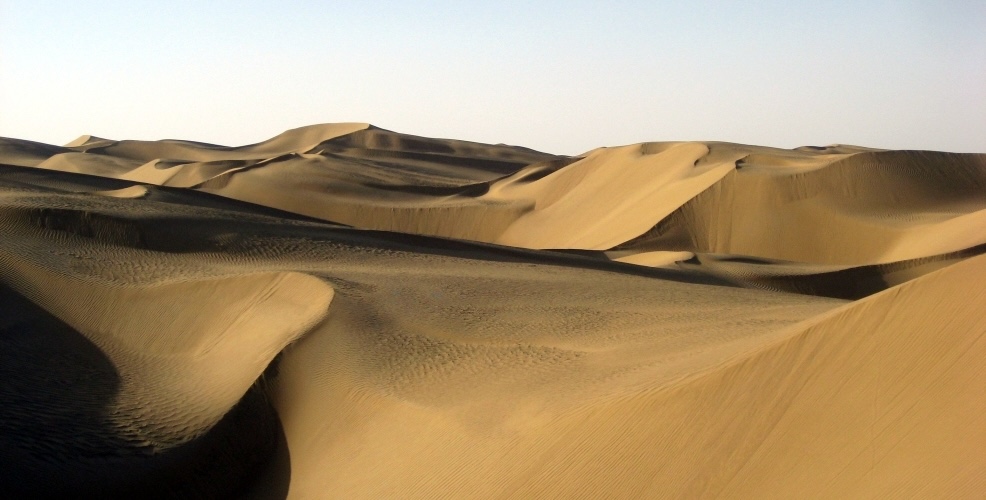
Taklamakan Desert – ©Pravit CC BY-SA 4.0 via Wikimedia Commons
The Dzungarian Basin is slightly cooler, and receives somewhat more precipitation, than the Tarim Basin. Nonetheless, it, too, has the Gurbantünggüt Desert in its centre. The Tian Shan range marks the Xinjiang-Kyrgyzstan border at the Torugart Pass. The Karakorum highway links Islamabad, Pakistan with Kashgar over the Khunjerab Pass.
Having hot summer and low precipitation, most of Xinjiang is endorheic. Its rivers either disappear in the desert, or terminate in salt lakes (within Xinjiang itself, or in neighbouring Kazakhstan), instead of running towards an ocean. The northernmost part of the region, with the Irtysh River rising in the Altai Mountains, that flows (via Kazakhstan and Russia) toward the Arctic Ocean, is the only exception. But even so, a significant part of the Irtysh’s waters has been artificially diverted via the Irtysh–Karamay–Ürümqi Canal to the drier regions of southern Dzungarian Basin.
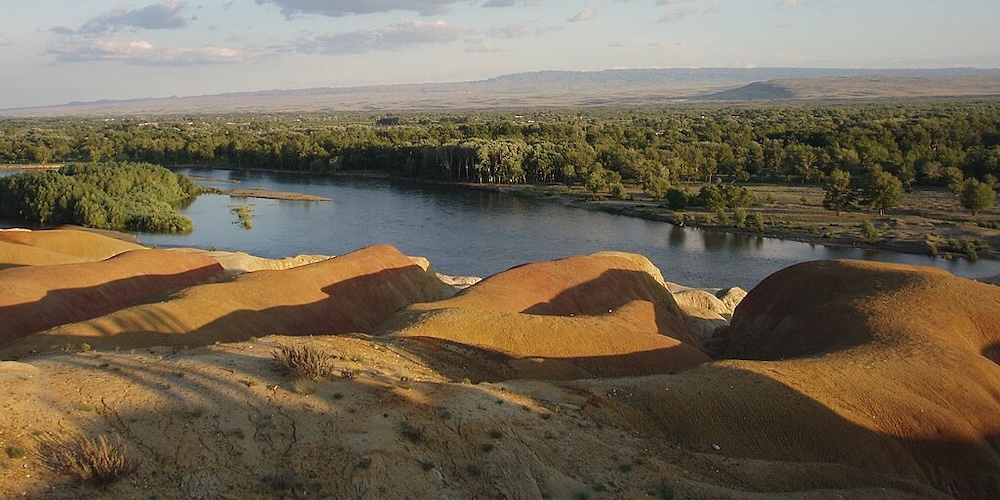
Irtysh River – ©Fanghong CC BY-SA 3.0 via Wikimedia Commons
Elsewhere, most of Xinjiang’s rivers are comparatively short streams fed by the snows of the several ranges of the Tian Shan. Once they enter the populated areas in the mountains’ foothills, their waters are extensively used for irrigation, so that the river often disappears in the desert instead of reaching the lake to whose basin it nominally belongs. This is the case even with the main river of the Tarim Basin, the Tarim, which has been dammed at a number of locations along its course, and whose waters have been completely diverted before they can reach the Lop Lake. In the Dzungarian basin, a similar situation occurs with most rivers that historically flowed into Lake Manas. Some of the salt lakes, having lost much of their fresh water inflow, are now extensively use for the production of mineral salts (used e.g., in the manufacturing of potassium fertilizers); this includes the Lop Lake and the Manas Lake.
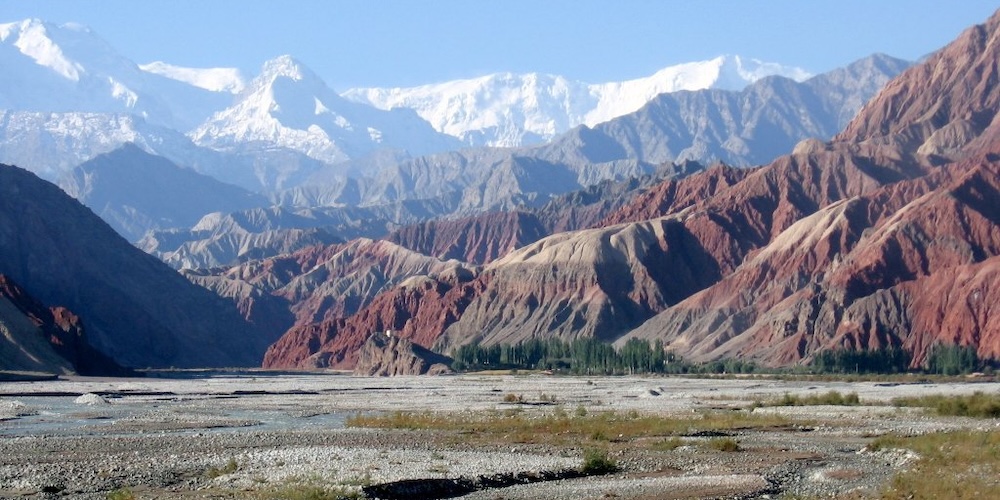
Karakorum – Public Domain via Wikimedia Commons
A semiarid or desert climate prevails in Xinjiang. The entire region has great seasonal differences in temperature with cold winters. The Turpan Depression often records some of the hottest temperatures nationwide in summer, with air temperatures easily exceeding 40 °C. Winter temperatures regularly fall below −20 °C in the far north and highest mountain elevations. Continuous permafrost is typically found in the Tian Shan starting at the elevation of about 3,500.
Birding Xinjiang
Landlocked Xinjiang, has three big mountain ranges; the Altai, shared with Russia in the north, the Tien Shan in the centre and the Kunlun-Altun Mountains in the south along the border with India and Pakistan. Between these three mountain ranges are two deserts, with the feared Taklamakan Desert in the south being the largest. There the enigmatic Xinjiang (formerly Biddulph’s) Ground Jay still clings on to existence, although numbers are declining due to overgrazing and other environmental damage. In some semi-desert areas both Great Bustard and McQueen’s Bustard may still be found. The fringes of the Taklamakan Desert are a place of many ruins of ancient civilisations.
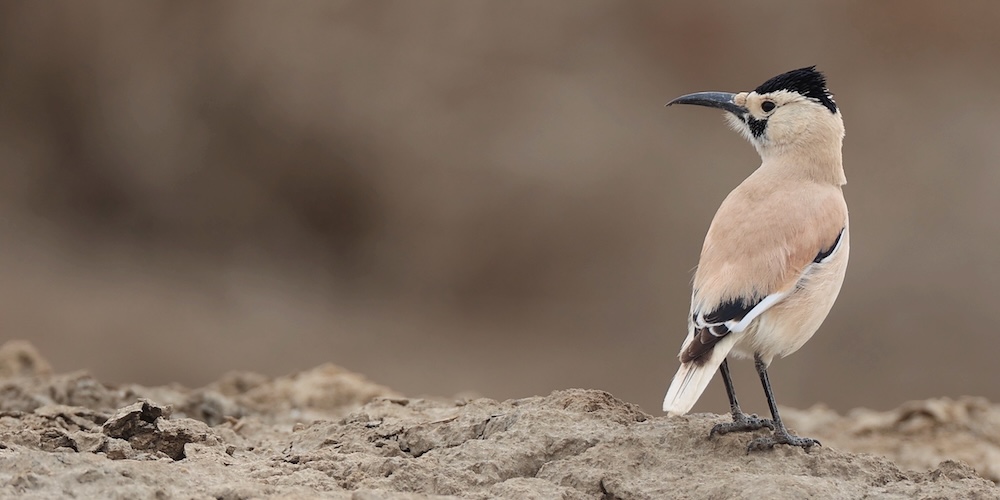
Xinjiang (Biddulph’s) Ground Jay Podoces biddulphi – ©Bird-Photo-Tours ASIA
Xinjiang has a palearctic avifauna, with many species at the eastern ends of their ranges. European Bee-eater and European Roller are colourful examples. In the far west, at the town of Yili, the former Russian Consulate is now a hotel, set in a compound with mature trees. Here there are Turkestan Tits. In spring the song of Nightingales and Eurasian Cuckoo can be heard.
Heaven Lake in the Tien Shan (Heavenly Mountains) is a three-hour drive northeast of the capital. The pines around the lake hold Three-toed Woodpecker, Blue-capped and White-winged Redstarts, Black-throated Accentor and Fire-fronted Serin. South of Urumqi, the oases around the city of Turpan are sites for Azure Tit, Little Owl and Barred Warbler. The biggest nature reserve in China is the Arjinshan National Nature Reserve in the southeast of Xinjiang. It covers 46,000 km2 of steppe, desert and lakes. However, it is remote and undeveloped, with as yet no visitor facilities.
Xinjiang was the site of discovery of one of China’s most enigmatic birds. In 1929, near the Karakoram Pass, Dutchman J A Sillem shot two specimens of mountain finch that were originally considered to be an odd race of Plain Mountain Finch. In 1992 the specimens were reassessed in Holland and it was decided they should be upgraded to a full species. Live examples of ‘Sillem’s Mountain Finch’ (now Sillem’s Rosefinch Carpodacus sillemi) had not been seen in the wild since the original specimens were collected until rediscovered 80 years later in Qinghai.
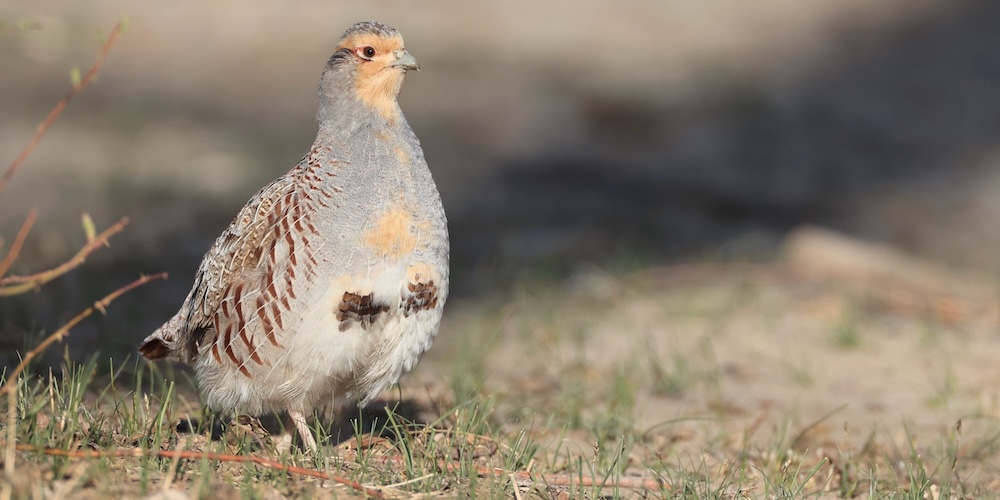
Daurian Partridge Perdix dauurica – ©Bird-Photo-Tours ASIA
Xinjiang has a few active birders, some of whom recently found a significant population of the endangered White-headed Duck breeding on reservoirs near Urumqi. No account of birding in Xinjiang would be complete without mention of Professor MA Ming, of the Xinjiang Institute of Ecology and Geography where he is Professor of Zoology. He is also the vice-director and council member of Scientific Committee of the China Ornithological Society. As well as being a prolific author, Prof. MA is a very well-known and dedicated champion of birds and their habitats throughout this vast region.
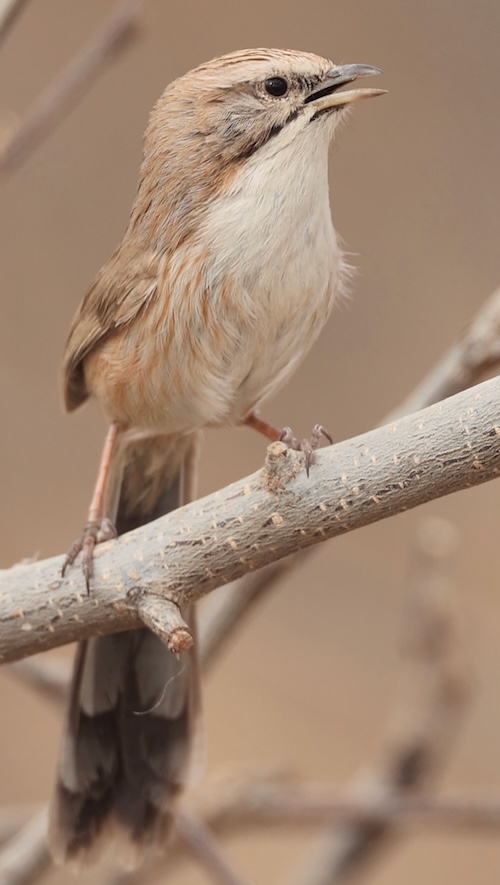
There are a number of nature reserves and other good birding spots worth mentioning including Tarim Nature Reserve, which is located in Weili and Luntai Counties on the edge of the Taklamakan Desert, and covers an area of 395,400 hectares. The reserve aims to protect the Euphrates Poplar Forest ecosystem and its rare fauna. Around 140 bird species have been recorded there. The Tarim River Wetlands within the reserve is an important stopover for migrating birds. Special species include Xinjiang Ground Jay, Azure Tit, Tarim Babbler, Black-throated, Red-throated & Dusky Thrushes, Blue-capped & Rufous-backed Redstarts, Red-mantled Rosefinch and Godlewski’s Bunting.
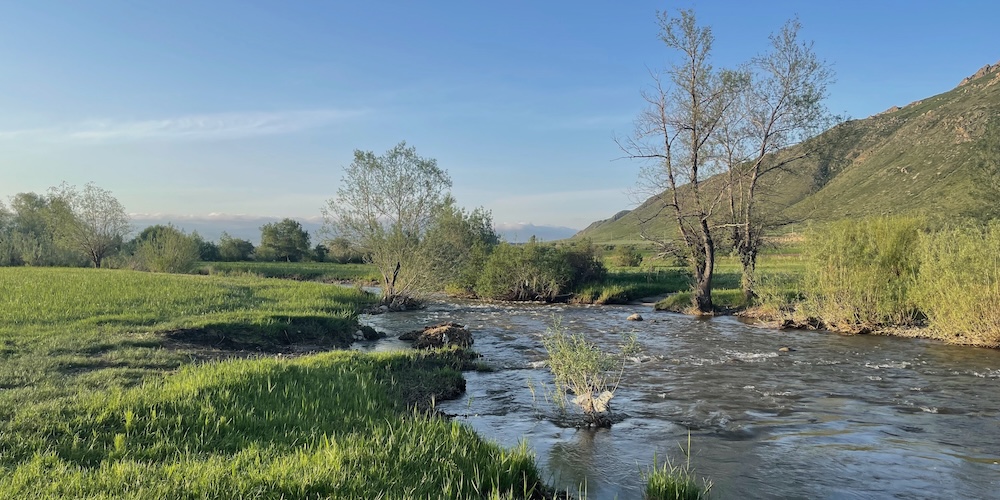
Qinggeda Lake Nature Reserve is located in Wujiaqu City on the northern slope of the Tianshan Mountains, and covers 30 km2. It is a wonderful place for birding and has recorded c.190 bird species. It is a stopover and breeding habitat for Whooper Swan, Great bustard, Pallas’s Fish Eagle, and other birds such as Red-crested Pochard, Ferruginous Duck, Black-winged Stilt, Black Tern, Isabelline Shrike and Great Reed Warbler.
Mushroom Lake is located about 30 kilometres to the northwest of Shihezi, and is the largest plain reservoir in Shihezi. The surrounding vegetation is rich, and the microorganisms, algae, fish and insects in the lake are also abundant. During the annual migration season, the reservoir attracts gulls, herons, ducks and more including Whooper Swan, Ferruginous Duck, Smew, Lesser Sand & Kentish Plovers, Caspian Gull, Gull-billed, Caspian, Black & White-winged Black Terns, White-tailed Eagle, Pallas’s Fish-Eagle, Long-legged Buzzard, European Bee-eater, Eurasian Golden Oriole, Isabelline Shrike, Great Grey Shrike, Paddyfield, Great Reed & Barred Warblers, & Black-throated Thrush.
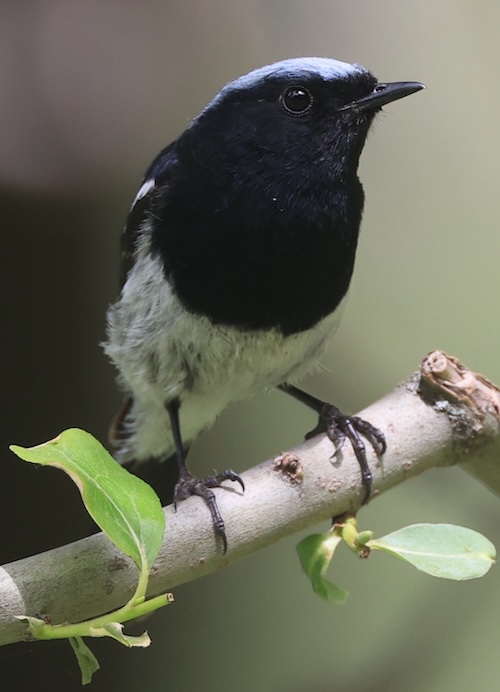
Blue-capped Redstart Phoenicurus coeruleocephala – ©Bird-Photo-Tours ASIA
The beautiful Tianshan Mountain (Baiyanggou) scenic spot is a renowned summer resort and tourist attraction in the southern suburb of Urumqi City, about 75 kilometres away from the city proper. It is situated at the northern foot of the northern Tianshan Mountain. The beauty spot belongs to the transition zone between the middle mountain and lower mountain, at an altitude of about 2,252 meters. More than 150 bird species have been recorded there. Specials include Himalayan Snowcock, Hill Pigeon, Pallas’s Sandgrouse, Black & Himalayan Griffon vultures, Booted Eagle, Long-legged Buzzard, European Roller, Eurasian Three-toed Woodpecker, Turkestan Shrike, Isabelline Shrike, Azure Tit, Rufous-backed & Blue-capped Redstarts, Isabelline & Desert Wheatears, Richard’s & Tawny Pipits, Common Rosefinch, Plain Mountain-Finch, Red-headed, Pine & Grey-necked Buntings.
Burqin Magic Forest is a riverine woodland at the confluence of the Burqin and Irytsh rivers. The birch forest and corresponding avifauna are similar to those of White Birch Forest Scenic Area. Over 100 bird species have been seen there. They include Black Stork, Eurasian Scops Owl, White-backed, Lesser Spotted, Grey-headed & Black Woodpeckers, Eurasian Golden Oriole, Red-backed, Turkestan & Lesser Grey Shrikes, Azure Tit and Blyth’s Reed Warbler.
This page is sponsored by Alpine Birding

This page is sponsored by Bird-Photo-Tours ASIA

-
John & Jemi Holmes
Hong Kong | johnjemi@gmail.com
Website -
Philip He
Alpine Birding
http://www.alpinebirding.com
-
Number of bird species: 563
(As at June 2025)
Number of endemics: 1
Xinjiang (Biddulph’s) Ground Jay Podoces biddulphi
-
Avibase
PDF ChecklistThis checklist includes all bird species found in Xinjiang Uighur , based on the best information available at this time. It is based on a wide variety of sources that I collated over many years. I am pleased to offer these checklists as a service to birdwatchers. If you find any error, please do not hesitate to report them. -
E-Bird
PDF ChecklistThis checklist is generated with data from eBird (ebird.org), a global database of bird sightings from birders like you. If you enjoy this checklist, please consider contributing your sightings to eBird. It is 100% free to take part, and your observations will help support birders, researchers, and conservationists worldwide.

-
A Checklist on the Distribution of the Birds in Xinjiang
| By Ma Ming | Huayu Nature Book Trade Co.Ltd | 2011 | Paperback | 244 pages, b/w photos | ISBN: 9787030300461 Buy this book from NHBS.com -
Birds of China
| By Liu Yang & Chen Shuihua | Princeton University Press | 2023 | Flexibound | 672 pages, plates with 4000 colour illustrations, colour distribution maps | ISBN: 9780691237527 Buy this book from NHBS.com -
Guide to the Birds of China
| By John MacKinnon | OUP | 2022 | Edition 2 | Paperback | 513 pages, 164 plates with colour illustrations; colour distribution maps | ISBN: 9780192893673 Buy this book from NHBS.com -
Watch and Research on Birds in Xinjiang
| By Ma Ming | Xinjiang Institute of Ecology and Geography | 2006 | Paperback | 255 pages, Colour photos | Field Guide in Chinese | ISBN: 9787537155403 Buy this book from NHBS.com
-
Xinjiang Bird Watching Society
InformationXinjiang Bird Watching Society, which was established in May 2004, is an NGO with about 40 core members concerning and protecting birds in Xinjiang. It is now under the Xinjiang Ecological Society. Photos and logs...
-
NNR Bogeda Peak
InformationSatellite ViewAccording to the record, there are 24 species of mammal, 50 species of birds, and 6 species of reptiles, fish and amphibians respectively… -
NR Mengda Nature Reserve
InformationSatellite ViewThe reserve, centered around the mountaintop Heavenly Lake (Tianchi) has forests of virgin trees, a large variety of exotic flowers and many wild animals... -
NR Tarim Huyang Nature Reserve
InformationSatellite ViewThe Huyang (Poplar diversifolious) forest and its associated ecosystem is the main target of this reserve. -
NR Xiaerxili
Observatory WebsiteSatellite ViewThere are more than 170 species of terrestrial animals and birds in the protected areas. Among them, there are 16 species belonging to the 1st National level or the 2nd National level of protected wildlife, such as Snow Leopard, North Goat, Saiga antelope, bear, and snow rabbit. There are also 25 species of birds with a Second National level protection designation. 6 species belong to Xinjiang's first and second protected wildlife list.
-
eBird
SightingseBirding This Month
-
Alpine Birding
Local Tour OperatorExplore the Vast Gobi Desert and Populus Euphratica Forest in Xinjiang for Its Fascinating Endemics and Specials -
Bird-Photo-Tours ASIA
Tour OperatorBird-Photo-Tours ASIA is the specialists in bird photography tours on the Asian continent with a portfolio of 50 bird photography tours across 26 countries and a particular specialism in bird photography in China including Xinjiang autonomous Region. -
BirdQuest
Tour OperatorKUNLUN & TARIM EXPEDITION, WEST CHINA – A Quest for Sillem’s Rosefinch, Wild Yak, Tibetan Antelope, Biddulph’s Ground Jay and so much more -
China Bird Tour
Local Tour OperatorMr. Tang Jun, owner and founder of China Bird Tour, worked in the travel industry since 1993 and his first experience on birding was from 1999 when the focused his work gradually inclined to birdwatching tourism. Till now his yearly travelling cover all popular birdwatching places within China. -
China Culture Tour
Local Tour OperatorXinjiang Birding Adventure in Ulungur Lake -
China Wild Tour
Local Tour OperatorWe are a licensed and professional wilderness guiding company offering premier guided adventure trips for wilderness in China. Our guiding service is specialised in birding but not limited to.
-
2017 [07 July] - Craig Brelsford
ReportBirding in Xinjiang is the adventure of a lifetime. In China’s largest and most northwesterly province, the birds, natural scenery, and people, including people wearing the uniforms of the state, are endlessly fascinating. -
2018 [06 June] - Hauun Jännes
PDF Report...Our stunning list of special birds included the much sought after Lord Derby's Parakeet as well as Tibetan Eared Pheasant, Szechenyi’s Monal Partridge (or Buff-throated Partridge), Giant and Tibetan (or Kozlov’s) Babaxes, Brown-cheeked (or Prince Henri’s) Laughingthrush, Ground Tit, Tibetan (or Kozlov’s) Bunting, Tibetan (or Roborovski’s) Rosefinch and the strange Przevalski’s (or Pink-tailed) Finch, the sole member of its family... -
2018 [07 July] - James Eaton - Tibetan Plateau & Xinjiang
PDF ReportMany of the birds encountered have exotic names which pay homage to the early explorers of these remote lands; Roborovski’s Rosefinch, Kozlov’s Bunting, Szechneyi’s Monal Partridge, Biddulph’s and Henderson’s Ground-jays, Güldenstädt's Redstart, Severtzov’s Tit-warbler and Przewalski with a partridge, redstart and most significantly for many, a beautiful pink passerine which is now in its own bird family – Prezwalski’s Pinktail. -
2019 [06 June] - Mike Nelson - Tibetan Plateau and Xinjiang
PDF ReportThe quality of the views of most species were particularly good on this tour; beginning in Xinjiang with roadside views of many Biddulph’s Ground Jays, Eversmann’s Redstart, Azure Tit, Red-headed Bunting and Daurian Partridge, conifer valleys revealed Eurasian Three-toed Woodpecker, Fire-fronted Serin and Blue-capped Redstart while arid areas added Tarim Babbler and Desert Whitethroat. A large water body gave us Savi’s and Paddyfield Warblers, Caspian Gull and Bearded Reedling. -
2019 [07 July] - Summer Wong
PDF Report...Today was the start of our extension towards Xinjiang. Given it is a very long drive with multiple checkpoints, we decided to split the journey in two. There was no need to leave very early, so for a change we didn’t leave in full darkness. A few stops along the road produced more Henderson’s Ground Jays, Desert Wheatear, Desert Whitethroats, Asian Short-toed Lark etc. We arrived at Huatugou in late afternoon, and checked out the sewage ponds. Besides a few Citrine Wagtails there wasn’t much of notice...
-
Northern Xinjiang
WebpageThis post is the first in a five-post series about my birding expedition of July 2017 to Northern Xinjiang.