| By C A Slater, P J Mundy & R B Williams | John Beaufoy Publishing | 2025 | Hardback | 472 pages, 135 illustrations | ISBN: 9781913679743 |
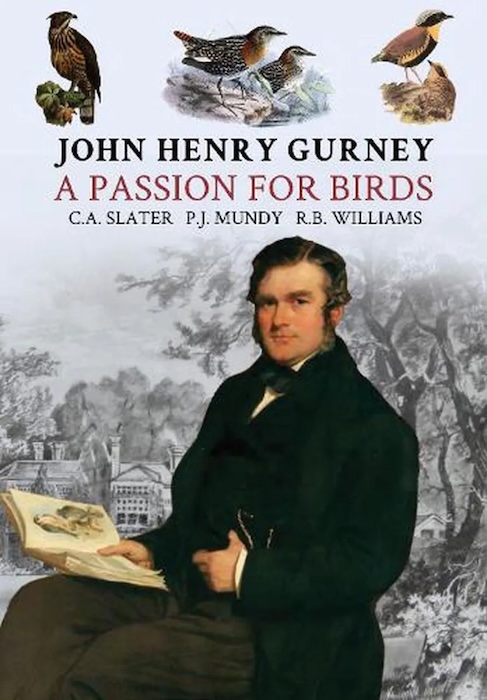
The Publisher’s View:
John Henry Gurney: A Passion for Birds details the life of John Henry Gurney (1819-1890) who became a successful banker when still young. His wealth enabled him to indulge his passion for collecting natural history specimens, especially birds. A major supporter of the fledgling Norfolk and Norwich Museum, in 1853 he announced his intention to collect a series of every species of bird of prey in the world, and to donate and display them in the museum. Unfortunately, devastating events in his private and professional life threatened to derail his efforts. Nevertheless, he persisted in his specimen-collecting and ornithological studies and became a world-renowned expert on birds of prey and the birds of southern Africa.
Gurney named nearly 30 bird species new to science and had several species named after him. He made significant and long-lasting contributions to bird identification and knowledge of the distribution of many species. But why did he choose to collect and study birds of prey in particular; how closely did he approach his goal and how much did it cost him? This book attempts to answer these questions.
Fatbirder View:
I know from many years researching the lives of people after whom birds have been named that often, frustratingly little is in the public domain. Putting together a life in this detail is no mean feat and only possible through recently opened sources of material and the family estate.
Its hard enough when the figure was a professional scientist or widely travelled bird collector. That was not Gurney, he was a banker who devoted his wealth to his passion even when the wealth dwindled. He bought collections, employed famed collectors and corresponded with ornithologists becoming expert himself.
He named many birds and had quite a few named after him, many being most sought-after such as Gurney’s Pitta.
This painstaking effort often quotes letters from or to the man through which it not only shares the facts, but goes a very long way to giving us insight into the man.
For UK readers it is no surprise that he donated much of his collection to Norfolk Museum; in a county which many of us birders have visit as often as we are able.
Definitely my kind of book!
Fatbirder