

Phaenicophilidae – Hispaniolan Tanagers
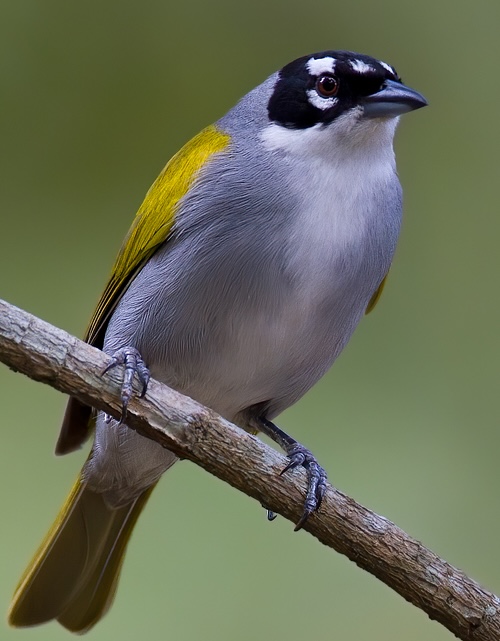
Phaenicophilidae is a family of passerine birds. It consists of three genera and four species; all are endemic to Hispaniola. They have been traditionally placed in the families Thraupidae (Phaenicophilus) and Parulidae (Xenoligea, Microligea) before DNA research showed them to be a distinct family. All are olive-backed with fairly long-tails songbird with grey or white below and some white in a grey or black face. Their calls are simple throaty or sibilant calls.
The Black-crowned Palm-tanager shares its genus with the Grey-crowned Palm-tanager. They do sometimes hybridise, and have at times been considered conspecific. The genus was long included in family Thraupidae, the ‘true’ tanagers, but it was moved recently (2017). The black-crowned palm-tanager is monotypic. It is found throughout the mainland Dominican Republic (including on Saona Island) and in Haiti (except for the Tiburon Peninsula).
It is a year-round resident that inhabits almost every landscape on Hispaniola, in many forest types from dry to humid and open to dense. It also occurs in rural and urban gardens and parks. In elevation it ranges from sea level to about 8,200 feet, but is most common well below 6,600 feet. It breeds April to June, making a deep, unlined cup in a tree or bush and often close to people. Two or three eggs are incubated for about ten days and fledged ten days later.
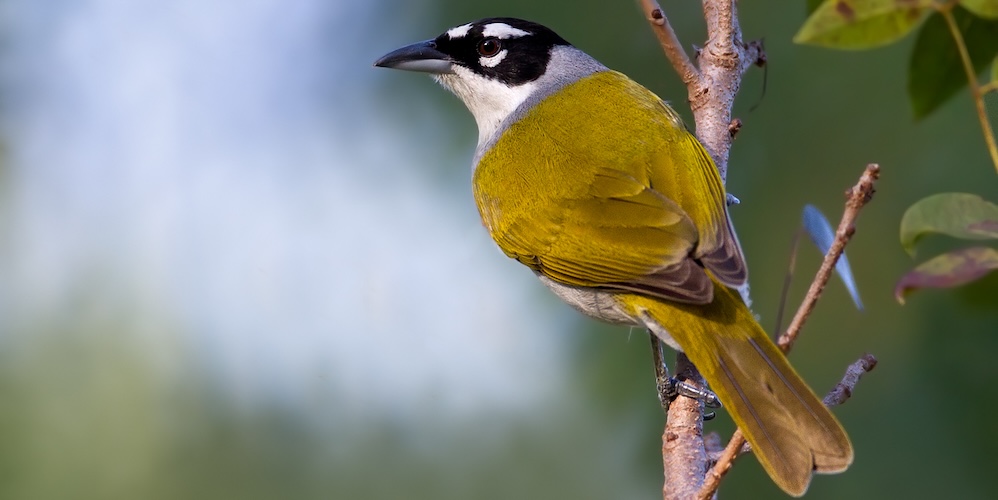
Black-crowned Palm-tanager Phaenicophilus palmarum – ©Dubi Shapiro
The Grey-crowned Palm-tanager’s nominate race is found on the Tiburon Peninsula of southwestern Haiti and the small island of Grande Cayemite off its northern shore. In the Dominican Republic, it is rarely found in the north and south slopes of the Sierra de Baoruco, as well as on the southern part of Loma de Toro and Hoyo de Pelempito. The subspecies tetraopes is found only on Île-à-Vache off the Tiburon Peninsula’s south coast, whereas coryi is found only on Gonâve Island in the Gulf of Gonâve north of the peninsula.
This species also inhabits every available forest type from dry to wet and open to dense; tree plantations and in rural and urban gardens and parks. It is most easily viewed on the Massif de la Hotte towards the western end of the Tiburon Peninsula. In elevation it ranges from sea level to 7,900 feet. It too is a year-round resident. It forages in pairs or family groups from the forest mid-level to the canopy, and also sometimes joins mixed-species foraging flocks. Its major dietary component is small arthropods with a lesser contribution from fruit. It forages for arthropods mostly by gleaning from foliage, both living and dead. It has a slightly later breeding season (May to July) with similar nest, clutch size, incubation and fledging periods. It is the scarcer of the two.
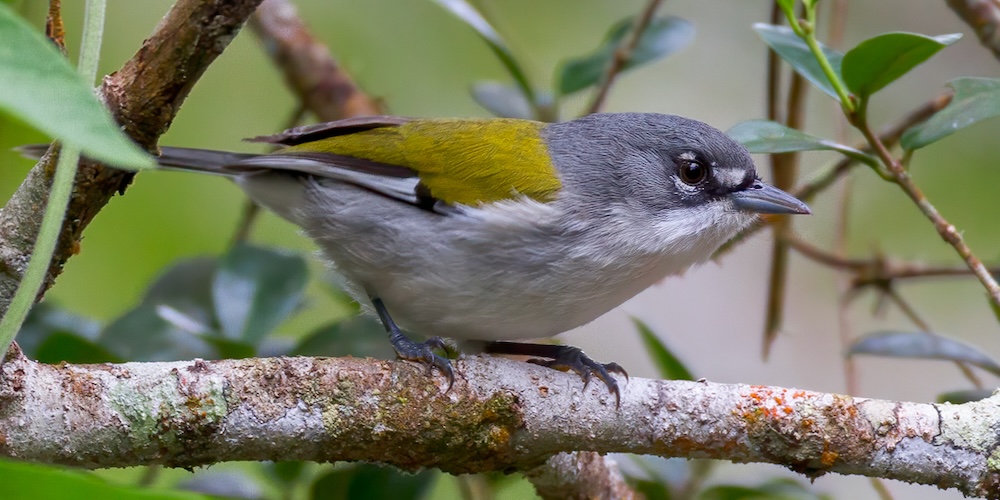
White-winged Warbler Xenoligea montana – ©Dubi Shapiro
Both ‘warblers’ are year-round residents. The White-winged Warbler is limited to montane regions of the Dominican Republic and Haiti. In the former it is found in the Cordillera Central, Sierra de Bahoruco, and Sierra de Neiba. In Haiti it is found in the Massif de la Hotte on the western Tiburon Peninsula and possibly other parts of the peninsula closer to the Dominican Republic. The species inhabits several forest types that have in common a dense understory; they include mature humid broadleaf, pine-broadleaf, pine, and karst limestone forests, as well as secondary forest. In elevation it ranges between 2,900 and 6,600 feet, but is most numerous above 4,300 feet. It feeds on seeds and arthropods, foraging in small groups. The white-winged warbler’s nesting season is believed to be May to July. The only known nest was found in 2004. It was a cup of moss, leaves, lichen, and other plant material lined with small fibres and placed in a vine thicket eight feet above the ground. It contained two eggs. Nothing else is known about the species’ breeding biology.
The IUCN originally assessed the white-winged warbler as Threatened but has classed it as Vulnerable (1994). Its estimated population of 1500 to 7000 mature individuals is very fragmented and believed to be decreasing. Much of its range has been deforested, especially in Haiti. Predation by introduced small Indian mongooses is also suspected to have contributed to the decline.
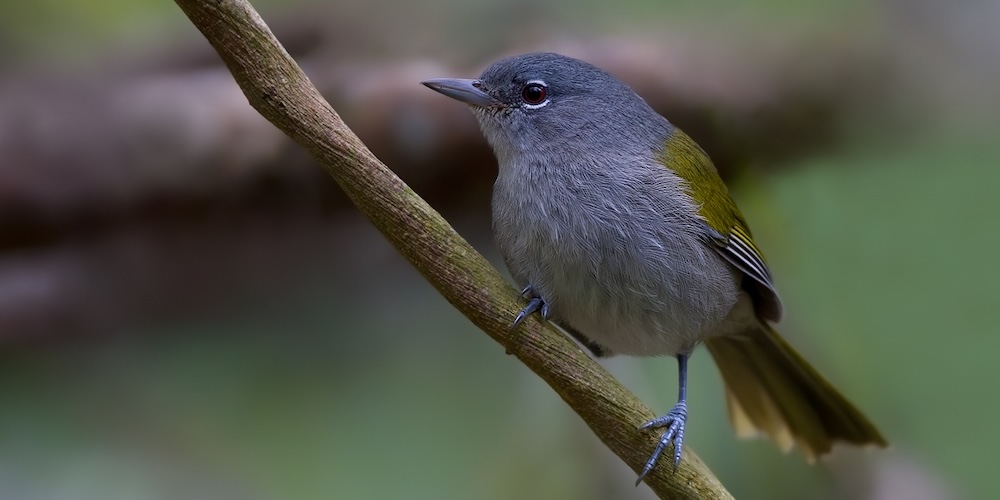
Green-tailed Warbler Microligea palustris – ©Dubi Shapiro
The nominate subspecies of the Green-tailed Warbler is found in the highlands of central Hispaniola that span the border between Haiti and the Dominican Republic, though it is found almost entirely in the latter country. There it inhabits broadleaf and pine montane forest with a dense understory at elevations up to about 9,500 feet. The subspecies vasta is a disjunct population found in the southwestern Dominican Republic lowlands and Beata Island. There, it inhabits semi-arid scrublands near sea level. It forages in vegetation, usually in the undergrowth and thickets. Its diet is mostly arthropods, especially insects. It forages alone, in pairs, and in mixed-species foraging flocks. So far as is known its breeding cycle et6c is similar to the other ‘warbler’. It too is assumed to be decreasing in population due to the same reasons.
-
Number of bird species: 4
(As at October 2025)
According to the recently (2025) amalgamated AviList there are just four species, in three genera of the Phaenicophilidae family. They are:
White-winged Warbler Xenoligea montana
Green-tailed Warbler Microligea palustris
Black-crowned Palm-tanager Phaenicophilus palmarum
Grey-crowned Palm-tanager Phaenicophilus poliocephalus
-
Phaenicophilidae
Family AccountThis group of tanagers, including two genera once thought to be warblers, is limited to the single island of Hispaniola in the Caribbean. -
Phaenicophilidae
Family AccountPhaenicophilidae is a family of passerine birds. It consists of three genera and four species, all endemic to Hispaniola.
Given that this is a very small family with just four species in only three genera, Fatbirder provides active links below to all species.
-
Black-crowned Palm-tanager Phaenicophilus palmarum
Species AccountA slow-moving and occasionally tail-twitching species of woodland thickets and dense cover; often found in mixed-species flocks. Note its black face... -
Black-crowned Palm-tanager Phaenicophilus palmarum
Species AccountThe black-crowned palm-tanager or black-crowned tanager (Phaenicophilus palmarum) is a species of bird of the family Phaenicophilidae, the Hispaniolan... -
Black-crowned Palm-tanager Phaenicophilus palmarum
Species AccountSound archive and distribution maps etc. -
Green-tailed Warbler Microligea palustris
Species AccountSecretive, found in montane thickets and scrub, typically in or near forests. Usually solitary and rarely found in mixed feeding flocks. -
Green-tailed Warbler Microligea palustris
Species AccountThe green-tailed warbler (Microligea palustris), also known as the green-tailed ground-tanager, is a species of bird of the family Phaenicophilidae... -
Green-tailed Warbler Microligea palustris
Species AccountSound archive and distribution maps etc. -
Grey-crowned Palm-tanager Phaenicophilus poliocephalus
Species AccountA woodland species that also ventures into parks and gardens. Often found in groups of up to five foraging at middle to upper heights... -
Grey-crowned Palm-tanager Phaenicophilus poliocephalus
Species AccountThe grey-crowned palm-tanager or grey-crowned tanager (Phaenicophilus poliocephalus) is a Near Threatened species of bird in the family Phaenicophilidae... -
Grey-crowned Palm-tanager Phaenicophilus poliocephalus
Species AccountSound archive and distribution maps etc. -
White-winged Warbler Xenoligea montana
Species AccountA denizen of mature montane forests wherein it feeds low in thickets and shrubs. Often found in pairs, but sometimes in mixed feeding flocks. -
White-winged Warbler Xenoligea montana
Species AccountThe white-winged warbler (Xenoligea montana), also called the white-winged ground-warbler or Hispaniolan highland-tanager, is a Vulnerable species of bird... -
White-winged Warbler Xenoligea montana
Species AccountSound archive and distribution maps etc.