

Hyliidae – Hylias
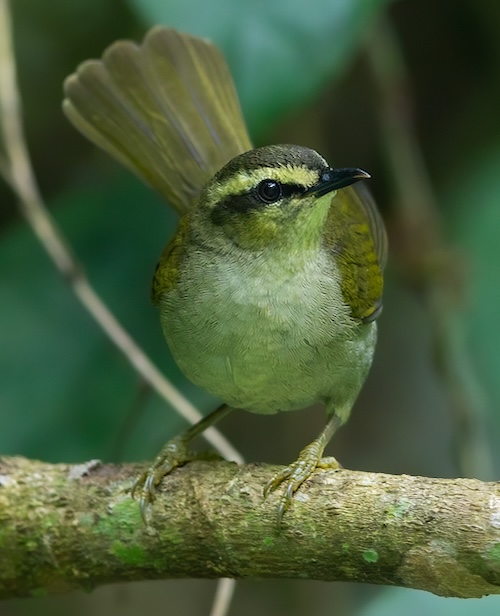
The Hyliidae is a family of passerine birds which contains just two species, the Green Hylia Hylia prasina and the Tit Hylia Pholidornis rushiae. Physiological similarities and molecular phylogenetic studies strongly supported the creation of this recently re-recognised family, which was originally introduced (1923) by the British ornithologist David Bannerman. Each species is placed in its own genus.
They have long puzzled taxonomists, and have over the course of their history been placed in at least seven different families. Relatively little is known about these two species, but both build relatively large dome-shaped nests, though one uses sticks, and the other soft plant material to create a soft, felt-like nest. Both are largely insectivorous, and scale-insects make up an important part of the diet of both species. They are small, insectivorous songbirds found in tropical Africa. Generally, they frequent the understory of wet tropical forests.
The Green Hylia Hylia prasina is a monotypic genus widespread in tropical Africa, where it mostly inhabits the understory and mid-stratum of moist forest. It is a canopy insectivore which had been tentatively placed within the family of Cettiidae warblers, but (2019) its assignment to the new family Hyliidae, was strongly supported.
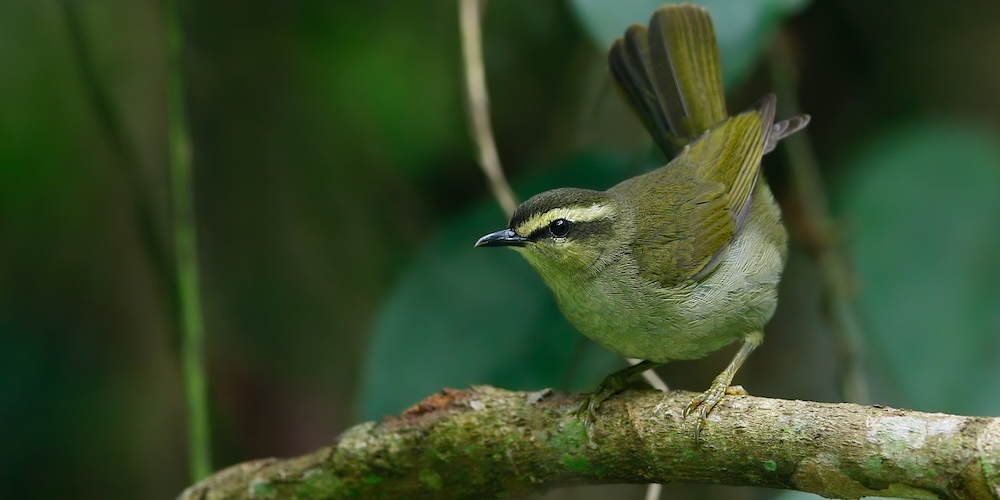
Green Hylia Hylia prasina ©Dubi Shapiro
Anatomically, it has similarities to sunbirds and warblers. Characteristics shared with sunbirds include a long hyloid with flattened epibranchial horns, a brush-tipped tongue and membrane-covered nostrils. Similarities to some warblers include very comparable colouring. The relationship between the genera Hylia and Phylloscopus (leaf warblers) has been examined, but seems to have low empirical support. A sister relationship between Hylia and Aegithalidae (long tailed tits) was similarly poorly supported. Close relationships with Nectariniidae (sunbirds), Estrildidae (finches) and Meliphagidae (honeyeaters) have also been considered and rejected.
It has dark brown irises, a black bill and olive-green feet. It is small, weighing approximately 14 g. There is no noticeable difference in colour between the sexes, however males are generally larger. They use several different calls, the most common being clear whistles (kee kee) or dry scolding rattles (trrit trrrit). It is known for its recognisable, pure, two-note song. Alarm calls used to warn of nearby predators are short as this makes it difficult for predators to locate exactly where the call is coming from.
It occurs in a wide range thr throughout the Guineo-Congolian forest and is found from western Gambia to western Kenya. It is a foliage-gleaning insectivore of the canopy and forest understory, usually foraging at a height of about 10 metres. Its diet includes insects, ants or butterflies which are accessible in its feeding area, on the underside of leaves or amongst forest litter. The species is considered a forest generalist as it is capable of surviving in a wide range of environmental conditions.
They are usually observed alone or in a mating pair, roosting together in their nest. The eggs are white and otherwise not very distinctive. The nest is built a few feet from the ground in a suitable location, such as the vertical forks of young palm trees. The nest is oval and domed in shape with a 20 mm circular opening at the side of the top. Nests are crumbly and friable, the bulk being made up of loose tufts of plant matter which are not fragmented, interwoven or compacted. The outside is covered by a fine layer of fibrous strips topped with the occasional leaf skeleton and measures 150 mm from top to bottom and 90 mm side to side and front to back. It differs from that of sunbirds in that it is positioned in forks of vegetation and not suspended in the air.

Tit Hylia Pholidornis rushiae ©Dubi Shapiro
The Tit Hylia Pholidornis rushiae is monotypic within the genus Pholidornis. It, too, is found in rainforests in West and Central Africa. It too had been placed in the family Cettiidae, but (2019) its assignment to a new family, the Hyliidae, was also strongly supported. It was first described by John Cassin (1855) as Diceum Rushiæ based on a specimen collected from present-day Gabon. It was placed in the genus Pholidornis by Gustav Hartlaub two years later. Its generic name is derived from the Ancient Greek pholidos for scale and ornis for bird.
It is a bird of the upper and middle canopy, usually foraging from 15 to 50 feet from the forest floor and rarely coming lower. It is social, feeding in small flocks of up to seven birds (although very rarely with other species). It feeds on insects, with Coccoidea (scale insects) being an important part of the diet.
It is a monogamous breeder, and a report from Angola has suggested that it may engage in cooperative breeding as well. The round nest, built by the pair or group, is large, 15 cm across, and is made of plant fibres. The entrance is a spout hanging from the bottom. The nest is situated 10 to 65 feet up a tree. The nests are well made and strongly bound to the branches they are found on. Two eggs are laid, although there is no information about the incubation, up to four adults have been reported feeding the chicks, and, like the Green Hylia, the nest is used for roosting after the breeding season.
-
Number of bird species: 2
(As at October 2025)
According to the recently (2025) amalgamated AviList, there are just two species, in two genera, in the Hyliidae family. They are:
Green Hylia Hylia prasina
Tit Hylia Pholidornis rushiae
-
Hyliidae
Family AccountGreen Hylia and Tit-hylia are mostly insectivorous, with scale insects making up important parts of the diet of both species -
Hyliidae
Family AccountHyliidae is a family of passerine birds which contains just two species, the green hylia (Hylia prasina) and the tit hylia (Pholidornis rushiae).
-
Green Hylia Hylia prasina
Species AccountAn unusual and distinctive warbler of humid forest, mostly olive-brown with a whitish eyebrow and throat. Found in rainforest at low and middle elevations. -
Green Hylia Hylia prasina
Species AccountThe green hylia (Hylia prasina) is a monotypic genus widespread in tropical Africa, where it mostly inhabits the understory and mid-stratum of moist forest. -
Green Hylia Hylia prasina
Species AccountSound archive and Distribution Maps. -
Tit Hylia Pholidornis rushiae
Species AccountTit-hylia Pholidornis rushiae Wings and back are olive-green, becoming paler and more streaked toward the head. -
Tit Hylia Pholidornis rushiae
Species AccountThe tit hylia (Pholidornis rushiae) is a species of bird, monotypic within the genus Pholidornis. It is found in rainforests in West and Central Africa. -
Tit Hylia Pholidornis rushiae
Species AccountSound archive and Distribution Maps.