

Mitrospingidae – Mitrospingid Tanagers
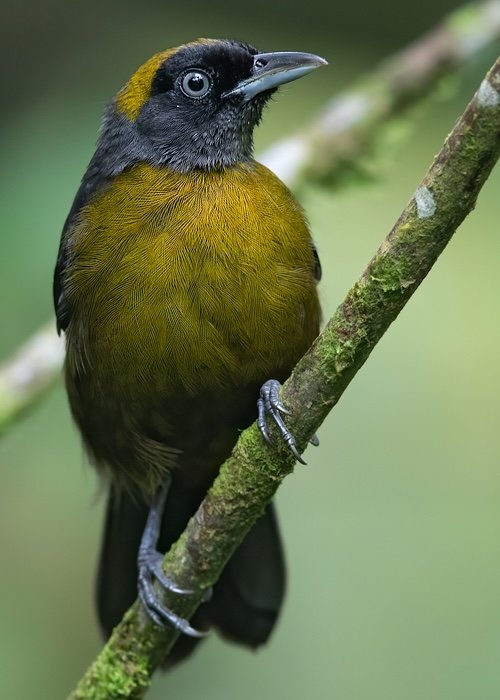
The Mitrospingidae is a family of passerine birds that consists of three genera and four species. The family is found in South America and southern Central America. The family was only recently (2013) identified and consists of birds that have been traditionally placed in the family Thraupidae. The family was adopted by the American Ornithological Society in their 58th supplement of their checklist (2017) and on by the International Ornithological Committee (IOC).
This small but eclectic family contains four ‘tanager’ species that have been united recently by molecular analyses. Three of the four resemble thraupid tanagers set in muted greys, olives, and browns, while the fourth is bold, black-and-white, with a bright red bill. All are gregarious insectivores that supplement their diets with fruit. As they forage, moving through the vegetation in loose bands over large ranges, they give a series of sharp strident calls, sometimes aggregated rhythmically into a song. Some of the species often form mixed-species flocks, whereas others seem not to mingle. They all jump or bound rather heavily through the branches.
The Olive-green Tanager and the three other species of Mitrospingidae were previously placed in family Thraupidae; the ‘true’ tanagers.
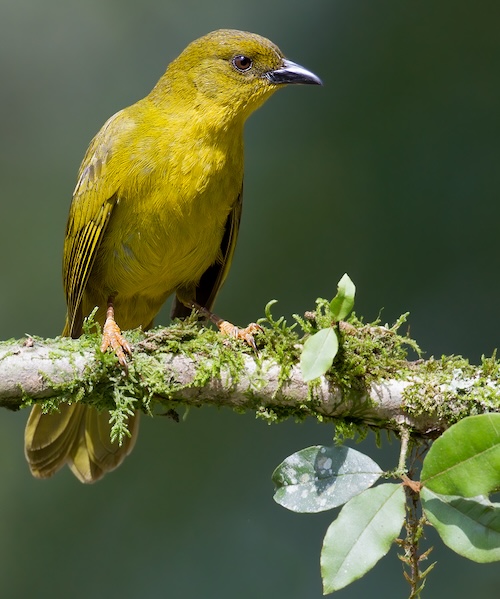
Olive-green Tanager Orthogonys chloricterus – ©Dubi Shapiro
The Olive-green Tanager Orthogonys chloricterus is the only member of its genus and has no subspecies. It is 18 to 19 cm long, olive green above and dull yellow below; it has a tinge of olive on the sides and flanks. It is found only in southeastern Brazil, from Espírito Santo state south to eastern Santa Catarina and northeastern Rio Grande do Sul and inhabits the interior and edges of humid montane forest at elevations of 3,000 to 5,900 feet. Its diet is primarily insects, though it also eats fruit. It typically forages in flocks of its own species that may number up to 20 individuals, but more usually have about eight. It feeds in the mid to upper levels of the forest, usually picking prey from leaves, and it also sallies for flying insects. One olive-green tanager was noted carrying nest material to a bromeliad in a large tree, but no other information has been published about its breeding phenology. Their song has been rendered as tséé-si, si, si, tséé-si, si, si. Its call is a buzzy tseee and it also calls wheek! while foraging.
The Red-billed Pied Tanager Lamprospiza melanoleuca is found in Bolivia, Brazil, French Guiana, Guyana, Peru and Suriname. Placed in family Thraupidae for over two centuries, the IOC recently (2018) reclassified it. It is 17 to 18 cm long and weighs 24 to 42 g. The male’s head and upper parts are glossy blue-black, its throat and chest black, and the rest of the underparts white. The female is similar but her nape, back, and rump are grey. Both have the eponymous red bill. The juvenile is quite different; it has a black bill and head. Its upper back is white and the lower back mottled black and white. The underparts are white with some black mixed in.
They are found in the upper Amazon Basin from eastern and southeastern Peru and northern Bolivia east to central Brazil and north into the Guianas. There it inhabits the canopy and emergent trees of humid terra firme forest up to about 3,000 feet elevation. It can also be found on the edges of the forest. Their diet includes berries, seeds, beetles, and Cecropia catkins. It typically forages in groups of three to eight individuals that may associate with mixed-species feeding flocks. It hops between branches and occasionally loops out for flying prey. Very little has been published about its breeding phenology. A female was seen on a nest in Brazil’s Amazonas state in February. Fledged young were seen in Mato Grosso in June and in Amazonas in September. Their song is complex, a semi-musical but jumbled series. Flocks give a call rendered as ééé-ééh…ééé-ééé-ééh…ééé-ééh-yuu.
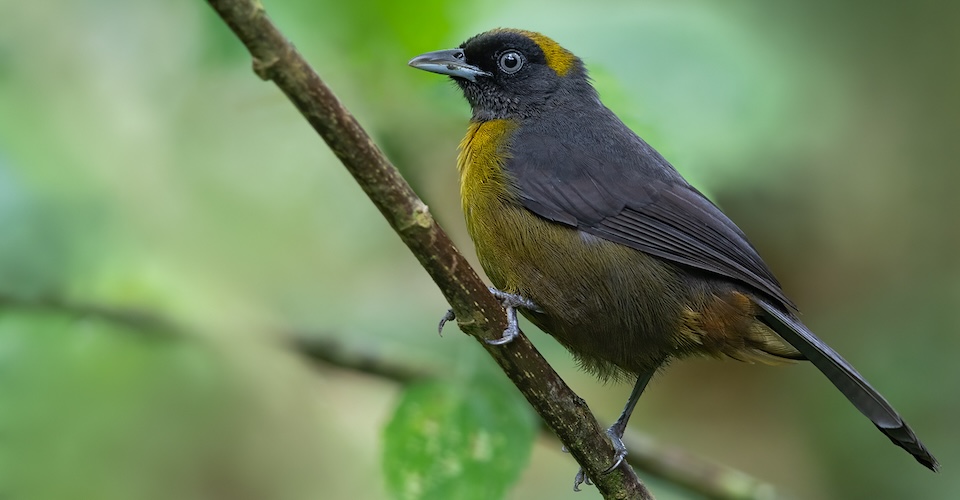
Dusky-faced Tanager Mitrospingus cassinii – ©Dubi Shapiro
The Dusky-faced Tanager appears to primarily eat fruits, though it also eats insects and seeds; its breeding behaviour has not been thoroughly studied. Breeding or breeding-condition birds have been recorded between March and May from Costa Rica, Panama, and Colombia. Two well-described nests were cups suspended in shrubs. The apparent clutch size is two, and nestlings were attended by at least three adults. Its dawn song is seety, seety, seety, seety, seety. They chatter all day long with sputtering notes such as chet or chet-ut.
The Olive-backed Tanager is 19 cm long and weighs 35.5 to 46 g. The nominate subspecies’ forehead and face are dark grey and the throat paler grey. The head, mantle, and back are deep olive green; the breast is olive-yellow becoming brighter and more yellow on the belly. The juvenile is duller and plainer than the adult and does not have the grey mask. They have a very small range in the area where Venezuela, Guyana, and Brazil meet. The nominate subspecies is the more eastern and is found in extreme southeastern Venezuela and the adjacent areas of west-central Guyana and far northern Brazil. They inhabit the slopes of tepuis (isolated mesas) in humid and wet forest, mostly in the interior of primary or secondary forest but also at the edges. In elevation it ranges between 3,000 and 6,000 feet.
The olive-backed tanager forages by hopping through the understorey or mid-level vegetation, primarily for insects but also for fruit. It also catches prey in short clumsy sallies. It typically forages in flocks of its own species that may number up to 20 individuals, though it may join mixed-species flocks or be joined by other species. No information about the olive-backed tanager’s breeding phenology has ever been published.
Its tanager’s song is rendered as zweee-eet? or zwee-er-eet? that is sometimes repeatedly sounded. It makes several thin, high-pitched calls while foraging.
-
Number of bird species: 4
(As at October 2025)
The recently (2025) amalgamated AviList, recognised just four species, in three genera in the Mitrospingidae family. They are:
Olive-green Tanager Orthogonys chloricterus
Red-billed Pied Tanager Lamprospiza melanoleuca
Dusky-faced Tanager Mitrospingus cassinii
Olive-backed Tanager Mitrospingus oleagineus
-
Mitrospingidae
Family AccountThis small but eclectic family contains four “tanager” species that have been united recently by molecular analyses. -
Mitrospingidae
Family AccountThe Mitrospingidae is a family of passerine birds. It consists of three genera and four species. The family is found in South America and southern Central...
Given that this is a very small family with just four species in only three genera, Fatbirder provides active links below to all species.
-
Dusky-faced Tanager Mitrospingus cassinii
Species AccountSubtly attractive tanager, fairly large with striking pale eye. Slaty gray back with olive-yellow crown and belly, dark blackish face. -
Dusky-faced Tanager Mitrospingus cassinii
Species AccountThe dusky-faced tanager (Mitrospingus cassinii) is a species of bird in the family Mitrospingidae. It is found in Colombia, Costa Rica, Ecuador, and Panama. -
Dusky-faced Tanager Mitrospingus cassinii
Species AccountSound archive and distribution maps. -
Olive-backed Tanager Mitrospingus oleagineus
Species AccountA bulky bird of tepui highlands, often encountered in groups. Unlikely to be confused within its limited range; plumage mostly coppery-olive ... -
Olive-backed Tanager Mitrospingus oleagineus
Species AccountThe olive-backed tanager (Mitrospingus oleagineus) is a species of bird in the family Mitrospingidae. It is found in Brazil, Guyana, and Venezuela. -
Olive-backed Tanager Mitrospingus oleagineus
Species AccountSound archive and distribution maps. -
Olive-green Tanager Orthogonys chloricterus
Species AccountLarge tanager found in the canopy of montane forests and at forest borders in coastal mountain ranges. Highly gregarious; gathers in groups of up to 20... -
Olive-green Tanager Orthogonys chloricterus
Species AccountThe olive-green tanager (Orthogonys chloricterus) is a species of bird in the family Mitrospingidae. It is endemic to Brazil. -
Olive-green Tanager Orthogonys chloricterus
Species AccountSound archive and distribution maps. -
Red-billed Pied Tanager Lamprospiza melanoleuca
Species AccountSocial, black-and-white bird of rainforest canopy. Combination of pied plumage and red bill is diagnostic. Always seen at the uppermost levels... -
Red-billed Pied Tanager Lamprospiza melanoleuca
Species AccountThe red-billed pied tanager (Lamprospiza melanoleuca) is a species of bird in the family Mitrospingidae. It is found in Bolivia, Brazil, French Guiana, Guyana... -
Red-billed Pied Tanager Lamprospiza melanoleuca
Species AccountSound archive and distribution maps.