

Miles Cluff (June 2022)
As a lifelong wildlife enthusiast, I was intrigued by what the Explorer WA ED-R 8×32 monocular could deliver. After only a few minutes, I was genuinely blown away, surprised by the depth and vibrancy of colours as I felt the monocular was picking up colour better than my own eyes! A particular moment that comes to mind was watching Common Starlings on a sunny afternoon. At first glance, Common Starlings seem rather dull, but in the right light, the iridescent feathers can produce all sorts of wonderful greens and purples. The monocular truly did the birds justice – picking up every subtle colour.
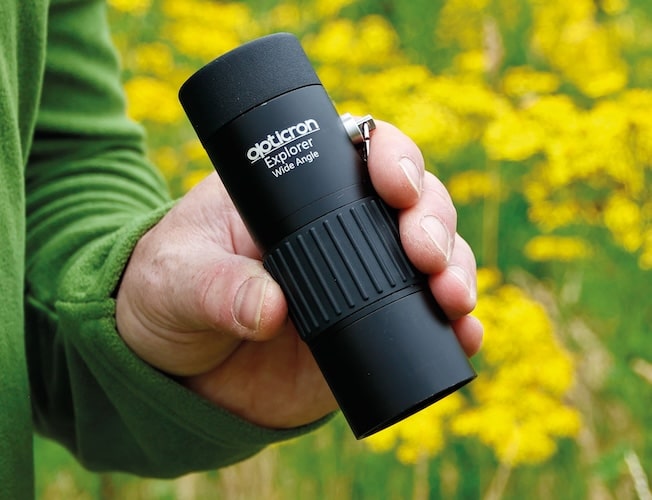
Opticron Explorer WA ED-R 8×32 Monocular
When testing new optics, I always make a conscious effort to see how they fare with flying back-lit birds. I spent a really enjoyable summer afternoon watching a few Eurasian Hobbies hawking for dragonflies at a local nature reserve. Even with the harsh sunlight silhouetting the birds, I was able to clearly see the diagnostic red ‘trousers’ and streaking/spotting on the underparts. There was no obvious chromatic aberration either, so clearly the ED glass used in the Explorer is effective.
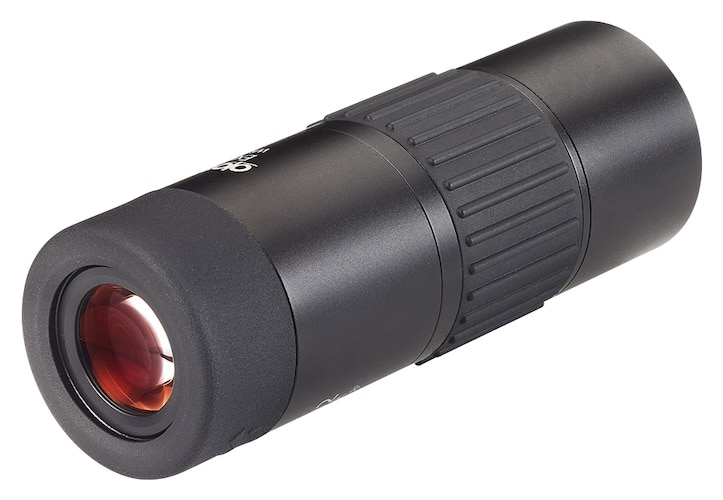
The Explorers are ideal for looking at a wide range of wildlife, but if you’re a fan of butterflies, dragonflies or any insects, this product might be just right for you. I spent a good amount of time looking at butterflies with the Explorer and found it to be the perfect tool searching through meadows and grasslands at close range. With a close focus of 2 metres, getting close to the subject was no problem at all, and I was provided with intimate views of a few Green Hairstreak butterflies near home that I’d never be able to get without the monocular. The detail and clarity were phenomenal and I couldn’t really ask for a sharper image.
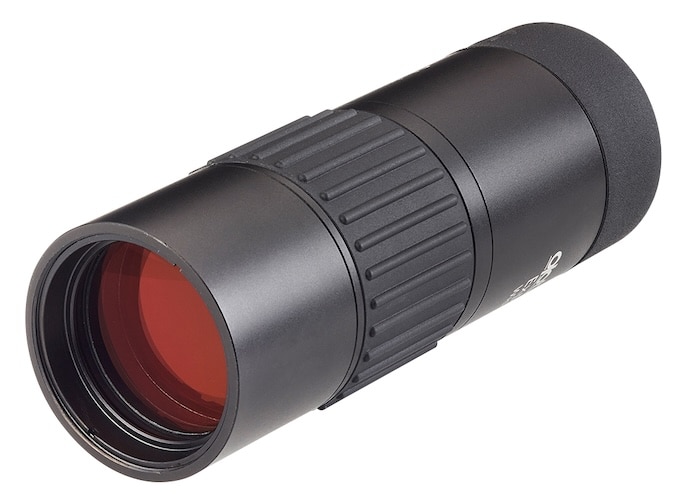
At only 260g, the Explorer is light which helps for stable viewing and easy carrying. In terms of ergonomics, the remarkably small size of the monocular means I could tuck it my pocket, and combined with the weight, I often found myself forgetting that I was carrying it. Holding the device was comfortable and it was easy to grip. There was enough room on the body to hold it steady with one hand while adjusting the focus wheel with the other.
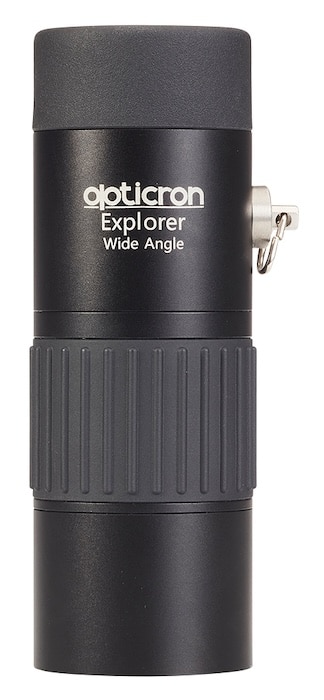
The focus wheel itself is well-made. The barrel was a little stiff to turn at first but eased with more use (always the case with any optics), but still remained tight. Personally, I prefer a tighter focus wheel as it gives you more control over your desired focus. The broad, deep ridges around the outside of the barrel made for easy gripping when adjusting the focus, even in wet conditions.
If you’re looking for a little extra distance, then perhaps the 10×42 are more suited to you, but I never felt limited by the 8×32. At 136m @1000m the field of view was another stand out feature and a big bonus when scanning wider vistas for birds. For £139 including sales tax, you’d struggle to get a better field of view from any other monocular on the market.
Rubber lens covers are provided for both ends of the monocular, and these were good quality. The adjustable strap was a nice touch too, well-made, comfortable and perfect if you prefer to have the monocular over your shoulder or around your neck rather than in your pocket. The eyecup could be raised to two different settings, and the transition between each was smooth so I never found myself inadvertently knocking the cup to another setting.
After extensive use in all kinds of scenarios, I struggled to find fault with this product. If I was being incredibly nitpicky, there was some visual distortion at the edges of the image, but I come to expect this from all optics. There was also a slight magenta over-wash to the image when viewing at range, but again, I didn’t find this distracting.
My overall experience with the Explorer was incredibly enjoyable. If you’re in the market for a high quality monocular that can be used on a wide range of subjects and at a great value for money, then I think you’d struggle to find any better options.