

Hubei Province
Hubei is a province in Central China covering 185,900 km2 (71,800 square miles). It has the seventh-largest economy among Chinese provinces, the second-largest within Central China, and the third-largest among inland provinces and has a population of c. 58 million people. Its largest city and provincial capital with about 14 million people is Wuhan, which serves as a major political, cultural, and economic hub for the region. Other major cities are Jingzhou, Xiangyang, Yichang, Shiytan, Jingmen and Huangshi.
The Jianghan Plain takes up most of central and southern Hubei, while the west and the peripheries are more mountainous, with ranges such as the Wudang Mountains, the Jing Mountains, the Daba Mountains, and the Wu Mountains (in rough north-to-south order). The Dabie Mountains lie to the northeast of the Jianghan Plain, on the border with Henan and Anhui; the Tongbai Mountains lie to the north on the border with Henan; to the southeast, the Mufu Mountains form the border with Jiangxi. The highest peak in Hubei is Shennong Peak, found in the Daba Mountains of the forestry area of Shennongjia; it has an altitude of 3105 m.
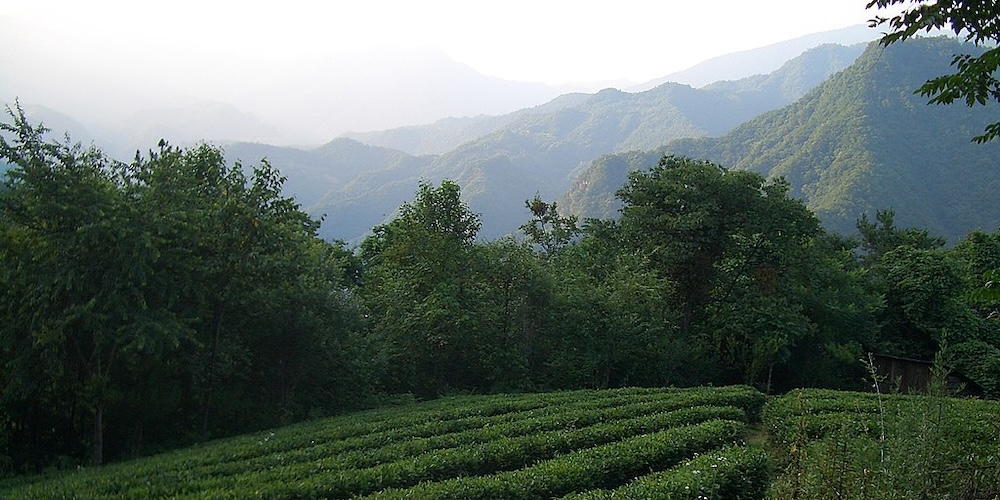
Muyu Hills – ©User:Vmenkov CC BY-SA 3.0 via Wikimedia Commons
The two major rivers of Hubei are the Yangtze River and its left tributary, the Han River; they lend their names to the Jianghan Plain – Jiang representing the Yangtze and han representing the Han River. The Yangtze River enters Hubei from the west via the Three Gorges; the eastern half of the Three Gorges (Xiling Gorge and part of Wu Gorge) lie in western Hubei, while the western half is in neighbouring Chongqing. The Han River enters the province from the northwest. After crossing most of the province, the two great rivers meet at the centre of Wuhan, the provincial capital.
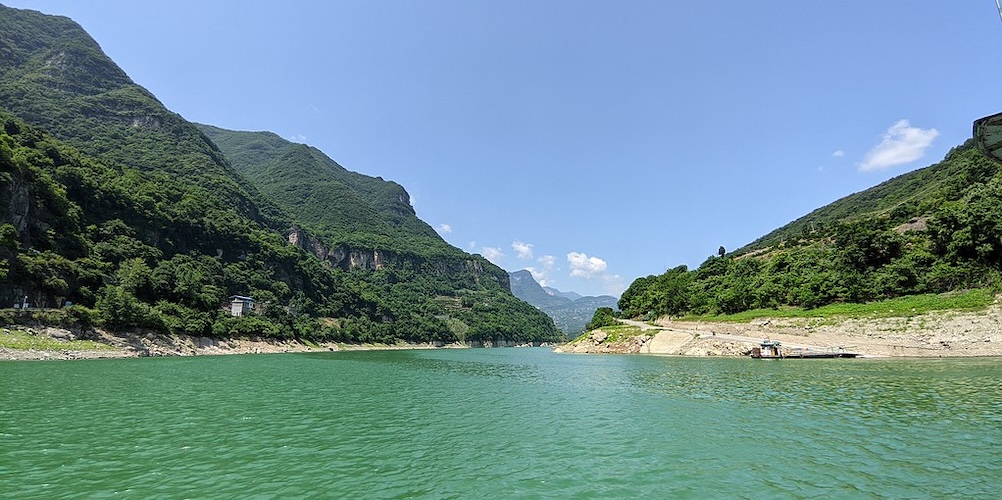
Qing River – ©Sun Jiao (Interaccoonale) CC BY 4.0 via Wikimedia Commons
Among the notable tributaries of the Yangtze within the province are the Shen Nong Stream (a small northern tributary, severely affected by the Three Gorges Dam project); the Qing, a major waterway of southwestern Hubei; the Huangbo near Yichang; and the Fushui River in the southeast. Thousands of lakes dot the landscape of Hubei’s Jianghan Plain, giving Hubei the name of ‘Province of Lakes’; the largest of these lakes are Liangzi Lake and Hong Lake. The numerous hydro-dams have created a number of large reservoirs, the largest of which is the Danjiangkou Reservoir on the Han River, on the border between Hubei and Henan.
Hubei has a humid subtropical climate with four distinct seasons. Winters are cool to cold, with average temperatures of 1 to 6 °C in January, while summers are hot and humid, with average temperatures of 24 to 30 °C in July; punishing temperatures of 40 °C or above are widely associated with Wuhan, the provincial capital. The mountainous districts of western Hubei, in particular Shennongjia, with their cooler summers, attract numerous visitors from Wuhan and other lowland cities.
The province’s best-known natural attraction (shared with the adjacent Chongqing municipality) is the scenic area of the Three Gorges of the Yangtze. Located in the far west of the province, the gorges can be conveniently visited by one of the numerous tourist boats (or regular passenger boats) that travel up the Yangtze from Yichang through the Three Gorges and into the neighbouring Chongqing municipality.
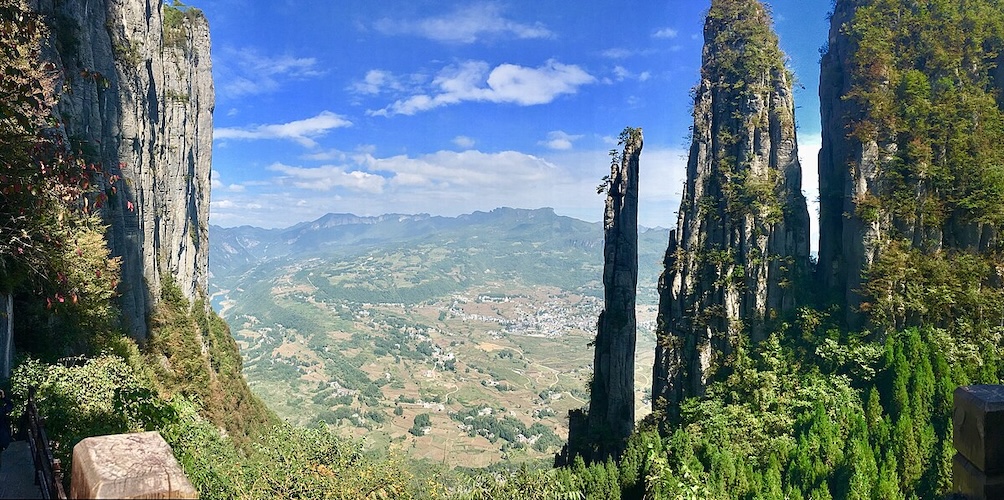
Enshi Grand Canyon – Public Domain, via Wikimedia Commons
The mountains of western Hubei, in particular in Shennongjia District, offer a welcome respite from Wuhan’s and Yichang’s summer heat, as well as skiing opportunities in winter. The tourist facilities in that area concentrate around Muyu in the southern part of Shennongjia, the gateway to Shennongjia National Nature Reserve. Closer to the provincial capital, Wuhan, is Mount Jiugong (Jiugongshan) National Park, in Tongshan County near the border with Jiangxi. A particular important site of both natural and cultural significance is Mount Wudang (Wudangshan) in the northwest of the province. Originally created early in the Ming dynasty, its building complex has been listed by UNESCO since 1994 as a World Heritage Site.
Birding Hubei
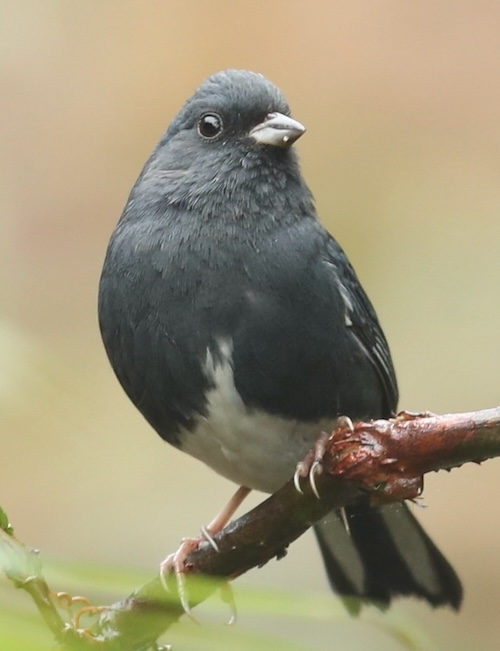
Rich mountains and wetlands provide habitats for many rare animals and plants. Such as Golden Snub-nosed Monkey, Oriental Stork, etc. And more than 440 bird species have been recorded in Hubei.
There are a number of excellent birding sites such as Dalaoling National Forest Park. On the northern bank of the Ming Gorge (one of the Three Gorges on the Yangtze River), the park, which is 100 kilometres from Yichang City, stands facing the Three Gorges in the south. The natural scenery in the park is very beautiful, with peaks rising one higher than the other, a vast sea of trees, crisscrossing ravines, bubbling springs and hanging waterfalls; 89 percent of its total area is covered by forests. Thanks to its natural eco-environment, the park is known as a ‘green warehouse’. More than 150 bird species have been recorded here. Targets include: Crested Honey-buzzard, Besra, Grey-capped Woodpecker, Crimson-breasted Woodpecker, Long-tailed Minivet, Collared Crow, Yellow-bellied Tit, Black-bibbed Tit, Pygmy Cupwing, Collared Finchbill, Brown-breasted Bulbul, Chinese Leaf Warbler, Buff-throated Warbler, Chestnut-crowned Warbler, Grey-hooded Fulvetta, Grey-headed Parrotbill, Streak-breasted Scimitar-Babbler, Spotted Laughingthrush, White-throated Laughingthrush, Elliot’s Laughingthrush, White-crowned Forktail, Vinaceous Rosefinch, Slaty Bunting and Golden Pheasant.
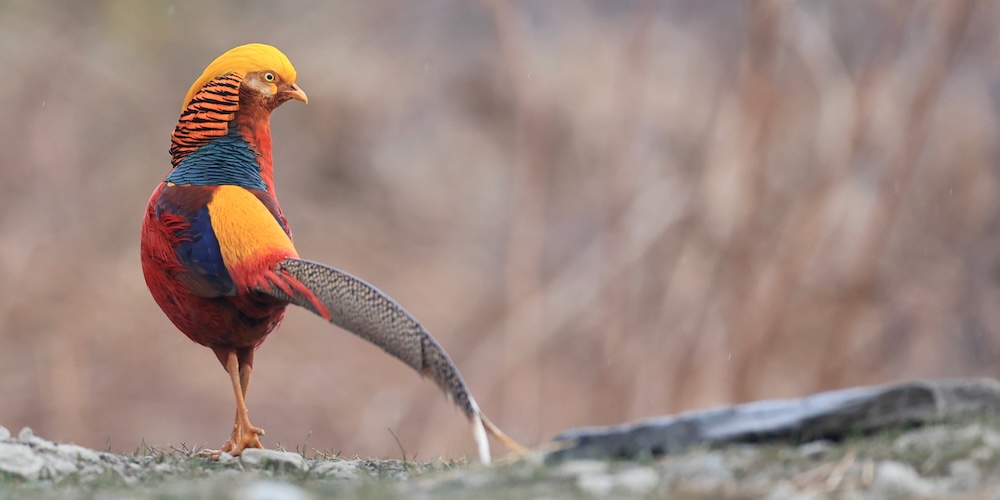
Golden Pheasant Chrysolophus pictus – ©Bird-Photo-Tours ASIA
Another great spot, Shennongjia Forestry District is named after the Shennongjia mountainous massif, which is usually considered to be the eastern (and the highest) section of the Daba Mountains. It lies within the Daba Mountains evergreen forests ecoregion. Some of Hubei’s highest mountains are located within the district. There are a number of conservation areas in the district’s mountains and wetlands, in particular the Shennongjia National Nature Reserve, listed on UNESCO’s World Network of Biosphere Reserves. The reserve includes 2,618 km2 of forest, and due to a variety of natural conditions at different elevations, has high diversity. The birds you can find here include Grey-faced Buzzard, Rufous-vented Tit, Yellow-bellied Tit, Grey-crested Tit, Sooty Tit, Collared Finchbill, Brown-breasted Bulbul, Spotted Laughingthrush, Chinese Babax, Siberian Rubythroat, Golden Bush-Robin, Blue-fronted Redstart and Slaty Bunting, etc.
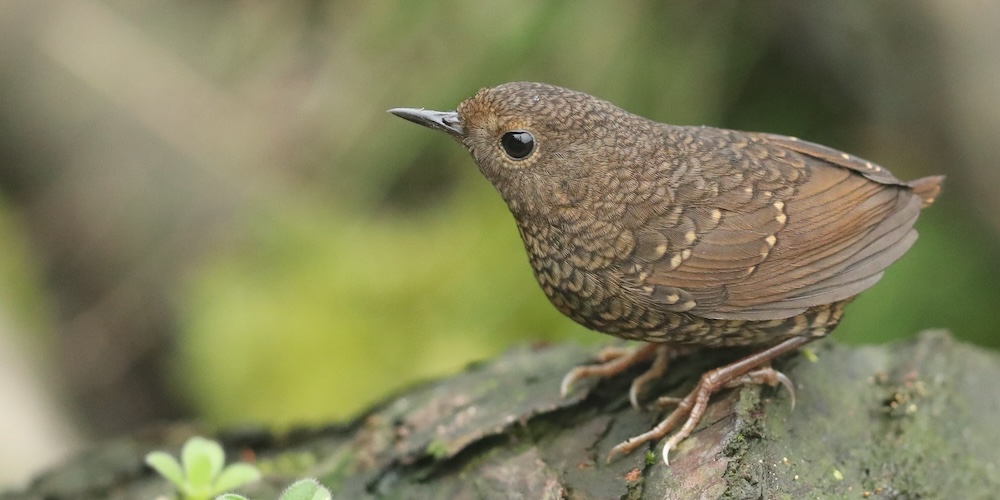
Pygmy Cupwing Pnoepyga pusilla – ©Bird-Photo-Tours ASIA
As the most famous lake in Wuhan, East Lake covers 33 km2 neighbouring Wuhan University. There are 34 hills sitting by the side of East Lake. More than 230 bird species have been recorded here. A large number of birds over-winter. The Luoyan Scenic Area, which is located in the north of East Lake, has well-protected wetlands and is excellent for many migratory birds including Pheasant-tailed Jacana, Slaty-breasted Rail, Yellow Bittern, Long-toed Stint, Chinese Penduline Tit, Chestnut Bunting, Chinese Bamboo Partridge, Black-naped Oriole, Azure-winged Magpie, Yellow-bellied Tit, Collared Finchbill, Silver-throated Bushtit, Hwamei, Masked Laughingthrush, White-browed Laughingthrush, Vinous-throated Parrotbill, Dusky Thrush, Chinese Grosbeak and Yellow-throated Bunting, etc.
With more than 8,000 plant species, Wuhan Botanical Garden covers over 70 hectares to the east of East Lake. The mixed vegetation provides good habitat for birds including some rare species. The birds you can find here include Chinese Bamboo Partridge, Striated Heron, Chinese Pond Heron, Crested Goshawk, Asian Koel, Large Hawk-Cuckoo, Speckled Piculet, Grey-capped Pygmy Woodpecker, Black-winged Cuckooshrike, Black-naped Oriole, Ashy Drongo, Red-billed Blue Magpie, Yellow-bellied Tit, Collared Finchbill, Mountain Bulbul, Brownish-flanked Bush Warbler, Pallas’s Leaf Warbler, Masked Laughingthrush, Grey-backed Thrush, Japanese Thrush, Dusky Thrush, Blue Whistling Thrush, Chinese Grosbeak and Yellow-throated Bunting, etc.
Located to the north of Huazhong University for Science and Technologies, Yujiashan is the highest peak standing 149.5 above the sea level in the Wuhan area. The quiet forest on the hill is good place for birding. You have chances to see Chinese Bamboo Partridge, Scaly Thrush, Crested Honey-buzzard, Crested Goshawk, Japanese Sparrowhawk, Amur Falcon, Speckled Piculet, Grey-headed Woodpecker, Bay Woodpecker, Red-billed Blue Magpie, Yellow-bellied Tit, Light-vented and Mountain Bulbuls, Masked Laughingthrush, Blue-winged Minla, Chestnut-flanked White-eye, Red-billed Starling, Siberian, Scaly, Grey-backed, Japanese and Eyebrowed Thrushes, Orange-flanked Bluetail, Dark-sided, Asian Brown, Mugimaki and Blue-and-white Flycatchers, Chinese Grosbeak and Tristram’s Bunting, etc.
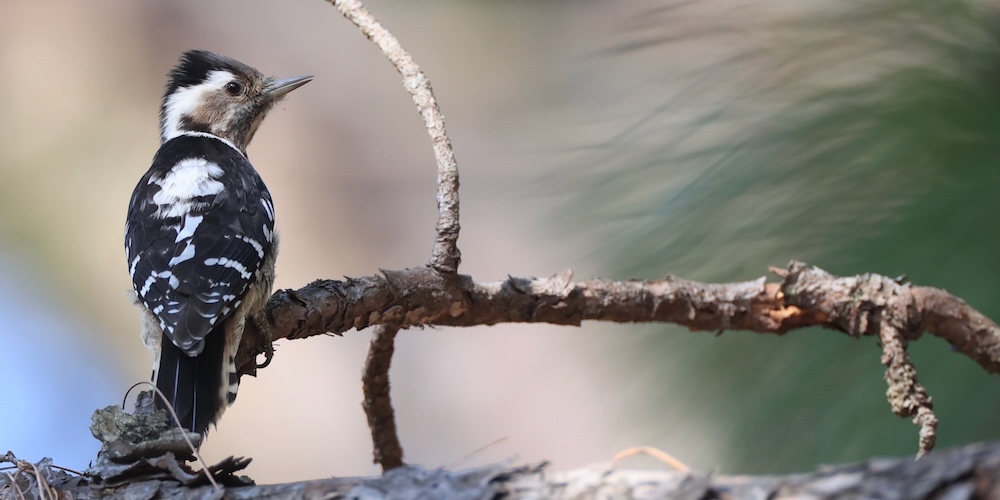
Grey-capped Pygmy Woodpecker Dendrocopos canicapillus – ©Bird-Photo-Tours ASIA
Located in the east of Wuhan, Maanshan Forest Park consists of forest, ponds, farmlands and tree nurseries. More than 80% of the park is covered by trees that serve as habitats for birds. Here you have chance to see Chinese Bamboo Partridge, a number of raptors, Speckled Piculet, Grey-capped Pygmy Woodpecker, Bay Woodpecker, Brown Shrike, Black Drongo, Eurasian Jay, Red-billed Blue Magpie, Yellow-bellied Tit, Collared Finchbill, Mountain Bulbul, Silver-throated Bushtit, Brownish-flanked Bush Warbler, Pallas’s Leaf Warbler, Plain Prinia, Masked Laughingthrush, Vinous-throated Parrotbill, Red-billed Starling as well as a number of thrush species.
This page is sponsored by Alpine Birding
This page is sponsored by Bird-Photo-Tours ASIA

-
Philip He
Alpine Birding
http://www.alpinebirding.com -
Wikipedia
GNU Free Documentation License
https://en.wikipedia.org/wiki/Hubei
-
Number of bird species: 574
(As at June 2026)
-
Avibase
PDF ChecklistThis checklist includes all bird species found in Hubei , based on the best information available at this time. It is based on a wide variety of sources that I collated over many years. I am pleased to offer these checklists as a service to birdwatchers. If you find any error, please do not hesitate to report them. -
E-Bird
PDF ChecklistThis checklist is generated with data from eBird (ebird.org), a global database of bird sightings from birders like you. If you enjoy this checklist, please consider contributing your sightings to eBird. It is 100% free to take part, and your observations will help support birders, researchers, and conservationists worldwide.

-
Birding in Wuhan University
| By Li Weilin | Huayu Nature Book Trade Co.Ltd | 2014 | Paperback | 157 pages, colour illustrations | Chinese Text | ISBN: 9787510055898 Buy this book from NHBS.com -
Birds of China
| By Liu Yang & Chen Shuihua | Princeton University Press | 2023 | Flexibound | 672 pages, plates with 4000 colour illustrations, colour distribution maps | ISBN: 9780691237527 Buy this book from NHBS.com -
Guide to the Birds of China
| By John MacKinnon | OUP | 2022 | Edition 2 | Paperback | 513 pages, 164 plates with colour illustrations; colour distribution maps | ISBN: 9780192893673 Buy this book from NHBS.com
-
Wuhan University
WebsiteWuhan University Animal Specimen Museum , is one of the oldest, biggest specimen museum in our country. It was first founded in 1929. Untile present time, totally collected 556 kinds of fish, 98 kinds of amphibian, 126 kinds of acrawl, 1300 kinds of birds, and 175 kinds of mammalia. And also some typical specimens, such as duckbill kangaroo, kiwi, African and Australian ostrich, etc. Have nearly 700 square meter showroom and workroom. Collected specimens number and scale is top among the whole country…
-
NNR Shennongjia
InformationSatellite ViewIt is known that there are 336 species of terrestrial vertebrate, 200 species of birds, 30 species of reptiles… -
NNR Wufeng Houhe National Nature Reserve
ArticleSatellite ViewDiversity and composition of bird species in the Hubei Wufeng Houhe National Nature Reserve -
NR Tian'ezhou White-Flag Dolphin Reserve
InformationSatellite View…The main protection targets are white-flag dolphins and their habitat. The white-flag dolphin, a rare mammal on the verge of extinction in the Yangtze River… -
Protected areas of Hubei
InformationSatellite ViewScroll down to the list National Nature reserves inn the province.
-
eBird
SightingseBirding This Month
-
Alpine Birding
Local Tour OperatorBirding trips here are made for avid birders including yearly-run trips and new China birding trips developed by AlpineBirding team and guided by our bird experts in the best -
Bird-Photo-Tours ASIA
Tour OperatorBird-Photo-Tours ASIA is the specialists in bird photography tours on the Asian and Oceanian continents with a portfolio of destinations across 40 countries and a particular specialism in bird photography in China including Hubei Province.
-
2008 [06 June] - Jean-Philippe Paris
Report…The village is surrounded by rice fields and different kind of cultures with a lot of fruit trees. In some place there are still some remaining forest areas with a big colony of Herons in one of them. The weather were always cloudy with very bad light for taking pictures unfortunately. I finally won a third price but we were several in this case I think. I saw more than 60 species in less than 2 days with 40 lifers and a lot of very good memories: Paradise Flycatcher, Tiger Shrike, Plain prinia but the main one is certainly the good moment with all this people!
-
Birding In Hubei Province
Webpage...About 456 bird species have been recorded in this province, of which 237 species are migratory birds including Red-crowned Crane and Scaly-sided Merganser and some other rare species....