

Acanthisittidae – New Zealand Wrens
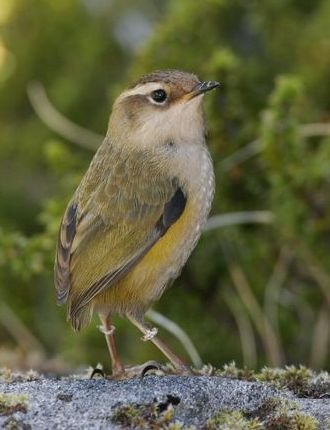
The New Zealand wrens Acanthisittidae are a family of very small passerines endemic to New Zealand. They were represented by six known species in four or five genera, although only two species survive in two genera today. They are understood to form a distinct lineage within the passerines. More recent studies suggest that they form a third (neither oscines or suboscines), most ancient, suborder Acanthisitti and have no living close relatives at all. They are called ‘wrens’ due to similarities in appearance and behaviour to the true wrens Troglodytidae.
This tiny family has just two extant species, in two genera. Two others have become extinct in modern times. The Stephens Island Wren was a small island endemic and almost flightless. It’s entire, very small, population was extirpated by the lighthouse keeper’s cat on Stephens Island! Once widespread in all three main islands of New Zealand, the near flightless Bushwren was last seen on North Island in 1955, on South Island in 1968 and the Stewart Island’s last survivor of an attempted breeding programme perished in 1972.
New Zealand wrens are mostly insectivorous foragers of New Zealand’s forests, with one species, the New Zealand rockwren, being restricted to alpine areas and only on South Island. Both the remaining species are poor fliers and four of the five extinct species are known to (or are suspected of having) been flightless (based on observations of living birds and the size of their sterna); along with the long-legged bunting from the Canary Islands, they are the only passerines known to have lost the ability to fly. Of the species for which the plumage is known they are fairly drab-coloured birds with brown-green plumage. They form monogamous pair bonds to raise their young laying their eggs in small nests in trees or amongst rocks. They are diurnal and like all New Zealand passerines, for the most part, are sedentary.
Rock wrens mostly eat invertebrates on the ground, but will sometimes take berries and seeds, and even nectar from flax flowers. Pairs maintain a year-round territory, and work together to build a large enclosed nest with an entrance tunnel. The nest is lined with feathers, often from other species of birds. It is a poor flier, rarely flying more than two metres off the ground or for distances of more than thirty metres. It prefers to hop and run with distinctive bobbing and wing flicks. Its call is three high-pitched notes, and pairs sometimes duet.
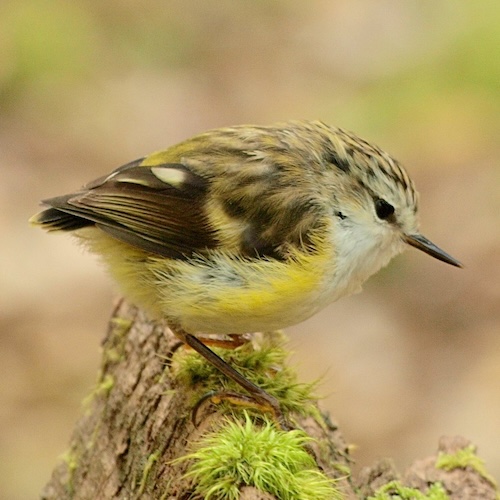
Rifleman ♀︎ Acanthisitta chloris – ©digitaltrails CC BY-SA 2.0 via Wikimedia Commons
The Rifleman is insectivorous and searches for maggots and small insects on tree trunks and among leaf litter on the forest floor. It searches for food in a similar way to the treecreeper. The bird begins its search from the base of a tree and climbs up it progressively, spiralling up around the trunk. Upon finishing its search of a particular tree, the bird glides to the foot of a neighbouring tree and begins its search again. This spiralling action, like the rifling of a gun barrel, gave rise to the name. The Rifleman has a range of simple high-pitched calls, the most commonly used call being a squeaky and repetitive zipt. Their calls are partly in the ultrasonic range of frequencies, although it is unknown what function this serves or even if riflemen are able to hear sounds at these frequencies.
They, like many New Zealand birds, suffered several extinctions after the arrival of humans in New Zealand. Two species became extinct after the arrival of the Māori and, specifically the Polynesian rat, and are known today only from fossil remains; a third, the Stephens Island wren, became extinct on the main islands, surviving only as a relict population on Stephens Island in the Cook Strait after European settlement. Of the two remaining species, the rifleman is still common on both the North and the South Islands, while the New Zealand rockwren is restricted to the alpine areas of the South Island and is considered vulnerable.
-
Number of bird species: 2
(As at July 2025)
Just two extant species:
Stephens Island Wren Traversia lyalli Extinct
Rifleman Acanthisitta chloris
New Zealand Rockwren Xenicus gilviventris
Bushwren Xenicus longipes Extinct
-
Acanthisittidae
Family AccountThese tiny New Zealand endemics are built like diminutive pittas, with long, thin legs and toes, stubby tails, and compact bodies supporting large heads and -
Acanthisittidae
Family AccountThe New Zealand wrens are a family (Acanthisittidae) of tiny passerines endemic to New Zealand. They were represented by seven Holocene species in four or...
As this is a very small family, and two species have been extirpated in recent times, the links below include some to the extinct species.
-
Bushwren Xenicus longipes
BirdLife Species AccountFull species account... -
Bushwren Xenicus longipes
Species AccountNorth Island, South island and Stewart Island subspecies. The North Island and Stewart Island subspecies could be extinct. The South Island subspecies has not been reported for some years. Fully protected… -
Bushwren Xenicus longipes
IUCN Species StatusThis species formerly occurred on New Zealand, but it is now Extinct, probably due to overpredation by invasive species. The last record was of the nominate subspecies on South Island, in 1972. -
Rifleman (Titipounamu) Acanthisitta chloris
https://ebird.org/species/soiwre1?siteLanguage=en_GBNew Zealand's smallest bird. Tiny endemic wren with fragmented distribution across both islands. Often found in patches of mature forest and scrub. -
Rifleman (Titipounamu) Acanthisitta chloris
Species AccountThe rifleman (Acanthisitta chloris) (Māori: tītipounamu) is a small insectivorous passerine bird that is endemic to New Zealand. It belongs to the Acanthisittidae family, also known as the New Zealand wrens, of which it is one of only two surviving species. The rifleman resembles a wren in form, but is not related to the family of true wrens, Troglodytidae, nor the fairy-wrens of Australia. -
Rifleman (Titipounamu) Acanthisitta chloris
Species AccountThe rifleman is generally considered to be New Zealand’s smallest bird (the equally light-weight grey warbler has a longer tail). It is one of only two surviving species within the ancient endemic New Zealand wren family. Riflemen are small forest-dwelling insectivores, and are constantly on the move, producing a characteristic ‘wing-flicking’ while moving through the canopy and foraging up and down tree trunks. -
Rifleman (Titipounamu) Acanthisitta chloris
Species AccountTo be able to hear the very high pitched cricket-like call of Titipounamu, the rifleman, is a real test of one`s hearing. Indeed many older people never hear them at all as the birds work their way about the bush, gleaning their food from small crevices and epiphytic mosses and lichens on the trunks and branches of trees… -
Rifleman (Titipounamu) Acanthisitta chloris
Species AccountSound archive and distribution map -
Rockwren (Tuke) Xenicus gilviventris
BirdLife Species AccountThis species has a small and fragmented population which is estimated to be undergoing a decline owing to heavy nest predation. It is therefore considered Vulnerable… -
Rockwren (Tuke) Xenicus gilviventris
https://ebird.org/species/soiwre1?siteLanguage=en_GBA perky, upright wren restricted to alpine regions in the South Island of New Zealand. Has a very short tail and rounded wings, but distinctive long legs and toes. Male is a mossy green above and pale gray below, with noticeable yellow flanks and a creamy eyebrow. -
Rockwren (Tuke) Xenicus gilviventris
Species AccountThe New Zealand rock wren (Xenicus gilviventris) is a small New Zealand wren (family Acanthisittidae) endemic to the South Island of New Zealand. Its Māori names include pīwauwau ("little complaining bird"), mātuitui, and tuke ("twitch", after its bobbing motion).[2] Outside New Zealand it is sometimes known as the rockwren or South Island wren to distinguish it from the unrelated rock wren of North America. -
Rockwren (Tuke) Xenicus gilviventris
IUCN Species Status10 cm. Small alpine bird. Male dull green above, grey-brown below, yellow flanks; female more olive brown; long legs and fine black bill. Similar: None in range. Hints: Has unusual habit of vigorously bobbing up and down. Voice: Three notes, first accentuated. -
Rockwren (Tuke) Xenicus gilviventris
Species AccountIllustration and species account… -
Rockwren (Tuke) Xenicus gilviventris
Species AccountSound archive and distribution map
-
Rifleman Monitoring
InformationRifleman raised three time more chicks after 1080 pest control than without. -
Rock wren conservation
InformationRock wrens are our only true alpine bird. It is unknown how they survive the harsh climate above the tree line all year round, but it is likely they continue to forage on rocky bluffs where snow has not collected and amongst large boulder fields. Some have suggested they may have a period of semi-hibernation.