

Casuariidae – Emu & Cassowaries
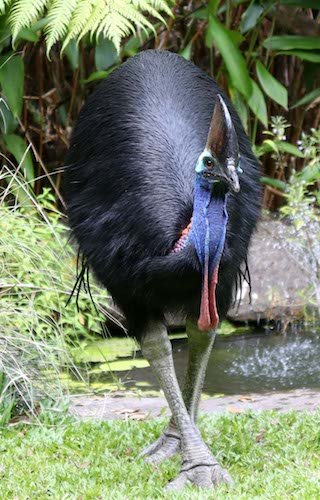
The Casuariidae are ratites (flightless birds without a keel on their sternum bone), which are native to the tropical forests of New Guinea, nearby islands, and to Australia. The order and family includes the emu, the only extant member of the genus Dromaius, and three cassowaries in the genus Casuarius: the Northern Cassowary, the Southern Cassowary, and the Dwarf Cassowary.
Emus are the second tallest birds (Ostriches are larger) and can reach heights of up to 1.8 meters (6.2 feet). They have long necks, strong legs, and shaggy, double-layered plumage, which helps insulate them from temperature extremes across various Australian habitats.
Cassowaries, on the other hand, are known for their striking appearance, including bright blue skin on their necks, brightly coloured wattles, and a casque (helmet) on the top their heads. Both genera are powerful runners, capable of reaching high speeds and covering long distances quickly. Their feet have powerful, sharp claws, formidable weapons against predators, real or imagined (they have been known to attack and injure humans and pet dogs that approach too closely). Cassowaries, in particular, are considered dangerous, known to use their powerful kick and having an aggressive nature when they feel threatened, although they are generally shy.
Emus and cassowaries have a common trait during breeding; the male assumes responsibility for egg incubation. In emus, females may court multiple males during the breeding season and can become quite aggressive towards other females. After laying a clutch of large, dark green eggs, the female departs, leaving the male to incubate the eggs for about eight weeks. During this period, male emus and cassowaries fast and rely on stored body fat, rarely leaving the nest and dutifully turning the eggs until they hatch.
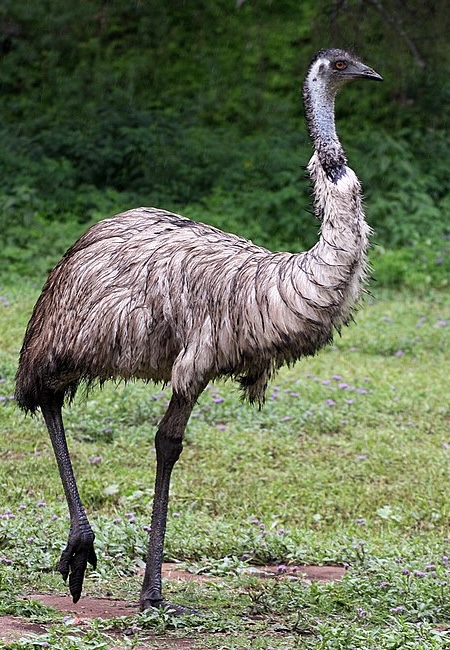
Emu Dromaius novaehollaniae – ©Sheba_Also 43,000 photos, CC BY-SA 2.0 via Wikimedia Commons
Both families of birds play significant roles in their ecosystems. Emus are important seed dispersers, consuming a wide variety of plant material, while cassowaries are considered ‘keystone species’ in rainforest ecosystems due to their role in seed dispersal, particularly of fruit too large for other animals to process.
Emus remain common in most of the more lightly settled parts of mainland Australia. The overall population varies from decade to decade according to rainfall; falling as low as 200,000 and or rising as high as a million, but a typical figure is about half a million individuals. Although emus are no longer found in the densely settled southern and south-western agricultural areas, the provision of permanent water for domestic stock in arid regions, has allowed the mainland species to extend its range.
Cassowaries feed mainly on fruit, although all species are truly omnivorous and will take a range of other plant food including shoots, grass seeds, and fungi in addition to invertebrates and small vertebrates. All cassowaries are adept at disappearing long before a human knows they are there. Even the more accessible southern cassowary of the far north Queensland rain forests is not well understood.
All cassowaries have feathers that consist of a shaft and loose barbules. They do not have tail feathers or a preen gland. They have small wings that are reduced to stiff, keratinous quills, like porcupine quills, with no barbs and there is a claw is on each second finger. The furcula and coracoid are degenerate, and their palatal bones and sphenoid bones touch each other. These, along with their wedge-shaped body, are thought to be adaptations to ward off vines, thorns, and saw-edged leaves, allowing them to run quickly through the rainforest.
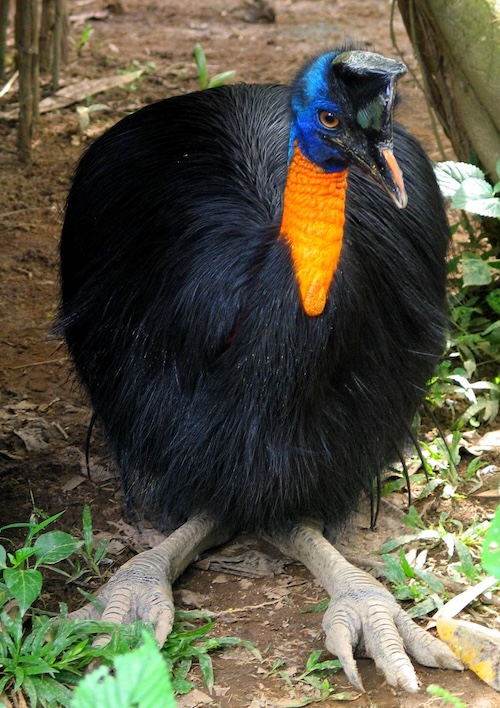
Northern Cassowary Casuarius unappendiculatus – ©www.viajar24h.com CC BY 2.0 via Wikimedia Commons
A cassowary’s three-toed feet have sharp claws. The second toe, the inner one in the medial position, sports a dagger-like claw that is 125 millimetres (5 in) long. This claw is particularly fearsome. Cassowaries can run at up to 50 kph through the dense forest., and can jump up to 1.5 metres and they are good swimmers, crossing wide rivers and even swimming in the sea.
All three species have horn-like, but soft and spongy crests on their heads, called casques, which are up to 18 cm high. Several purposes for the casques have been proposed. One possibility is that they are secondary sexual characteristics. Other suggestions include that they are used to batter through underbrush, as a weapon for dominance disputes, or as a tool for pushing aside leaf litter during foraging. The latter three are disputed by biologist Andrew Mack, whose personal observation suggests that the casque amplifies deep sounds. However, the earlier article by Crome and Moore says that the birds lower their heads when running …full tilt through the vegetation, brushing saplings aside and occasionally careening into small trees. The casque would help protect the skull from such collisions. Cassowaries live on fallen fruit, and spend a lot of time under trees where seeds the size of golfballs or larger fall from heights of up to 30 metres; so, the wedge-shaped casque may protect the head by deflecting falling fruit. At least the dwarf cassowary and southern cassowary produce very-low frequency sounds, which may aid in communication in dense rainforest. This ‘boom’ is the lowest known bird call, and is at the lower frequency limit of human hearing.
-
Number of bird species: 4
(As at July 2025)
Traditionally the order Struthioniformes contained all the world’s ratites including kiwis, rheas, emus and cassowaries. However, recent genetic analysis has found that the group is not monophletyic, as it is paraphyletic in respect to the tinamous. Moreover, whilst treated as different families, emus and cassowaries are now considered to be in the same order Casuariiformes, which is one family, the Casuariidae consisting of two genera.
Southern Cassowary Casuarius casuarius
Dwarf Cassowary Casuarius bennetti
Northern Cassowary Casuarius unappendiculatus
Emu Dromaius novaehollaniae
-
Casuariidae
Family AccountA small group of large, flightless birds endemic to the Australasian region, specifically Australia and New Guinea. This family includes the emu, the only extant member of the genus Dromaius, and three cassowaries in the genus Casuarius: the northern cassowary, the southern cassowary, and the dwarf cassowary. -
Casuariidae
Family AccountThe bird family Casuariidae has four surviving members: the three species of cassowary and the emu. All living members of the family are very large flightless birds native to Australia-New Guinea.
-
Dwarf Cassowary Casuarius bennetti
Species AccountBirdLife species profile -
Dwarf Cassowary Casuarius bennetti
Species AccountThe dwarf cassowary (Casuarius bennetti), also known as Bennett's cassowary, little cassowary, mountain cassowary or muruk, is the smallest of the three extant species of cassowaries. -
Dwarf Cassowary Casuarius bennetti
Species AccountSpecies account and image -
Dwarf Cassowary Casuarius bennetti
Species AccountSound archive and distribution map -
Dwarf Cassowary Casuarius bennetti
Species AccountDwarf CassowaryCasuarius bennetti. © Hector Gomez de Silva. 7 July 1992. Herowana, Chimbu, Papua New Guinea. -
Emu Dromaius novaehollandiae
Species AccountThe Emu is Australia's tallest native bird, reaching between 1.6 m and 1.9 m when standing erect.... -
Emu Dromaius novaehollandiae
Species AccountEndemic to Australia, this enormous flightless bird has drooping gray shaggy plumage. Only confusion possible with introduced Common Ostrich... -
Emu Dromaius novaehollandiae
Species AccountIt is a robust bipedal runner that can travel great distances, and when necessary can sprint at 48 km/h (30 mph). -
Emu Dromaius novaehollandiae
Species AccountSound archive and distribution map -
Northern Cassowary Casuarius unappendiculatus
Species AccountCassowaries (genus Casuarius) are very large flightless birds native to the tropical forests of New Guinea and northeastern Australia… -
Northern Cassowary Casuarius unappendiculatus
Species AccountSpecies account and image -
Northern Cassowary Casuarius unappendiculatus
Species AccountSound archive and distribution map. -
Northern Cassowary Casuarius unappendiculatus
Species AccountBirdLife species profile -
Northern Cassowary Casuarius unappendiculatus
Species AccountThe northern cassowary (Casuarius unappendiculatus), also known as the one-wattled cassowary, single-wattled cassowary, or golden-necked cassowary, is a large, stocky flightless bird of northern New Guinea. -
Northern Cassowary Casuarius unappendiculatus
Species AccountAn enormous flightless bird of lowland rainforest. Shaggy black plumage, blue head and bright red or yellow around the base of the neck. -
Southern Cassowary Casuarius casuarius
Species AccountThe Southern Cassowary is the second-largest bird in Australia and the third-largest remaining bird in the world (after the ostrich and emu)… -
Southern Cassowary Casuarius casuarius
Species AccountBirdLife species profile -
Southern Cassowary Casuarius casuarius
Species AccountEnormous flightless bird with dark glossy plumage and large, horn-like plate on colorful head with two red neck wattles. Unlikely to be confused with other... -
Southern Cassowary Casuarius casuarius
Species AccountSpecies account and images -
Southern Cassowary Casuarius casuarius
Species AccountSound archive and distribution map.
-
Diet of the Dwarf Cassowary Casuarius bennetti picticollis
InformationThis paper describes the diet of the Dwarf Cassowary in a lower montane forest at Wau in Papua New Guinea…
-
Southern Cassowary Casuarius casuarius
VideoYouTube - Southern Cassowaries (Casuarius casuarius) at Etty Bay, Queensland, Australia