

Cathartidae – New World Vultures
The Cathartidae or New World vultures are the only family of Cathartiformes. The family has seven species in five genera, most of which are monotypic. It includes five vultures and two condors found in warm and temperate areas of the Americas.
The ‘New World’ vultures were widespread in both the Old World and North America during the Neogene. They do not form a monophyletic clade with the superficially similar family of Old-World vultures, but similarities between the two groups are due to convergent evolution. They are closely related to, but distinct from, Accipitriformes – the Old-World vultures and allies.
These vultures are scavenging birds, feeding mostly from carcasses of dead animals without apparent ill effects. Bacteria in the food source, pathogenic to other vertebrates, dominate the vulture’s gut flora, and vultures benefit from the bacterial breakdown of carrion tissue.
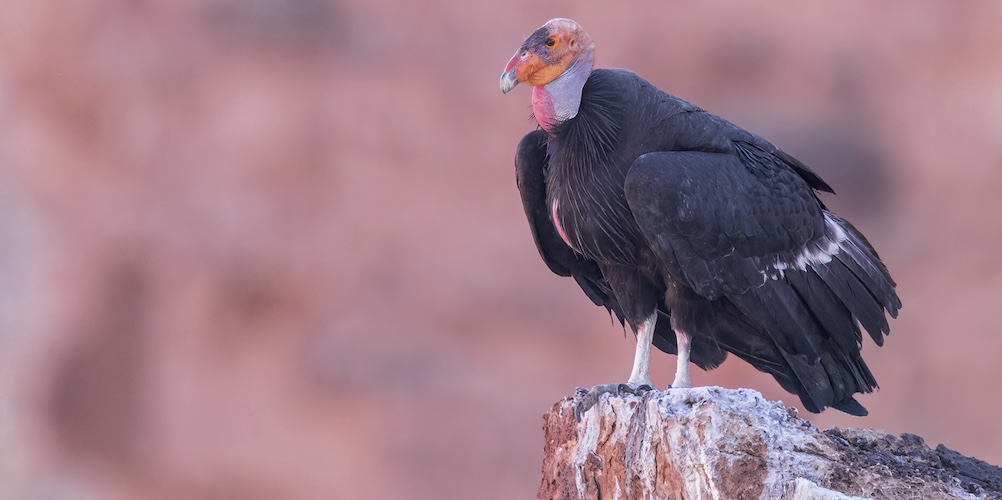
California Condor Gymnogyps californianus – ©Dubi Shapiro
New World vultures have a good sense of smell, whereas Old World vultures find carcasses exclusively by sight. A particular characteristic of many vultures is a bald head, devoid of feathers to reduce fouling as they push their head deep into a carcass.
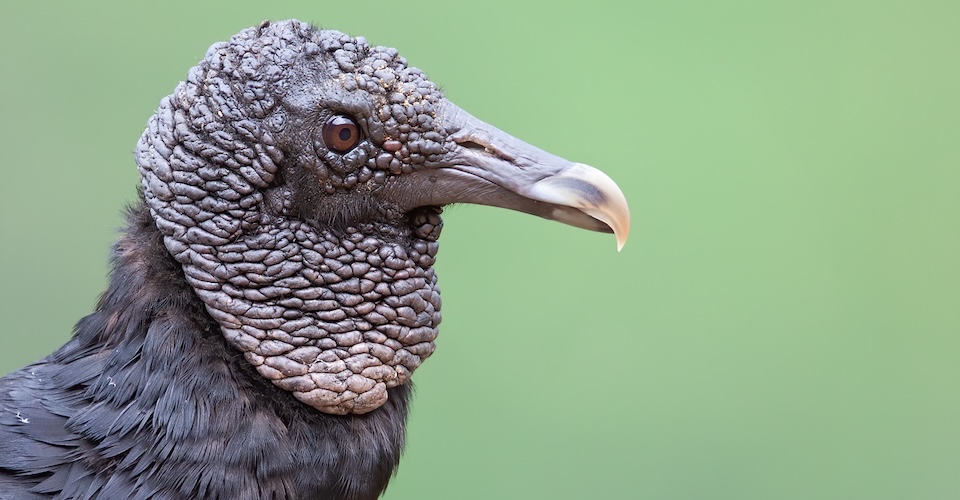
American Black Vulture Coragyps atratus – ©Dubi Shapiro
New World vultures are generally large, ranging in length from the Lesser Yellow-headed Vulture at 56–61 centimetres up to the California Condor and Andean Condor, both of which can reach 120 centimetres in length and weigh 12 or more kilograms. Plumage is predominantly black or brown, and is sometimes marked with white. All species have featherless heads and necks. In some, this skin is brightly coloured, and in the King Vulture it is developed into colourful wattles and outgrowths. They all have long, broad wings and a stiff tail, suitable for soaring and are the best adapted to soaring of all land birds. The feet are clawed but weak and not adapted to grasping. The front toes are long with small webs at their bases. No New World vulture possesses a syrinx, the vocal organ of birds. Therefore, the voice is limited to infrequent grunts and hisses.
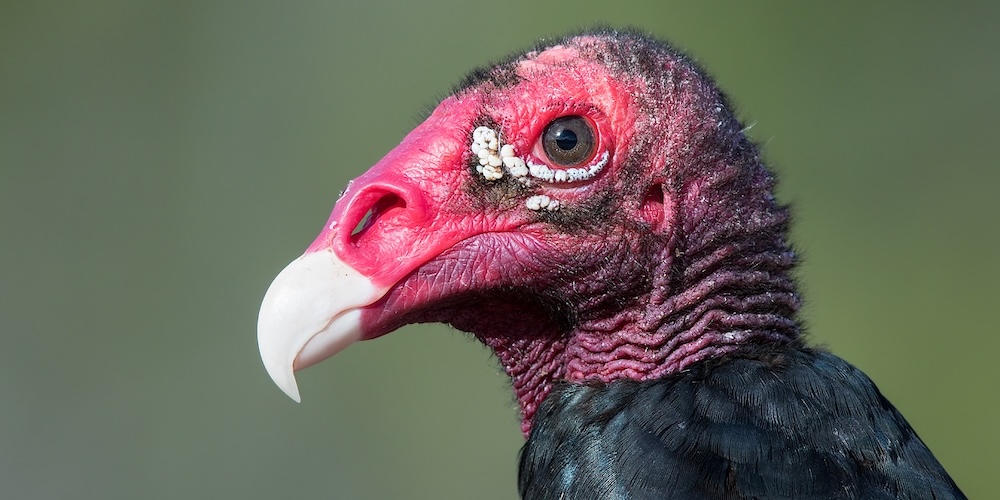
Turkey Vulture Cathartes aura – ©Dubi Shapiro
Their beaks are slightly hooked and relatively weak compared with those of other birds of prey. This is because it is adapted to tear the weak flesh of partially rotted carrion, rather than fresh meat. The nostrils are oval and are set in a soft cere. The nasal passage is not divided by a septum (it is perforate), so that when looking from the side, one can see through the beak. The eyes are prominent, and, unlike those of eagles, hawks, and falcons, they are not shaded by a brow bone. Members of Coragyps and Cathartes have a single incomplete row of eyelashes on the upper lid and two rows on the lower lid, while Gymnogyps, Vultur, and Sarcoramphus lack eyelashes altogether.
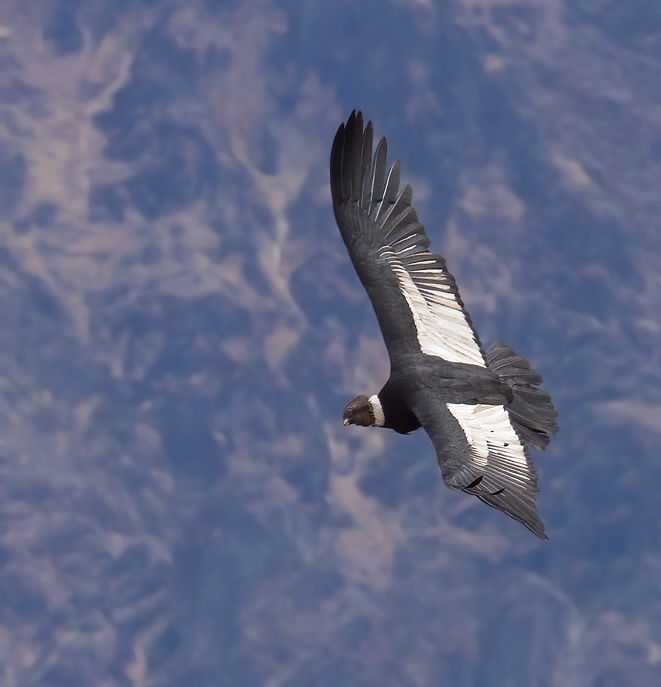
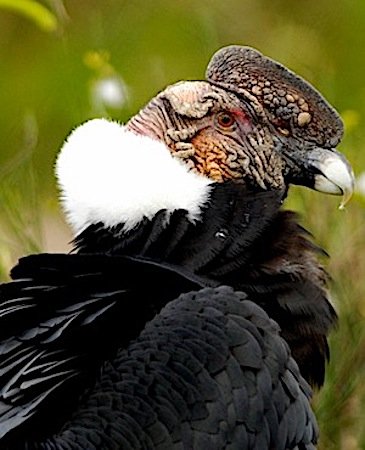
Andean Condor Vultur gryphus – ©Dubi Shapiro
New World vultures have the unusual habit of urohidrosis, or defecating on their legs to cool them evaporatively. As this behaviour is also present in storks, it is one of the arguments for a close relationship between the two groups.
New World vultures are restricted to the western hemisphere. They can be found from southern Canada to South America. Most species are mainly resident, but the turkey vulture populations breeding in Canada and the northern US migrate south in the northern winter. New World vultures inhabit a large variety of habitats and ecosystems, ranging from deserts to tropical rainforests and at heights of sea level to mountain ranges, using their highly adapted sense of smell to locate carrion. These species of birds are also occasionally seen in human settlements, perhaps emerging to feed upon the food sources provided from roadkill.
New World vultures and condors do not build nests, but lay eggs on bare surfaces. On average one to three eggs are laid, depending on the species. Chicks are naked on hatching and later grow down. Like many birds the parents feed the young by regurgitation. The young are altricial, fledging in 2 to 3 months.
-
Number of bird species: 7
(As at August 2025)
According to the recently (2025) combined AviList, there are just seven species of New World Vultures in five genera in the family Cathartidae; which are:
California Condor Gymnogyps californianus
King Vulture Sarcoramphus papa
Andean Condor Vultur gryphus
American Black Vulture Coragyps atratus
Turkey Vulture Cathartes aura
Lesser Yellow-headed Vulture Cathartes burrovianus
Greater Yellow-headed Vulture Cathartes melambrotus
-
California Condor Gymnogyps californianus
WebsiteRe-introduction programme with images, essays etc
-
Return of the Condor - The Race to Save Our Largest Bird from Extinction
| By John Moir | Lyons Press | 2023 | Paperback | 256 pages, colour photos | ISBN: 9781493076659 Buy this book from NHBS.com -
The New World Vultures
| By Nigel Hughes | Nigel Hughes | 2015 | Paperback | 25 pages, 7 colour illustrations, 8 colour distribution maps | ISBN: 9781910010310 Buy this book from NHBS.com -
Vulture
| By Thom van Dooren | Reaktion Books | 2011 | Paperback | 192 pages, 100 col & b/w illus | ISBN: 9781861898067 Buy this book from NHBS.com -
Vultures - Their Evolution, Ecology and Conservation
| By Michael O'Neal Campbell | Apple Academic Press | 2020 | Paperback | 364 pages, colour & b/w illustrations, colour distribution maps | ISBN: 9780367738105 Buy this book from NHBS.com -
Vultures of the World - Essential Ecology and Conservation
| By Keith L Bildstein | Comstock | 2022 | Hardback | 252 pages, 8 plates with 23 colour photos | ISBN: 9781501761614 Buy this book from NHBS.com
-
Cathartidae
Family AccountCathartidae, known commonly as New World vultures or condors, are a family of birds of prey consisting of seven extant species in five genera. -
Cathartidae
Family AccountThey are small brownish black vultures with red heads as adults (dark gray as juveniles) and a wingspan of nearly 2 metres...
Given that this is a small family with just seven species in five genera, Fatbirder provides active links below to all species.
-
American Black Vulture Coragyps atratus
Species AccountThe black vulture (Coragyps atratus) also known as the American black vulture, is a bird in the New World vulture family whose range extends from the southeastern United States to Central Chile and Uruguay in South America. -
American Black Vulture Coragyps atratus
Species AccountWith sooty black plumage, a bare black head, and neat white stars under the wingtips, Black Vultures are almost dapper. Whereas Turkey Vultures are lanky birds with teetering flight, Black Vultures are compact birds with broad wings, short tails, and powerful wingbeats. -
American Black Vulture Coragyps atratus
Species AccountCoragyps atratus is listed as Least Concern. -
American Black Vulture Coragyps atratus
Species AccountSound archive and distribution map. -
Andean Condor Vultur gryphus
Species AccountWhilst highly visible, this species is naturally scarce with a small global population, which is declining due to direct and indirect persecution by humans. -
Andean Condor Vultur gryphus
Species AccountThe Andean condor (Vultur gryphus) is a South American bird in the New World vulture family Cathartidae and is the only member of the genus Vultur. Found in the Andes mountains and adjacent Pacific coasts of western South America, the Andean condor is the largest flying bird in the world by combined measurement of weight and wingspan. -
Andean Condor Vultur gryphus
Species Accountultur gryphus is listed as Vulnerable under criteria A4cde; C2a(i). -
Andean Condor Vultur gryphus
Species AccountSound archive and distribution map. -
California Condor Gymnogyps californianus
Species AccountThe California condor (Gymnogyps californianus) is a New World vulture, the largest North American land bird. This condor became extinct in the wild in 1987 (all remaining wild individuals were captured), but the species has been reintroduced to northern Arizona and southern Utah (including the Grand Canyon area and Zion National Park), the coastal mountains of central and southern California, and northern Baja California. -
California Condor Gymnogyps californianus
Species AccountThe spectacular but endangered California Condor is the largest bird in North America. These superb gliders travel widely to feed on carcasses of deer, pigs, cattle, sea lions, whales, and other animals. -
California Condor Gymnogyps californianus
Species AccountGymnogyps californianus is listed as Critically Endangered under criteria C2a(i); D. -
California Condor Gymnogyps californianus
Species AccountSound archive and distribution map. -
Greater Yellow-headed Vulture Cathartes melambrotus
Species AccountSound archive and distribution map. -
Greater Yellow-headed Vulture Cathartes melambrotus
Species AccountThe greater yellow-headed vulture (Cathartes melambrotus), also known as the forest vulture,[2] is a species of bird in the New World vulture family Cathartidae. It was considered to be the same species as the lesser yellow-headed vulture until they were split in 1964. -
Greater Yellow-headed Vulture Cathartes melambrotus
Species AccountCathartes melambrotus is listed as Least Concern. -
Greater Yellow-headed Vulture Cathartes melambrotus
Species AccountWidespread and common vulture in lowland rainforest. Head may not appear yellow unless seen at close range. Best identified by steady flight. -
King Vulture Sarcoramphus papa
Species AccountUncommon, large, and spectacular bird of lowland tropical forest, mainly in wilder areas and not around human habitation. -
King Vulture Sarcoramphus papa
Species AccountThe king vulture (Sarcoramphus papa) is a large bird found in Central and South America. It is a member of the New World vulture family Cathartidae. This vulture lives predominantly in tropical lowland forests stretching from southern Mexico to northern Argentina. It is the only surviving member of the genus Sarcoramphus, although fossil members are known. -
King Vulture Sarcoramphus papa
Species AccountSound archive and distribution map. -
Lesser Yellow-headed Vulture Cathartes burrovianus
Species AccountOverall looks very much like the slightly larger Turkey Vulture (TV), but head is more colorful, with a yellow face and pale blue crown; at a distance, head... -
Lesser Yellow-headed Vulture Cathartes burrovianus
Species AccountThe lesser yellow-headed vulture (Cathartes burrovianus) also known as the savannah vulture,[2] is a species of bird in the New World vulture family Cathartidae. It was considered to be the same species as the greater yellow-headed vulture until they were split in 1964. -
Lesser Yellow-headed Vulture Cathartes burrovianus
Species AccountCathartes burrovianus is listed as Least Concern. -
Lesser Yellow-headed Vulture Cathartes burrovianus
Species AccountSound archive and distribution map. -
Turkey Vulture Cathartes aura
Species AccountSound archive and distribution map. -
Turkey Vulture Cathartes aura
Species AccountFull species account with images, distribution maps and etc… -
Turkey Vulture Cathartes aura
Species AccountThe turkey vulture (Cathartes aura), also known in some North American regions as the turkey buzzard (or just buzzard), and in some areas of the Caribbean as the John crow or carrion crow,[2] is the most widespread of the New World vultures.[3] One of three species in the genus Cathartes of the family Cathartidae, the turkey vulture ranges from southern Canada to the southernmost tip of South America. -
Turkey Vulture Cathartes aura
Species AccountIf you’ve gone looking for raptors on a clear day, your heart has probably leaped at the sight of a large, soaring bird in the distance– perhaps an eagle or osprey.
-
Condor Americano
WebsiteThe history of the Condor in Argentina…