

Cinclidae – Dippers
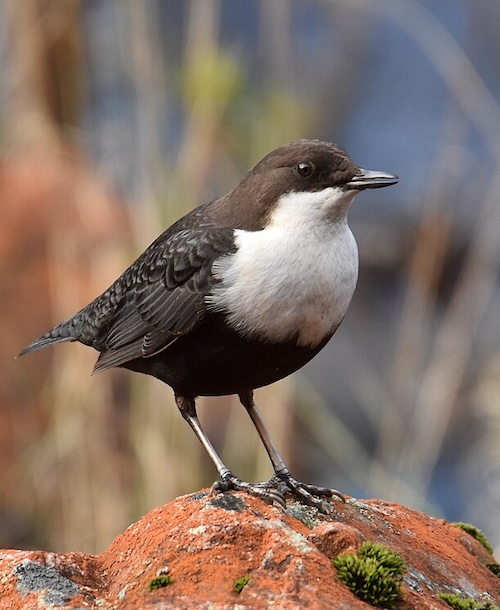
Cinclidae (Dippers) are small, water associated passerine members of the genus Cinclus. They are named for their bobbing or dipping movements – as they dip under water to seek prey. The scientific name also refers to this, cinclus being from the classical Greek word kinklos that was used to describe small tail-wagging birds that resided near water. They are unique among passerines for their ability to dive and swim underwater. Mitrochondrial DNA sequencing and molecular phylogenetics showed (2002) that all five species occupy one genus and that their nearest avian relatives are the Turdidae (true Thrushes).
They are small, chunky, stout, short-tailed, short-winged, strong-legged birds. The different species are generally dark brown (sometimes nearly black), or brown and white in colour, apart from the rufous-throated dipper, which is brown with a reddish-brown throat patch. Sizes range from 14–22 cm in length and 40–90 g in weight, with males larger than females. Their short wings give them a distinctive whirring flight. They have a characteristic bobbing motion when perched beside the water, while under water, they are covered by a thin, silvery film of air, due to small bubbles being trapped on the surface of the plumage.
They are found in suitable freshwater habitats in the highlands of the Americas, Europe and Asia. In Africa they are only found in the Atlas Mountains of Morocco. They frequent the banks of fast-moving, shallow, upland rivers with cold, clear waters, though, outside the breeding season, they may visit lake shores and even sea coasts.
Unlike many water birds, dippers are generally similar in form to many terrestrial birds (for example they do not have webbed feet), but they do have some morphological and physiological adaptations to their aquatic habits. Their wings are relatively short but strongly muscled, enabling them to be used as flippers underwater. To reduce their buoyancy in water, the bones are solid instead of hollow. They have dense plumage with a large preen gland for waterproofing their feathers. Relatively long legs and sharp claws enable them to hold on to rocks in swift water. Their eyes have well-developed focus muscles that can change the curvature of the lens to enhance underwater vision and they have nasal flaps to prevent water entering their nostrils.
Dippers’ calls are loud and high-pitched, being similar to calls made by other birds on fast rivers; the call frequencies lying within a narrow range of 4.0 to 6.5 kHz, well above the torrent noise frequency which has a maximum of 2 kHz. Dippers also communicate visually by their characteristic dipping or bobbing movements, as well as in courtship and threat displays, by blinking rapidly to expose the white feathers on their upper eyelids as a series of white flashes.
Their blood has a high haemoglobin concentration, allowing a greater capacity to store oxygen than terrestrial passerines, allowing them to remain underwater for thirty seconds or more, whilst their basal metabolic rate is approximately one-third slower than typical terrestrial passerines of similar mass. One small population wintering at a hot spring in Suntar-Khayata Mountains of Siberia feeds underwater when air temperatures drop below −55 °C.
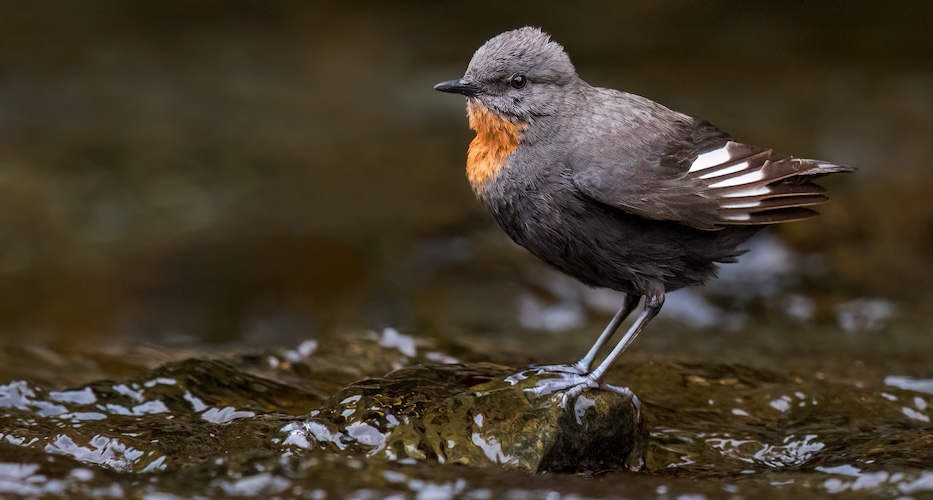
Rufous-throated Dipper Cinclus schulzi – ©Dubi Shapiro
Dippers forage for small animal prey in and along the margins of fast-flowing freshwater streams and rivers. They perch on rocks and feed at the edge of the water, but they often also grip the rocks firmly and walk down them beneath the water until partly or wholly submerged. They then search underwater for prey between and beneath stones and debris; they can also swim with their wings. The two South American species swim and dive less often than the three northern ones. Their prey consists primarily of invertebrates such as the nymphs or larvae of mayflies, blackflies, stoneflies and caddisflies, as well as small fish and fish eggs. Molluscs and crustaceans are also consumed, especially in winter when insect larvae are less available.
Breeding territories are established by pairs of dippers along suitable rivers, and maintained against incursion by other dippers. Within their territory the pair must have a good nest site and roost sites, but the main factor affecting the length of the territory is the availability of sufficient food to feed themselves and their broods. Consequently, the length of a territory may vary from about 300 metres to over 2,500 metres.
Their nests are usually large, round, domed structures made of moss, with an internal cup of grass and rootlets, and a side entrance hole. They are often built in confined spaces over, or close to, running water. The site may be on a ledge or bank, in a crevice or drainpipe, or beneath a bridge. Tree sites are rare apart from waterside exposed tree roots.
The usual clutch-size of the three northern dipper species is four or five; those of the South American species is not well known, though some evidence suggests that in the rufous-throated dipper it is two. The incubation period of 16 or 17 days is followed by the hatching of altricial young which are brooded by the female alone for the next 12 to 13 days. The nestlings are fed by both parents and the whole fledging period is about 20–24 days. Young dippers usually become independent of their parents within a couple of weeks of leaving the nest. Adults may raise second broods if conditions allow. The maximum recorded age from ring-recovery data (Finland) of a White-throated Dipper is 10 years and 7 months. The maximum age for an American Dipper is 8 years and 1 month.
Despite threats to local populations, the conservation status of most dipper species is considered to be of least concern. The one exception, the Rufous-throated Dipper, is classified as vulnerable because of its small, fragmented and declining population which is threatened, especially in Argentina, by changes in river management.
-
Number of bird species: 5
(As at November 2025)
According to the recently (2025) amalgamated AviList, there are five species, in a single genus in the Cinclidae family. They are:
White-throated Dipper Cinclus cinclus
Brown Dipper Cinclus pallasii
American Dipper Cinclus mexicanus
White-capped Dipper Cinclus leucocephalus
Rufous-throated Dipper Cinclus schulzi
-
The Dippers
| Stephanie Tyler & Stephen Ormerod | T & AD Poyser Ltd (A & C Black) | 2010 | Hardback | 225 pages, Col plate, b/w illus, tabs | ISBN: 9781408136812 Buy this book from NHBS.com
-
Cinclidae
Family AccountCinclids feed mostly on aquatic larval insects but will regularly take larval fish, fish eggs, and freshwater crabs. Dippers dive to find food and can stay... -
Cinclidae
Family AccountDippers are members of the genus Cinclus in the bird family Cinclidae, so-called because of their bobbing or dipping movements.
Given that this is a very small family with just five species in one genus, Fatbirder provides active links below to all species.
-
American Dipper Cinclus mexicanus
Species AccountInhabits fast-moving rocky streams in western North America, from Alaska to Panama. Often nests under bridges. -
American Dipper Cinclus mexicanus
Species AccountThe American dipper (Cinclus mexicanus), also known as a water ouzel, is a semiaquatic bird species native to western North America and parts of Central... -
American Dipper Cinclus mexicanus
Species AccountSound archive and distribution map. -
Brown Dipper Cinclus pallasii
Species AccountA chocolate-brown, short-tailed thrush-like bird of clear, flowing streams. No other stream bird in its range is dark brown all over (adult) or dark brown... -
Brown Dipper Cinclus pallasii
Species AccountThe brown dipper (Cinclus pallasii), alternatively known by the common names Pallas's dipper, Asian dipper or the Asiatic dipper, is an aquatic songbird found in the mountains of southern and central Asia. At 22 cm (8.7 in) and 87 grams (3.1 oz), it is the largest of the dippers. This species, which is not often seen, is found at medium to low elevations where mountain streams flow. -
Brown Dipper Cinclus pallasii
Species AccountSound archive and distribution map. -
Rufous-throated Dipper Cinclus schulzi
Species AccountDipper endemic to fast-moving streams in semi-humid montane forest with alders in Southern Bolivia and Northeast Argentina. -
Rufous-throated Dipper Cinclus schulzi
Species AccountThe rufous-throated dipper or Argentine dipper (Cinclus schulzi) is an aquatic songbird found in South America, and is part of the dipper family. -
Rufous-throated Dipper Cinclus schulzi
Species AccountCinclus schulzii is listed as Vulnerable under criteria C2a(i). -
Rufous-throated Dipper Cinclus schulzi
Species AccountSound archive and distribution map. -
White-capped Dipper Cinclus leucocephalus
Species AccountA denizen of fast-moving streams and rivers with plenty of rocks to perch on. Fairly widely distributed in the Andes from Venezuela to Bolivia. -
White-capped Dipper Cinclus leucocephalus
Species AccountThe white-capped dipper (Cinclus leucocephalus) is an aquatic songbird found in South America. It is a small black bird with white spots. It is found in Bolivia, Colombia, Ecuador, Peru and Venezuela. -
White-capped Dipper Cinclus leucocephalus
Species AccountSound archive and distribution map. -
White-throated Dipper Cinclus cinclus
Species AccountPlump little gray bird found along unpolluted rivers and streams, almost always near running water. Bright white "bib" is present across vast majority of range. -
White-throated Dipper Cinclus cinclus
Species AccountThe white-throated dipper (Cinclus cinclus), also known as the European dipper or just dipper, is an aquatic passerine bird found in Europe, Middle East, Central Asia and the Indian Subcontinent. The species is divided into several subspecies, based primarily on colour differences, particularly of the pectoral band. The white-throated dipper is Norway's national bird. -
White-throated Dipper Cinclus cinclus
Species AccountSound archive and distribution map.