

Climacteridae – Australasian Treecreepers
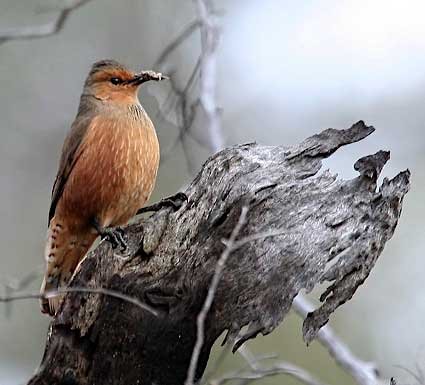
The Climacteridae (Australasian Treecreepers) consists of seven passerine species in two genera. They are medium-small, mostly brown birds with patterning on their underparts, and all are endemic to Australia-New Guinea. They resemble, but are not closely related to, the Holarctic treecreepers. The family is one of several families identified by DNA–DNA hybridisation studies to be part of the Australo-Papuan songbird radiation. There is some molecular support for suggesting that their closest relatives are the large Lyrebirds.
They are small oscine passeriness, measuring 14 to 19 cm in length and weighing 17–44 g. They have relatively long tails, short legs with strong feet, stout bodies and longish and slightly down-curved bills. The plumage of this family is dull, trending towards brown, reddish-brown or greyish brown above and paler below. There is usually some sexual dimorphism in plumage, with females having some reddish colour in the head or breast that is absent in the males. Other differences between the sexes are common, and can arise very early in the life of these birds, being present even in late-stage nestlings. They are poor fliers, with their flight described as undulating and gliding.
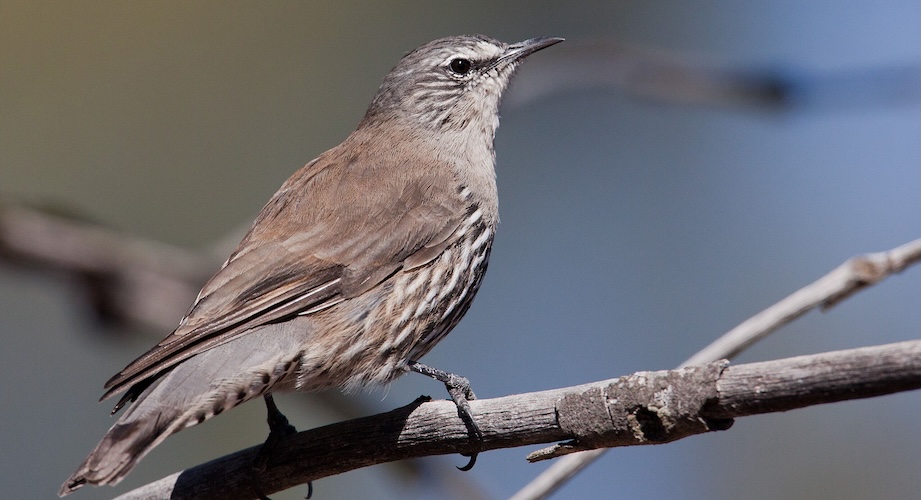
White-browed Treecreeper Climacteris affinis – ©Peter Jacobs CC BY-SA 2.0 via Wikimedia Commons
As their name implies, treecreepers forage for insects and other arthropods living on and under the bark of trees, mostly eucalypts, though several species also hunt on the ground, through leaf-litter, and on fallen timber and will eat tree sap and nectar from flowers. Unlike the Holarctic treecreepers they do not use their tail for support when climbing tree trunks, only their feet. They commonly obtain insect prey by gleaning from surface of bark, but will also probe into holes and pull at loose strips of bark and flick underneath it with their quadrifid tongue.
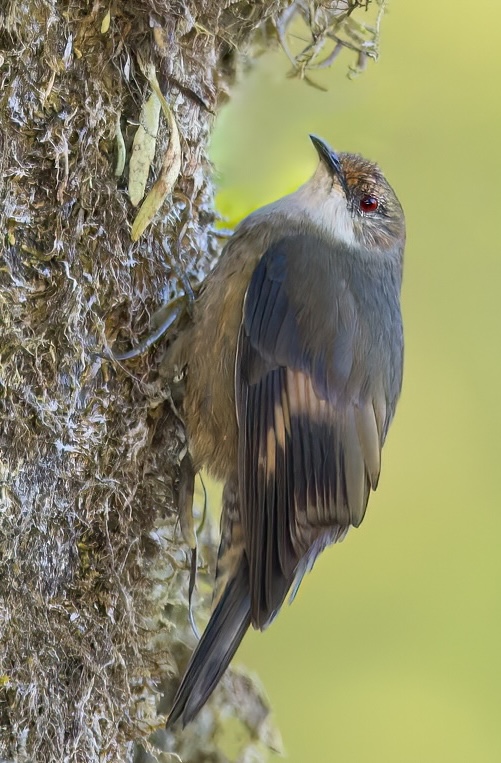
Papuan Treecreeper Cormobates placens – Dubi Shapiro
All the Australian treecreepers are endemic to Australia except for one species restricted to New Guinea. They are found across much of Australia except for the large island of Tasmania, possibly because they are poor fliers and unable to disperse across water barriers, or possibly because of a lack of bark-dwelling invertebrates to feed on.
Across their global distribution they occupy a wide range of habitats. The Papuan Treecreeper is found in mid-montane to montane forested habitats on New Guinea, from 4,000 to 10,000 feet.
The White-browed Treecreeper inhabits acacia and Casuarina woodlands in deserts in southern Australia. Other species inhabit subtropical rainforest, eucalypt woodlands and southern beech forests.
The Brown Treecreeper is semi-terrestrial and can live in more open woodland habitats, but is still sensitive to the loss of its habitat. They are essentially non-migratory, although there are distinct differences in the dispersal of young birds after fledging, especially between the two different genera.
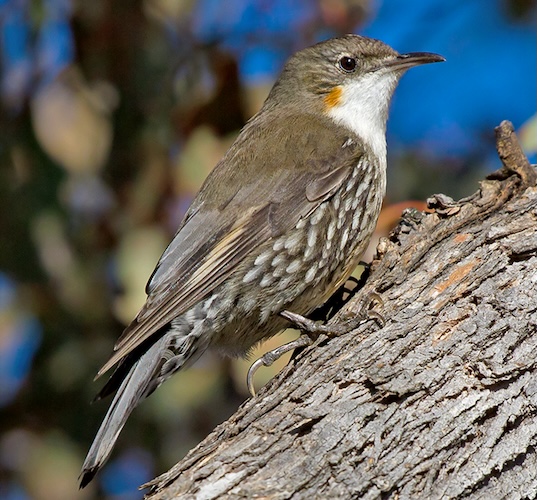
White-throated Treecreeper Cormobates leucophaea – Patrick_K59 CC BY 2.0 via Wikimedia Commons
Australasian treecreepers nest in holes in trees. They hold breeding territories, although the extent to which they are defended and last varies. Some species, such as the Red-browed Treecreeper and the Brown treecreeper are cooperative breeders, others, like the White-throated Treecreeper are not. The cooperative breeders form groups or a single breeding pair as well as up to three helpers, which are usually the young males of previous pairings. Helpers assist with the construction of the nest, feeding of the incubating female and feeding and defending the young.
Their breeding season lasts from June into January; the birds lay two or three eggs per clutch with an incubation time of seventeen days. Nests are built by both male and female with soft materials like grass and feathers.
-
Number of bird species: 7
(As at November 2025)
According to the recently (2025) amalgamated AviList, there are seven species, in two genera in the Climacteridae family. They are:
Papuan Treecreeper Cormobates placens
White-throated Treecreeper Cormobates leucophaea
White-browed Treecreeper Climacteris affinis
Red-browed Treecreeper Climacteris erythrops
Brown Treecreeper Climacteris picumnus
Black-tailed Treecreeper Climacteris melanurus
Rufous Treecreeper Climacteris rufus
-
Climacteridae
Family AccountThey are the only Australian passerines that habitually nest in cavities left by broken-off tree limbs. Approximately half of these species are cooperative... -
Climacteridae
Family AccountThere are seven species of Australasian treecreeper in the passerine bird family Climacteridae.
Given that this is a quite small family with just seven species in only two genera, Fatbirder provides active links below to all species.
-
Black-tailed Treecreeper Climacteris melanura
Species AccountThe black-tailed treecreeper (Climacteris melanurus) is a species of bird in the Climacteridae family. It is endemic to north and northwestern Australia. Its natural habitats are temperate forests and subtropical or tropical moist lowland forests... -
Black-tailed Treecreeper Climacteris melanura
Species StatusClimacteris melanurus is listed as Least Concern. -
Black-tailed Treecreeper Climacteris melanura
Species AccountSound archive and distribution map. -
Brown Treecreeper Climacteris picumnus
Species AccountThe Brown Treecreeper is the largest of Australia's treecreepers. It is mostly pale brown in plumage. Birds of northern Queensland are darker brown. -
Brown Treecreeper Climacteris picumnus
Species StatusClimacteris picumnus is listed as Least Concern. -
Brown Treecreeper Climacteris picumnus
Species AccountSound archive and distribution map. -
Papuan Treecreeper Cormobates placens
Species Account...OICE: A mellow series off 5- 10 flute- like or bell- like notes, slowly ascending in pitch, with final note sustained; a gradually descending trill similar to that of Chestnut- breasted Cuckoo (Cacomantis castaneiventris); and a faint nasal triplet, “chu chee chu“.... -
Papuan Treecreeper Cormobates placens
Species AccountThe Papuan treecreeper (Cormobates placens) is a species of bird in the Climacteridae family. It was previously considered a subspecies of the white-throated treecreeper (C. leucophaea) -
Papuan Treecreeper Cormobates placens
Species AccountSound archive & distribution map -
Red-browed Treecreeper Climacteris erythrops
Species AccountSound archive and distribution map. -
Red-browed Treecreeper Climacteris erythrops
Species StatusClimacteris erythrops is listed as Least Concern. -
Red-browed Treecreeper Climacteris erythrops
Species AccountThe red-browed treecreeper (Climacteris erythrops) is a species of bird in the Climacteridae family. It is endemic to Australia. Its natural habitats are subtropical or tropical moist lowland forests and subtropical or tropical moist montane forests. -
Rufous Treecreeper Climacteris rufus
Species AccountThe rufous treecreeper (Climacteris rufus) is a species of bird in the Climacteridae family. It is endemic to Australia. -
Rufous Treecreeper Climacteris rufus
Species StatusClimacteris rufus is listed as Least Concern. -
Rufous Treecreeper Climacteris rufus
Species AccountSound archive and distribution map. -
White-browed Treecreeper Climacteris affinis
Species AccountSmall bird with rather massive feet and pale eyebrow, most often seen running up and down the sides of trees in arid and semi-arid woodlands. -
White-browed Treecreeper Climacteris affinis
Species AccountThe white-browed treecreeper (Climacteris affinis) is the smallest of the Australo-papuan treecreepers and sole family member adapted to arid environments. -
White-browed Treecreeper Climacteris affinis
Species AccountSound archive and distribution map -
White-throated Treecreeper Cormobates leucophaeus
Species AccountThe White-throated Treecreeper is dark brown, with a distinctive white throat and chest, and white streaks on its flanks, edged with black. -
White-throated Treecreeper Cormobates leucophaeus
Species AccountThe white-throated treecreeper (Cormobates leucophaea) is an Australian treecreeper found in the forests of eastern Australia. It is unrelated to the northern hemisphere treecreepers. It is a small passerine bird with predominantly brown and white plumage and measuring some 15 cm (6 in) long on average. It is insectivorous, eating mainly ants. Unlike treecreepers of the genus Climacteris, the white-throated treecreeper does not engage in cooperative breeding, and wherever it overlaps with species of that genus, it feeds upon much looser bark[2] besides typically using different trees. -
White-throated Treecreeper Cormobates leucophaeus
Species AccountSound archive and distribution map.