

Cnemophilidae – Satinbirds
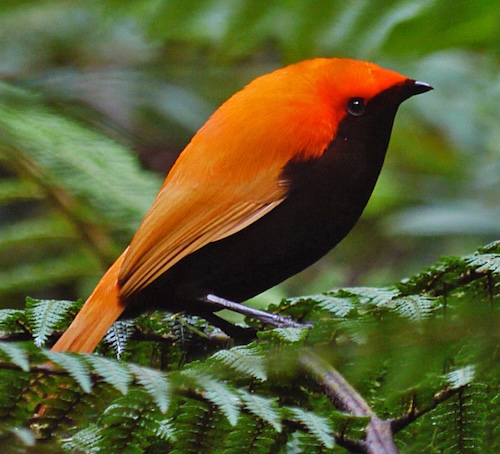
The Cnemophilidae (Satinbirds) are a group of passerines made up of just three species endemic to the mountain forests of New Guinea. They were originally thought to be part of the birds-of-paradise family Paradisaeidae until genetic research suggested that the birds are not closely related to birds-of-paradise at all and are perhaps closer to Melanocharitidae. The current evidence suggests that their closest relatives may be the cuckoo-shrikes Campephagidae.
In each of the three species the male is more brightly coloured than the female, which is dull and inconspicuous. The males of Yellow-breasted Satinbirds have a yellow breasts, black heads and brown backs. The male Crested Satinbird has a reddish to orange head, back and tail with a black throat and breast and the Loria’s Satinbird male is the least distinctive, being black.
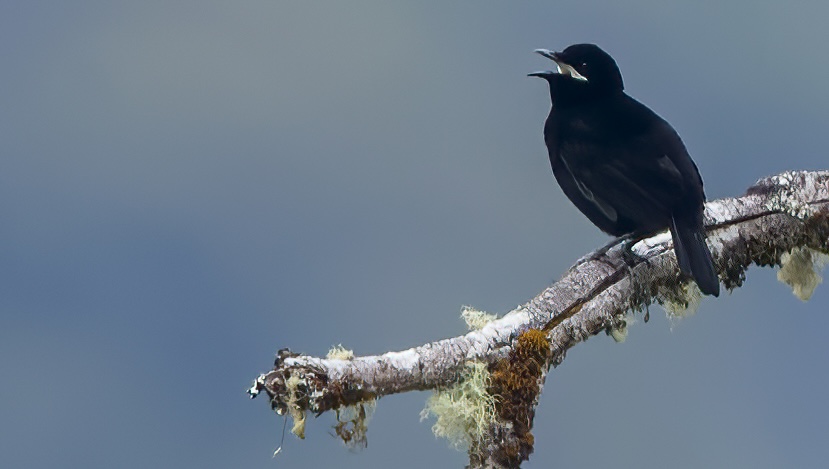
Loria’s Satinbird Cnemophilus loriae – Dubi Shapiro (Male above, female below)
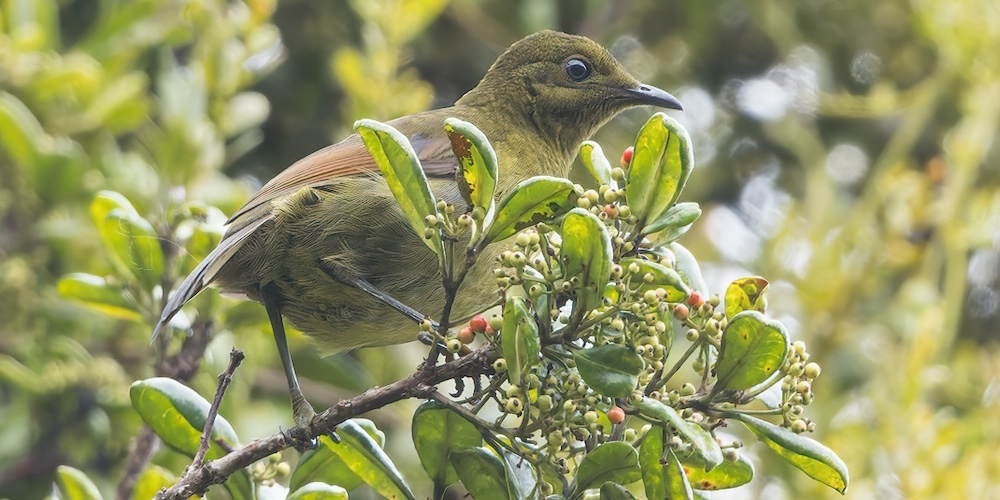
Satinbirds have weak, non-manipulative feet, wide gapes (at one time they were given the name wide-gaped bird-of-paradise), as well as an unossified nasal region. Their bodies are compact with rounded wings.
Loria’s Satinbird may have the broadest range in the central highlands, mostly from 2000m to 4000m, but is inconspicuous except at fruiting trees. The Crested Satinbird inhabits high mountain forest and shrubbery, and the Yellow-breasted Satinbird is the least known. Almost nothing is known of its biology, and it seems scarce and local within the patches of habitat along the Central Ranges east to the base of the Huon Peninsula.
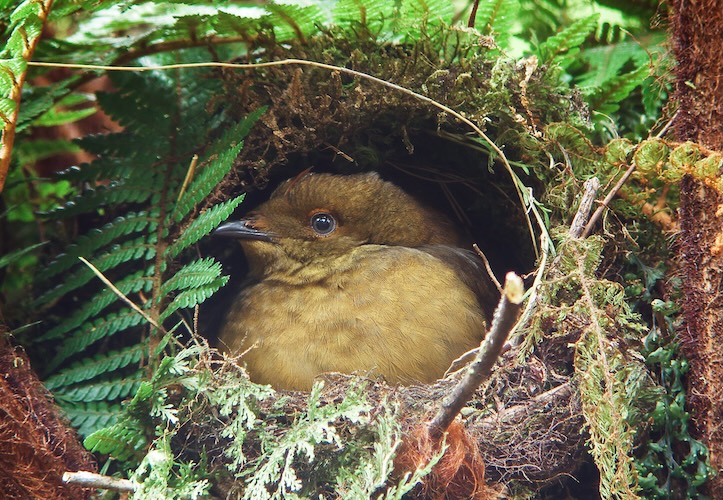
Crested Satinbird Cnemophilus macgregorii at Nest – ©Nik Borrow
All species of satinbirds build globular, domed nests of moss on a foundation of sticks, about four metres up, unlike those of birds of paradise. The female lays a single egg and takes care of it, usually without any assistance from the male. Incubation can take over three weeks. Fledging happens almost a month after hatching. Satinbirds feed almost exclusively on fruit, even at a young age, although invertebrates are occasionally taken.
-
Number of bird species: 3
(As at October 2025)
According to the recently (2025) amalgamated AviList, there are two genera, containing three species in the Cnemophilidae family. They are:
Yellow-breasted Satinbird (Silken Bird-of-paradise) Loboparadisea sericea
Loria’s Satinbird (Velvet Bird-of-paradise) Cnemophilus loriae
Crested Satinbird (Antenna Bird-of-paradise) Cnemophilus macgregorii
-
Cnemophilidae
Family AccountThe satinbirds are a group of three species that have traditionally been treated as birds-of-paradise (Paradisaeidae). -
Cnemophilidae
Family AccountThe satinbirds or cnemophilids, are passerine birds of the family Cnemophilidae...
Given that this is a tiny family with just three species in only two genera, Fatbirder provides active links below to all three species.
-
Crested Satinbird Cnemophilus macgregorii
Species AccountA fairly large, colorful bird of upper montane forest. Plump with a rather square-shaped head. -
Crested Satinbird Cnemophilus macgregorii
Species AccountThe crested satinbird, antenna satinbird or crested cnemophilus (Cnemophilus macgregorii), formerly known as the (sickle) crested bird-of-paradise is a species of bird in the family Cnemophilidae. -
Crested Satinbird Cnemophilus macgregorii
Species AccountCnemophilus macgregorii is listed as Least Concern. -
Crested Satinbird Cnemophilus macgregorii
Species AccountSound archive and distribution map. -
Loria's Satinbird Cnemophilus loriae
Species AccountLoria's Satinbird Cnemophilus loriae A medium-sized bird of montane forest canopy. Plump, with a bulge on the head and a somewhat narrow bill. -
Loria's Satinbird Cnemophilus loriae
Species AccountThe Loria's satinbird or velvet satinbird (Formerly known as the Loria's bird-of-paradise) (Cnemophilus loriae) is a species of bird in the family Cnemophilidae. It is found in Indonesia and Papua New Guinea. Its natural habitats are subtropical or tropical moist lowland forests and subtropical or tropical moist montane forests. -
Loria's Satinbird Cnemophilus loriae
Species AccountCnemophilus loriae is listed as Least Concern. -
Loria's Satinbird Cnemophilus loriae
Species AccountSound archive and distribution map. -
Yellow-breasted Satinbird Loboparadisea sericea
Species AccountA rare, medium-sized bird of mid-montane forest canopy. Male has dark head, rufous back, wings and tail with bright yellow rump and underparts... -
Yellow-breasted Satinbird Loboparadisea sericea
Species AccountThe yellow-breasted satinbird (Loboparadisea sericea), formerly known as the yellow-breasted bird-of-paradise and also known as the silken satinbird, is a species of bird in the Cnemophilidae family. It is monotypic within the genus Loboparadisea. It is found in the New Guinea highlands. Its natural habitats are subtropical or tropical moist lowland forests and subtropical or tropical moist montane forests. It is threatened by habitat loss. -
Yellow-breasted Satinbird Loboparadisea sericea
Species AccountLoboparadisea sericea is listed as Least Concern. -
Yellow-breasted Satinbird Loboparadisea sericea
Species AccountSound archive and distribution map.