

Conopophagidae – Gnateaters
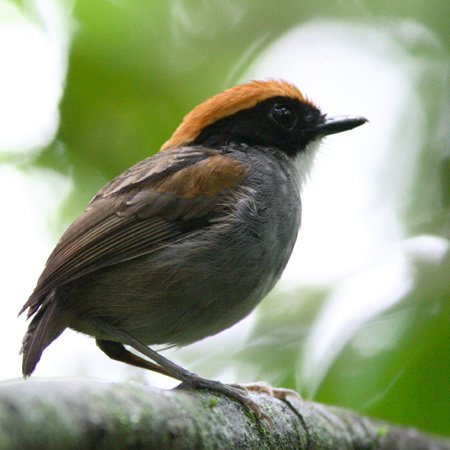
The gnateaters (sometimes known as antpipits) are a bird family, Conopophagidae, consisting of twelve small passerine species in two genera, which occur in South and Central America. The family was formerly restricted to the gnateater genus Conopophaga, however, analysis of mtDNA cytochrome b and NADH dehydrogenase subunit 2 sequences (Rice 2005a,b) indicates that the ‘antpittas’ of the genus Pittasoma also belong in this family. The association between this genus and Conopophaga is also supported by traits in their natural history, morphology, and vocalisations. The members of this family are very closely related to the antbirds and less closely to the antpittas and tapaculos. Due to their remote and dim habitat, gnateaters are a little-studied and poorly known family of birds.
They are round, short-tailed, and long-legged birds, about 12–19 cm in length, with Pittasoma being larger than Conopophaga. They are quite upright when standing. All species are sexually dimorphic, although the extent of this varies greatly. Most Conopophaga species have a white tuft behind the eye.
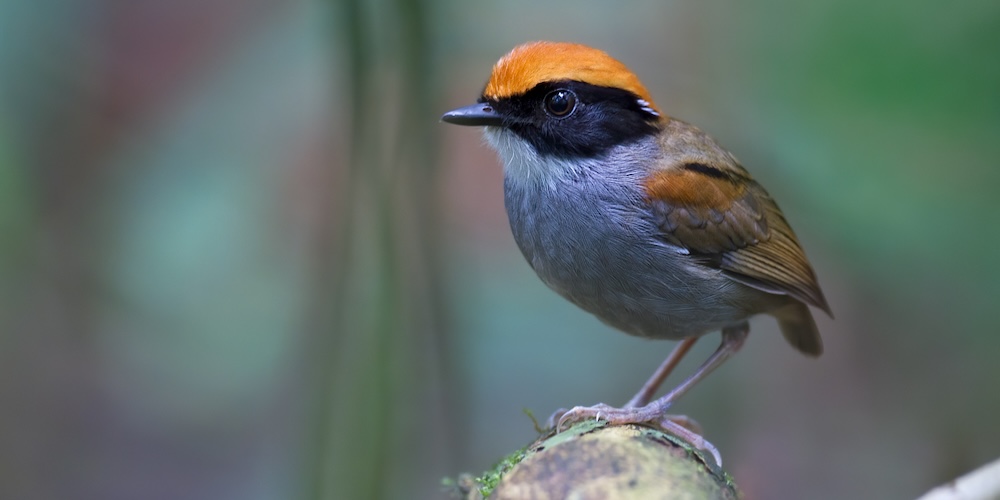
Black-cheeked Gnateater Conopophaga melanops – ©Dubi Shapiro
Gnateaters are birds of the forest understory, bamboo stands, and the forest floor. The members of the genus Conopophaga are found in the Amazon and Orinoco basins, east and central Andean slopes, Atlantic Forest, and nearby regions, while the members of the genus Pittasoma are found in the Chocó, and Panama and Costa Rica. Some species live in impenetrable thickets; others live in more open forest. Most are entirely restricted to humid habitats, but several species extend into drier regions in eastern Brazil. While the members of the genus Conopophaga always are found near the forest floor, seldom rising more than 1.5 m above the ground, they also seldom travel or spend much time on the ground (though they do feed there). The members of the genus Pittasoma are more commonly seen hopping around on the ground.
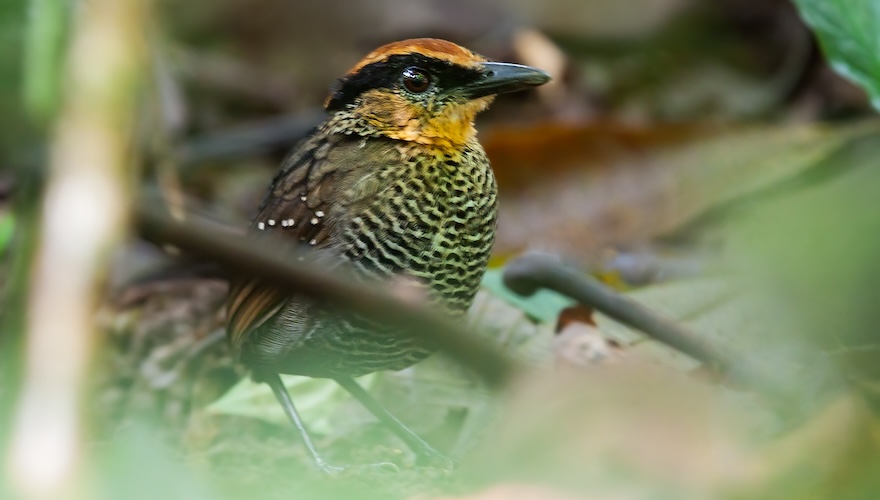
Rufous-crowned Antpitta Pittasoma rufopileatum – ©Dubi Shapiro
Most gnateaters make cup-shaped nests in the rainy season, often with a cluttered appearance, using materials like leaves, rootlets, and twigs. They are typically situated low to the ground, near branches or stems in the undergrowth, and lined with fine rootlets. One study mentioned a nest located about 65 cm above the ground on a steep slope at the base of a large tree root. Another example involves a nest of the Hooded Gnateater built on an epiphytic fern and lined with dark green leaves, with an exterior of dried leaves and thin dry sticks. They are thought tp be monogamous and both sexes participate in nest construction and parental care. The incubation period is at least 12 days, and the chicks stay in the nest for about 18 days.
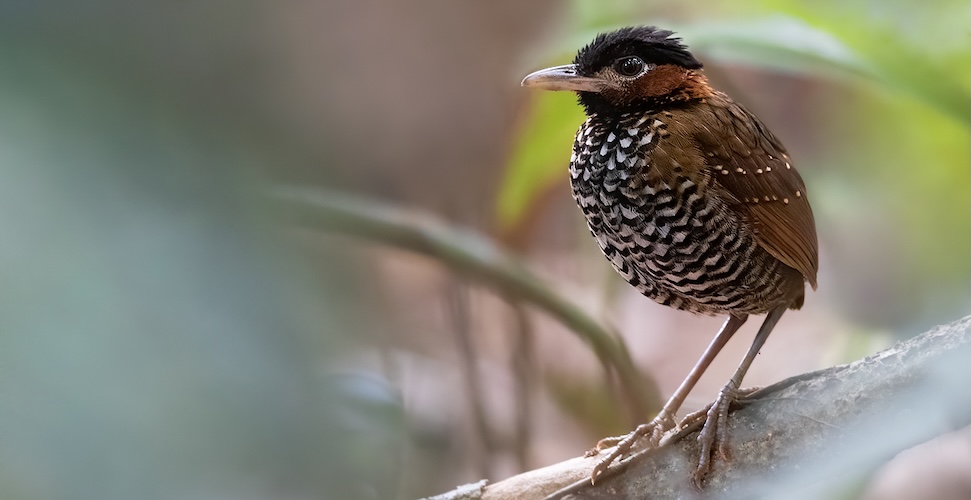
Black-crowned Antpitta Pittasoma michleri – ©Dubi Shapiro
Gnateaters tend to have loud, usually unmusical voices that may be heard in echo duets. However, some are known for their diverse vocalizations, including songs, calls, and subsong, often accompanied by wing sounds. Their vocalizations vary, with some species exhibiting distinct calls for alarm and nestling vocalizations differing from adults. For example, there are recordings of Rufous Gnateater Conopophaga lineata songs that are both short and longer, with variations in pace and note number. Furthermore, some subspecies show significant vocal differences, potentially indicating separate taxa. Nestlings have their own unique vocalizations, which can differ from those of adults, particularly in frequency and modulation.
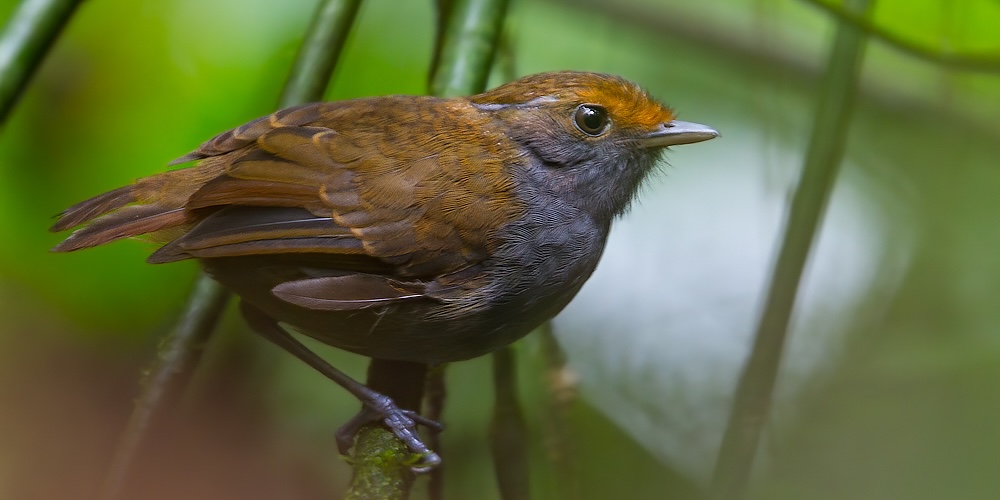
Slaty Gnateater Conopophaga ardesiaca – ©Dubi Shapiro
Gnateaters are insectivorous as the group name implies. The members of the genus Conopophaga feed mostly using two methods; one is to perch above the forest floor until prey is spotted, then lunge down to the ground to snatch it; having landed on the ground to snatch a prey item it will not remain on the forest floor for more than a couple of seconds. The second method used is to glean insects directly from the foliage, trunks, and branches of low vegetation. Typical prey items include spiders, caterpillars, insect larvae, grasshoppers and beetles; individuals of some species have also been observed eating fruit and in one case a frog.
Very little information is available on the diet of the two Pittasoma, but they are also presumed to be insectivorous, and have been recorded following army ants swarms – more to take advantage of the insects displaced by the ants, than the ants themselves.
-
Number of bird species: 12
(As at July 2025)
After DNA sequencing showed that two species formerly regarded as antpittas, form part of this group, the newly unified AviList (2025) assert that there are 12 species, in two genera in this family. They are:
Black-crowned Antpitta Pittasoma michleri
Rufous-crowned Antpitta Pittasoma rufopileatum
Black-bellied Gnateater Conopophaga melanogaster
Black-cheeked Gnateater Conopophaga melanops
Chestnut-belted Gnateater Conopophaga aurita
Black-breasted Gnateater Conopophaga snethlageae
Ash-throated Gnateater Conopophaga peruviana
Ceara Gnateater Conopophaga cearae
Hooded Gnateater Conopophaga roberti
Rufous Gnateater Conopophaga lineata
Chestnut-crowned Gnateater Conopophaga castaneiceps
Slaty Gnateater Conopophaga ardesiaca
-
Antpittas and Gnateaters
| By Harold Greeney & David Beadle | Helm | 2018 | Hardback | 496 pages, 24 plates with colour illustrations; 250 colour photos, colour distribution maps | ISBN: 9781472919649 Buy this book from NHBS.com
-
Conopophagidae
Family AccountFood of conopophagids tends to be very small, less than 5 mm long, and consists almost exclusively of insects and other small vertebrates. -
Conopophagidae
Family AccountThe gnateaters are a bird family, Conopophagidae, consisting of twelve small suboscine passerine species in two genera, which occur in South and Central America...
Given that this is a relatively small family with just 12 species in only two genera, Fatbirder provides active links below to species accounts for all Conopophagidae species.
-
Ash-throated Gnateater Conopophaga peruviana
Species AccountLooks like a ball of fluff with legs and a stubby beak; very short-tailed, with a compact body. Males are grayish brown with a gray face and eyebrow... -
Ash-throated Gnateater Conopophaga peruviana
Species AccountThe ash-throated gnateater (Conopophaga peruviana) is a species of bird in the family Conopophagidae. It is found in Bolivia, Brazil, Ecuador, and Peru. -
Ash-throated Gnateater Conopophaga peruviana
Species AccountSound archive and distribution map, etc. -
Black-bellied Gnateater Conopophaga melanogaster
Species AccountLarge gnateater with striking plumage. Note the bold white eyebrow. Males have a black head and underparts contrasting with chestnut wings and back... -
Black-bellied Gnateater Conopophaga melanogaster
Species AccountThe black-bellied gnateater (Conopophaga melanogaster) is a species of bird in the family Conopophagidae. It is endemic to Brazil. -
Black-bellied Gnateater Conopophaga melanogaster
Species AccountSound archive and distribution map, etc. -
Black-breasted Gnateater Conopophaga snethlageae
Species AccountThe Black-breasted Gnateater is endemic to Brazil, inhabiting only a small region south of the Amazon River, mostly within the state of Pará. -
Black-breasted Gnateater Conopophaga snethlageae
Species AccountSmall, chunky bird with a short tail endemic to the Brazilian Amazon. Male has black extending from face to chest and a bright white tuft. -
Black-breasted Gnateater Conopophaga snethlageae
Species AccountThe black-breasted gnateater (Conopophaga snethlageae) is a species of bird in the family Conopophagidae. It is found in Amazonian Brazil. -
Black-cheeked Gnateater Conopophaga melanops
Species AccountSound archive and distribution map -
Black-cheeked Gnateater Conopophaga melanops
Species AccountThe black-cheeked gnateater (Conopophaga melanops) is a species of bird in the family Conopophagidae endemic to Brazil. -
Black-cheeked Gnateater Conopophaga melanops
Species AccountEndemic to the Atlantic Forest of eastern Brazil, between Paraíba in the north and Santa Catarina in the south, this species inhabits wet forest and dense, older second growth in the lowlands and foothills, as well as ranging locally into drier forest. -
Black-crowned Antpitta Pittasoma michleri
Species AccountStriking and rare, this antpitta is found in humid foothill forest from Costa Rica to Colombia. It is quite plump and very short-tailed, with a hefty hooked... -
Black-crowned Antpitta Pittasoma michleri
Species AccountThe black-crowned antpitta (Pittasoma michleri) is a species of bird in the gnateater family, Conopophagidae. It is found in Colombia, Costa Rica... -
Black-crowned Antpitta Pittasoma michleri
Species AccountSound archive and distribution map, etc. -
Ceara Gnateater Conopophaga cearae
Species AccountPlump rufous bird with a whitish belly and long legs. Males have a narrow white tuft behind the eye that can be erected when excited. -
Ceara Gnateater Conopophaga cearae
Species AccountThe Ceará gnateater or Caatinga gnateater (Conopophaga cearae) is a passerine bird of the gnateater family, Conopophagidae -
Ceara Gnateater Conopophaga cearae
Species AccountSound archive and distribution map, etc. -
Chestnut-belted Gnateater Conopophaga aurita
Species AccountSound archive and distribution map, etc. -
Chestnut-belted Gnateater Conopophaga aurita
Species AccountPlump, short-tailed bird of Amazonian rainforest. Both sexes have a chestnut breast. Male has a black face and throat and a bright white tuft behind the eye... -
Chestnut-belted Gnateater Conopophaga aurita
Species AccountThe chestnut-belted gnateater (Conopophaga aurita) is a species of bird in the family Conopophagidae, the gnateaters. It is found in the Amazon Basin... -
Chestnut-crowned Gnateater Conopophaga castaneiceps
Species AccountPlump, short-tailed bird of Andean cloud forest understory. Male is gray with a chestnut crown and brownish-tinged back. -
Chestnut-crowned Gnateater Conopophaga castaneiceps
Species AccountThe chestnut-crowned gnateater (Conopophaga castaneiceps) is a species of bird in the family Conopophagidae. It is found in Colombia, Ecuador, and Peru. -
Chestnut-crowned Gnateater Conopophaga castaneiceps
Species AccountSound archive and distribution map, etc. -
Hooded Gnateater Conopophaga roberti
Species AccountChunky little bird with long legs. Males have a black head and breast, while females have a rusty-brown head, white throat, and light gray underparts. -
Hooded Gnateater Conopophaga roberti
Species AccountThe hooded gnateater (Conopophaga roberti) is a species of bird in the family Conopophagidae. It is endemic to northern Brazil. -
Hooded Gnateater Conopophaga roberti
Species AccountSound archive and distribution map, etc. -
Rufous Gnateater Conopophaga lineata
Species AccountSound archive and distribution map -
Rufous Gnateater Conopophaga lineata
Species AccountFound in the understory of dense humid forests and open woodlands. Note the rufous-orange face and breast, pale collar, olive-brown upperparts, and buffy belly. -
Rufous Gnateater Conopophaga lineata
Species AccountThe rufous gnateater (Conopophaga lineata) is a passerine bird of the gnateater family, Conopophagidae. It is found in forest understory and bushes in eastern Brazil from Rio Grande do Sul north to central Brazil. -
Rufous Gnateater Conopophaga lineata
Species AccountThe Rufous Gnateater is a fairly common bird of forest understory. It is best known from the coastal mountains of southern Brazil, where it occurs in montane evergreen forest, especially near thickets of bamboo. -
Rufous-crowned Antpitta Pittasoma rufopileatum
Species AccountChunky, nearly tailless bird of lowland and foothill rainforest in northwestern Ecuador and western Colombia. -
Rufous-crowned Antpitta Pittasoma rufopileatum
Species AccountThe rufous-crowned antpitta or rufous-crowned pittasoma (Pittasoma rufopileatum) is a species of bird in the gnateater family, Conopophagidae. -
Rufous-crowned Antpitta Pittasoma rufopileatum
Species AccountSound archive and distribution map, etc. -
Slaty Gnateater Conopophaga ardesiaca
Species AccountSmall, compact bird found in the understory of humid, mossy mid-elevation montane forest. Males are dark gray with a brown back and cap; females are similar. -
Slaty Gnateater Conopophaga ardesiaca
Species AccountThe slaty gnateater (Conopophaga ardesiaca) is a species of bird in the family Conopophagidae. It is found in Bolivia and Peru. -
Slaty Gnateater Conopophaga ardesiaca
Species AccountSound archive and distribution map, etc.