

Hirundinidae – Swallows & Martins
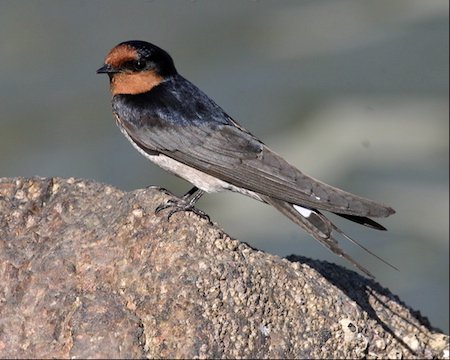
Hirundinidae (Swallows, Saw-wings & Martins) are a family of passerines, which are characterised by their adaptation to aerial feeding. Swallow is used colloquially in Europe as a synonym for the Barn Swallow.
This family comprises two subfamilies: Pseudochelidoninae (the river martins of the genus Pseudochelidon) and Hirundininae (all other swallows and martins). Within the Hirundininae, the name ‘martin’ tends to be used for the squarer-tailed species, and the name ‘swallow’ for the more fork-tailed species; however, there is no scientific distinction between these two groups. The family contains around ninety-two species in twenty-one genera.
The hirundines have an evolutionary conservative body shape, which is unlike that of any other passerines. They have adapted to hunting insects on the wing by developing a slender, streamlined body and long pointed wings, which allow for great manoeuvrability and endurance, as well as frequent periods of gliding. Because their body shape allows for a very efficient flight, their metabolic rate during flight is up to 72% lower than similar sized passerines. They have particularly sharp lateral and frontal vision which helps them to track prey. They also have relatively long eyes and their length almost equals their width. These long eyes allow for an increase in visual acuity without competing with the brain for space inside the head. In fact, the morphology of their eyes is very similar to that of raptors.
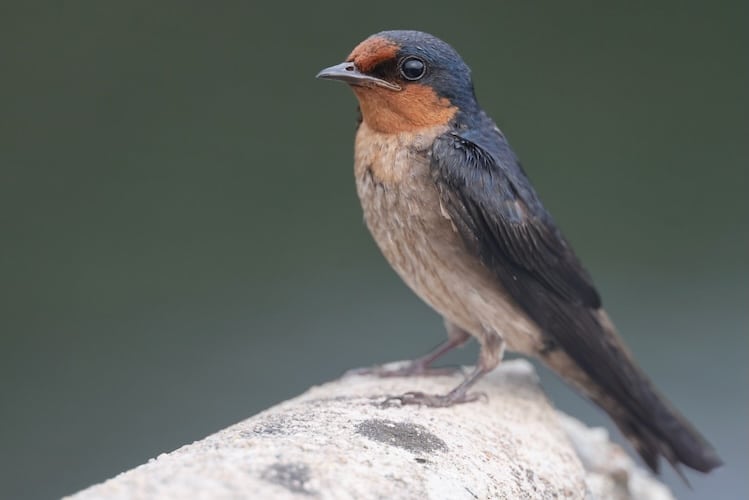
Pacific Swallow Hirundo javanica- ©Nick Ludovic Green Bird-Photo-Tours ASIA
Like the unrelated swifts and nightjars which hunt in a similar way, they have short beaks but strong jaws and a wide gape. Across the family their body length ranges from about 10 to 24 cm and their weight from about 10 to 60 g. The smallest species by weight may be the Fanti Sawing at a mean body mass of just 9.4 g while the Purple Martin and Southern Martin, which both weigh in excess of 50 g, rival one another as the heaviest swallows. Their wings are long, pointed, and have nine primary feathers. The tail has twelve feathers and maybe deeply forked, somewhat indented or square-ended. A long tail increases manoeuvrability; it may also function as a sexual adornment, since the tail is frequently longer in males. In Barn Swallows, the tail of the male is 18% longer than those of the female, and female select mates on the basis of tail length. Her feet on the other hand are short and adapted for perching while the walking, as the front toes are partially joined at the base. Swallows are capable of walking and even running, but they do so with a shuffling waddling gate. The leg muscles of river martins are stronger and more robust than those of other swallows. They have other characteristics that separate them from the rest of the family too. The structure of the syrinx is substantially different between the two sub-families and in most swallows, the bill, legs and feet are dark brown or black. But in the river martins, the bill is orange-red and their legs and feet are pink.
|
|
|
|
Black-capped Swallow Atticora pileata |
Violet-green Swallow Tachycineta thalassina |
|
Both the above photos courtesy of ©Dubi Shapiro |
|
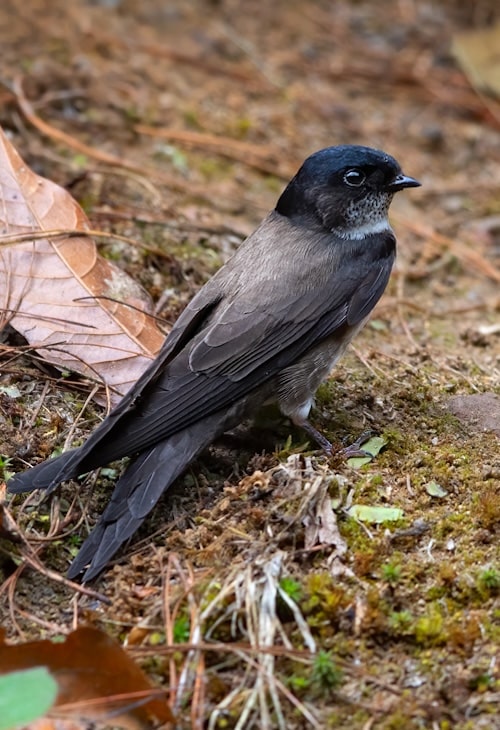
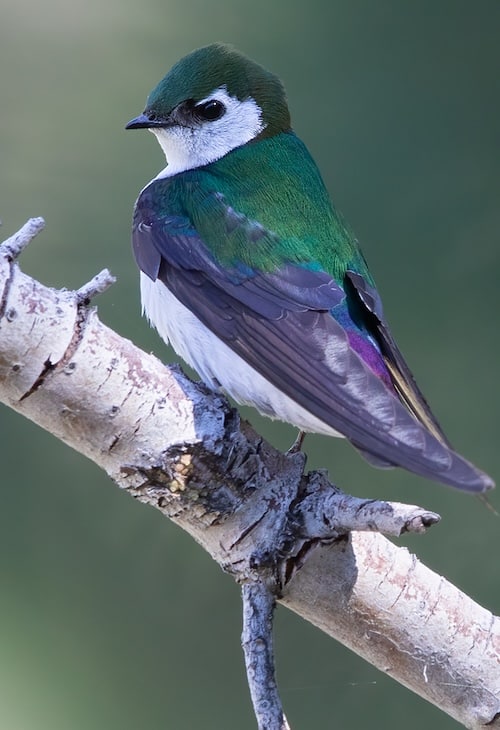
The most common plumage across the family is glossy dark blue or green above and plain or streaked underneath often white or slightly rufous. Species that burrow or live in dry or mountainous areas however, often are matt brown above, such as Sand Martins and Crag Martins. They show limited or no sexual dimorphism, with longer male tail feathers probably being the most common distinction. Chicks hatch naked with closed eyes. Fledged juveniles usually appear as duller versions of the adults.
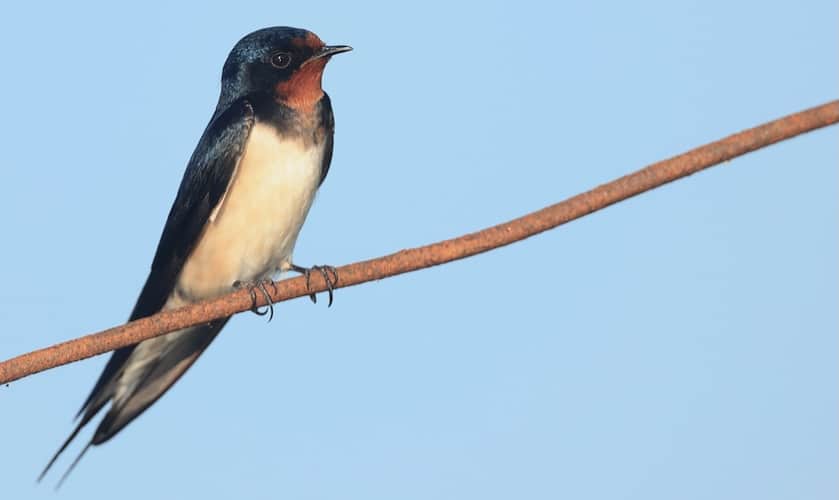
Barn Swallow Hirundo rustica – ©Nick Ludovic Green Bird-Photo-Tours ASIA
The swallows have a cosmopolitan distribution across the world and breed on all the continents except Antarctica. They’re also a number which occur on oceanic Islands. It is believed that this family originated in Africa as hole-nesters; Africa still has the greatest diversity of species. A number of European and North American species are long-distance migrants; by contrast, the West and South African swallows are non-migratory. Many species have enormous worldwide arranges, particularly the Barn Swallow, which breeds over most of the northern hemisphere and winter is over most of the southern hemisphere. They occupy a wide range of habitats. Because they are dependent on flying insects they are commonly seen over waterways and lakes and frequently feed over these, but they can be found in open habitat including grasslands, open woodland, savanna, marshes, mangroves and scrubland, from sea level to high alpine areas. Many species inhabit human-altered landscapes, including agricultural land and even urban areas. In fact, land use changes has, in some cases, caused some species to expand their range, most impressively the Welcome Swallow, which began to colonise New Zealand in the 1920s, started breeding in the 1950s and is now a common landbird there.
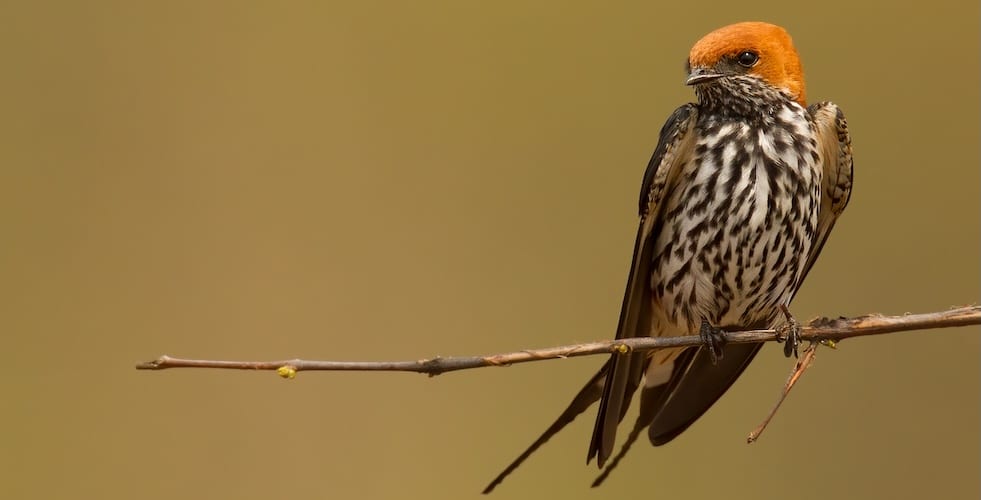
Lesser Striped Swallow Cecropis abyssinica – ©Dubi Shapiro
In temperate regions, species that breed in the summer usually migrate during the winter because of the collapse of insect populations during that season. However, species that are native to more tropical areas, either do not migrate at all, or make shorter migrations. During the winter Emma greeting swallows can form enormous roosts. For example, one winter roosting sight in Nigeria has attracted 1 ½ million individuals. Most species, most of the time are completely insectivorous. However, some birds have been observed heating fruit and even the seeds of acacia trees.
A large number of species nest in holes sometimes in sandbanks, old woodpecker nests or other existing cabbages. Those nesting in sandbanks excavate Burrows in the soft substrate.
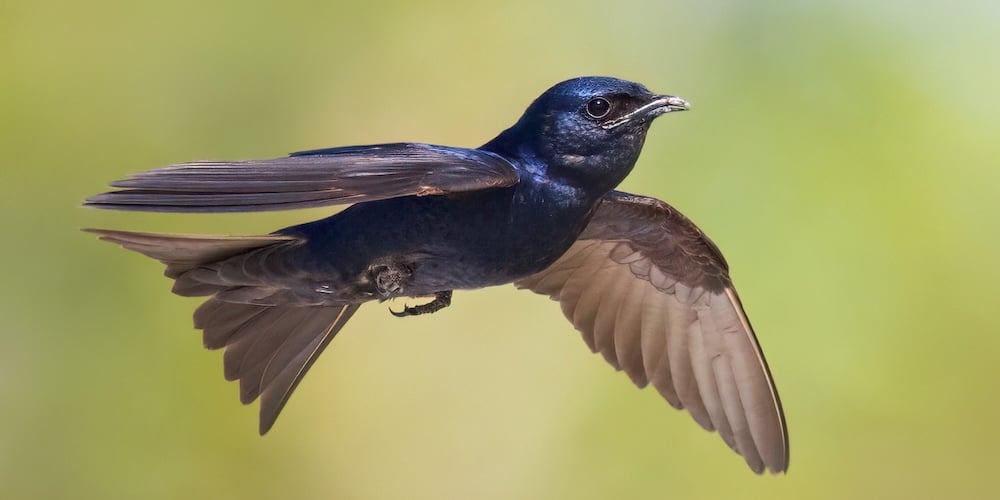
Purple Martin Progne subis – ©Dubi Shapiro
Other species, particularly some of the Martens, build mad nests using an overhead to shelter in locations that are protected from both weather and predators. Mud nesting is the most common in the old world, particularly Africa. Pairs tend to be monogamous and pairs of non-migratory species often stay near their breeding area. Migratory species often return to the same breeding area year after year and may select the same nest site if they were previously successful in that location. First year breeders, generally select a nesting site close to where they were raised.
A few species of swallow and martin are threatened with extinction by human activities, although other species have benefited from human changes to the environment and live around humans.
-
Number of bird species: 92
(As at December 2025)
According to the recently (2025) amalgamated AviList, there are ninety-two species, in twenty-one genera in the Hirundinidae family. They are:
African River Martin Pseudochelidon eurystomina
White-eyed River Martin Pseudochelidon sirintarae
Fanti Saw-wing Psalidoprocne obscura
Square-tailed Saw-wing Psalidoprocne nitens
Mountain Saw-wing Psalidoprocne fuliginosa
White-headed Saw-wing Psalidoprocne albiceps
Black Saw-wing Psalidoprocne pristoptera
White-backed Swallow Cheramoeca leucosterna
Grey-rumped Swallow Pseudhirundo griseopyga
Mascarene Martin Phedina borbonica
Brazza’s Martin Phedinopsis brazzae
Banded Martin Neophedoina cincta
Congo Martin Riparia congica
Sand Martin Riparia riparia
Pale Martin Riparia diluta
Grey-throated Martin Riparia chinensis
Madagascar Martin Riparia cowani
Brown-throated Martin Riparia paludicola
Tree Swallow Tachycineta bicolor
Tumbes Swallow Tachycineta stolzmanni
White-winged Swallow Tachycineta albiventer
White-rumped Swallow Tachycineta leucorrhoa
Chilean Swallow Tachycineta leucopyga
Mangrove Swallow Tachycineta albilinea
Golden Swallow Tachycineta euchrysea
Violet-green Swallow Tachycineta thalassina
Bahama Swallow Tachycineta cyaneoviridis
Purple Martin Progne subis
Cuban Martin Progne cryptoleuca
Caribbean Martin Progne dominicensis
Sinaloa Martin Progne sinaloae
Grey-breasted Martin Progne chalybea
Southern Martin Progne elegans
Peruvian Martin Progne murphyi
Galapagos Martin Progne modesta
Brown-chested Martin Progne tapera
Southern Rough-winged Swallow Stelgidopteryx ruficollis
Northern Rough-winged Swallow Stelgidopteryx serripennis
Black-capped Swallow Atticora pileata
White-thighed Swallow Atticora tibialis
White-banded Swallow Atticora fasciata
Black-collared Swallow Pygochelidon melanoleuca
Blue-and-white Swallow Pygochelidon cyanoleuca
Tawny-headed Swallow Alopochelidon fucata
Pale-footed Swallow Orochelidon flavipes
Brown-bellied Swallow Orochelidon murina
Andean Swallow Orochelidon andecola
Rock Martin Ptyonoprogne fuligula
Dusky Crag Martin Ptyonoprogne concolor
Eurasian Crag Martin Ptyonoprogne rupestris
Red-throated Rock Martin Ptyonoprogne rufigula
Pale Crag Martin Ptyonoprogne obsoleta
Blue Swallow Hirundo atrocaerulea
Black-and-rufous Swallow Hirundo nigrorufa
Pied-winged Swallow Hirundo leucosoma
White-tailed Swallow Hirundo megaensis
Pearl-breasted Swallow Hirundo dimidiata
Welcome Swallow Hirundo neoxena
Hill Swallow Hirundo domicola
Pacific Swallow Hirundo javanica
Tahiti Swallow Hirundo tahitica
Wire-tailed Swallow Hirundo smithii
White-bibbed Swallow Hirundo nigrita
White-throated Swallow Hirundo albigularis
Barn Swallow Hirundo rustica
Ethiopian Swallow Hirundo aethiopica
Angola Swallow Hirundo angolensis
Red-chested Swallow Hirundo lucida
Forest Swallow Atronanus fuliginosus
Common House Martin Delichon urbicum
Nepal House Martin Delichon nipalense
Siberian House Martin Delichon lagopodum
Asian House Martin Delichon dasypus
Lesser Striped Swallow Cecropis abyssinica
Red-breasted Swallow Cecropis semirufa
Greater Striped Swallow Cecropis cucullata
Mosque Swallow Cecropis senegalensis
African Red-rumped Swallow Cecropis melanocrissus
European Red-rumped Swallow Cecropis rufula
Sri Lanka Swallow Cecropis hyperythra
Rufous-bellied Swallow Cecropis badia
Eastern Red-rumped Swallow Cecropis daurica
Red Sea Cliff Swallow Petrochelidon perdita
South African Cliff Swallow Petrochelidon spilodera
Red-throated Cliff Swallow Petrochelidon rufigula
Preuss’s Cliff Swallow Petrochelidon preussi
Tree Martin Petrochelidon nigricans
Fairy Martin Petrochelidon ariel
Streak-throated Swallow Petrochelidon fluvicola
American Cliff Swallow Petrochelidon pyrrhonota
Chestnut-collared Swallow Petrochelidon rufocollaris
Cave Swallow Petrochelidon fulva
-
Sand Martin Trust
WebsiteIf you are interested in birds but don`t know much about Sand Martins and so think you will not be able to help them, we are pleased to tell you that indeed you will.
-
Guests of Summer
| A House Martin Love Story | By Theunis Piersma | BTO | 2016 | Paperback | 117 pages, 1 b/w map | ISBN: 9789085815709 Buy this book from NHBS.com -
The Barn Swallow
| By Angela Turner | Poyser | 2006 | Hardback | 256 pages, 16 pages of colour photos | ISBN: 9780713665581 Buy this book from NHBS.com -
The Purple Martin
| By Robin R Doughty & Rob Fergus | McDonald & Woodward Publishing | 2016 | Paperback | 186 pages, 28 colour photos | ISBN: 9781935778325 Buy this book from NHBS.com -
The Swallow - A Biography
| By Stephen Moss | Square Peg | 2020 | Hardback | 195 pages, colour & b/w illustrations | ISBN: 9781529110265 Buy this book from NHBS.com
-
Hirundinidae
Family AccountSwallows are highly specialized aerial insectivores. Feeding on aerial plankton that is constantly varying with the vagaries of the weather. -
Hirundinidae
Family AccountThe swallows, martins, and saw-wings, or Hirundinidae are a family of passerine songbirds found around the world on all continents, including occasionally in...
Given the number of species in this family, Fatbirder does not provide quick links to all of them. However, the entries below do include links to representatives of every genera, all those illustrated and some of the most often encountered, iconic or sought-after species.
-
African River Martin Pseudochelidon eurystomina
Species AccountThe African river martin (Pseudochelidon eurystomina) is a passerine bird, one of two members of the river martin subfamily of the swallow family, Hirundinidae. -
African River Martin Pseudochelidon eurystomina
Species AccountSound archive and distribution map. -
Banded Martin Neophedoina cincta
Species AccountLarge brown-and-white swallow with a band across the chest and a pale mark above the eye. In flight, shows broad wings with large white patches below. -
Banded Martin Neophedoina cincta
Species AccountSound archive and distribution map. -
Barn Swallow Hirundo rustica
Species AccountThe barn swallow (Hirundo rustica) is the most widespread species of swallow in the world. -
Barn Swallow Hirundo rustica
Species AccountSound archive and distribution map. -
Black-capped Swallow Atticora pileata
Species AccountSmall swallow, rather local in high mountains; found around towns and villages and in pine-oak forests and clearings. -
Black-capped Swallow Atticora pileata
Species AccountSound archive and distribution map. -
Blue-and-white Swallow Pygochelidon cyanoleuca
Species AccountThe blue-and-white swallow (Pygochelidon cyanoleuca) is a passerine bird that breeds from Nicaragua south throughout South America. -
Blue-and-white Swallow Pygochelidon cyanoleuca
Species AccountSound archive and distribution map. -
Brazza’s Martin Phedinopsis brazzae
Species AccountBrazza's martin (Phedinopsis brazzae) is a passerine bird in the swallow family, Hirundinidae. It is 12 centimeters (4.7 in) long with grey-brown upperparts. -
Brazza’s Martin Phedinopsis brazzae
Species AccountSound archive and distribution map. -
Common House Martin Delichon urbicum
Species AccountThe western house martin (Delichon urbicum), sometimes called the common house martin... -
Common House Martin Delichon urbicum
Species AccountSound archive and distribution map. -
Eastern Red-rumped Swallow Hirundo daurica
Species AccountThe red-rumped swallow (Cecropis daurica) is a small passerine bird in the swallow family. It breeds in open hilly country of temperate southern Europe and Asia from Portugal and Spain to Japan, India, Sri Lanka and tropical Africa. -
Eastern Red-rumped Swallow Hirundo daurica
Species AccountSound archive and distribution map. -
Eurasian Crag Martin Ptyonoprogne rupestris
Species Account(Ptyonoprogne rupestris) is a small passerine bird in the swallow family. -
Eurasian Crag Martin Ptyonoprogne rupestris
Species AccountSound archive and distribution map. -
Fairy Martin Petrochelidon ariel
Species AccountSmall swallow dark above, pale below, with white rump, reddish crown, and notched tail. Nests colonially over much of Australia. -
Fairy Martin Petrochelidon ariel
Species AccountSound archive and distribution map. -
Fanti Saw-wing Psalidoprocne obscura
Species AccountAn elegant sooty-brown swallow with a distinctive long and deeply forked tail. Plumage has a greenish gloss if seen well. -
Fanti Saw-wing Psalidoprocne obscura
Species AccountSound archive and distribution map. -
Forest Swallow Atronanus fuliginosus
Species AccountSound archive and distribution map. -
Forest Swallow Atronanus fuliginosus
Species AccountForest Swallow Atronanus fuliginosus Small and compact with a short, mostly squared tail. -
Grey-rumped Swallow Pseudhirundo griseopyga
Species AccountSound archive and distribution map. -
Grey-rumped Swallow Pseudhirundo griseopyga
Species AccountSlim, long-tailed swallow with pale underparts and dark blue upperparts. The gray rump is not conspicuous when perched but can be discerned in flight. -
Lesser Striped Swallow Cecropis abyssinica
Species AccountThe lesser striped swallow (Cecropis abyssinica) is a large swallow. -
Lesser Striped Swallow Cecropis abyssinica
Species AccountSound archive and distribution map. -
Mascarene Martin Phedina borbonica
Species AccountThe Mascarene martin or Mascarene swallow (Phedina borbonica) is a passerine bird in the swallow family that breeds in Madagascar... -
Mascarene Martin Phedina borbonica
Species AccountSound archive and distribution map. -
Mosque Swallow Cecropis senegalensis
Species AccountThis large swallow has rusty-red underparts, a pale buff throat, and a white leading edge to the underwing that is obvious only in flight. -
Mosque Swallow Cecropis senegalensis
Species AccountSound archive and distribution map. -
Northern Rough-winged Swallow Stelgidopteryx serripennis
Species AccountPlainest swallow in North America. Plain brown above with indistinct brown wash across throat and breast. Wings are relatively broad; tail is short and square. -
Northern Rough-winged Swallow Stelgidopteryx serripennis
Species AccountSound archive and distribution map. -
Pacific Swallow Hirundo javanica
Species AccountThe Pacific swallow (Hirundo javanica) is a small passerine bird in the swallow family Hirundinidae. -
Pacific Swallow Hirundo javanica
Species AccountSound archive and distribution map. -
Pale-footed Swallow Orochelidon flavipes
Species AccountThe pale-footed swallow (Orochelidon flavipes) is a species of bird in the family Hirundinidae. -
Pale-footed Swallow Orochelidon flavipes
Species AccountSound archive and distribution map. -
Purple Martin Progne subis
Species AccountThe purple martin (Progne subis) is a passerine bird in the swallow family Hirundinidae. -
Purple Martin Progne subis
Species AccountSound archive and distribution map. -
Sand Martin Riparia riparia
Species AccountThe sand martin (Riparia riparia), also known as the collared sand martin or common sand martin, and in the Americas as the bank swallow... -
Sand Martin Riparia riparia
Species AccountSound archive and distribution map. -
Tawny-headed Swallow Alopochelidon fucata
Species AccountDiminutive swallow of grasslands and savanna, particularly near water, where it occurs on its own or in small groups. -
Tawny-headed Swallow Alopochelidon fucata
Species AccountSound archive and distribution map. -
Violet-green Swallow Tachycineta thalassina
Species AccountThe violet-green swallow (Tachycineta thalassina) is a small North American passerine bird in the swallow family. -
Violet-green Swallow Tachycineta thalassina
Species AccountSound archive and distribution map. -
Welcome Swallow Hirundo neoxena
Species AccountThe welcome swallow (Hirundo neoxena) is a small passerine bird in the swallow family. -
Welcome Swallow Hirundo neoxena
Species AccountSpecies InformationBreeding and ecologyWelcome swallows are small fast-flying birds found in open country particularly around lakes, coasts, riverbeds and ponds. Their flight is circular and darting in style, and they may be seen singly, in pairs or in flocks. Flocks often perch en masse, lined up on fences or power lines. They were named ‘welcome swallows’ because they appeared in southern Australia as a herald of spring. Due to their elegant shape and flight, and their preference for nesting around buildings, swallows are noticed and appreciated more than most other small birds. -
Welcome Swallow Hirundo neoxena
Species AccountSound archive and distribution map. -
White-backed Swallow Cheramoeca leucosterna
Species AccountThe white-backed swallow (Cheramoeca leucosterna) is a member of the swallow family Hirundinidae and is endemic to Australia. -
White-backed Swallow Cheramoeca leucosterna
Species AccountSound archive and distribution map.
-
PurpleMartins
Mailing ListThis is a list for those who are interested in the Beautiful and Beneficial Purple Martins - Attracting and protecting them - general information about Martins, Migration Dates, etc. -
Swifts, Swallows & Martins Worldwide
Mailing ListAimed at specialist and amateur alike, you may record observations, describe interesting behavioral features, ask questions, advise readers about publications, and submit photographs and texts via Files or Photos. Articles and messages in languages other than English may be posted, provided a summary in English is also attached.