

Nyctibiidae – Potoos
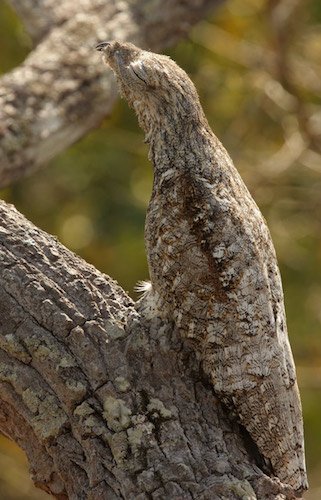
The Nyctibiidae or Potoos are a group of near passerine birds related to the nightjars and frogmouths in their own order, the Nyctibiiformes. They are sometimes called poor-me-ones, after their haunting calls. There are seven species in two genera, all found in tropical Central and South America. The genus Nyctibius, is drawn from Greek to indicate night-feeding, literally being nux for night and bios for life. The Rufous Potoo was shown (2018) through study, to be in its own genus, as it diverges deeply from the other potoos.
They are nocturnal insectivores which lack the bristles around the mouth found in the true nightjars. They hunt from a perch like a shrike or flycatcher. During the day they perch upright on tree stumps, camouflaged to look like part of the stump. The single spotted egg is laid directly on the top of a broken branch stump.
The potoos are a highly conservative family in appearance, with all the species closely resembling one another; species accounts in ornithological literature remark on their unusual appearance. They range from 21cm to 58cm in length. They resemble upright sitting nightjars, a closely related order – Caprimulgiformes. They also resemble the frogmouths of Australasia, that are stockier and have much heavier bills. They have proportionally large heads for their body size and long wings and tails. The large head is dominated by a massive broad bill and enormous eyes. In the treatment of the family in the Handbook of the Birds of the World, Cohn-Haft describes the potoos as little more than a flying mouth and eyes. The bill, while large and broad, is also short, barely projecting past the face. It is delicate, but has a unique ‘tooth’ on the cutting edge of the upper mandible that may assist in foraging. Unlike the closely related nightjars, the potoos lack rictal bristles around the mouth. The legs and feet are weak and used only for perching.
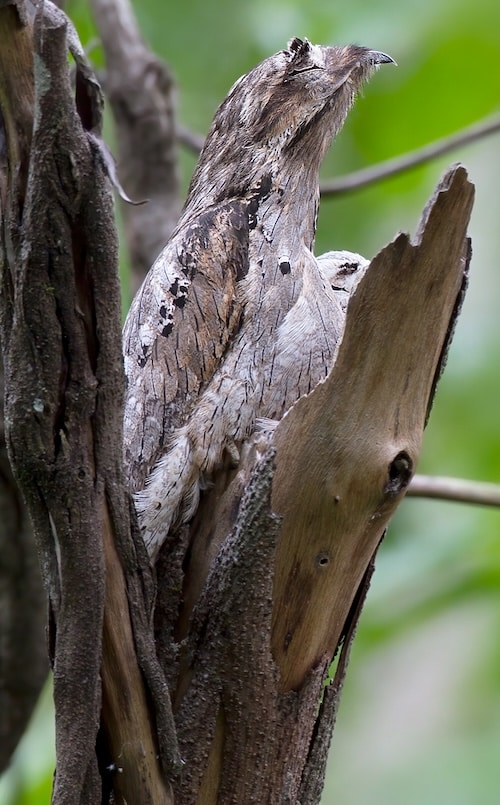
Common Potoo Nyctibius griseus – ©Dubi Shapiro
Their eyes are large, even larger than those of nightjars. As in many species of nocturnal birds, they reflect the light of flashlights. Their eyes, which could be conspicuous to potential predators during the day, have unusual slits in the lids, which allow potoos to sense movement even when their eyes are closed. Their plumage is cryptic, helping them blend into the branches on which they spend their days.
At night, they emit distinctive songs, from the plaintive whistles of the Common Potoo Nyctibius griseus to the percussive guttural roar of the Great Potoo Nyctibius grandis. They respond well to tape playback of their songs, often approaching closely and replying repeatedly, and their highly reflective eyes make them relatively easy to find at night.
They have a Neotropical distribution. They range from Mexico to Argentina, with the greatest diversity occurring in the Amazon Basin, which holds five species. They are found in every Central and South American country except Chile. They also occur on three Caribbean islands: Jamaica, Hispaniola and Tobago.
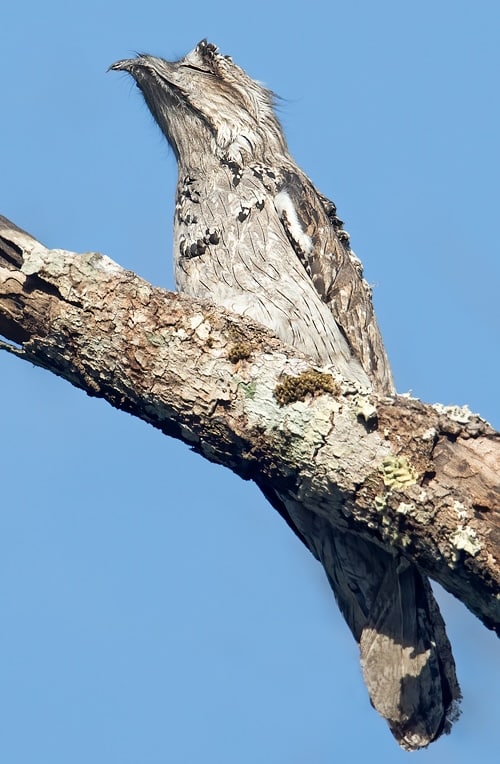
Northern Potoo Nyctibius jamaicensis – ©Dubi Shapiro
They are generally highly sedentary, although there are occasional reports of vagrants, particularly species that have travelled on ships. All species occur in humid forests, although a few species also occur in drier forests.
They are highly nocturnal and generally do not fly during the day. They spend the day perched on exposed branches with the eyes half closed. With their extraordinarily cryptic plumage they resemble stumps, and should they detect potential danger they adopt a ‘freeze’ position which even more closely resembles a broken branch. The transition between perching and the freeze position is gradual and hardly perceptible to the observer.
-
Number of bird species: 7
(As at August 2025)
Nyctibiidae are the only family of Nyctibiiformes. According to the recently (2025) compiled AviList, there are just 7 species of Potoo currently recognised, in two genera. They are:
Rufous Potoo Phyllaemulor bracteatus
Great Potoo Nyctibius grandis
Long-tailed Potoo Nyctibius aethereus
Common Potoo Nyctibius griseus
Northern Potoo Nyctibius jamaicensis
Andean Potoo Nyctibius maculosus
White-winged Potoo Nyctibius leucopterus
-
Nightjars of the World - Potoos, Frogmouths, Oilbird and Owlet-nightjars
| By Nigel Cleere | WILDGuides | 2010 | Hardback | 464 pages, colour photos | ISBN: 9781903657072 Buy this book from NHBS.com
-
Nyctibiidae
Family AccountPotoos are night birds that favor exposed perches during the day, trusting their safety to their extraordinarily cryptic plumage. -
Nyctibiidae
Family AccountPotoos (family Nyctibiidae) are a group of birds related to the nightjars and frogmouths. They are sometimes called poor-me-ones, after their haunting calls.
-
Andean Potoo Nyctibius maculosus
Species AccountRare night bird found in high elevation Andean cloud forest. Cryptically patterned in brown and buff with white patches in the wings. -
Andean Potoo Nyctibius maculosus
Species AccountThe Andean potoo (Nyctibius maculosus) is a species of bird in the Nyctibiidae family. It is found in Bolivia, Colombia, Ecuador, Peru, and Venezuela. Its natural habitat is subtropical or tropical moist montane forests. -
Andean Potoo Nyctibius maculosus
Species AccountSound archive and distribution map. -
Common Potoo Nyctibius griseus
Species AccountStrange nocturnal bird like a mix between an owl and a nightjar. Large head and huge yellow eyes. Overall grayish-brown with splotchy patterning. -
Common Potoo Nyctibius griseus
Species AccountThe common potoo, grey potoo, lesser potoo or poor-me-one (Nyctibius griseus), is a nocturnal bird which breeds in tropical Central and South America from Nicaragua to northern Argentina and northern Uruguay. -
Common Potoo Nyctibius griseus
Species AccountSound archive and distribution map. -
Great Potoo Nyctibius grandis
Species AccountA monstrous nightbird, superficially similar to an owl but not related. Pale mottled gray with large head; larger than other potoos and lacks a dark... -
Great Potoo Nyctibius grandis
Species AccountThe great potoo (Nyctibius grandis) is a near passerine bird, both the largest potoo species and the largest member of the order Caprimulgiformes (nightjars and allies). They are also one of seven species in one genus, Nyctibius, located in tropical America. -
Great Potoo Nyctibius grandis
Species AccountSound archive and distribution map. -
Long-tailed Potoo Nyctibius aethereus
Species AccountSound archive and distribution map. -
Long-tailed Potoo Nyctibius aethereus
Species AccountThe long-tailed potoo (Nyctibius aethereus) is a species of bird in the Nyctibiidae family. It is found in Brazil, Venezuela, Guyana, Colombia, Ecuador, Peru, Bolivia, and Paraguay; also in Argentina in the extreme northeast. Its natural habitat is subtropical or tropical moist lowland forests. -
Long-tailed Potoo Nyctibius aethereus
Species AccountLarge potoo with a long graduated tail. Mostly rusty brown with streaked underparts, a conspicuous pale shoulder patch, and a whitish moustache. -
Northern Potoo Nyctibius jamaicensis
Species AccountBizarre, big-headed, and bug-eyed nocturnal bird with yellow eyes and cryptically streaked plumage. Found in wooded and semiopen habitats in tropical... -
Northern Potoo Nyctibius jamaicensis
Species AccountThe northern potoo (Nyctibius jamaicensis) is a nocturnal bird belonging to the potoo family, Nyctibiidae. It is found from Mexico south to Costa Rica and on the islands of Jamaica and Hispaniola. It was formerly classified as a subspecies of the common potoo (Nyctibius griseus) but is now usually treated as a separate species based on differences in vocalizations. -
Northern Potoo Nyctibius jamaicensis
Species AccountSound archive and distribution map. -
Rufous Potoo Phyllaemulor bracteatus
Species AccountRarely observed, nocturnal bird of lowland rainforest. Considerably smaller than other potoos, and distinguished from them by bright rufous plumage spotted... -
Rufous Potoo Phyllaemulor bracteatus
Species AccountThe rufous potoo (Nyctibius bracteatus)[2] is a species of bird in the Nyctibiidae family. Its common name refers to its rufous, or reddish-brown color. Their species name bracteatus is Latin for "gold-leaf". -
Rufous Potoo Phyllaemulor bracteatus
Species AccountSound archive and distribution map. -
White-winged Potoo Nyctibius leucopterus
Species AccountUncommon, rarely seen potoo, active only at night. If found during the day, large white wing patches are key to identification. -
White-winged Potoo Nyctibius leucopterus
Species AccountThe white-winged potoo (Nyctibius leucopterus) is a species of bird in the Nyctibiidae family, the potoos. It is found in Roraima and Amazonas, Brazil and Guyana in the Amazon Basin; also localised populations in Peru and French Guiana. -
White-winged Potoo Nyctibius leucopterus
Species AccountSound archive and distribution map.