

Orthonychidae – Logrunners & Chowchilla
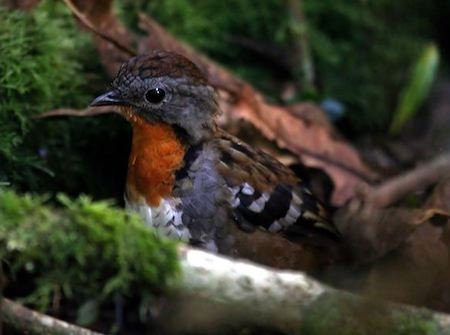
The Orthonychidae (Logrunners) are a family of birds which comprises just three species of passerines endemic to Australia and New Guinea. The three species use their stiffened tails to brace themselves when feeding.
The logrunners, enigmatic denizens of the wet forests of eastern Australia and New Guinea, spend most of their time on the ground, foraging for invertebrates in the forest litter with lateral movements of their strong legs. This unusual leg movement (most passerines sort through the litter with movements fore and aft) has left its distinctive signature on the skeletal anatomy of these birds, allowing even a single leg bone to be recognized in partial fossil deposits from many millions of years ago. The flight musculature of orthonychids is also reduced, and they seldom fly very far, probably spending all their lives in a small patch of rainforest floor.
The Australian Logrunner Orthonyx temminckii is from northeastern New South Wales and southeast Queensland, where it is very local in its distribution, and strictly terrestrial in its habits. The wings are barred with white, and the chin, throat and breast are in the male pure white, but of a bright reddish-orange in the female. The remiges are very short, rounded and much incurved, showing that the bird has weak flight. The rectrices are very broad, the shafts stiff, and towards the tip divested of barbs. The population which is found locally in New Guinea, formerly considered the same species, is now generally considered a separate species, the Papuan Logrunner Orthonyx novaeguineae.
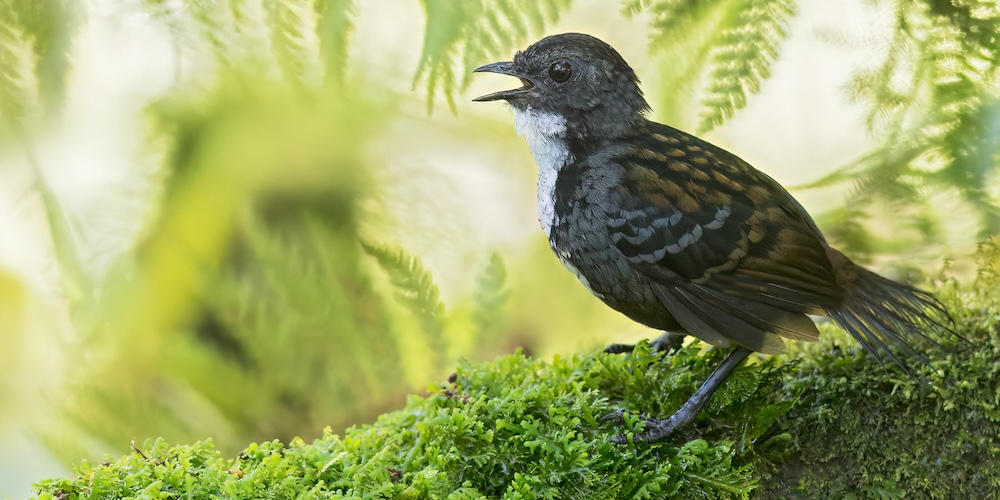
Papuan Logrunner Orthonyx novaeguineae – ©Dubi Shapiro
Logrunners have a length ranging from 17 to 20 cm. On the other hand, the bulky chowchilla is significantly larger, measuring around 26 to 28 cm in length. The Chowchilla Orthonyx spaldingii, from north-east Queensland is of much greater size than either species of logrunner, and with a jet-black plumage, the throat being white in the male and orange-rufous in the female. They have a blue-grey eye-ring. Logrunners, on the other hand, display a patterned plumage combination of olive, grey, and mottled black. Male logrunners feature a white throat, while females have a rufous throat and upper breast.
Logrunners are semi-terrestrial birds of weak flight. They are strictly carnivorous, with insects and larvae being their chief food, whilst the larger Chowchilla will also eat small lizards. They find their food by digging in the soil, using their spiny tails as a support in the wet forest. In accordance with their non-seasonal, warm rainforest habitat, logrunners can be very long-lived. The Chowchilla, the sole species with any banding data, has an average lifespan of around five years and has been known to live for as long as seventeen years.
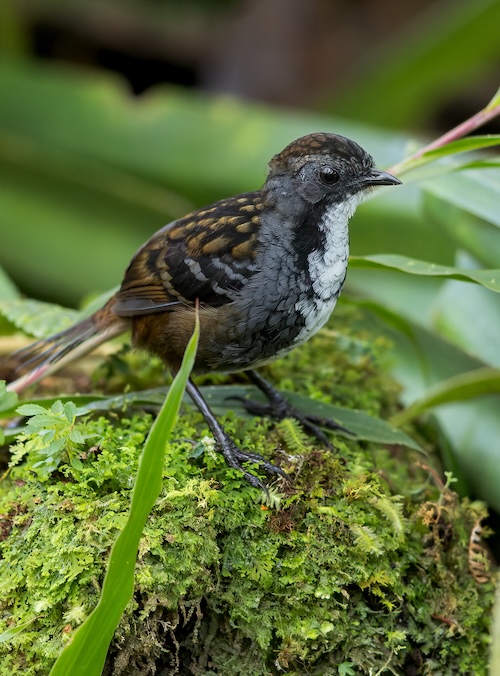
Papuan Logrunner Orthonyx novaeguineae – ©Dubi Shapiro
Logrunners have a somewhat unusual social structure. They are basically monogamous, but male offspring are often retained on the natal territory for more than a year after fledging. Despite this, only the female ever feeds the young; the much larger males stay primarily for the purpose of territorial defence and protecting the female from predation. Similar patterns of retention of young without alloparental care also occur in the Speckled Warbler, the corvid genus Perisoreus and the bustard genus Eupodotis.
Like the lyrebirds, logrunners typically breed in the southern winter from June to September, though this is often extended depending on weather conditions by a month or more. Both the Chowchilla and the Papuan Logrunner lay only one egg, whilst the Australian Logrunner typically lays two though a few reports exist of clutches of one or even three. The eggs are very unusual in their tubular shape, and are pure white in colour, whilst the incubation period is among the longest for any songbird. The young generally become independent of the female in two to two and a half weeks, which is an exceptionally short time for an insectivorous altricial Australian bird, where parental dependence of forty to sixty days post-fledging is typical. This is probably why, unlike in birds of drier habitats in Australia, alloparental care is superfluous for rearing young and may actually increase the risk of predation.
The nests are domed and constructed entirely of sticks, and are located on the ground below a tree. They have special coverings to prevent the extremely heavy downpours typical of the eastern Australian coast from damaging the eggs. Males are described as performing dancing antics like those of the lyrebirds.
-
Number of bird species: 3
(As at December 2025)
According to the recently (2025) amalgamated AviList, there are just three species, in one genus in the Orthonychidae family. They are:
Papuan Logrunner Orthonyx novaeguineae
Australian Logrunner Orthonyx temminckii
Chowchilla Orthonyx spaldingii
-
Orthonychidae
Family AccountThe logrunners, enigmatic denizens of the wet forests of eastern Australia and New Guinea, spend most of their time on the ground, foraging for invertebrates in the forest litter with lateral movements of their strong legs. -
Orthonychidae
Family AccountOrthonychidae is a clade of passerine birds endemic to Australia and New Guinea.
Given that this is a very small family with just three species in a single genus, Fatbirder provides active links below to all species.
-
Australian Logrunner Orthonyx temminckii
Species AccountThe Australian logrunner (Orthonyx temminckii) is a species of bird that is endemic to eastern Australia where it uses unique foraging techniques and adaptations to search for its food on the floors of temperate, subtropical, or tropical moist lowland forests in south-eastern Australia. -
Australian Logrunner Orthonyx temminckii
Species AccountThe Logrunner is a small, robust, ground-dwelling bird, with a short and sturdy bill. The short wings are rounded and the short, broad tail has obvious spines at the end. Adult male birds have a grey face and sides, and are white underneath, olive-rufous above, with grey bars across the wing. -
Australian Logrunner Orthonyx temminckii
Species AccountSound archive and distribution map. -
Chowchilla Orthonyx spaldingii
Species AccountImage + The Chowchilla is endemic to the Wet Tropics region… -
Chowchilla Orthonyx spaldingii
Species AccountSound archive and distribution map. -
Chowchilla Orthonyx spaldingii
Species AccountThe chowchilla (Orthonyx spaldingii) is a passerine bird in the family Orthonychidae. It is endemic to Australia. -
Papuan Logrunner Orthonyx novaeguineae
Species AccountA medium-sized, ground-dwelling bird of mossy montane forest. Brown streaked back, gray and buff wing bars, and gray face, extending down the sides of the... -
Papuan Logrunner Orthonyx novaeguineae
Species AccountThe Papuan logrunner or New Guinea logrunner (Orthonyx novaeguineae) is a species of bird in the family Orthonychidae. It was formerly considered conspecific with the Australian logrunner. It is found in New Guinea. Its natural habitat is subtropical or tropical moist montane forests. -
Papuan Logrunner Orthonyx novaeguineae
Species AccountSound archive and distribution map.