

Pedionomidae – Plains Wanderer
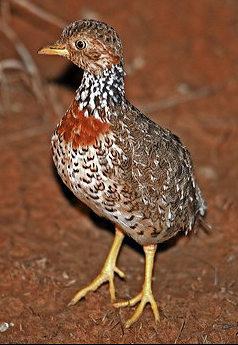
The family Pedionomidae consists of just one species, the Plains-wanderer Pedionomus torquatus.
It is an Australian endemic species that has long evoked interest from the world ornithological community.
It is the sole member of the family, having no known living relatives. Plains-wanderers superficially resemble buttonquail (Turnix sp.) in that females are larger and more brightly coloured than males and have bright yellow legs and bill and give a low ooming call. However, they are more closely related to plovers and dotterels. Like buttonquail, the male Plains-wanderer does most of the incubation and chick rearing if not all of it. This disparity in size and role reversal of the sexes during breeding is unusual among birds.
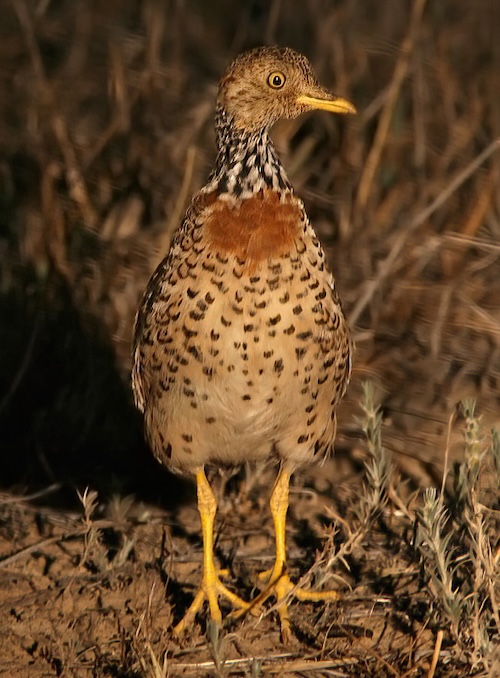
Plainswanderer Pedionomus torquatus – ©Dubi Shapiro
Plains-wanderers’ prime habitat on the Riverine Plain is the hard, red-brown earths with a sparse covering of native herbs and grasses. Living in such an open environment, Plains-wanderers are vulnerable to predators such as Black Falcons Falco subniger, Brown Falcons Falco berigora and Spotted Harriers Circus assimilis. Their camouflage and cryptic daylight behaviour is their main safeguard. When disturbed at night, they are less secretive. They rarely fly during the day, however, and, when they do, their flight is more dipping and uneven than at night, presumably as a defence against raptors. The flight pattern at night is slow and direct, resembling a crake’s Porzana spp. with rapid, shallow wingbeats and legs trailing out behind. They are diurnal, feeding on a wide variety of seeds and ground dwelling insects.
In years of average rainfall Plains-wanderers pair up in July, have eggs in August and young in September. However if conditions are wet in August and September they are more likely to successfully produce young in October and November.
On two occasions during wet conditions Plains-wanderers have been recorded on raised grass nests about 30 mm off the ground. They will continue to breed through the summer if there have been good rains. Breeding can also occur in autumn, particularly if there has been little success in the spring and summer.
-
Number of bird species: 1
(As at July 2025)
Plains-wanderer Pedionomus torquatus
-
Pedionomidae
Family AccountThe plains-wanderer (Pedionomus torquatus) is an atypical species of wading bird, the only representative of family Pedionomidae and genus Pedionomus.
-
Plains-wanderer Pedionomus torquatus
Species AccountPlains-wanderer Pedionomus torquatus has most recently been assessed for The IUCN Red List of Threatened Species in 2022. Pedionomus torquatus is listed as Endangered under criteria C2a(ii). -
Plains-wanderer Pedionomus torquatus
Species AccountThe plains-wanderer (Pedionomus torquatus) is a bird, the only representative of family Pedionomidae and genus Pedionomus. It is endemic to Australia. The majority of the remaining population is found in the Riverina region of New South Wales. -
Plains-wanderer Pedionomus torquatus
Species AccountSound archive and distribution map.
-
Philip N. Maher
P.O Box 385 South Yarra, 3141, Victoria Australia | mahert@patash.com.au
http://www.philipmaher.com/main.htm
-
Plains-wanderer Conservation
InformationThe only surviving species in the family Pedionomidae, Plains-wanderers sit alone on their own branch of the evolutionary tree.