

Pelecanidae – Pelicans
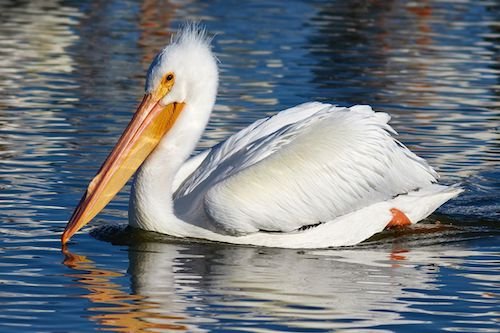
The Pelecanidae or Pelicans, are a family and genus of large water birds. They are part of Pelecaniformes along with Ardeidae (Herons, Egrets & Bitterns), Threskiornithidae (Ibises & Spoonbills), Scopidae (Hamerkop) and Balaenicipitidae (Shoebill).
They are characterised by a long beak and a large throat pouch used for catching prey and draining water from the scooped-up contents before swallowing. They have predominantly pale plumage, the exceptions being the brown and Peruvian pelicans. The bills, pouches and bare facial skin of all species become brightly coloured before the breeding season. The eight living pelican species have a patchy global distribution, ranging latitudinally from the tropics to the temperate zone, though they are absent from interior South America as well as from polar regions and the open ocean. However, at least one species is known to migrate to the inland desert of Australia’s Red Centre, after heavy rains create temporary lakes. White pelicans are also observed at the American state of Utah’s Great Salt Lake, for example, some 600 miles (965 km) from the nearest coastline (the Pacific West Coast). They have also been seen hundreds of miles inland in North America, having flown northwards along the Mississippi River and other large waterways.
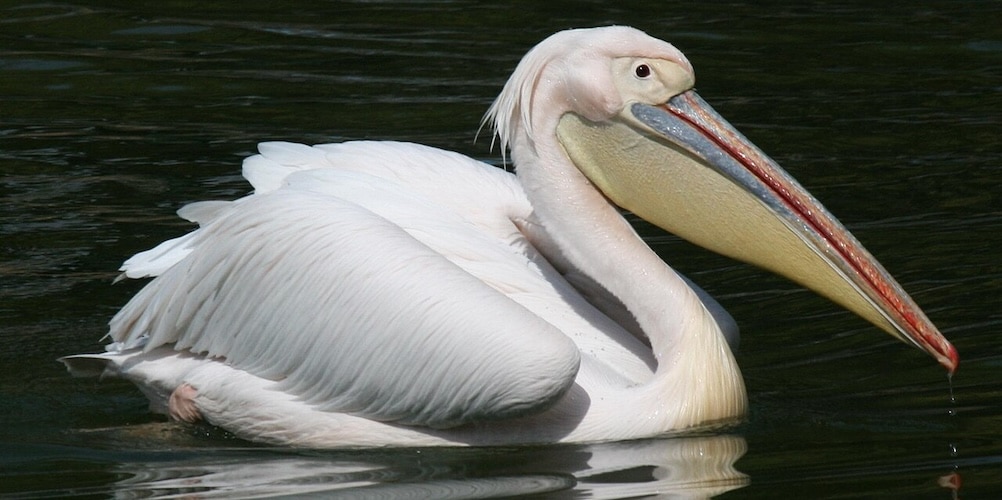
Great White Pelican Pelecanus onocrotalus – ©DickDaniels CC BY-SA 3.0 via Wikimedia Commons
Long thought to be related to frigatebirds, cormorants, tropicbirds, gannets and boobies, pelicans instead are now known to be part of the order Pelecaniformes that also includes Threskiornidae (Ibises & Spoonbills), Balaenicipitidae (Shoebill), Scopidae (Hamerkop) and Ardeidae (Herons, Egrets & Bitterns). They are most closely related to the shoebill and hamerkop with which they form a clade. On the other hand, Ibises, spoonbills, bitterns and herons are more distant relatives in the same order. Fossil evidence of pelicans, dates back to at least 30 million years to the remains of a beak very similar to that of modern species recovered from Oligocene strata in France. They are thought to have evolved in the Old World and spread into the Americas; this is reflected in the relationships within the genus as genetic studies of the eight species show they divide into Old World and New World lineages.
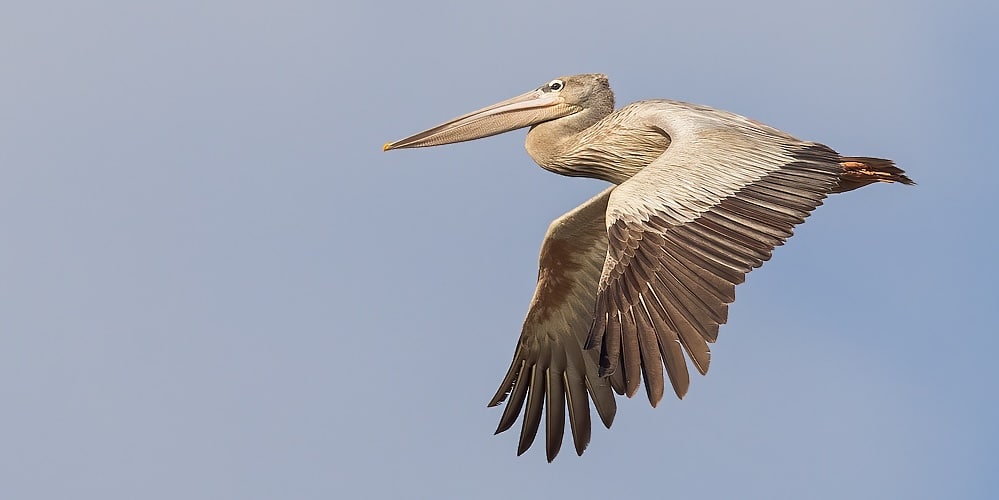
Pink-backed Pelican Pelecanus rufescens – ©Dubi Shapiro
Pelicans frequent inland and coastal waters where they feed principally on fish, catching them at or near the water surface. They are gregarious birds, travelling in flocks, hunting cooperatively and breeding colonially. Four white-plumaged species tend to nest on the ground, and four brown or grey-plumaged species nest mainly in trees. Their populations have fallen through habitat destruction, disturbance and environmental pollution, and three species are of conservation concern.
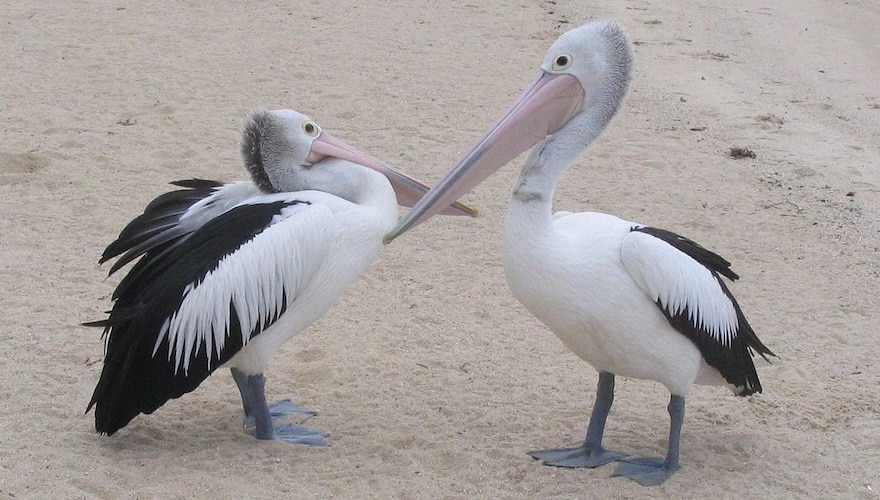
Australian Pelican Pelecanus conspicillatus – ©Public Domain, via Wikipedia
The eight living pelican species were traditionally divided into two groups, one containing four ground-nesters with mainly white adult plumage (Australian, Dalmatian, Great White, and American White Pelicans), and one containing four grey or brown plumaged species which nest preferentially either in trees (Pink-backed, Spot-billed and Brown Pelicans), or on sea rocks (Peruvian Pelican). The largely marine Brown and Peruvian pelicans, formerly considered conspecific, are now separated from each other.
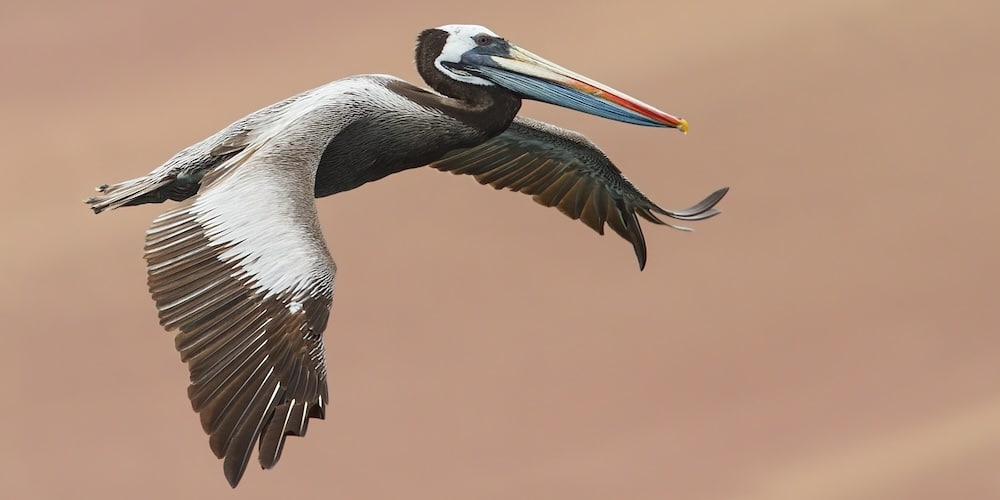
Peruvian Pelican Pelecanus thagus – ©Dubi Shapiro
Males are generally larger than females and have longer bills. The smallest species is the Brown Pelican, small individuals of which can be no more than 2.75 kg and 1.06 m long, with a wingspan of as little as 1.83 m. The largest is believed to be the Dalmatian Pelican, at up to 15 kg and 1.83 m in length, with a maximum wingspan of 3 m. The Australian Pelican’s bill may grow up to 0.5 m long in large males, the longest of any bird.
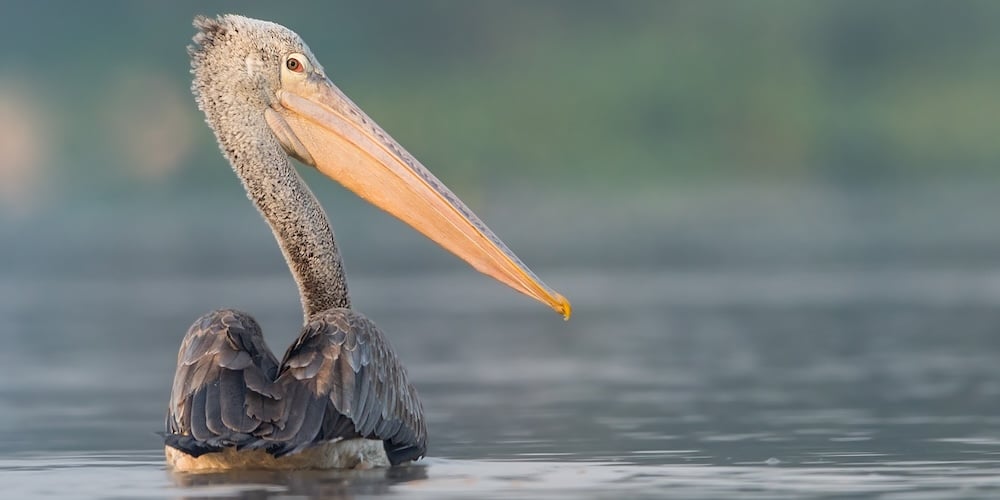
Spot-billed Pelican Pelecanus philippensis – ©Dubi Shapiro
Pelicans have a network of subcutaneous air sacs under their skin situated across the ventral surface including the throat, breast and undersides of the wings, as well as having air sacs in their bones. The air sacs are connected to the airways of the respiratory system, and the pelican can keep its air sacs inflated by closing its glottis, but it is not entirely clear how air sacs are inflated.
-
Number of bird species: 8
(As at August 2025)
According to the recently (2025) combined AviList, there are just eight species, in one genus in the Pelecanidae family, part of the order Pelecaniformes that also includes Threskiornidae (Ibises & Spoonbills), Balaenicipitidae (Shoebill), Scopidae (Hamerkop) and Ardeidae (Herons, Egrets & Bitterns). They are:
American White Pelican Pelecanus erythrorhynchos
Peruvian Pelican Pelecanus thagus
Brown Pelican Pelecanus occidentalis
Great White Pelican Pelecanus onocrotalus
Australian Pelican Pelecanus conspicillatus
Pink-backed Pelican Pelecanus rufescens
Spot-billed Pelican Pelecanus philippensis
Dalmatian Pelican Pelecanus crispus
-
Dalmatian Pelican Reintroduction
WebpageA spectacular bird that once soared over Britain’s extensive wetlands. -
Pelican Specialist Group
WebpageThis group promotes the conservation of Pelecanidae through sound scientific research. In southeastern Europe the group had an important impact. -
Pelican Way of LIFE
WebsitePelican Way of LIFE is a conservation initiative to protect Dalmatian pelicans, aiming to reduce threats and improve habitat along the Black-Sea Mediterranean...
-
Pelicans, Cormorants and their Relatives ? The Pelicaniformes
| By J Bryan Nelson, illustrated by John Busby, Andrew Mackay & Bas Teunis | OUP | 2006 | Hardback | 661 pages, 12 colour plates, 159 b/w illustrations, 62 maps ISBN: 9780198577270 Buy this book from NHBS.com -
The Book of Pelicans
| By Giorgos Catsadorakis | Society for the Protection of Prespa | 2002 | Hardback | 181 pages, colour photos, colour maps | ISBN: 9789608581142 Buy this book from NHBS.com
-
Pelecanida
Family AccountThe Pelecanidae is a family of pelecaniform birds within the Pelecani that contains three genera: the extinct Eopelecanus and Miopelecanus and the extant... -
Pelicans
Family AccountPelicans (genus Pelecanus) are a genus of large water birds that make up the family Pelecanidae.
-
American White Pelican Pelecanus erythrorhynchos
Species AccountOne of the largest North American birds, the American White Pelican is majestic in the air. The birds soar with incredible steadiness on broad, white-and-black wings -
American White Pelican Pelecanus erythrorhynchos
Species AccountAmerican White Pelican Pelecanus erythrorhynchos has most recently been assessed for The IUCN Red List of Threatened Species in 2016. Pelecanus erythrorhynchos is listed as Least Concern. -
American White Pelican Pelecanus erythrorhynchos
Species AccountBirdLife profile & Status -
American White Pelican Pelecanus erythrorhynchos
Species AccountThe American white pelican (Pelecanus erythrorhynchos) is a large aquatic soaring bird from the order Pelecaniformes. It breeds in interior North America, moving south and to the coasts, as far as Central America and South America, in winter. -
American White Pelican Pelecanus erythrorhynchos
Species AccountSound archive and distribution map. -
Australian Pelican Pelecanus conspicillatus
Species AccountBirdLife species profile & status -
Australian Pelican Pelecanus conspicillatus
Species AccountThe Australian pelican (Pelecanus conspicillatus) is a large waterbird of the family Pelecanidae, widespread on the inland and coastal waters of Australia and New Guinea, also in Fiji, parts of Indonesia and as a vagrant in New Zealand. It is a predominantly white bird with black wings and a pink bill. It has been recorded as having the longest bill of any living bird. It mainly eats fish, but will also consume birds and scavenges for scraps. -
Australian Pelican Pelecanus conspicillatus
Species AccountThe Australian Pelican's bill is 40 cm - 50 cm long and is larger in males than females. Pelicans have large wings and a wingspan of 2.3 m - 2.5 m. -
Australian Pelican Pelecanus conspicillatus
Species AccountSound archive and distribution map. -
Brown Pelican Pelecanus occidentalis
Species AccountBirdLife species profile & status -
Brown Pelican Pelecanus occidentalis
Species AccountThe brown pelican (Pelecanus occidentalis) is a small pelican found in the Americas. It is one of the best known and most prominent birds found in the coastal areas of the southern and western United States. It is one of only three pelican species found in the Western Hemisphere and one of the only two that feeds by diving into the water. -
Brown Pelican Pelecanus occidentalis
Species AccountThe Brown Pelican is a comically elegant bird with an oversized bill, sinuous neck, and big, dark body. -
Brown Pelican Pelecanus occidentalis
Species AccountBrown Pelican Pelecanus occidentalis has most recently been assessed for The IUCN Red List of Threatened Species in 2018. Pelecanus occidentalis is listed as Least Concern. -
Brown Pelican Pelecanus occidentalis
Species AccountSound archive and distribution map. -
Dalmatian Pelican Pelecanus crispus
Species AccountSound archive and distribution map. -
Dalmatian Pelican Pelecanus crispus
Species AccountDalmatian Pelican Pelecanus crispus has most recently been assessed for The IUCN Red List of Threatened Species in 2017. Pelecanus crispus is listed as Near Threatened under criteria A3cde. -
Dalmatian Pelican Pelecanus crispus
Species AccountThe Dalmatian pelican (Pelecanus crispus) is a massive member of the pelican family. It breeds from southeastern Europe to India and China in swamps and shallow lakes. The nest is a crude heap of vegetation. -
Dalmatian Pelican Pelecanus crispus
Species AccountBirdLife species profile & status -
Great White Pelican Pelecanus onocrotalus
Species AccountBirdLife species profile & status -
Great White Pelican Pelecanus onocrotalus
Species AccountThe great white pelican (Pelecanus onocrotalus) also known as the eastern white pelican, rosy pelican or white pelican is a bird in the pelican family.[2] It breeds from southeastern Europe through Asia and in Africa in swamps and shallow lakes. -
Great White Pelican Pelecanus onocrotalus
Species AccountGreat White Pelican Pelecanus onocrotalus has most recently been assessed for The IUCN Red List of Threatened Species in 2020. Pelecanus onocrotalus is listed as Least Concern. -
Great White Pelican Pelecanus onocrotalus
Species AccountSound archive and distribution map. -
Peruvian Pelican Pelecanus thagus
Species AccountSound archive and distribution map. -
Peruvian Pelican Pelecanus thagus
Species AccountBirdLife species profile & status -
Peruvian Pelican Pelecanus thagus
Species AccountThe Peruvian pelican (Pelecanus thagus) is a member of the pelican family. It lives on the west coast of South America, from Lobos de Tierra Island in Peru to Pupuya Islet in Chile. -
Pink-backed Pelican Pelecanus rufescens
Species AccountBirdLife species profile & status -
Pink-backed Pelican Pelecanus rufescens
Species AccountThe pink-backed pelican (Pelecanus rufescens) is a bird of the pelican family. It is a resident breeder in swamps and shallow lakes of Africa, southern Arabia, southern India and is apparently extirpated in Madagascar. -
Pink-backed Pelican Pelecanus rufescens
Species AccountPink-backed Pelican Pelecanus rufescens has most recently been assessed for The IUCN Red List of Threatened Species in 2016. Pelecanus rufescens is listed as Least Concern. -
Pink-backed Pelican Pelecanus rufescens
Species AccountSound archive and distribution map. -
Spot-billed Pelican Pelecanus philippensis
Species AccountFull species account... -
Spot-billed Pelican Pelecanus philippensis
Species AccountThe Spotbilled Pelican (Pelecanus phillipensis), one of the largest birds of the Indian subcontinent, is in danger of vanishing forever from the face of the earth. This is the story of a group of dedicated people fighting to save one of the five remaining breeding colonies of this endangered bird, in a small village in Karnataka… -
Spot-billed Pelican Pelecanus philippensis
Species AccountSound archive and distribution map.