

Pluvianidae – Egyptian Plover
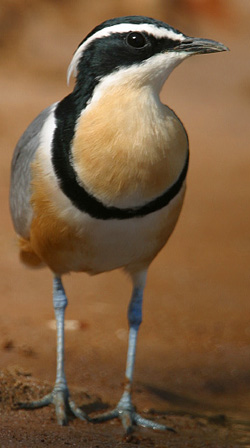
The Pluvianidae has Egyptian plover, also known as the crocodile bird, as the sole member of its own monotypic family. It is a wader, the only member of the genus Pluvianus and was formerly placed in the pratincole and courser family, Glareolidae. The species is one of several plovers doubtfully associated with the ‘trochilus’ bird mentioned in a supposed cleaning symbiosis with the Nile crocodile.
It is a striking and unmistakable species. The 19cm to 21cm long adult has a black crown, back, eye-mask and breast band. The rest of the head is white. The remaining upper plumage is blue-grey, and the underparts are orange. The longish legs are blue-grey.
In flight, it is even more spectacular, with the black crown and back contrasting with the grey of the upper parts and wings. The flight feathers are brilliant white crossed by a black bar. From below, the flying bird is entirely white, apart from the orange belly and black wing bar. After landing, members of a pair greet each other by raising their wings in an elaborate ceremony that shows off the black and white markings.
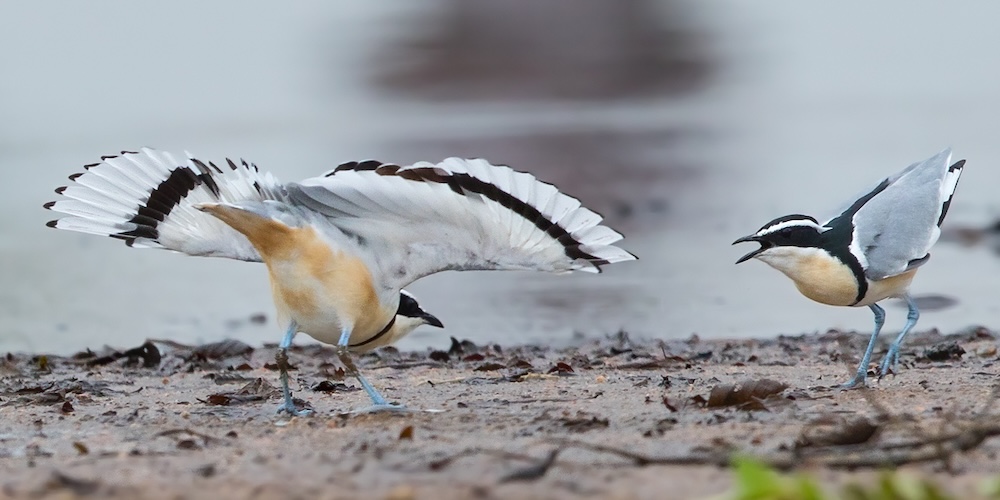
Egyptian Plover Pluvianus aegyptius – ©Dubi Shapiro
The sexes are similar, but juveniles are duller and the black marking are intermixed with brown. This usually very tame bird is found in pairs or small groups near water. It feeds by pecking for insects. The call is a high-pitched krrr-krrr-krrr.
It occurs in a band across sub-Sahan Africa from Senegal in the west to Ethiopia in the east and south to parts of the Democratic Republic of the Congo. It no longer occurs in Egypt. It breeds on sandbars in large rivers, avoiding forested areas. Breeding takes place between early January and the end of March. The nest is a scrape in loose sand on a riverine island. The clutch is usually 3 to 4 eggs which are light yellow-brown with red-brown to grey spots and measure around 32 mm × 24 mm (1.26 in × 0.94 in). The eggs are incubated by both sexes and hatch after 28–31 days. The parent covers the eggs with sand when it leaves the nest. During the hot period of the day the parents wet the feathers of their underparts and then use this water to soak the eggs and the associated covering layer of sand. The chicks are precocial and nidifugous. They are cared for by both parents and can feed themselves independently when around 1 week of age. The fledging period is around 35 days. They mainly eat worms, molluscs, aquatic insects and small flies, picking them from the surface but also probing wet sand and occasionally in the air.
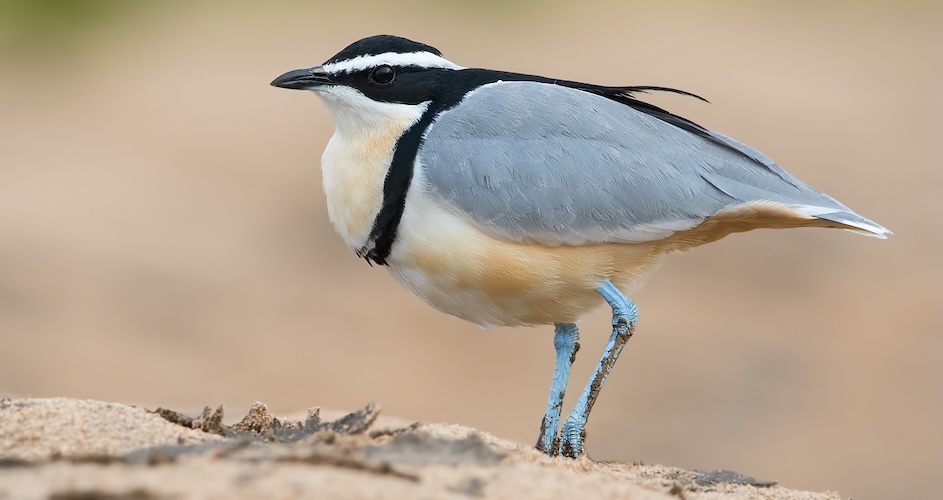
Egyptian Plover Pluvianus aegyptius – ©Dubi Shapiro
The bird is sometimes referred to as the crocodile bird for its alleged symbiotic relationship with crocodiles. According to Herodotus, the crocodiles lie on the shore with their mouths open and a bird called trochilus flies into the crocodiles’ mouths so as to feed on decaying meat lodged between the crocodiles’ teeth. The identification of the trochilus with any particular plover is doubtful, as is the cleaning symbiosis itself; no known photographic evidence exists, and the written accounts are considered suspect.
-
Number of bird species: 1
(As at July 2025)
Egyptian Plover Pluvianus aegyptius
-
Pluvianidae
Family AccountWidespread along large open rivers in central Africa, these birds feed along the shore, picking invertebrates from the ground.
-
Egyptian Plover Pluvianus aegyptius
Species AccountThis species has an extremely large range, and hence does not approach the thresholds for Vulnerable under the range size criterion (Extent of Occurrence under 20,000 km² combined with a declining or fluctuating range size, habitat extent/quality, or population size and a small number of locations or severe fragmentation). -
Egyptian Plover Pluvianus aegyptius
Species AccountAn unusual shorebird that is so distinctive that it has been placed in its own family. The back is blue-gray and the underparts salmon. -
Egyptian Plover Pluvianus aegyptius
Species AccountThe Egyptian Plover has recently been reinstated in its own family… -
Egyptian Plover Pluvianus aegyptius
Species AccountEgyptian Plover Pluvianus aegyptius has most recently been assessed for The IUCN Red List of Threatened Species in 2024. Pluvianus aegyptius is listed as Least Concern. -
Egyptian Plover Pluvianus aegyptius
Species AccountSound archive and distribution map.