

Recurvirostridae – Avocets & Stilts
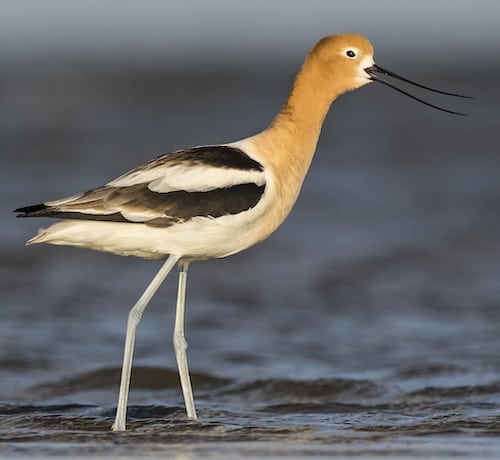
The Recurvirostridae (Stilts & Avocets) family is related to the waders, but sufficiently distinctive to merit its own family. The order Charadriiformes also includes Pluvianellidae (Magellanic Plover), Chionidae (Sheathbills), Burhinidae (Thick-knees & Stone Curlews), Pluvianidae (Egyptian Plover), Ibidorhynchidae (Ibisbill), Haematopodidae (Oystercatchers), Charadriidae (Plovers & Lapwings), Pedionomidae (Plains Wanderer), Thinocoridae (Seedsnipes), Rostratulidae (Painted Snipe), Jacanidae (Jacanas), Scolopacidae (Sandpipers), Turnicidae (Buttonquails), Dromadidae (Crab-Plover), Glareolidae (Coursers & Pratincoles), Stercorariidae (Skuas), Alcidae (Auks) and Laridae (Gulls, Terns & Skimmers). It contains two distinct groups of birds, the avocets (one genus) and the stilts (two genera).
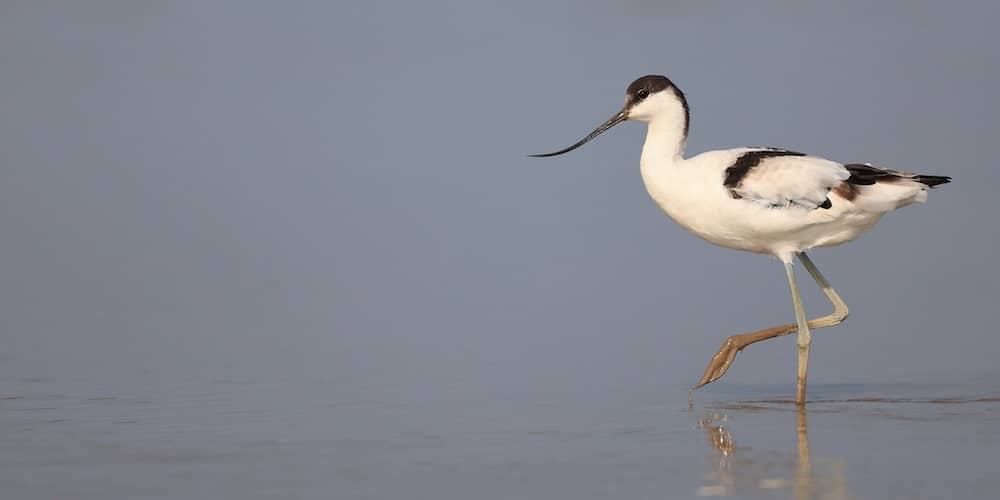
Pied Avocet Recurvirostra avosetta – ©Bird-Photo-Tours ASIA
Avocets and stilts range in length from 30cm to 46cm and in weight from 140g to 435g, males are usually slightly bigger than females. All possess long, thin legs, necks, and bills. The bills of avocets are curved upwards, and are swept from side to side when the bird is feeding in the brackish or saline wetlands they prefer. The bills of stilts, in contrast, are straight. The front toes are webbed, partially in most stilts, and fully in avocets and the Banded Stilt, which swim more. The majority of species’ plumage has contrasting areas of black and white, with some species having patches of buff or brown on the head or chest. The sexes are similar. Their vocalisations are usually yelps of one or two syllables.
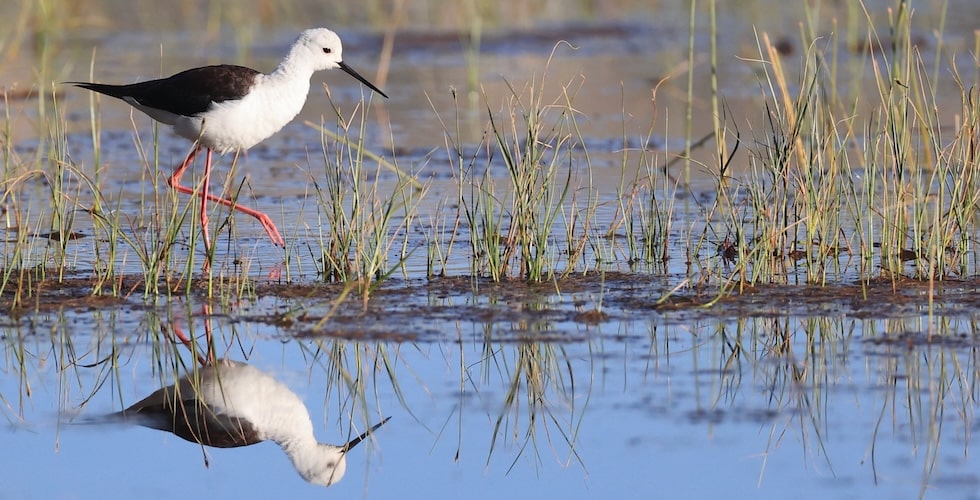
Black-winged Stilt Himantopus Himantopus – ©Bird-Photo-Tours ASIA
Avocets and stilts are a cosmopolitan family, being distributed on all the world’s continents except Antarctica, and occurring on several oceanic islands. Several species are wide-ranging and a few are locally distributed. One species, the Black Stilt of New Zealand, is critically endangered due to habitat loss, introduced predators, and hybridisation with the Pied Stilt.
All species feed on small aquatic animals such as mollusks, brine shrimp and other crustaceans, larval insects, segmented worms, tadpoles, and small fish.
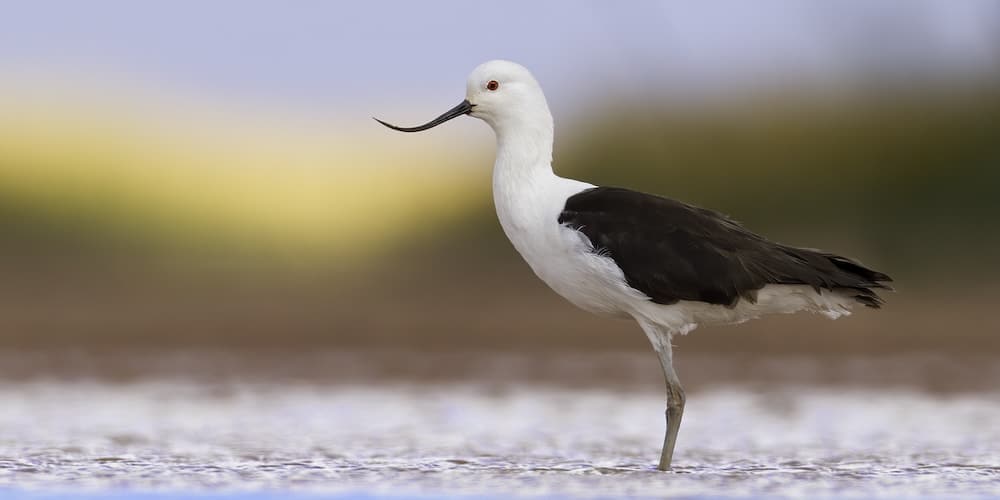
Andean Avocet Recurvirostra andina – ©Dubi Shapiro
Both stilts and avocets breed on open ground near water, sometimes on muddy areas that may become inundated, often in loose colonies. They defend nesting territories vigorously with aggressive displays, and mob intruders and possible predators with a great deal of noise. They are monogamous, although the pair bonds are not maintained from season to season. Their eggs are light-coloured with dark markings, weighing 22 to 44 grams. Three to four are laid in simple nests, and both parents share the incubation duties, which last 22 to 28 days.
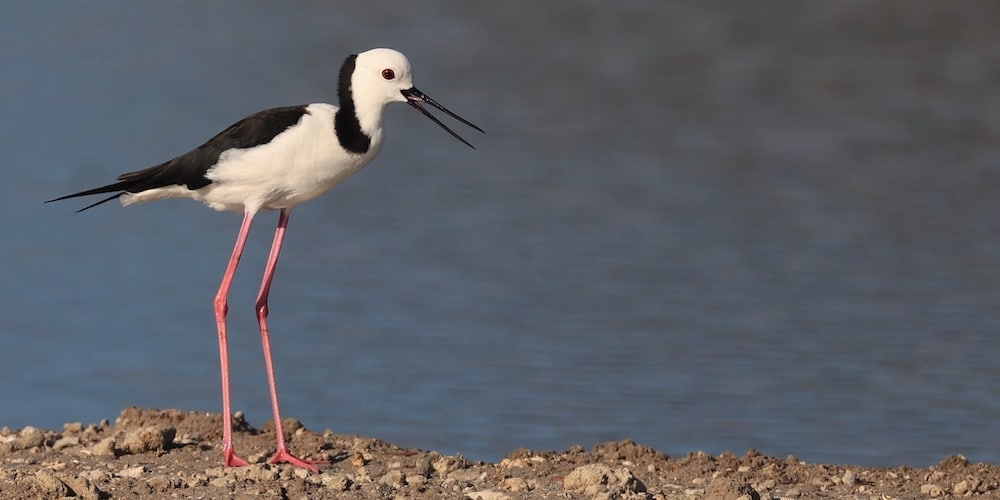
Black-necked Stilt Himantopus mexicanus – ©Bird-Photo-Tours ASIA
The Banded Stilt may breed only every few years, as it breeds on temporary lakes caused by rains in the deserts of Australia. The chicks are downy and precocial, leaving the nest within a day of hatching; they fledge in 28 to 35 days. In all species except the Banded Stilt, the chicks are cared for by the parents for several months, and they may move them to new areas and defend territories there. Banded Stilts deviate from this by collecting their progeny in massive crèches numbering several hundred chicks.
-
Number of bird species: 9
(As at August 2025)
The recently (2025) unified AviList recognises just 9 species, in three genera within this family, which are:
Banded Stilt Cladorhynchus leucocephalus
Pied Avocet Recurvirostra avosetta
Red-necked Avocet Recurvirostra novaehollandiae
American Avocet Recurvirostra americana
Andean Avocet Recurvirostra andina
Black-necked Stilt Himantopus mexicanus
Black-winged Stilt Himantopus himantopus
White-headed Stilt Himantopus leucocephalus
Black Stilt Himantopus novaezelandiae
White-backed Stilt Himantopus (mexicanus) melanurus
Three species are recognised by AviList in the Himantopus himantopus (black and white stilts) complex pending further research: monotypic H. himantopus; monotypic H. leucocephalus; and polytypic H. mexicanus (including melanurus and knudseni). Although the all-black taxon (H. novaezelandiae) is widely accepted as a distinct species (as here), the number of species recognised among the five black-and-white taxa ranges from one to four. Genetic divergence across the genus appears to be low (Steeves et al. 2010; Forsdick et al. 2021), there is considerable uncertainty over levels of reproductive isolation across the complex (Steeves et al. 2010; Harvey et al. 2014; Forsdick et al. 2021), and detailed vocal studies are lacking. In the absence of a more comprehensive review, AviList continue to recognise the black-winged (nominate H. himantopus), pied (H. leucocephalus), and black-necked (H. mexicanus) groups.
-
Australia Wader Study Group
WebsiteThe Australasian Wader Studies Group was formed in 1981 as a special interest group of Birds Australia. The group is an non-government organisation dedicated to studying waders (otherwise known as shorebirds) throughout the East-Asian Australasian Flyway. There are about 330 members, of which 90 are from Asia -
International Wader Study Group
WebsiteThe International Wader Study Group (IWSG) is an association of amateurs and professionals from all parts of the world interested in Charadrii (waders or shorebirds). Membership of the WSG is currently over 650 worldwide. Members can be found in over 50 countries around the world, including all European countries and the Americas, Asia, Africa and Australasia. The interests of the group have diversified from its original focus from ringing and migration-related studies to embrace all aspects of wader biology. -
Western Hemisphere Shorebird Reserve Network
WebsiteWHSRN is a voluntary, non-regulatory coalition of over 200 private and public organizations in seven countries working together to study and conserve shorebirds throughout their habitats. Participation in WHSRN provides the site with international recognition as a major host for shorebirds. OUR MISSION: The conservation, restoration, and management of critical shorebird habitats throughout the Americas
-
Geographical Variation in Waders
| By Meinte Engelmoer & Cees S Roselaar | Kluwer Academic Publishers | 1998 | Hardback | 331 pages, figures, tabs, maps | ISBN: 9780792350200 Buy this book from NHBS.com -
Waders of Europe, Asia & North America
| By Stephen Message & Don Taylor | Christopher Helm 2005 | Paperback | 224 pages, 80 plates with colour illustrations | ISBN: 9780713652901 Buy this book from NHBS.com
-
Recurvirostridae
Family AccountWith slender bills, long necks, and a pair of seemingly endless legs to match, stilts and avocets feed on invertebrates from shallow lakes and lagoons... -
Recurvirostridae
Family AccountThis is a small family, of only 10 species. All are extremely long-legged, long-billed wading birds with a striking black and white plumage.
-
American Avocet Recurvirostra americana
Species AccountDistinctive large shorebird with a long, thin, upturned bill. Look for bold black-and-white wings and long blue-gray legs. -
American Avocet Recurvirostra americana
Species AccountThe American avocet (Recurvirostra americana) is a large wader in the avocet and stilt family, Recurvirostridae. -
American Avocet Recurvirostra americana
Species AccountRecurvirostra americana is listed as Least Concern. -
American Avocet Recurvirostra americana
Species AccountSound archive and distribution map. -
Andean Avocet Recurvirostra andina
Species AccountAn elegant, boldly patterned large shorebird of high Andean salt lakes, bogs, and lagoon shores. -
Andean Avocet Recurvirostra andina
Species AccountThe Andean avocet (Recurvirostra andina) is a large wader in the avocet and stilt bird family, Recurvirostridae. It is resident in the Andes, breeding above 3500 m in northwestern Argentina, western Bolivia, northern Chile and southern Peru. -
Andean Avocet Recurvirostra andina
Species AccountSound archive and distribution map. -
Banded Stilt Cladorhynchus leucocephalus
Species AccountThe banded stilt (Cladorhynchus leucocephalus) is a nomadic stilt endemic to Australia. It belongs to the monotypic genus Cladorhynchus. -
Banded Stilt Cladorhynchus leucocephalus
Species AccountSound archive and distribution map. -
Black Stilt Himantopus novaezelandiae
Species AccountThe black stilt or kakī (Māori), Himantopus novaezelandiae, is found only in New Zealand, and is the world's rarest wading bird: less than 100 adults survive in the wild. Adult kakī have distinctive black plumage, very long red legs, and a long thin black bill. Black stilts currently breed only in the Mackenzie Basin in the South Island, and are threatened by introduced feral cats and ferrets, as well as habitat degradation from hydroelectric dams, agriculture, and invasive weeds. -
Black Stilt Himantopus novaezelandiae
Species AccountHimantopus novaezelandiae is listed as Critically Endangered under criteria D. -
Black Stilt Himantopus novaezelandiae
Species AccountOnce the common stilt of New Zealand, the black stilt is now critically endangered with a breeding population confined to the Mackenzie Basin of South Canterbury and North Otago. Adults are distinctive in having entirely black plumage, long red legs and a thin black bill, but juveniles and subadults can easily be overlooked amongst pied stilts, while hybrids add to the plumage confusion. -
Black Stilt Himantopus novaezelandiae
Species AccountSound archive and distribution map. -
Black-necked Stilt Himantopus mexicanus
Species AccountSound archive and distribution map. -
Black-necked Stilt Himantopus mexicanus
Species AccountThe black-necked stilt (Himantopus mexicanus) is a locally abundant shorebird of American wetlands and coastlines. It is found from the coastal areas of California through much of the interior western United States and along the Gulf of Mexico as far east as Florida, then south through Central America and the Caribbean to northwest Brazil southwest Peru, east Ecuador and the Galápagos Islands. -
Black-necked Stilt Himantopus mexicanus
Species AccountElegant shorebird with exceptionally long, bright pink legs. Distinctive black-and-white plumage and thin black bill. Male is glossier black above, female is... -
Black-winged Stilt Himantopus himantopus
Species AccountThe black-winged stilt, common stilt, or pied stilt (Himantopus himantopus) is a widely distributed very long-legged wader in the avocet and stilt family (Recurvirostridae). -
Black-winged Stilt Himantopus himantopus
Species AccountThe Black-winged Stilt is a large black and white wader with long orange-red legs and a straight black bill. It has black on the back of the neck, a white collar and a red iris. Both sexes are similar, and the plumage does not change during the year. -
Black-winged Stilt Himantopus himantopus
Species AccountHimantopus himantopus is listed as Least Concern. -
Black-winged Stilt Himantopus himantopus
Species AccountSound archive and distribution map. -
Pied Avocet Recurvirostra avosetta
Species AccountThe pied avocet (Recurvirostra avosetta) is a large black and white wader in the avocet and stilt family, Recurvirostridae. They breed in temperate Europe and western and Central Asia. It is a migratory species and most winter in Africa or southern Asia. Some remain to winter in the mildest parts of their range, for example in southern Spain and southern England. The pied avocet is one of the species to which the Agreement on the Conservation of African-Eurasian Migratory Waterbirds (AEWA) applies. -
Pied Avocet Recurvirostra avosetta
Species AccountRecurvirostra avosetta is listed as Least Concern. -
Pied Avocet Recurvirostra avosetta
Species AccountA distinctively-patterned black and white wader with a long up-curved beak. It is the emblem of the RSPB and symbolises the bird protection movement in the UK more than any other species. -
Pied Avocet Recurvirostra avosetta
Species AccountSound archive and distribution map. -
Red-necked Avocet Recurvirostra novaehollandiae
Species AccountThe red-necked avocet (Recurvirostra novaehollandiae) also known as the Australian avocet, cobbler, cobbler's awl, and painted lady, is a wader of the family Recurvirostridae that is endemic to Australia and is fairly common and widespread throughout, except for the north and north east coastal areas of the country. -
Red-necked Avocet Recurvirostra novaehollandiae
Species AccountThe Red-necked Avocet has a chestnut brown head and neck with a white eye-ring and a long, upturned, black bill. The rest of the body is white, except for two black streaks along the back. -
Red-necked Avocet Recurvirostra novaehollandiae
Species AccountSound archive and distribution map. -
White-backed Stilt Himantopus mexicanus melanurus
Species AccountSound archive and distribution map. -
White-headed Stilt Himantopus leucocephalus
Species AccountThe white-headed stilt (Himantopus leucocephalus) is a bird in the family Recurvirostridae. It is sometimes considered a subspecies of the black-winged stilt (H. himantopus). This shorebird has been recorded from Malaysia, Japan, the Philippines, Brunei, Christmas Island, Indonesia, Palau, Papua New Guinea, Australia and New Zealand. -
White-headed Stilt Himantopus leucocephalus
Species AccountSound archive and distribution map.
-
The New Shorebirds Handbook Project
BlogThis is a blog of The New Shorebirds Handbook Project which aims to bring together the current knowledge on shorebird science, conservation and a little bit more. By following the blog, readers could insight into the progress and important milestones of the project and the recent news on the world of waders and a bit more of us, the authors….