

Rheidae – Rheas
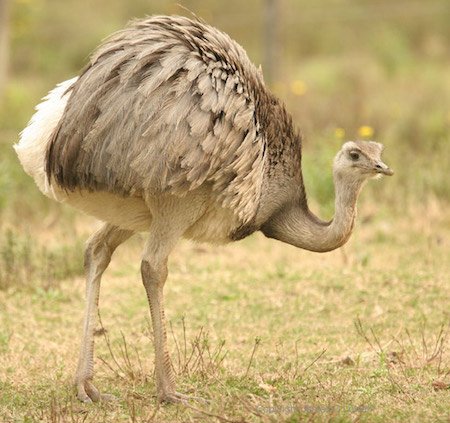
The Rheas are large flightless birds that are three toed, terrestrial and have long legs and long necks. They live for about 10 years in the wild. The are confined to South America where they inhabit open grassland, grassy wetlands or scrub ranging from sea-level up to 4500m and even into very arid areas. When not breeding they form flocks of up to 100 birds. They generally eat broadleaf foliage, seeds and fruit, but will also take insects, scorpions, reptiles, and small mammals and birds. Often eating seeds and tough vegetation they swallow pebbles which help grind the food min their crops and so aid digestion. As they tend not to eat grains they are considered beneficial to cereal growing farmers as they will take pests from crops including locust, beetles and other pests.
Like other ratites males tend eggs and nests.
The greater rhea Rhea americana is sometimes known as the grey, common, or American rhea. One of two species of Rheidae, it inhabits a variety of open areas, such as grasslands, savanna or grassy wetlands. Weighing 20–27 kilograms (44–60 lb), the greater rhea is the largest native bird in the Americas. In the wild, the greater rhea has a life expectancy of c.10 years. The species is listed as Near Threatened by the IUCN.
The adults have an average weight of 20–27 kg (44–60 lb) and often measure 127 to 140 cm (50 to 55 in) long from beak to tail; they usually stand about 1.5 m (4 ft 11 in) tall, with a typical range of 1.4 to 1.7 m (4 ft 7 in to 5 ft 7 in), to the top of the head. The males are generally bigger than the females. Despite the delineation of this species as the ‘greater rhea’ the lesser rhea averages about the same weight, but even at mass parity that greater species appears larger and is taller due to its longer legs and neck, whereas the lesser rhea is more compact and more so resembles an outsized, long-necked turkey in build. Elsewhere, the lesser rhea has been cited with a lower average weight of 16 kg (35 lb). In some areas, male Greater Rheas weights of up to 35 kg (77 lb) are not uncommon and even females of up to 30 kg (66 lb) have been observed, both weights higher than the maximum known mass for the lesser rhea. Large males can weigh up to 40 kg (88 lb), stand nearly 1.83 m (6.0 ft) tall and measure over 150 cm (59 in) long, although this is uncommon.
The head and bill are fairly small, the latter measuring 8–10.4 cm (3.1–4.1 in) in length. The legs are long, with the tarsus measuring between 33.5 and 37 cm (13.2 and 14.6 in), and strong and have 22 horizontal plates on the front of the tarsus. They have three toes, and the hind toe is absent. Their wings are rather long; the birds use them during running to maintain balance during tight turns, and also during courtship displays. They have a fluffy, tattered-looking plumage, that is grey or brown, with high individual variation. The head, neck, rump, and thighs are feathered. In general, males are darker than females. Even in the wild, particularly in Argentina, leucistic individuals as well as albinos occur. Hatchling greater rheas are grey with dark lengthwise stripes.
It is native to Argentina, Bolivia, Brazil, Paraguay, and Uruguay. There are also feral populations of the greater rhea in Germany. This species inhabits any grassland, although it prefers areas with at least some tall vegetation. It is absent from the humid tropical forests of the uplands along the coast of Brazil and extends south to 40° latitude. They prefer lower elevations and seldom go above 1,200 metres (3,900 ft). During the breeding season (spring and summer), they tend to stay near water sources.
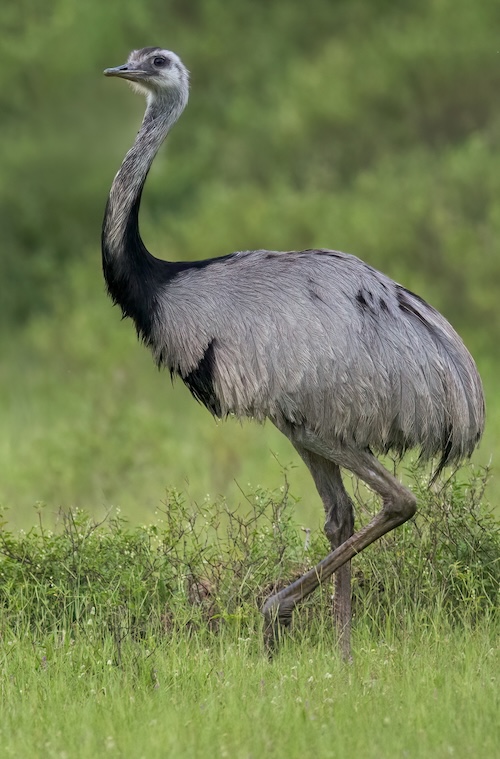
Greater Rhea Rhea americana – Dubi Shapiro
They are silent birds except during mating season, when they make low booming noises, and as chicks, when they give a mournful whistle. During the non-breeding season, they will form flocks of between 10 and 100 birds. When in flocks, they tend to be less vigilant, but the males can get aggressive towards other males. When chased they will flee in a zigzag pattern, alternately raising one wing then the other. These flocks break up in the winter in time for breeding season.
The Greater Rhea’s diet mainly consists of broad-leaved foliage, particularly seed and fruit such as Avocados when in season, but also insects, scorpions, fish, small rodents, reptiles, and small birds. They do not usually eat cereal grains, or monocots in general. However, the leaves of particular grass species like Brachiaria brizantha can be eaten in large quantities, as well as broad-leaved plants and even tough and spiny vegetable matter like tubers or thistles is eaten with relish. Like many birds which feed on tough plant matter, the greater rhea swallows pebbles which help grind down the food for easy digestion. It is much attracted to sparkling objects and sometimes accidentally swallows metallic or glossy objects. Rheas are also coprophagous and occasionally consume fresh fecal matter of other rheas. Juveniles eat more animal matter than adults.
After the large flocks break up in the winter, they form into three loose groups; single males, flocks of between two and fifteen females, and a large flock of yearlings. As winter approaches, males become more aggressive towards each other. Then they start courting females by calling and raising the front of their body up while keeping their neck straight and ruffling their plumage. They will raise their wings and may run some distance like this, sometime flapping their wings methodically. After doing this and attracting females, they will continue calling at a specific female, and will start to either walk alongside her or in front of her while spreading his wings and lowering his head. As the display continues, he will get more intense and animated and start waving his neck around and in figure eights. Once he has attracted a first mate he will copulate with her and then lead her to his nest. The male will roll the egg into his nest. Males are simultaneously polygynous, females are serially polyandrous. In practice, this means that the females move around during breeding season, mating with a male and depositing their eggs with the male before leaving him and mating with another male. Males on the other hand are sedentary, attending the nests and taking care of incubation and the hatchlings all on their own. Recent evidence has shown that some males will utilize subordinate males to help incubate and protect the eggs. If this happens, the dominant male will find a second harem and start the process over again. The nests are thus collectively used by several females and can contain as many as 80 eggs laid by a dozen females; each individual female’s clutch numbers some 5–10 eggs. However, the average clutch size is 26 eggs laid by 7 different females.
Rhea eggs measure about 130 mm × 90 mm (5.1 in × 3.5 in) and weigh 600 g (21 oz) on average; they are thus less than half the size of an ostrich egg. Their shell is greenish-yellow when fresh but soon fades to dull cream when exposed to light. The nest is a simple shallow and wide scrape in a hidden location; males will drag sticks, grass, and leaves in the area surrounding the nest so it resembles a firebreak as wide as their neck can reach. The incubation period is 29–43 days. All the eggs hatch within 36 hours of each other even though the eggs in one nest were laid perhaps as much as two weeks apart. As it seems, when the first young are ready to hatch they start a call resembling a pop-bottle rocket or even fireworks, even while still inside the egg, thus the hatching time is coordinated. Greater rheas are half-grown about three months after hatching, and sexually mature by their 14th month.
The natural predators of adult greater rheas are limited to the cougar Puma concolor, which are found in most areas inhabited by greater rheas and are certain to be their leading predator, and the jaguar Panthera onca. Feral dogs are known to kill younger birds, and Crested Caracara Caracara plancus is suspected to prey on hatchlings. Armadillos sometimes feed on their eggs.
Farmers sometimes consider the greater rhea pests, because they will eat broad-leaved crop plants, such as cabbage, chard and bok choy. Where they occur as pests, farmers tend to hunt and kill greater rheas. The burning of crops in South America has also contributed to their decline.
-
Number of bird species: 2
(As at July 2025)
The IOC recognises just two species in this family, which are:
Lesser Rhea Rhea pennata
Greater Rhea Rhea americana
Taxon tarapacensis (polytypic, including garleppi) is treated as conspecific with Rhea pennata based on available evidence. Although reported to differ in breeding plumage and tarsal scutellation, a comprehensive review of phenotypic variation and potential intergradation at the contact zone is required; genetic data would also be informative.
Both species have a number of races.
The Lesser Rhea races are:
P.p. garleppi -Chubb 1913 (S Peru, SW Bolivia & NW Argentina)
P.p. tarapacensis -Chubb 1913 (N Chile)
P.p. pennata – d’Orbigny 1834 (S Chile & W central & S Argentina)
The Greater Rhea races are:
R.a. americana Linneus 1758 (NE to SE Brazil)
R.a. intermedia Rothschild & Chubb 1914 (SE Brazil & Uruguay)
R.a. nobilis Brodkorb 1939 (E Paraguay)
-
Rheidae
Family AccountIt is today represented by the sole living genus Rhea, but also contains several extinct genera -
Rheiformes
Order AccountRheiformes is an order that contains the family Rheidae (rheas). It is in the infraclass Paleognathae, which contains all ratites.
-
Greater Rhea Rhea americana
Species AccountThe largest bird in South America; resembles an ostrich and is unmistakable. Flightless and appears tailless. Mostly gray-brown overall with very long legs... -
Greater Rhea Rhea americana
Species AccountThe greater rhea (Rhea americana) is a species of flightless bird native to eastern South America. -
Greater Rhea Rhea americana
Species AccountImage of skull & Morphology -
Greater Rhea Rhea americana
Species AccountIUCN species profile... -
Greater Rhea Rhea americana
Species AccountSound archive and distribution map -
Lesser Rhea Rhea pennata
Species AccountThis flightless South American relative of the ostriches stands about 5 feet tall with a body about the size of a sheep; no similar species in its range. -
Lesser Rhea Rhea pennata
Species AccountDarwin's rhea or the lesser rhea (Rhea pennata) is a large flightless bird, the smaller of the two extant species of rheas. It is found in the Altiplano and Patagonia in South America. -
Lesser Rhea Rhea pennata
Species AccountIUCN species profile... -
Lesser Rhea Rhea pennata
Species AccountSound archive and distribution map
-
Lesser Rhea Rhea pennata
ArticleEnvironmental factors influencing the distribution of the Lesser Rhea (Rhea pennata pennata) in southern Patagonia -
Mating Behavior of the Male Greater Rhea
ArticleThaïs L. Codenotti and Fernando Alvarez -
Stress in wild Greater Rhea populations Rhea americana
Article...effects of agricultural activities on seasonal excreted glucocorticoid metabolite levels. A. Lèche, G. Bazzano, C. Hansen, J. L. Navarro, R. H. Marin, M. B. Martella - Journal of Ornithology, October 2014, Volume 155, Issue 4, pp 919-926
-
Greater Rhea Rhea americana
VideoZoo images... The Greater Rhea (Rhea americana) is a flightless bird found in eastern South America. Other names for the Greater Rhea include the Grey, Common, American Rhea, ñandú (Guaraní) or ema (Portuguese). One of two species in the genus Rhea, in the family Rheidae, the Greater Rhea is endemic to Argentina, Bolivia... -
Lesser Rhea Rhea pennata
VideoLesser Rhea (Rhea pennata), is a large flightless bird, but the smaller of the two extant species of rheas. It is found in the Altiplano and Patagonia in South America...