

Strigidae – Owls
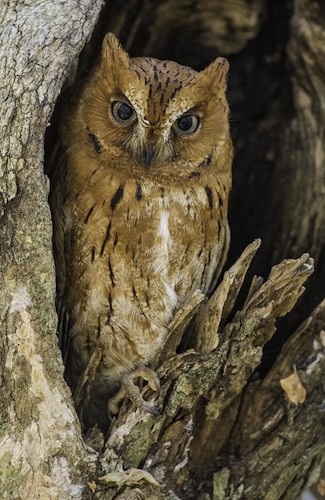
The Strigidae (true owls or typical owls) are one of the two generally accepted families of owls, the other being the Tytonidae (barn owls and bay owls). This large family comprises two hundred and twenty-five species in twenty-three genera. They have a global distribution being found on every continent except Antarctica.
While typical owls vary greatly in size, with the smallest species, the elf owl, being a hundredth the size of the largest, the Eurasian eagle-owl and Blakiston’s fish owl, owls generally share an extremely similar overall look. They have proportionately large heads, short tails, cryptic plumage, and round facial discs around the eyes. The family is generally arboreal (with a few exceptions like the burrowing owl) and obtain their food on the wing (with exceptions like the fishing owls). The wings are large, long, broad and rounded. As is the case with most birds of prey, in many owl species females are larger than males.
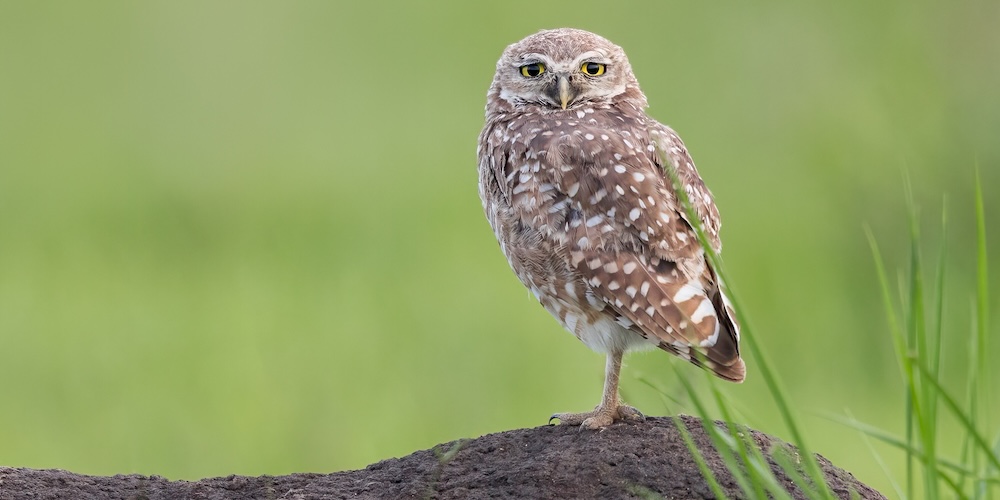
Burrowing Owl Athene cunicularia
Because of their nocturnal habits, they tend not to exhibit sexual dimorphism in their plumage. Specialized feathers and wing shape suppress the noise produced by flying, both taking off, flapping and gliding. This silent flight allows owls to hunt without being heard by their prey. Owls possess three physical attributes that are thought to contribute to their silent flight capability. Firstly, on the leading edge of the wing, there is a comb of stiff feathers; secondly, the trailing edge of the wing contains a flexible fringe and, lastly, owls have downy material distributed on the tops of their wings that creates a compliant but rough surface (similar to that of a soft carpet). All these factors result in significant aerodynamic noise reductions.
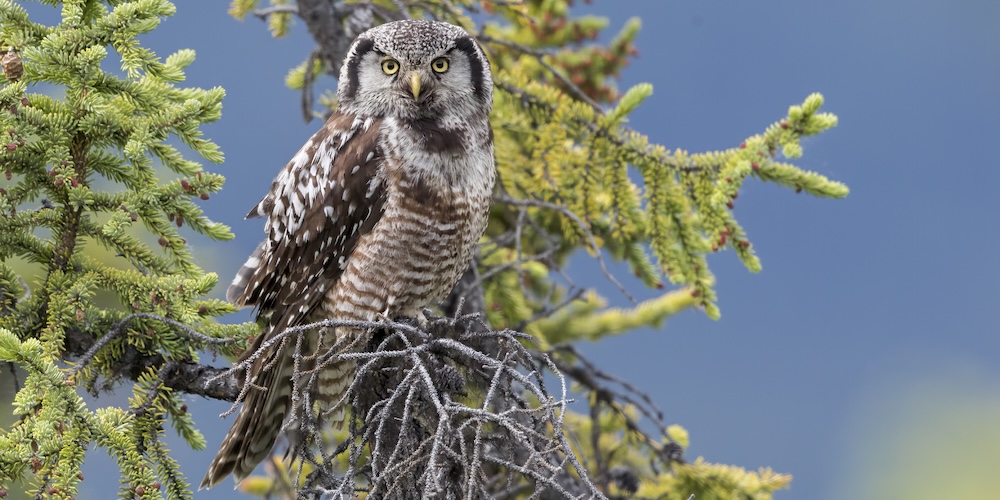
Northern Hawk-Owl Surnia ulula
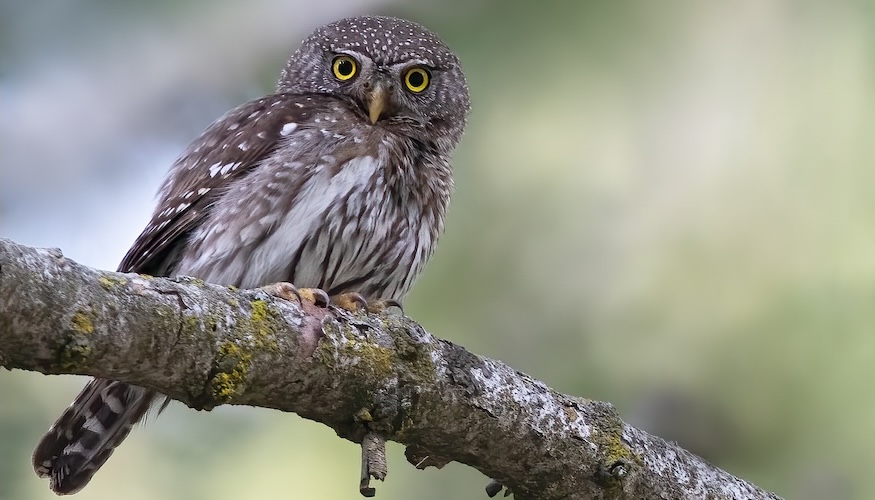
Northern Pygmy Owl Glaucidium gnoma
The toes and tarsi are feathered in some species, and more so in species at higher latitudes. Numerous species of owls in the genus Glaucidium and the northern hawk-owl have eye patches on the backs of their heads, apparently to convince other birds they are being watched at all times.
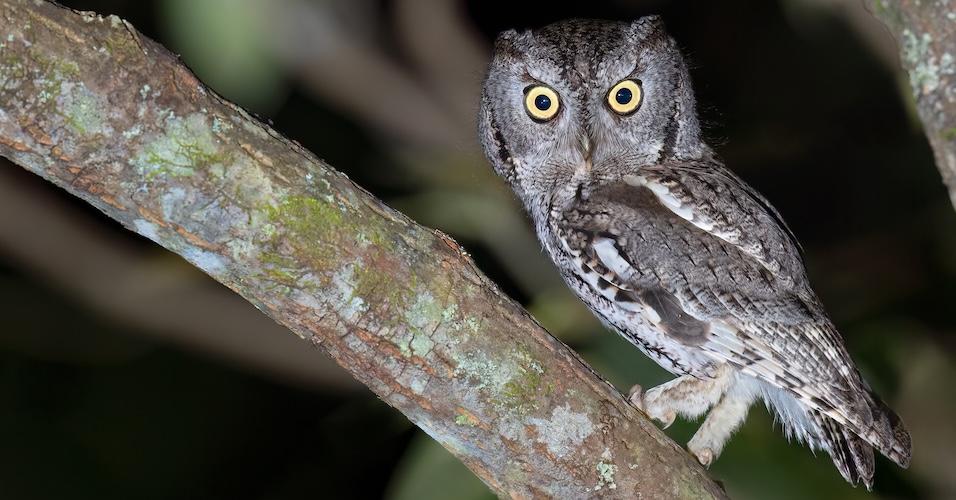
Eastern Screech Owl Megascops asio
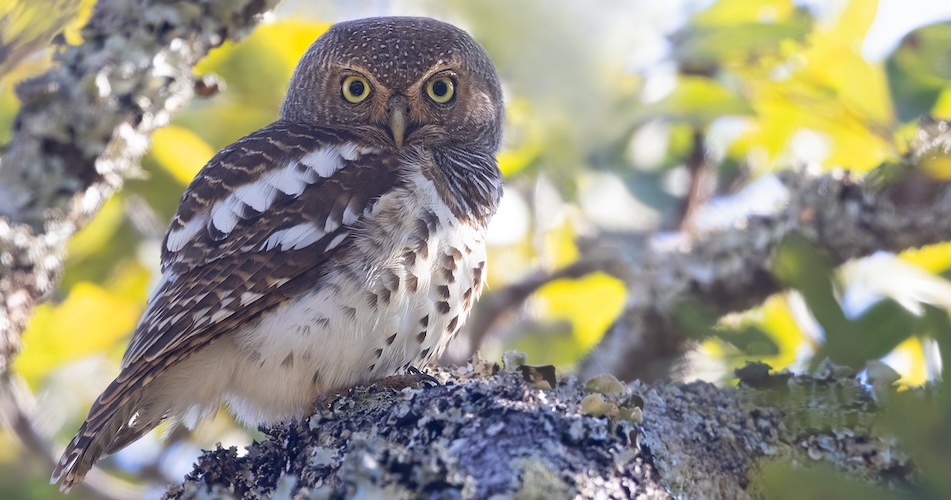
African Barred Owlet Glaucidium capense
Numerous nocturnal species have ear-tufts, feathers on the sides of the head that are thought to have a camouflage function, breaking up the outline of a roosting bird. The feathers of the facial disc are arranged in order to increase sound delivered to the ears. Hearing in owls is highly sensitive and the ears are asymmetrical allowing the owl to localise a sound in multiple directions. Owls can pinpoint the position of prey, such as a squeaking mouse, by computing when the sound from the object reaches the owl’s ears. If the sound reaches the left ear first, the mouse must be to the left of the owl. The owl’s brain will then direct the head to directly face the mouse. In addition to hearing, owls have massive eyes relative to their body size. Contrary to popular belief, however, owls cannot see well in extreme dark and are able to see well in the day.
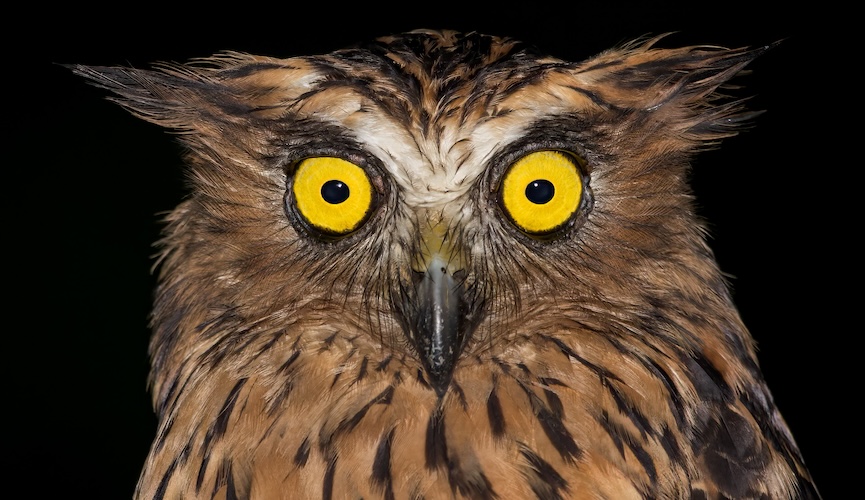
Buffy Fish Owl Ketupa ketupu
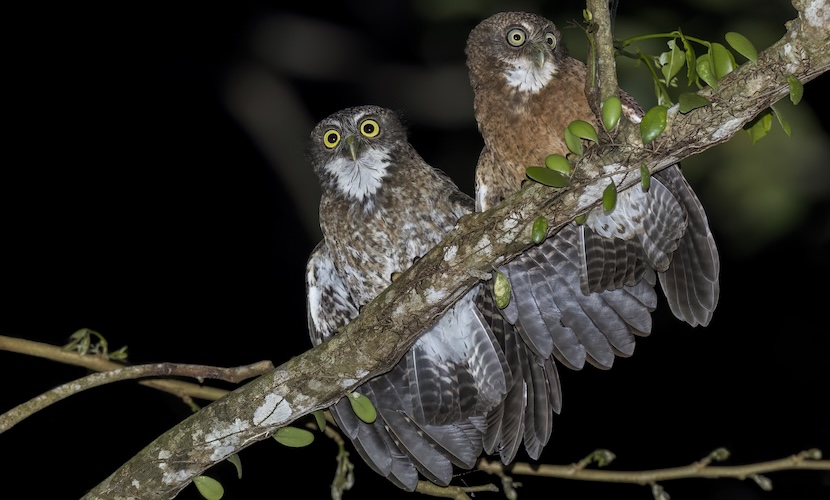
Cebu Hawk-Owl Ninox rumseyi
Owls are also able to rotate their heads by as much as 270 degrees in either direction without damaging the blood vessels in their necks and heads, and without disrupting blood flow to their brains. Researchers have found four major biological adaptations that allow for this unique capability. First, in the neck there is a major artery, called the vertebral artery, that feeds the brain. This artery passes through bony holes in the vertebra. These bony holes are ten times larger in diameter than the artery that passes through them (extra space in the transverse foramina) which creates air pockets that allow for more movement of the artery when twisted. 12 of the 14 cervical vertebrae in the owl’s neck have this adaptation. This vertebral artery also enters the neck higher up than it does in other birds. Instead of going in at the 14th cervical vertebrae, it enters in at the 12th cervical vertebrae. Finally, the small vessel connection between the carotid and the vertebral arteries allow the exchanging of blood between two blood vessels. These cross connections allow for uninterrupted blood flow to the brain. This means that even if one route is blocked during extreme head rotations, another route can continue blood circulation to the brain.
|
|
|
|
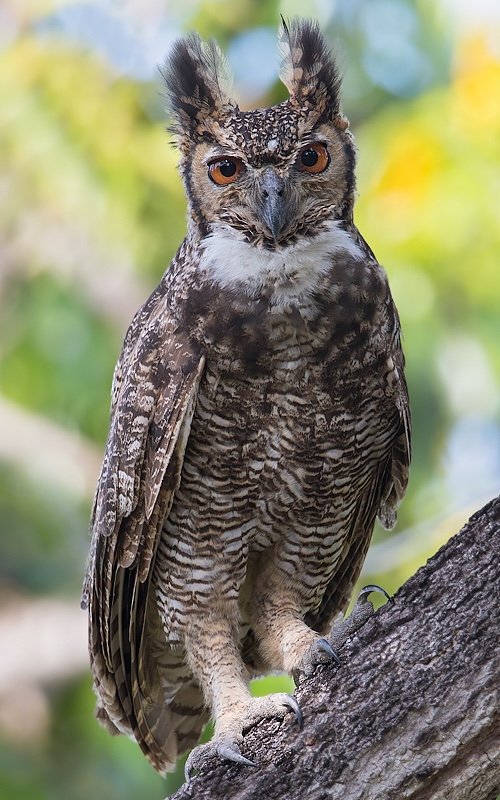
Great Horned Owl Bubo virginianus |
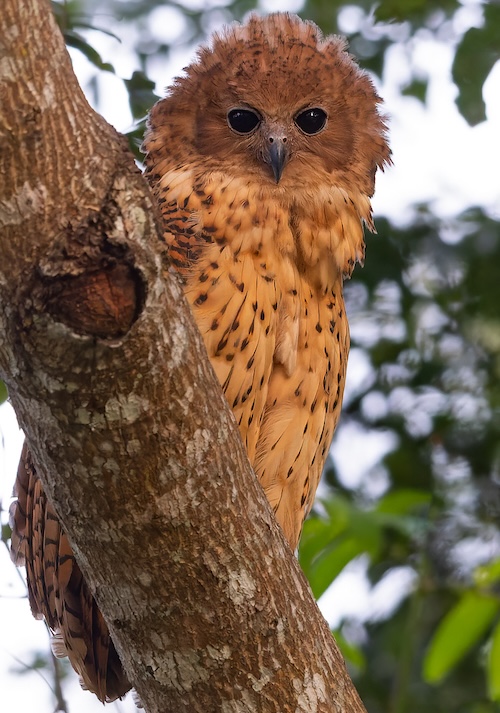
Pel’s Fishing Owl Scotopelia peli |
|
All photos in this intro ©Dubi Shapiro |
|
Several owl species also have fluorescent pigments called porphyrins under their wings. A large group of pigments defined by nitrogen-containing pyrole rings, including chlorophyll and heme (in animal blood), make up the porphyrins. Other bird species will use porphyrins to pigment eggshells in the oviduct. Owl species, however, use porphyrins as a pigment in their plumage. Porphyrins are most prevalent in new feathers and are easily destroyed by sunlight. Porphyrin pigments in feathers fluoresce under UV light, allowing biologists to more accurately classify the age of owls. The relative ages of the feathers are differentiated by the intensity of fluorescence that they emit when the primaries and secondaries are exposed to black light. This method helps to detect the subtle differences between third and fourth generation feathers, whereas looking at wear and colour makes age determination difficult.
|
|
|
|
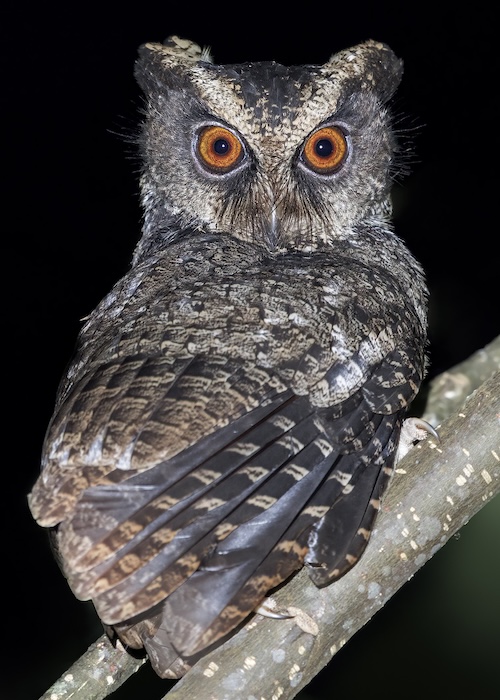
Everett’s Scops Owl Otus everetti |
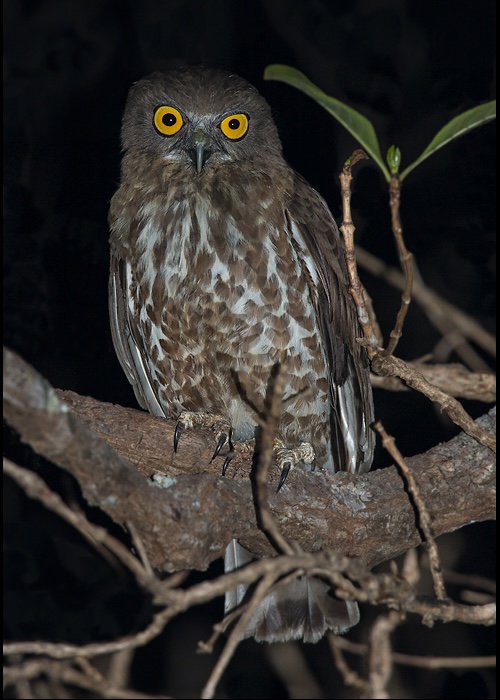
Brown Hawk-Owl Ninox scutulata |
Most owls are generally nocturnal or crepuscular and spend much of the day roosting. They are often misperceived as ‘tame’ since they allow humans to approach quite closely before taking flight, but in reality, they are attempting to avoid detection through stillness. Their cryptic plumage and the inconspicuous locations they adopt are an effort to avoid predators and mobbing by small birds.
|
|
|
|
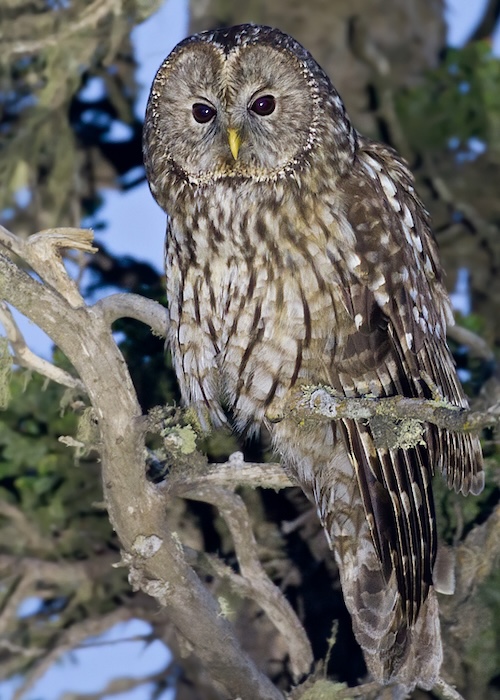
Ural OwlStrix uralensis davidi |
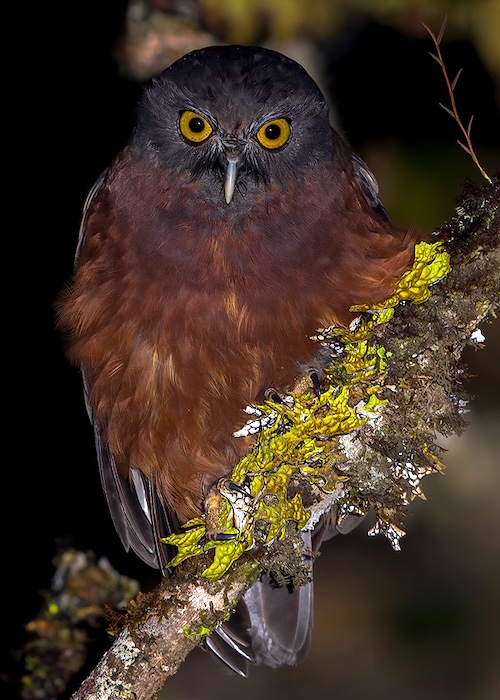
Papuan Boobook Ninox theomacha |
In 2002, the late Friedhelm Weick, author of Owls of the World, wrote this for Fatbirder:
Owls, my favourite birds
Owls are outstanding birds! Is it their silent hunting in the poor evening light and at night, their distinctive appearance – huge head and forward-looking eyes or maybe the echoes of ancient myths and tales of woodland goblins and bewitched owl-shaped princesses? However, since my childhood owls were my favourite birds. They even outranked my ambition for the diurnal birds of prey. As a wildlife artist, birder and ornithologist – I never lost my contact with these feather-armoured knights of the twilight. When in 1980 my book Birds of Prey of the World was printed, I had the idea for a similar project on the Strigiformes of the world. So, I began to collect every bit of information about this subject – and, remember: the Internet wasn’t in reach for the common wildlife artist then.
|
|
|
|
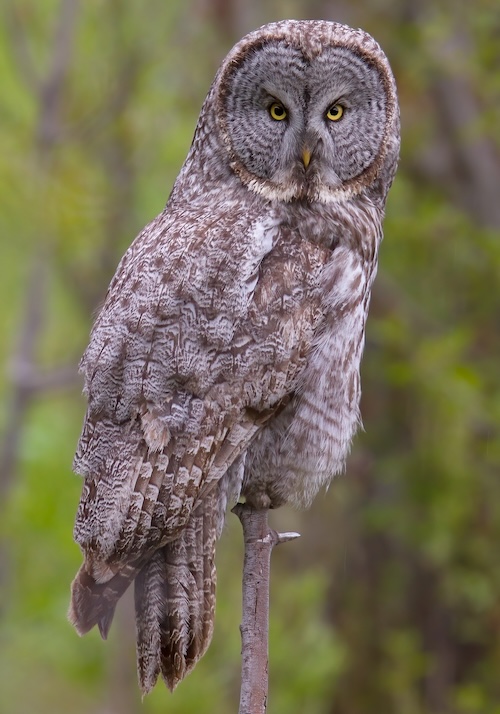
Great Grey Owl Strix nebulosa |
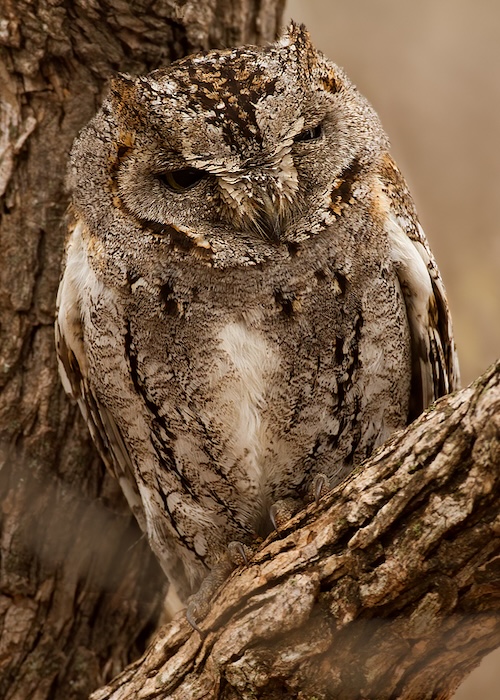
African Scops Owl Otus senegalensis |
I filed scientific articles, photos and colour-copies of books, sketches and other descriptions back to 1758, photos from living owls in the wild or captivity. Detailed lists of measurements and colours of skins, weights and feathers grew larger and larger. Beside that, I also visited zoological gardens, ornithological institutes and a lot of private owl-keepers, birders and ornithologists. In the early nineties I wrote three different annotated checklists for Strigiformes. The first included all recent complete taxa and their distribution. A second listed all-important measurements and weights linked to an index of photos and paintings. The third list was a full description of plumages and soft parts combined with a detailed bibliography.
This situation led Claus König, head of the Natural Science Museum at Stuttgart and an ambitious ornithologist, asked me if I would be interested in a project that should result in nothing less than the standard guide to all owls of the world. The publisher would be Pica Press. Of course I was, wasn’t I?
The three checklists were the basic-stock for our further work. In the following years I examined some thousands of skins and mounted owls in all-important museums of the world, only supported by my dear wife Christel. Within nearly three years I painted all different taxa and morphs that were sometimes known only by one skin…
In 1999 the book was published… leaving me more time for birding and outdoor projects and, last but not least, for new paintings of my favourite birds, guess which?
-
Number of bird species: 225
(As at September 2025)
According to the recently (2025) amalgamated AviList, there are 225 extant species in twenty-three genera of typical owl species in the Strigidae family. They are:
Papuan Hawk-Owl Uroglaux dimorpha
Bare-legged Owl Margarobyas lawrencii
Rufous Owl Ninox rufa
Powerful Owl Ninox strenua
Barking Owl Ninox connivens
Sumba Boobook Ninox rudolfi
Andaman Hawk-Owl Ninox affinis
Southern Boobook Ninox boobook
Rote Boobook Ninox rotiensis
Timor Boobook Ninox fusca
Alor Boobook Ninox plesseni
Tasmanian Boobook Ninox leucopis
Morepork Ninox novaeseelandiae
Little Sumba Hawk-Owl Ninox sumbaensis
Brown Hawk-Owl Ninox scutulata
Hume’s Hawk-Owl Ninox obscura
Northern Boobook Ninox japonica
Chocolate Boobook Ninox randi
Luzon Hawk-Owl Ninox philippensis
Mindanao Hawk-Owl Ninox spilocephala
Mindoro Hawk-Owl Ninox mindorensis
Romblon Hawk-Owl Ninox spilonotus
Cebu Hawk-Owl Ninox rumseyi
Camiguin Hawk-Owl Ninox leventisi
Sulu Hawk-Owl Ninox reyi
Ochre-bellied Boobook Ninox ochracea
Togian Boobook Ninox burhani
Cinnabar Boobook Ninox ios
Halmahera Boobook Ninox hypogramma
Tanimbar Boobook Ninox forbesi
Seram Boobook Ninox squamipila
Buru Boobook Ninox hantu
Christmas Boobook Ninox natalis
Papuan Boobook Ninox theomacha
Manus Boobook Ninox meeki
Speckled Boobook Ninox punctulata
New Ireland Boobook Ninox variegata
New Britain Boobook Ninox odiosa
Collared Owlet Taenioptynx brodiei
Sunda Owlet Taenioptynx sylvaticus
Long-whiskered Owlet Xenoglaux loweryi
Elf Owl Micrathene whitneyi
Boreal Owl Aegolius funereus
Northern Saw-whet Owl Aegolius acadicus
Unspotted Saw-whet Owl Aegolius ridgwayi
Buff-fronted Owl Aegolius harrisii
Forest Owlet Athene blewitti
White-browed Owl Athene superciliaris
Burrowing Owl Athene cunicularia
Little Owl Athene noctua
Spotted Owlet Athene brama
West Solomons Owl Athene jacquinoti
Guadalcanal Owl Athene granti
Malaita Owl Athene malaitae
Makira Owl Athene roseoaxillaris
Northern Hawk-Owl Surnia ulula
Eurasian Pygmy Owl Glaucidium passerinum
Pearl-spotted Owlet Glaucidium perlatum
Northern Pygmy Owl Glaucidium gnoma
Costa Rican Pygmy Owl Glaucidium costaricanum
Cloud-forest Pygmy Owl Glaucidium nubicola
Andean Pygmy Owl Glaucidium jardinii
Yungas Pygmy Owl Glaucidium bolivianum
Subtropical Pygmy Owl Glaucidium parkeri
Central American Pygmy Owl Glaucidium griseiceps
Tamaulipas Pygmy Owl Glaucidium sanchezi
Colima Pygmy Owl Glaucidium palmarum
Amazonian Pygmy Owl Glaucidium hardyi
Pernambuco Pygmy Owl Glaucidium mooreorum
East Brazilian Pygmy Owl Glaucidium minutissimum
Ferruginous Pygmy Owl Glaucidium brasilianum
Austral Pygmy Owl Glaucidium nana
Pacific Pygmy Owl Glaucidium peruanum
Cuban Pygmy Owl Glaucidium siju
Red-chested Owlet Glaucidium tephronotum
Sjöstedt’s Barred Owlet Glaucidium sjostedti
Asian Barred Owlet Glaucidium cuculoides
Javan Owlet Glaucidium castanopterum
Jungle Owlet Glaucidium radiatum
Chestnut-backed Owlet Glaucidium castanotum
African Barred Owlet Glaucidium capense
Albertine Owlet Glaucidium albertinum
White-fronted Scops Owl Otus sagittatus
Andaman Scops Owl Otus balli
Reddish Scops Owl Otus rufescens
Serendib Scops Owl Otus thilohoffmanni
Sandy Scops Owl Otus icterorhynchus
Sokoke Scops Owl Otus ireneae
Flores Scops Owl Otus alfredi
Mountain Scops Owl Otus spilocephalus
Rajah Scops Owl Otus brookii
Javan Scops Owl Otus angelinae
Mentawai Scops Owl Otus mentawi
Indian Scops Owl Otus bakkamoena
Collared Scops Owl Otus lettia
Giant Scops Owl Otus gurneyi
Sunda Scops Owl Otus lempiji
Japanese Scops Owl Otus semitorques
Wallace’s Scops Owl Otus silvicola
Palawan Scops Owl Otus fuliginosus
Philippine Scops Owl Otus megalotis
Everett’s Scops Owl Otus everetti
Negros Scops Owl Otus nigrorum
Mindoro Scops Owl Otus mindorensis
Moluccan Scops Owl Otus magicus
Rinjani Scops Owl Otus jolandae
Palau Owl Otus podargina
Mantanani Scops Owl Otus mantananensis
Ryukyu Scops Owl Otus elegans
Sulawesi Scops Owl Otus manadensis
Banggai Scops Owl Otus manadensis
Mindanao Scops Owl Otus mendeni
Sangihe Scops Owl Otus collari
Siau Scops Owl Otus siaoensis
Sula Scops Owl Otus sulaensis
Biak Scops Owl Otus beccarii
Simeulue Scops Owl Otus umbra
Enggano Scops Owl Otus enganensis
Nicobar Scops Owl Otus alius
Arabian Scops Owl Otus pamelae
Eurasian Scops Owl Otus scops
Cyprus Scops Owl Otus cyprius
Principe Scops Owl Otus bikegila
Pemba Scops Owl Otus pembaensis
Sao Tome Scops Owl Otus hartlaubi
African Scops Owl Otus senegalensis
Pallid Scops Owl Otus brucei
Mindanao Scops Owl Otus mirus
Luzon Scops Owl Otus longicornis
Moheli Scops Owl Otus moheliensis
Karthala Scops Owl Otus pauliani
Seychelles Scops Owl Otus insularis
Oriental Scops Owl Otus sunia
Socotra Scops Owl Otus socotranus
Anjouan Scops Owl Otus capnodes
Mayotte Scops Owl Otus mayottensis
Rainforest Scops Owl Otus rutilus
Northern White-faced Owl Ptilopsis leucotis
Southern White-faced Owl Ptilopsis granti
Fearful Owl Asio solomonensis
Marsh Owl Asio capensis
Short-eared Owl Asio flammeus
Stygian Owl Asio stygius
Striped Owl Asio clamator
Long-eared Owl Asio otus
Jamaican Owl Asio grammicus
Madagascan Owl Asio madagascariensis
Abyssinian Owl Asio abyssinicus
Long-eared Owl Asio otus
Maned Owl Jubula lettii
Snowy Owl Bubo scandiacus
Lesser Horned Owl Bubo magellanicus
Great Horned Owl Bubo virginianus
Cape Eagle-Owl Bubo capensis
Pharaoh Eagle-Owl Bubo ascalaphus
Eurasian Eagle-Owl Bubo bubo
Indian Eagle-Owl Bubo bengalensis
Greyish Eagle-Owl Bubo cinerascens
Spotted Eagle-Owl Bubo africanus
Arabian Eagle-Owl Bubo milesi
Pel’s Fishing Owl Scotopelia peli
Rufous Fishing Owl Scotopelia ussheri
Vermiculated Fishing Owl Scotopelia bouvieri
Fraser’s Eagle-Owl Ketupa poensis
Akun Eagle-Owl Ketupa leucostictus
Verreaux’s Eagle-Owl Ketupa lactea
Shelley’s Eagle-Owl Ketupa shelleyi
Blakiston’s Fish Owl Ketupa blakistoni
Buffy Fish Owl Ketupa ketupu
Brown Fish Owl Ketupa zeylonensis
Tawny Fish Owl Ketupa flavipes
Dusky Eagle-Owl Ketupa coromanda
Spot-bellied Eagle-Owl Ketupa nipalensis
Barred Eagle-Owl Ketupa sumatrana
Philippine Eagle-Owl Ketupa philippensis
Flammulated Owl Psiloscops flammeolus
Puerto Rican Owl Gymnasio nudipes
Bare-shanked Screech Owl Megascops clarkii
Whiskered Screech Owl Megascops trichopsis
White-throated Screech Owl Megascops albogularis
Tropical Screech Owl Megascops choliba
Koepcke’s Screech Owl Megascops koepckeae
Rufescent Screech Owl Megascops ingens
Cinnamon Screech Owl Megascops petersoni
Cloud-forest Screech Owl Megascops marshalli
Yungas Screech Owl Megascops hoyi
Middle American Screech Owl Megascops guatemalae
Choco Screech Owl Megascops centralis
Roraiman Screech Owl Megascops roraimae
Long-tufted Screech Owl Megascops sanctaecatarinae
Bearded Screech Owl Megascops barbarus
Balsas Screech Owl Megascops seductus
Pacific Screech Owl Megascops cooperi
Western Screech Owl Megascops kennicottii
Eastern Screech Owl Megascops asio
Santa Marta Screech Owl Megascops gilesi
West Peruvian Screech Owl Megascops roboratus
Tawny-bellied Screech Owl Megascops watsonii
Black-capped Screech Owl Megascops atricapilla
Crested Owl Lophostrix cristata
Spectacled Owl Pulsatrix perspicillata
Tawny-browed Owl Pulsatrix koeniswaldiana
Band-bellied Owl Pulsatrix melanota
Mottled Owl Strix virgata
Black-and-white Owl Strix nigrolineata
Black-banded Owl Strix huhula
Rufous-banded Owl Strix albitarsis
Spotted Wood Owl Strix seloputo
Mottled Wood Owl Strix ocellata
Brown Wood Owl Strix leptogrammica
Tawny Owl Strix aluco
Himalayan Owl Strix nivicolum
Desert Owl Strix hadorami
Omani Owl Strix butleri
Spotted Owl Strix occidentalis
Barred Owl Strix varia
Cinereous Owl Strix sartorii
Fulvous Owl Strix fulvescens
Rusty-barred Owl Strix hylophila
Rufous-legged Owl Strix rufipes
Chaco Owl Strix chacoensis
Ural Owl Strix uralensis
Great Grey Owl Strix nebulosa
African Wood Owl Strix woodfordii
-
Hawk & Owl Trust
WebsiteWelcome to The Hawk and Owl Trust Website. Owls, hawks, eagles, falcons - magnificent birds like these symbolise freedom and wild places. The Hawk and Owl Trust is dedicated to ensuring that birds of prey survive in the wild for future generations to enjoy. Founded in 1969 because of concerns about the alarming decline in numbers of peregrines and other raptors, today we work to conserve all wild birds of prey and their habitats in the face of mounting human pressures -
International Owl Society
WebsiteThe intention being that this should provide a world-wide forum for all those interested in owls. Set out below are the objectives and intentions of this organisation and everybody with an interest in this Family are cordially invited to apply for membership. Most certainly the International Owl Society cannot succeed without an energetic and committed membership and the Council looks forward to receiving your active support. Any suggestions as to how the objectives and intentions may be expanded or amended to better reflect the interests of the Members are most welcome and will be carefully considered -
World Owl Trust
WebsiteWe are the only organisation that works solely on owl conservation on a global scale, and we have members in many countries around the world. Our conservation programmes are a last ditch attempt to protect populations of endangered owls until we have succeeded in restoring their habitat. This is the purpose of our Owl Centre. If we succeed in breeding from the birds we hold we can reintroduce them back into to the wild. This has already been achieved for the European Eagle Owl and British Barn Owl.
-
Owls
| By Chris Mead, Mike Toms & Guy Troughton | Whittet Books | 2011 | 2nd Edition | Hardback | 152 pages, 9 colour photos, b/w illustrations | ISBN: 9781873580837 Buy this book from NHBS.com -
Owls (Strigiformes) - Annotated and Illustrated Checklist
| By Friedhelm Weick | Springer Nature | 2006 | Hardback | 350 pages, 86 illus., 23 in colour | ISBN: 9783540352341 Buy this book from NHBS.com -
Owls In The Wild - A Visual Essay
| By Rob Palmer | Amherst Media | 2018 | Paperback | 128 pages, colour photos | ISBN: 9781682033340 Buy this book from NHBS.com -
Owls of the World
| By James Duncan | New Holland Publishers | 2018 | Paperback | 192 pages, 120 colour photos | ISBN: 9781925546316 Buy this book from NHBS.com -
Owls of the World
| Friedhelm Weick & Jan-Hendrik Becking Claus König | Helm | 2008 | Edition 2 | Hardback | 528 pages | A CD of owl vocalisations will accompany the book | ISBN: 9780713665482 Buy this book from NHBS.com -
Owls of the World - A Photographic Guide
| By Heimo Mikkola | Christopher Helm | 2013 | Hardback | 528 pages, colour photos, colour distribution maps | ISBN: 9781472905932 Buy this book from NHBS.com -
The Owl Book
| By Jane Russ | Graffeg | 2018 | Hardback | 160 pages, 100 colour photos and colour illustrations | ISBN: 9781912050420 Buy this book from NHBS.com
-
Strigidae
Family AccountThe true owls or typical owls (family Strigidae) are one of the two generally accepted families of owls, the other being the barn owls and bay owls... -
Strigidae
Family AccountArchetypal birds of the night, these keen predators have evolved numerous adaptations to nocturnal hunting: acutely sensitive ears... -
Strigidae
Family AccountAll owls are easily recognised by their rounded bodies, upright stance and large eyes, and all have powerful, feathered leg...
Given the number of species in this family, Fatbirder does not provide quick links to all of them. However, the entries below do include links to representatives of every genera, all those illustrated and some of the most often encountered, iconic or sought-after species.
-
African Barred Owlet Glaucidium capense
Species AccountChunky brownish owlet. Shows bars on the breast and spots on the belly. There is significant though subtle geographic variation. -
African Barred Owlet Glaucidium capense
Species AccountSound archive and distribution map. -
African Scops Owl Otus senegalensis
Species AccountThe African scops owl (Otus senegalensis) is a small owl which is widespread in sub-Saharan Africa. African scops owl. Roosting at Lake Baringo, Kenya. -
African Scops Owl Otus senegalensis
Species AccountSound archive and distribution map. -
Bare-legged Owl Margarobyas lawrencii
Species AccountThe bare-legged owl (Margarobyas lawrencii), also called the Cuban bare-legged owl or Cuban screech owl, is a species of owl in the family Strigidae that... -
Bare-legged Owl Margarobyas lawrencii
Species AccountSound archive and distribution map. -
Barred Owl Strix varia
Species AccountLarge owl, mottled brown and white. Rounded head lacks ear tufts. Black eyes. -
Barred Owl Strix varia
Species AccountSound archive and distribution map. -
Boreal Owl Aegolius funereus
Species AccountThe boreal owl (Aegolius funereus) or Tengmalm's owl is a small owl in the "true owl" family Strigidae. It is known as the boreal owl in North America. -
Boreal Owl Aegolius funereus
Species AccountSound archive and distribution map. -
Brown Hawk-Owl Ninox scutulata
Species AccountBrown hawk-like owl with large, unsettling yellow eyes. Note solid brown back, patchily brown-spotted white breast, and pale triangle above the bill. -
Brown Hawk-Owl Ninox scutulata
Species AccountSound archive and distribution map. -
Buffy Fish Owl Ketupa ketupu
Species AccountThe buffy fish owl (Ketupa ketupu), also known as the Malay fish owl, is a fish owl in the family Strigidae. It is native to Southeast Asia -
Buffy Fish Owl Ketupa ketupu
Species AccountSound archive and distribution map. -
Burrowing Owls Athene cunicularia
Species AccountThe burrowing owl (Athene cunicularia) is a small, long-legged owl found throughout open landscapes of North and South America. Burrowing owls can be found in grasslands, rangelands, agricultural areas, deserts, or any other open dry area with low vegetation. -
Burrowing Owls Athene cunicularia
Species AccountAthene cunicularia is listed as Least Concern. -
Burrowing Owls Athene cunicularia
Species AccountThe first published report of the Burrowing Owl was by Giovanni Iganzio Molina, an Italian Jesuit priest stationed in Chile. His description appeared in a book he wrote on the natural history of the country in 1782. -
Burrowing Owls Athene cunicularia
Species AccountSound archive and distribution map. -
Cebu Hawk-Owl Ninox rumseyi
Species AccountThe Cebu boobook or Cebu hawk-owl (Ninox rumseyi) is a species of owl in the family Strigidae. It is endemic to the Philippines. -
Cebu Hawk-Owl Ninox rumseyi
Species AccountSound archive and distribution map. -
Collared Owlet Taenioptynx brodiei
Species AccountA tiny brown owl of mountains and foothills; descends into valleys and lowlands during the winter. -
Collared Owlet Taenioptynx brodiei
Species AccountSound archive and distribution map. -
Crested Owl Lophostrix cristata
Species AccountThe crested owl (Lophostrix cristata) is a species of owl in the family Strigidae. It is the only species (monotypic) in the genus Lophostrix. -
Crested Owl Lophostrix cristata
Species AccountSound archive and distribution map. -
Eastern Screech Owl Megascops asio
Species AccountSmall, stocky owl with large head and no neck. Pointed ear tufts are often raised. Varies in color from gray to bright rufous (reddish-brown). -
Eastern Screech Owl Megascops asio
Species AccountSound archive and distribution map. -
Elf Owl Micrathene whitneyi
Species AccountThe elf owl (Micrathene whitneyi) is a small grayish-brown owl about the size of a sparrow found in the Southwestern United States, central Mexico... -
Elf Owl Micrathene whitneyi
Species AccountSound archive and distribution map. -
Eurasian Eagle-Owl Bubo bubo
Species AccountThe Eurasian eagle-owl (Bubo bubo) is a species of eagle-owl, a type of bird that resides in much of Eurasia. -
Eurasian Eagle-Owl Bubo bubo
Species AccountSound archive and distribution map. -
Eurasian Pygmy Owl Glaucidium passerinum
Species AccountTiny, almost sparrow-sized, owl of coniferous and mixed forests. Note staring golden eyes, white eyebrows, and fine pale spotting on the crown. -
Eurasian Pygmy Owl Glaucidium passerinum
Species AccountSound archive and distribution map. -
Eurasian Scops Owl Otus scops
Species AccountVery small owl with golden-yellow eyes. Cryptic and well-camouflaged, with streaky gray-brown plumage that blends in perfectly with tree bark. -
Eurasian Scops Owl Otus scops
Species AccountSound archive and distribution map. -
Everett’s Scops Owl Otus everetti
Species AccountEverett's scops owl (Otus everetti) is an owl, endemic to the Philippines, belonging to the family of the typical owls Strigidae. -
Everett’s Scops Owl Otus everetti
Species AccountSound archive and distribution map. -
Flammulated Owl Psiloscops flammeolus
Species AccountSound archive and distribution map. -
Flammulated Owl Psiloscops flammeolus
Species AccountUnique among small owls with entirely dark eyes. Finely vermiculated gray plumage looks stained with bits of rust. Surprisingly common in montane forest. -
Great Grey Owl Strix nebulosa
Species AccountThe great grey owl (Strix nebulosa) is a true owl, and is the world's largest species of owl by length. It is distributed across the Northern Hemisphere... -
Great Grey Owl Strix nebulosa
Species AccountSound archive and distribution map. -
Great Horned Owl Bubo virginianus
Species AccountLarge and widespread owl with distinctive ear tufts. Found in a variety of habitats from dense woods to prairie and deserts with at least some trees. -
Great Horned Owl Bubo virginianus
Species AccountSound archive and distribution map. -
Little Owl Athene noctua
Species AccountThe little owl (Athene noctua) is a bird that inhabits much of the temperate and warmer parts of Europe, Asia east to Korea, and north Africa. It was introduced into Britain at the end of the nineteenth century and into the South Island of New Zealand in the early twentieth century. -
Little Owl Athene noctua
Species AccountAthene noctua is listed as Least Concern. -
Little Owl Athene noctua
Species AccountThe facial disc is not well defined, and is greyish-brown with light mottling. There are prominent whitish eyebrows. Eyes are sulphur-yellow to pale yellow, cere is olive-grey and bill is greyish-green to yellowish-grey. Forehead and crown are streaked and spotted whitish. -
Little Owl Athene noctua
Species AccountSound archive and distribution map. -
Long-eared Owl Asio otus
Species AccountThe long-eared owl (Asio otus, previously Strix otus) is a species of owl which breeds in Europe, Asia, and North America. This species is a part of the larger grouping of owls known as typical owls, family Strigidae, which contains most species of owl. The other grouping of owls are the barn owls, family Tytonidae.... -
Long-eared Owl Asio otus
Species AccountAsio otus is listed as Least Concern. -
Long-eared Owl Asio otus
Species AccountSound archive and distribution map. -
Long-whiskered Owlet Xenoglaux loweryi
Species AccountThe long-whiskered owlet (Xenoglaux loweryi) is a vulnerable species of owl in subfamily Surniinae of the typical owls, family Strigidae. -
Long-whiskered Owlet Xenoglaux loweryi
Species AccountSound archive and distribution map. -
Maned Owl Jubula lettii
Species AccountDistinctive and unusual rainforest owl. Mostly rufous-brown, with long, shaggy ear tufts and plumes at the back of the head. -
Maned Owl Jubula lettii
Species AccountSound archive and distribution map. -
Morepork Ninox novaeseelandiae
Species AccountThe ruru (or morepork) is a small, dark, forest-dwelling owl. Found in both native and plantation forests, its distinctive “more-pork” call is commonly heard... -
Morepork Ninox novaeseelandiae
Species AccountSound archive and distribution map. -
Northern Hawk-Owl Surnia ulula
Species AccountThe northern hawk-owl (Surnia ulula), or northern hawk owl, is a medium-sized true owl of the northern latitudes. -
Northern Hawk-Owl Surnia ulula
Species AccountSound archive and distribution map. -
Northern Pygmy Owl Glaucidium gnoma
Species AccountThe mountain pygmy owl (Glaucidium gnoma), or northern pygmy owl, is a small species of owl from the family Strigidae -
Northern Pygmy Owl Glaucidium gnoma
Species AccountSound archive and distribution map. -
Northern White-faced Owl Ptilopsis leucotis
Species AccountThe northern white-faced owl (Ptilopsis leucotis) is a species of owl in the family Strigidae. -
Northern White-faced Owl Ptilopsis leucotis
Species AccountSound archive and distribution map. -
Papuan Boobook Ninox theomacha
Species AccountThe commonest owl from lowland and montane forest and edge. Fairly small, with dark brown back and rich chocolate brown chest. -
Papuan Boobook Ninox theomacha
Species AccountSound archive and distribution map. -
Papuan Hawk-Owl Uroglaux dimorpha
Species AccountA rare and little-known owl of lowland and foothill forest. Medium-sized with a small-headed appearance. Dark brown with barred back and tail. -
Papuan Hawk-Owl Uroglaux dimorpha
Species AccountSound archive and distribution map. -
Pearl-spotted Owlet Glaucidium perlatum
Species AccountA small, round, brownish owl that is often active by day. It has white speckles on its back and tail; white spots (not bars) on the crown and head are... -
Pearl-spotted Owlet Glaucidium perlatum
Species AccountSound archive and distribution map. -
Pel’s Fishing Owl Scotopelia peli
Species AccountPel's fishing owl (Scotopelia peli) is a large species of owl in the family Strigidae, found in Africa. -
Pel’s Fishing Owl Scotopelia peli
Species AccountSound archive and distribution map. -
Pernambuco Pygmy Owl Glaucidium mooreorum
Species AccountThe Pernambuco Pygmy Owl (Glaucidium mooreorum) was first described in December 2002 when two study skins were examined in Pernambuco, Brazil. The skins were originally collected in 1980 and thought to be subspecies of the Least Pygmy Owl (Glaucidium minutissimum) or Amazonian Pygmy Owl (Glaucidium hardyi). Upon closer examination of the skins, and vocalisations of the birds also obtained in 1980, it was concluded that this was a new species. The name mooreorum was chosen in honour of Dr. Gordon Moore and his wife Betty, who have made significant contributions to conservation… -
Pernambuco Pygmy Owl Glaucidium mooreorum
Species AccountThe Pernambuco pygmy owl (Glaucidium mooreorum) is a species of owl in the family Strigidae. This recently described species is endemic to Pernambuco in Brazil. -
Pernambuco Pygmy Owl Glaucidium mooreorum
Species AccountGlaucidium mooreorum is listed as Critically Endangered under criteria B1ab(ii,iii,iv,v); C2a(i,ii); D. -
Pernambuco Pygmy Owl Glaucidium mooreorum
Species AccountSound archive and distribution map. -
Powerful Owl Ninox strenua
Species AccountSound archive and distribution map. -
Powerful Owl Ninox strenua
Species AccountThe powerful owl (Ninox strenua), a species of owl native to south-eastern and eastern Australia, is the largest owl on the continent. -
Puerto Rican Owl Gymnasio nudipes
Species AccountThe Puerto Rican owl (Gymnasio nudipes) or múcaro común (Spanish via Taino), formerly known as the Puerto Rican screech owl, is a mid-sized typical owl... -
Puerto Rican Owl Gymnasio nudipes
Species AccountSound archive and distribution map. -
Rainforest Scops Owl Otus rutilus
Species AccountInhabits both moist and dry habitats throughout Madagascar, including rainforest, dry deciduous forest, spiny forest, scrub, and plantations. -
Rainforest Scops Owl Otus rutilus
Species AccountSound archive and distribution map. -
Serendib Scops Owl Otus thilohoffmanni
Species AccountVery small rufescent owl, with yellow-orange eyes, and sparse, light speckles on the underparts. -
Serendib Scops Owl Otus thilohoffmanni
Species AccountSound archive and distribution map. -
Short-eared Owl Asio flammeus
Species AccountThe short-eared owl (Asio flammeus) is a species of typical owl (family Strigidae). Owls belonging to genus Asio are known as the eared owls, as they have tufts of feathers resembling mammalian ears. -
Short-eared Owl Asio flammeus
Species AccountAsio flammeus is listed as Least Concern. -
Short-eared Owl Asio flammeus
Species AccountA Danish bishop and amateur naturalist, Erich Ludvigsen Pontoppidan, published the first description of this Owl in 1763… -
Short-eared Owl Asio flammeus
Species AccountSound archive and distribution map. -
Snowy Owl Nyctea scandiaca
Species AccountSound archive and distribution map. -
Snowy Owl Nyctea scandiaca
Species AccountThe Snowy Owl was first classified in 1758 by Carolus Linnaeus, the Swedish Swedish naturalist who developed binomial nomenclature to classify and organise plants and animals. The name scandiaca is a Latinised word referring to Scandinavia, as the Owl was first observed in the northern parts of Europe. Some other names for the Snowy Owl are Arctic Owl, Great White Owl, Ghost Owl, Ermine Owl, Tundra Ghost, Ookpik, Scandinavian Nightbird, White Terror of the North, and Highland Tundra Owl. It is the official bird of Quebec… -
Snowy Owl Nyctea scandiaca
Species AccountThe snowy owl (Bubo scandiacus) is a large, white owl of the typical owl family. Snowy owls are native to Arctic regions in North America and Eurasia. Males are almost all white, while females have more flecks of black plumage. Juvenile snowy owls have black feathers until they turn white. The snowy owl is a ground nester that predominantly hunts rodents. -
Spectacled Owl Pulsatrix perspicillata
Species AccountVery large spectacular owl of humid evergreen forest in tropical lowlands and foothills. -
Spectacled Owl Pulsatrix perspicillata
Species AccountSound archive and distribution map. -
Tawny Owl Strix aluco
Species AccountThe tawny owl (Strix aluco), also called the brown owl, is a stocky, medium-sized owl in the family Strigidae. It is commonly found in woodlands... -
Tawny Owl Strix aluco
Species AccountSound archive and distribution map. -
Tropical Screech Owl Megascops choliba
Species AccountAs with all screech-owls, much easier to identify by voice: a short rapid trill with a pop at the end. -
Tropical Screech Owl Megascops choliba
Species AccountSound archive and distribution map. -
Ural Owl Strix uralensis
Species AccountThe Ural owl (Strix uralensis) is a large nocturnal owl. It is a member of the true owl family, Strigidae. The Ural owl is a member of the genus Strix... -
Ural Owl Strix uralensis
Species AccountSound archive and distribution map. -
Verreaux’s Eagle-Owl Ketupa lactea
Species AccountVerreaux's eagle-owl (Ketupa lactea), also commonly known as the milky eagle owl or giant eagle owl, is a member of the family Strigidae. -
Verreaux’s Eagle-Owl Ketupa lactea
Species AccountSound archive and distribution map.
-
Aves de Rapina Brasil
WebsiteWelcome to the biggest Brazilian website dedicated to raptors. The webmaster, Willian MenQ, is a graduate student in Biological Sciences. He works in conservation and ornithology in the region the northwest of the Paraná, studying raptors… -
CD - All Europe's Owls
WebsiteText in Swedish and English. 77 voices of all 13 European owl species, between 2 and 9 different voices per species. Not only territorials calls of males but even contacting calls, voices of females and owlets. CD, about 68 min… -
The Owl Pages
WebsiteOwls have fascinated man from time immemorial - to some cultures they are symbols of wisdom, while to others they are harbingers of doom and death. Here, the Owl Pages sheds some light on these mysterious creatures…