

Trogonidae – Trogons & Quetzals
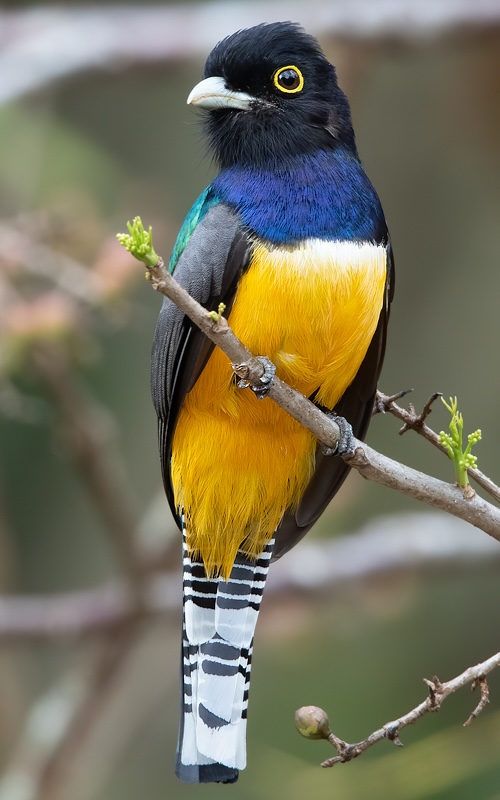
The Trogonidae or trogons and quetzals are birds in the order Trogoniformes, which contains just one family. The family contains forty-seven species in seven genera. The fossil record of the trogons dates back 49 million years to the Early Eocene. They might constitute a member of the basal radiation of the order Coraciiformes or be closely related to mousebirds and owls. The word ‘trogon’ is Greek for ‘nibbling’ and refers to the fact that they gnaw holes in trees to make their nests.
They are residents of tropical forests worldwide. They have a cosmopolitan distribution in the world’s wet tropics, being found in the Americas, Africa and Asia. A few species are distributed into the temperate zone, with one species, the elegant trogon, reaching the south of the United States, specifically southern Arizona and the surrounding area.
The Narina trogon of Africa is slightly exceptional in that it utilises a wider range of habitats than any other trogon, ranging from dense forest to fairly open savannah, and from the Equator to southern South Africa. It is the most widespread and successful of all the trogons. The eared quetzal of Mexico is also able to use more xeric habitats, but preferentially inhabits forests. Most other species are more restricted in their habitat, with several species being restricted to undisturbed primary forest. Within forests they tend to be found in the mid-story, occasionally in the canopy.
|
|
|
|
Narina Trogon Apaloderma narina |
Resplendent Quetzal Pharomachrus mocinno |
| All Photos on this page ©Dubi Shapiro | |

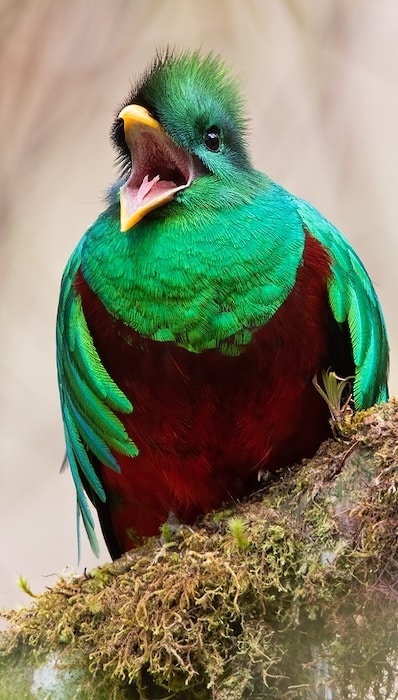
Some species, particularly the quetzals, are adapted to cooler montane forest. There are a number of insular species; these include a number of species found in the Greater Sundas, one species in the Philippines as well as two species endemic to Cuba and Hispaniola respectively. Outside of South East Asia and the Caribbean, however, trogons are generally absent from islands, especially oceanic ones.
|
|
|
|
Hispaniolan Trogon Priotelus roseigaster |
Cuban Trogon Priotelus temnurus |


The greatest diversity is in the Neotropics, where four genera – Euptiloti, Pharomachrus, Priotelus & Trogon – containing thirty-two species occur. The genus Apaloderma contains the three African species. The genera Harpactes and Apalharpactes, containing twelve species, are found in southeast Asia.
Trogons are generally sedentary, with no species known to undertake long migrations. A small number of species are known to make smaller migratory movements, particularly montane species which move to lower altitudes during different seasons. This has been demonstrated using radio tracking in the resplendent quetzal in Costa Rica and evidence has been accumulated for a number of other species. The Narina trogon of Africa is thought to undertake some localised short-distance migrations over parts of its range, for example birds of Zimbabwe’s plateau savannah depart after the breeding season. A complete picture of these movements is however lacking. Trogons are difficult to study as their thick tarsi (feet bones) make ringing studies difficult.
|
|
|
|
Female & Male Mountain Trogon Trogon mexicanus |
|

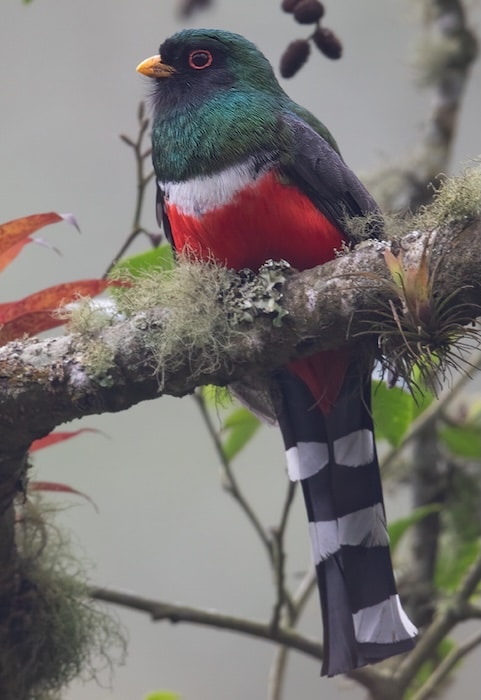
The calls of trogons are generally loud and uncomplex, consisting of monosyllabic hoots and whistles delivered in varying patterns and sequences. The calls of the quetzals and the two Caribbean genera are the most complex. Among the Asian genera the Sumatran trogon Apalharpactes has the most atypical call of any trogon, research has not yet established whether the closely related Javan trogon has a similar call. The calls of the other Asian genus, Harpactes, are remarkably uniform. In addition to the territorial and breeding calls given by males and females during the breeding seasons, trogons have been recorded as having aggression calls given by competing males and alarm calls.
They feed on insects (particularly caterpillars), other arthropods and fruit, and their broad bills and weak legs reflect their diet and arboreal habits. The three African trogons are exclusively insectivorous, whereas the Asian and American genera consume varying amounts of fruit. Diet is somewhat correlated with size, with larger species feeding more on fruit and smaller species focusing on insects.
Although their flight is fast, they are reluctant to fly any distance. Trogons are generally not migratory, although some species undertake partial local movements. They have soft, often colourful, feathers with distinctive male and female plumage. They are the only type of animal with a heterodactyl toe arrangement (two toes forward and two backwards).
|
|
|
|
Slaty-tailed Trogon Trogon massena |
Bar-tailed Trogon Apaloderma vittatum |
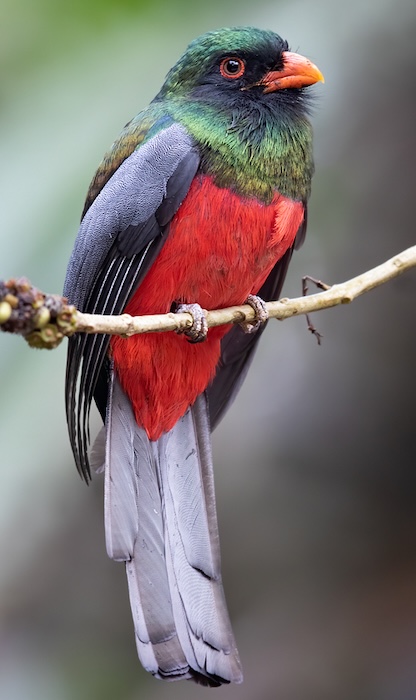
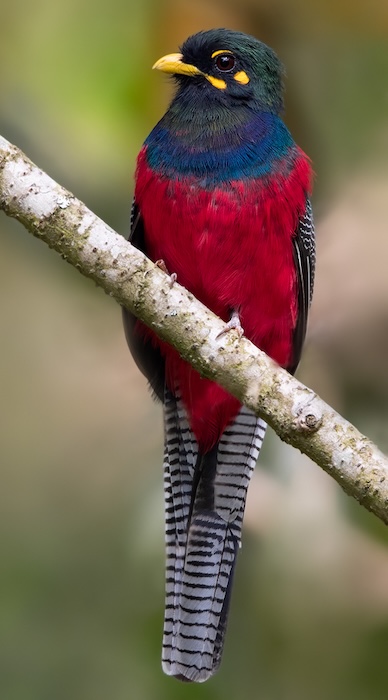
Trogons are territorial and monogamous. Males will respond quickly to playbacks of their calls and will repel other members of the same species and even other hole-nesting species from around their nesting sites. Males attract females by singing, and, in the case of the resplendent quetzal, undertaking display flights. Some species have been observed in small flocks of 3–12 individuals prior to and sometimes during the breeding season, calling and chasing each other, but the function of these flocks is unclear.
Trogons are cavity nesters, and nest are dug into rotting wood or termite nests, with one species, the Violaceous Trogon, nesting in wasp nests. Nest cavities can either be deep upward slanting tubes that lead to fully enclosed chambers, or much shallower open niches (from which the bird is visible). Nests are dug with the beak, incidentally giving the family its name. Nest digging may be undertaken by the male alone or by both sexes. In the case of nests dug into tree trunks, the wood must be strong enough not to collapse but soft enough to dig out. Trogons have been observed landing on dead tree trunks and slapping the wood with their tails, presumably to test the firmness.
|
|
|
|
Female & Male Philippine Trogon Harpactes ardens |
|
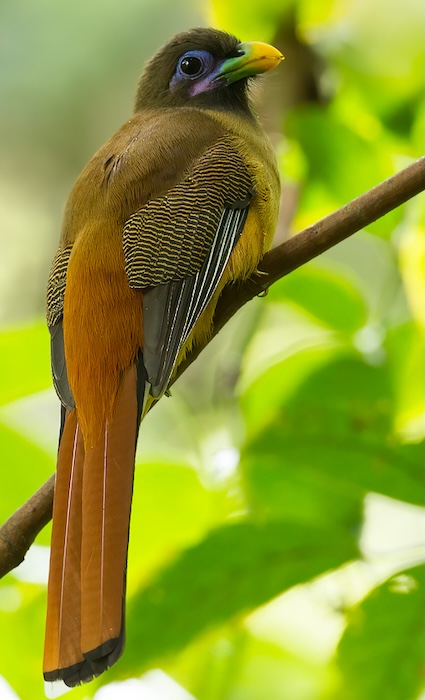
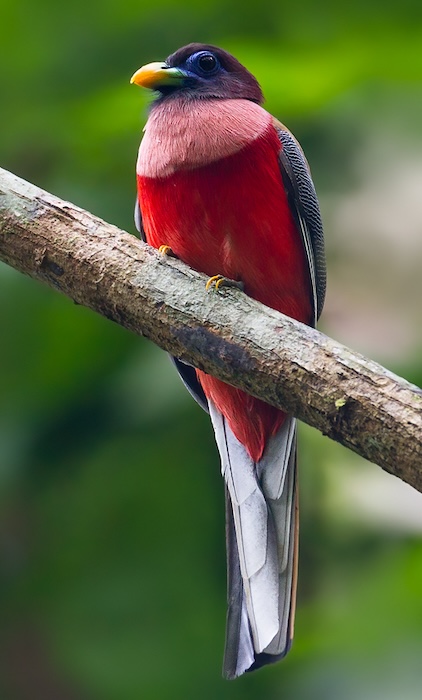
The nests of trogons are thought to usually be unlined. Between two and four eggs are laid in a nesting attempt. These are round and generally glossy white or lightly coloured (buff, grey, blue or green), although they get increasingly dirty during incubation. Both parents incubate the eggs (except in the case of the Bare-cheeked Trogon, where apparently the male takes no part), with the male taking one long incubation stint a day and the female incubating the rest of the time. Incubation seems to begin after the last egg is laid. The incubation period varies by species, usually lasting between 16–19 days.
On hatching the chicks are altricial, blind and naked. The chicks acquire feathers rapidly in some of the montane species, in the case of the mountain trogon in a week, but more slowly in lowland species like the Black-headed Trogon, which may take twice as long. The nestling period varies by species and size, with smaller species generally taking 16 to 17 days to fledge, whereas larger species may take as long as 30 days, although 23–25 days is more typical.
-
Number of bird species: 47
(As at August 2025)
According to the newly (2025) combined AviList there are 47 species in seven genera of Trogonidae in this family; the only family in the Trogoniformes order. They are:
Narina Trogon Apaloderma narina
Bare-cheeked Trogon Apaloderma aequatoriale
Bar-tailed Trogon Apaloderma vittatum
Javan Trogon Apalharpactes reinwardtii
Sumatran Trogon Apalharpactes mackloti
Orange-breasted Trogon Harpactes oreskios
Malabar Trogon Harpactes fasciatus
Red-naped Trogon Harpactes kasumba
Diard’s Trogon Harpactes diardii
Philippine Trogon Harpactes ardens
Whitehead’s Trogon Harpactes whiteheadi
Cinnamon-rumped Trogon Harpactes orrhophaeus
Scarlet-rumped Trogon Harpactes duvaucelii
Red-headed Trogon Harpactes erythrocephalus
Ward’s Trogon Harpactes wardi
Eared Quetzal Euptilotis neoxenus
Pavonine Quetzal Pharomachrus pavoninus
Golden-headed Quetzal Pharomachrus auriceps
Resplendent Quetzal Pharomachrus mocinno
White-tipped Quetzal Pharomachrus fulgidus
Crested Quetzal Pharomachrus antisianus
Hispaniolan Trogon Priotelus roseigaster
Cuban Trogon Priotelus temnurus
Lattice-tailed Trogon Trogon clathratus
Slaty-tailed Trogon Trogon massena
Choco Trogon Trogon comptus
Ecuadorian Trogon Trogon mesurus
Black-tailed Trogon Trogon melanurus
Black-headed Trogon Trogon melanocephalus
Citreoline Trogon Trogon citreolus
White-tailed Trogon Trogon chionurus
Green-backed Trogon Trogon viridis
Baird’s Trogon Trogon bairdii
Gartered Trogon Trogon caligatus
Guianan Trogon Trogon violaceus
Amazonian Trogon Trogon ramonianus
Blue-crowned Trogon Trogon curucui
Surucua Trogon Trogon surrucura
Graceful Black-throated Trogon Trogon tenellus
Choco Black-throated Trogon Trogon cupreicauda
Amazonian Black-throated Trogon Trogon rufus
Atlantic Black-throated Trogon Trogon chrysochloros
Elegant Trogon Trogon elegans
Coppery-tailed Trogon Trogon ambiguus
Mountain Trogon Trogon mexicanus
Collared Trogon Trogon collaris
Masked Trogon Trogon personatus
-
Trogons: A Natural History of the Trogonidae
| By Joseph Michael Forshaw | Illustrated by Albert Earl Gilbert | PUP | Hardcover | 2010 | 304pp | 75 colour illustrations | ISBN: 9780691141589 Buy this book from NHBS.com
-
Trogonidae
Family AccountTrogons are monogamous with biparental care. All are cavity-nesting birds, usually nesting in a hole made by other species or excavating their own hole in the... -
Trogonidae
Family AccountThe family Trogonidae contains 49 species in seven genera. The fossil record of the trogons dates back 49 million years to the Early Eocene. -
Trogonidae
Family AccountThere are around 40 species in this family of colorful tropical birds. Trogons and quetzals are found in warm, forested areas in North America, Central and South America, Asia, and Africa
Given the number of species in this family, Fatbirder does not provide quick links to all of them. However, the entries below do include links to representatives of every genera, all those illustrated and some of the most often encountered, iconic or sought-after species.
-
Bar-tailed Trogon Apaloderma vittatum
Species AccountThe bar-tailed trogon (Apaloderma vittatum) is a species of bird in the family Trogonidae. It is a resident bird to central Africa that eats primarily insects... -
Bar-tailed Trogon Apaloderma vittatum
Species AccountSound archive and distribution map. -
Cuban Trogon Priotelus temnurus
Species AccountA splendid medium-sized inhabitant of woodlands; often found in pairs. Its iridescent blue-green back, smooth gray chest, and brilliant red belly easily... -
Cuban Trogon Priotelus temnurus
Species AccountSound archive and distribution map. -
Eared Quetzal Euptilotis neoxenus
Species AccountThe eared quetzal (Euptilotis neoxenus), also known as the eared trogon, is a near passerine bird in the trogon family, Trogonidae. -
Eared Quetzal Euptilotis neoxenus
Species AccountSound archive and distribution map. -
Elegant Trogon Trogon elegans
Species AccountThe elegant trogon (Trogon elegans) (formerly the "coppery-tailed" trogon), is a near passerine bird in the trogon family.[2] Along with the eared quetzal, it is the most poleward-occurring species of trogon in the world, ranging from Guatemala in the south as far north as the upper Gila River in Arizona and New Mexico. -
Elegant Trogon Trogon elegans
Species AccountMany kinds of trogons live in tropical forests, but only one species regularly occurs in North America. Easily recognized by their metallic-green and rose-red colors, as well as their unusual stout-bodied, square-tailed profile, Elegant Trogons are a prized sighting for birders who visit southeastern Arizona. -
Elegant Trogon Trogon elegans
Species AccountSound archive and distribution map. -
Guianan Trogon Trogon violaceus
Species AccountSound archive and distribution map. -
Guianan Trogon Trogon violaceus
Species AccountTrogon violaceus is listed as Least Concern. -
Guianan Trogon Trogon violaceus
Species AccountThe Guianan trogon (Trogon violaceus), is a near passerine bird in the trogon family, Trogonidae. It is found in humid forests in the Amazon basin of South America and on the island of Trinidad. Until recently, this species, the gartered trogon (T. caligatus) of Mexico, Central America, and northern South America, and the Amazonian trogon (T. ramonianus) of the western Amazon were all considered to be conspecific and collectively called violaceous trogon. -
Guianan Trogon Trogon violaceus
Species AccountGuianan Trogon Trogon violaceus Medium-sized, long-tailed, sluggish bird that occurs in a variety of humid forest types. -
Hispaniolan Trogon Priotelus roseigaster
Species AccountThe Hispaniolan trogon (Priotelus roseigaster), also known as cacos is a species of bird in the family Trogonidae. It is endemic to Hispaniola... -
Hispaniolan Trogon Priotelus roseigaster
Species AccountSound archive and distribution map. -
Javan Trogon Apalharpactes reinwardtii
Species AccountThe Javan trogon (Apalharpactes reinwardtii) is a bird species in the family Trogonidae. It was previously grouped with the Sumatran trogon as a single... -
Javan Trogon Apalharpactes reinwardtii
Species AccountSound archive and distribution map. -
Malabar Trogon Harpactes fasciatus
Species AccountThe Malabar trogon (Harpactes fasciatus) is a species of bird in the trogon family. It is found in the forests of India and Sri Lanka. -
Malabar Trogon Harpactes fasciatus
Species AccountSound archive and distribution map. -
Masked Trogon Trogon personatus
Species AccountSound archive and distribution map. -
Masked Trogon Trogon personatus
Species AccountMasked Trogon Trogon personatus Average red-bellied trogon of subtropical forests. Male is iridescent green on breast, head, and back; female is brown. -
Masked Trogon Trogon personatus
Species AccountThe masked trogon (Trogon personatus) is a species of bird in the family Trogonidae. It is fairly common in humid highland forests in South America, mainly the Andes and tepuis. -
Mountain Trogon Trogon mexicanus
Species AccountThe mountain trogon (Trogon mexicanus), also known as the Mexican trogon, is a species of bird in the family Trogonidae. -
Mountain Trogon Trogon mexicanus
Species AccountSound archive and distribution map. -
Narina Trogon Apaloderma narina
Species AccountThe Narina trogon (Apaloderma narina) is a largely green and red, medium-sized (32–34 cm long), bird of the family Trogonidae. It is native to forests and woodlands of the Afrotropics. Though it is the most widespread and catholic in habitat choice of the three Apaloderma species, their numbers are locally depleted due to deforestation.[2] Some populations are sedentary while others undertake regular movements. The species name commemorates Narina, mistress of French ornithologist François Levaillant, whose name he derived from a Khoikhoi word for "flower",[3] as her given name was difficult to pronounce. -
Narina Trogon Apaloderma narina
Species AccountSound archive and distribution map. -
Philippine Trogon Harpactes ardens
Species AccountThe Philippine trogon (Harpactes ardens) is a species of bird in the family Trogonidae. It is endemic to the Philippines... -
Philippine Trogon Harpactes ardens
Species AccountSound archive and distribution map. -
Resplendent Quetzal Pharomachrus mocinno
Species AccountSound archive and distribution map. -
Resplendent Quetzal Pharomachrus mocinno
Species AccountPharomachrus mocinno is listed as Near Threatened under criteria A2cd+3cd+4cd. -
Resplendent Quetzal Pharomachrus mocinno
Species AccountThe resplendent quetzal (pronunciation: /ˈkɛtsəl/) (Pharomachrus mocinno) is a bird in the trogon family. It is found from Chiapas, Mexico to western Panama (unlike the other quetzals of the genus Pharomachrus, which are found in South America and eastern Panama). It is well-known for its colorful plumage. There are two subspecies, P. m. mocinno and P. m. costaricensis. -
Resplendent Quetzal Pharomachrus mocinno
Species AccountIt is the national bird (and lends its name to the currency) of Guatemala. Usually rather shy, but can be found feeding quietly at fruiting trees. -
Slaty-tailed Trogon Trogon massena
Species AccountLarge, red-bellied trogon of humid tropical lowlands. Favors rainforest interior, but also found at edges and around clearings, mainly perched quietly. -
Slaty-tailed Trogon Trogon massena
Species AccountSound archive and distribution map. -
White-tipped Quetzal Pharomachrus fulgidus
Species AccountElegant large trogon with a black tail tipped with white below, and lacking a crest. Has golden-tinged green upperparts and breast and bright red belly. -
White-tipped Quetzal Pharomachrus fulgidus
Species AccountThe white-tipped quetzal (Pharomachrus fulgidus) is a species of bird in the family Trogonidae. It is found in Venezuela, Colombia, and Guyana. In Venezuela and Colombia, three separated ranges occur, all contiguous and on the northern coasts. Its natural habitat is subtropical or tropical moist montane forests. -
White-tipped Quetzal Pharomachrus fulgidus
Species AccountSound archive and distribution map. -
Whitehead's Trogon Harpactes whiteheadi
Species AccountBreathtaking, thickset trogon found only in Borneo's north-central mountains. Male is predominantly bright red, whereas the female is mostly tan-orange. -
Whitehead's Trogon Harpactes whiteheadi
Species AccountSound archive and distribution map.