
Tytonidae – Barn & Grass Owls
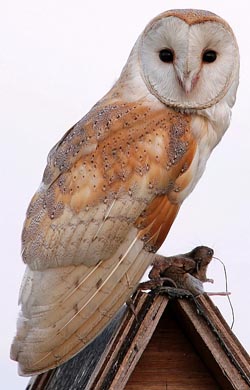
The Tytonidae (Barn & Grass Owls) family are Strigiformes, along with Strigidae (true Owls or typical Owls). It includes just two genera; the barn owls Tyto and the bay owls Phodilu. The two modern genera are thought to have originated from a common ancestor from the Oligocene period. It is believed the modern genus Tyto descended from large nocturnal birds in the West Indies during the Quaternary.
The main characteristic of the barn owls is the heart-shaped facial disc, formed by stiff feathers which serve to amplify and locate the source of sounds when hunting. Further adaptations in the wing feathers eliminate sound caused by flying, aiding both the hearing of the owl listening for hidden prey and keeping the prey unaware of the owl. Barn owls overall are darker on the back than the front, usually an orange-brown colour, the front being a paler version of the back or mottled, although considerable variation is seen even within species. Bay owls closely resemble the Tyto owls, but have a divided facial disc, ear tufts, and tend to be smaller. They are medium to large owls with large heads long, strong legs with powerful talons. They also differ from the Strigidae in structural details relating in particular to the sternum and feet.
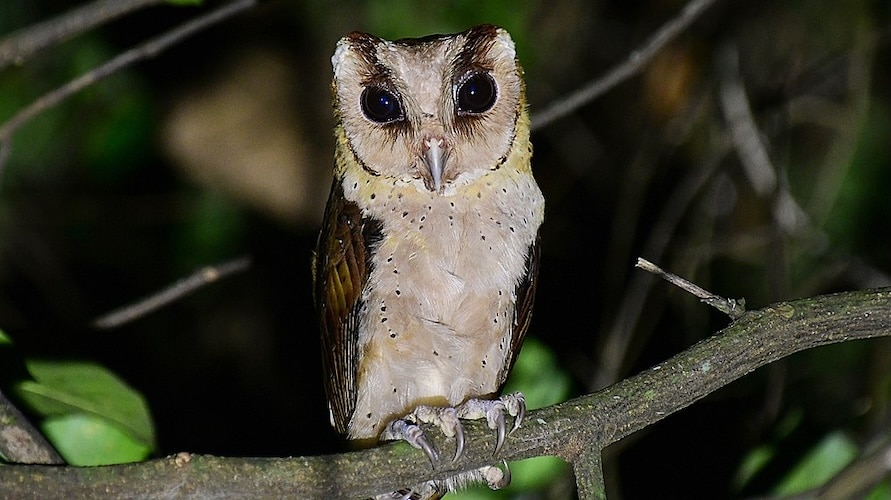
Sri Lanka Bay Owl Phodilus assimilis – ©Thomson Saburaj CC BY-SA 4.0 via Wikimedia Commons
The family is wide-ranging, although they are not very tolerant of severe winter cold, so are absent from northern areas of Europe, Asia, and North America; they are also absent from driest desert regions. They live in a wide range of habitats from semi-deserts to forests, and from temperate latitudes to the tropics. Within these habitats, they live near agricultural areas with high amounts of human activity. The majority of the 17 living species of barn owls are poorly known. Some, like the red owl, have barely been seen or studied since their discovery, in contrast to the western barn owl Tyto alba, which is one of the best-known owl species in the world. However, some subspecies of the western barn owl possibly deserve to be separate species, but are very poorly known.
Five species of barn owl are threatened, and some island species went extinct during the Holocene or earlier. Barn owls are mostly nocturnal and generally non-migratory, living in pairs or singly.
Some island subspecies are occasionally treated as distinct species, a move which should await further research into barn owl phylogeography as mitochondrial DNA shows little variation in many cases. Twenty to thirty subspecies are usually recognised, varying mainly in body proportions, size, and colour. Barn Owls range in colour from the almost beige-and-white nominate subspecies alba, erlangeri, and niveicauda, to the nearly black-and-brown contempta. Island forms are mostly smaller than mainland ones, and those inhabiting forests have darker plumage and shorter wings than those living in open grasslands. Several subspecies are generally considered to be intergrades between more distinct populations.
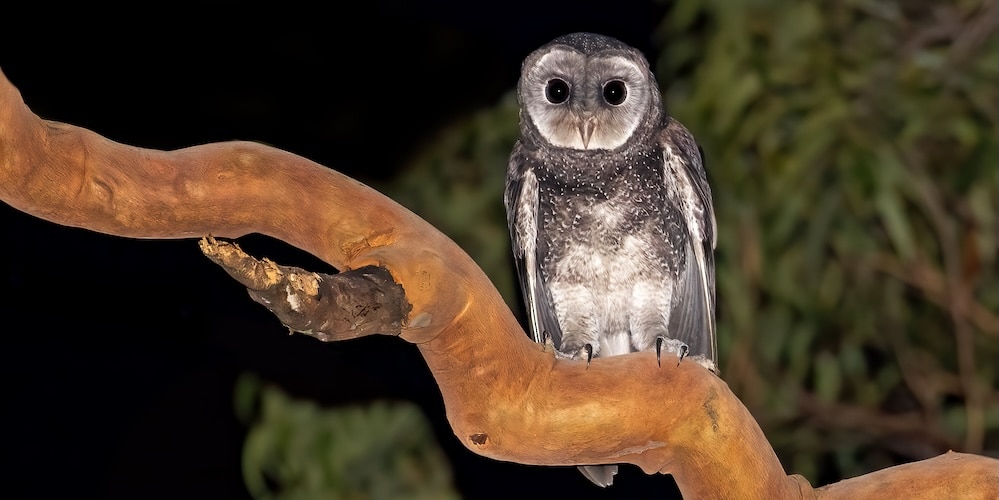
Greater Sooty Owl Tyto tenebricosa – ©JJ Harrison CC BY-SA 3.0 via Wikimedia Commons
The Barn Owl is the most widespread landbird species in the world, occurring on every continent except Antarctica. Its range includes all of Europe (except Fennoscandia and Malta), most of Africa apart from the Sahara, the Indian subcontinent, Southeast Asia, Australia, many Pacific Islands, and North-, Central-, and South America. In general, it is considered to be sedentary, and, indeed, many individuals, having taken up residence in a particular location, remain there even when better nearby foraging areas are available. In the British Isles, the young seem largely to disperse along river corridors, and the distance travelled from their natal site averages about 9 km (5.6 miles). In continental Europe, the dispersal distance is greater, commonly somewhere between 50 and 100 kilometres (31 and 62 miles) but exceptionally 1,500 km (932 mi), with ringed birds from the Netherlands ending up in Spain and in Ukraine.
In the United States, dispersal is typically over distances of 80 and 320 km (50 and 199 miles), with the most travelled individuals ending up some 1,760 km (1,094 miles) from their points of origin. Dispersal movements in the African continent include 1,000 km (621 miles), from Senegambia to Sierra Leone, and up to 579 km (360 miles) within South Africa. In Australia, there is some migration, as the birds move towards the northern coast in the dry season and southward in the wet season, as well as nomadic movements in association with rodent plagues. Occasionally, some of these birds turn up on Norfolk Island, Lord Howe Island, or New Zealand, showing that crossing the ocean is within their capabilities. In 2008, Barn Owls were recorded for the first time breeding in New Zealand. The barn owl has been successfully introduced into the Hawaiian island of Kauai in an attempt to control rodents; distressingly, it has been found to also feed on native birds
Hunting in twilight or at night, the barn owl can target its prey and dive to the ground. Its legs and toes are long and slender, which improves its ability to forage among dense foliage or beneath the snow and gives it a wide spread of talons when attacking prey. They hunt by flying slowly, quartering the ground and hovering over spots that may conceal prey. Their long, broad wings enable abrupt turns. They have acute hearing, with ears placed asymmetrically, which improves detection of sound position and distance; so, they do not require sight to hunt. The facial disc helps with the bird’s hearing, as is shown by the fact that, with the ruff feathers removed, the bird can still determine a sound source’s direction, although without the disc it cannot determine the source’s height. It may perch on branches, fence posts, or other lookouts to scan its surroundings.

Red Owl Tyto soumagnei – ©Dubi Shapiro
Rodents and other small mammals may constitute over ninety percent of the prey caught. Birds are also taken, as well as lizards, amphibians, fish, spiders, and insects. Even when they are plentiful, and other prey scarce, earthworms do not seem to be consumed. In North America and most of Europe, voles predominate in the diet, and shrews are the second most common food choice. In Ireland, the accidental introduction of the bank vole in the 1950s led to a major shift in the barn owl’s diet: where their ranges overlap, the vole is now by far the largest prey item. Mice and rats are the main foodstuffs in the Mediterranean region, the tropics, subtropics, and Australia. Gophers, muskrats, hares, rabbits, and bats are also preyed upon. Barn owls are usually specialist feeders in productive areas and generalists in areas where prey is scarce.
On the Cape Verde Islands, geckos are the mainstay of the diet, supplemented by birds such as plovers, godwits, turnstones, weavers, and pratincoles. On a rocky islet off the coast of California, a clutch of four young were being reared on a diet of Leach’s Storm Petrel Oceanodroma leucorhoa. On bird-rich islands, a barn owl might include birds as some fifteen to twenty percent of its diet, while in grassland it will gorge itself on swarming termites, or on Orthoptera such as Copiphorinae katydids, Jerusalem crickets Stenopelmatidae, or true crickets Gryllidae. Smaller prey is usually torn into chunks and eaten completely, including bones and fur, while prey larger than about 100 grams (3.5 oz) – such as baby rabbits, Cryptomys blesmols, or Otomys vlei rats – is usually dismembered and the inedible parts discarded.
Compared to other owls of similar size, the barn owl has a much higher metabolic rate, requiring relatively more food. Studies have shown that an individual barn owl may eat one or more voles (or their equivalent) per night, equivalent to about fourteen percent of the bird’s bodyweight. Excess food is often cached at roosting sites and can be used when food is scarce. This makes the barn owl one of the most economically valuable wildlife animals for agriculture. Farmers often find these owls more effective than poison in keeping down rodent pests, and they can encourage barn owl habitation by providing nesting sites.
Barn owls living in tropical regions can breed at any time of year, but some seasonality in nesting is still evident. Where there are distinct wet and dry seasons, egg-laying usually takes place during the dry season, with increased rodent prey becoming available to the birds as the vegetation dies off. In arid regions, such as parts of Australia, breeding may be irregular and may happen in wet periods, with the resultant temporary increase in the populations of small mammals. In temperate climates, nesting seasons become more distinct, and there are some seasons of the year when no egg-laying takes place. In Europe and North America, most nesting takes place between March and June, when temperatures are increasing. The actual dates of egg-laying vary by year and by location, being correlated with the amount of prey-rich foraging habitat around the nest site. An increase in rodent populations will usually stimulate the local barn owls to begin nesting, and, consequently, two broods are often raised in a good year, even in the cooler parts of the owl’s range.
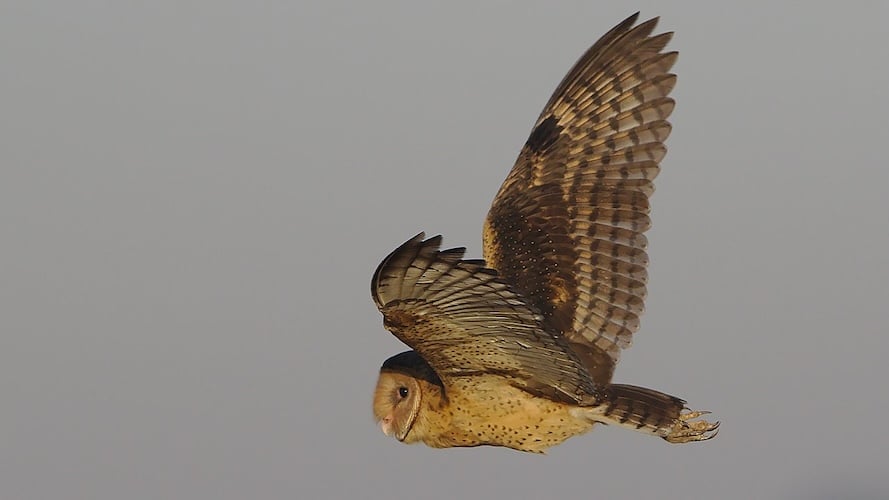
African Grass Owl Tyto capensis – ©Derek Keats CC BY 2.0 via Wikimedia Commons
Feathers become abraded over time and all birds need to replace them at intervals. Barn owls are particularly dependent on their ability to fly quietly and manoeuvre efficiently. In temperate areas, the owls undergo a prolonged moult that lasts through three phases over a period of two years. The female starts to moult while incubating the eggs and brooding the chicks, a time when the male feeds her, so she does not need to fly much. The first primary feather to be shed is a central one, number 6, and it has regrown completely by the time the female resumes hunting. Feathers 4, 5, 7, and 8 are dropped at a similar time the following year and feathers 1, 2, 3, 9 and 10 in the bird’s third year of adulthood. The secondary and tail feathers are lost and replaced over a similar timescale, again starting while incubation is taking place. In the case of the tail, the two outermost tail feathers are first shed, followed by the two central ones, the other tail feathers being shed the following year.
The male owl moults rather later in the year than the female, at a time when there is an abundance of food, the female has recommenced hunting, and the demands of the chicks are lessening. Unmated males without family responsibilities often start losing feathers earlier in the year. Their moult follows a pattern similarly prolonged as that of the female. The first sign that the male is moulting is often when a tail feather has been dropped at the roost. A consequence of moulting is the loss of thermal insulation. This is of little importance in the tropics, and barn owls there usually moult a complete complement of flight feathers annually. The hot-climate moult may still take place over a long period but is usually concentrated at a particular time of year outside the breeding season
When disturbed at its roosting site, an angry barn owl lowers its head and sways it from side to side, or the head may be lowered and stretched forward and the wings outstretched and drooped while the bird emits hisses and makes snapping noises with its beak. Another defensive attitude involves lying flat on the ground or crouching with wings spread out.
-
Number of bird species: 17
(As at August 2025)
According to the recently (2025) combined AviList there are 17 species in just two genera of the Tytonidae family, in the Strigiformes order. They are:
Sri Lanka Bay Owl Phodilus assimilis
Oriental Bay Owl Phodilus badius
Greater Sooty Owl Tyto tenebricosa
Australian Masked Owl Tyto novaehollandia
Golden Masked Owl Tyto aurantia
Taliabu Masked Owl Tyto nigrobrunnea
Minahassa Masked Owl Tyto inexspectata
Sulawesi Masked Owl Tyto rosenbergii
Congo Bay Owl Tyto prigoginei
Eastern Grass Owl Tyto longimembris
African Grass Owl Tyto capensis
Western Barn Owl Tyto alba
Eastern Barn Owl Tyto javanica
American Barn Owl Tyto furcata
Andaman Masked Owl Tyto deroepstorffi
Ashy-faced Owl Tyto glaucops
Red Owl Tyto soumagnei
Two owls, sometimes considered as full species, are here regarded as races of Australian Masked Owl Tyto novaehollandia. Lesser Sooty Owl Tyto (tenebricosa) multipunctate is regarded as a race of Greater Sooty Owlk, but Tyto tenebricosa needs further research.
-
Barn Owl Trust
WebsiteThe Barn Owl Trust is a registered charity dedicated to conserving the Barn Owl and its environment and is the main source of Barn Owl information in the UK. The Trust's educational work began in 1989 and we now also run training courses for ecological consultants and planning officers. We carry out surveys of old buildings due for development, and advise on Barn Owl mitigation measures. Our booklet 'Barn Owls on Site, a guide for developers and planners', published by English Nature is widely used by local authorities and other official bodies
-
Barn Owls - Evolution and Ecology – with Grass Owls, Masked Owls and Sooty Owls
| By Alexandre Roulin | Cambridge University Press | 2020 | Hardback | 300 pages, 50 colour illustrations | ISBN: 9781107165755 Buy this book from NHBS.com -
Barn Owls - Predator - Prey Relations and Conservation
| By Iain Taylor | Cambridge University Press | 2004 | Paperback | 304 pages, 48 b/w photos, 93 line diagrams, 7 tables | ISBN: 9780521545877 Buy this book from NHBS.com -
Owls
| By Chris Mead, Mike Toms & Guy Troughton | Whittet Books | 2011 | 2nd Edition | Hardback | 152 pages, 9 colour photos, b/w illustrations | ISBN: 9781873580837 Buy this book from NHBS.com -
Owls In The Wild - A Visual Essay
| By Rob Palmer | Amherst Media | 2018 | Paperback | 128 pages, colour photos | ISBN: 9781682033340 Buy this book from NHBS.com -
Owls of the World
| By James Duncan | New Holland Publishers | 2018 | Paperback | 192 pages, 120 colour photos | ISBN: 9781925546316 Buy this book from NHBS.com -
Owls of the World - A Photographic Guide
| By Heimo Mikkola | Christopher Helm | 2013 | Hardback | 528 pages, colour photos, colour distribution maps | ISBN: 9781472905932 Buy this book from NHBS.com -
The Barn Owl
| By Derek S Bunn, AB Warburton, RD Wilson & Ian Willis | T & AD Poyser Ltd (A & C Black) | 2010 | Hardback | 280 pages, Colour photos, drawings | ISBN: 9781408139585 Buy this book from NHBS.com -
The Barn Owl - Guardian of the Countryside
| By Jeff R Martin | Whittet Books | 2017 | Hardback | 249 pages, colour & b/w photos, colour & b/w illustrations, colour maps, tables | ISBN: 9781873580899 Buy this book from NHBS.com -
The Owl Book
| By Jane Russ | Graffeg | 2018 | Hardback | 160 pages, 100 colour photos and colour illustrations | ISBN: 9781912050420 Buy this book from NHBS.com
-
Tytonidae
Family AccountBarn owls are strongly nocturnal and hunt primarily by ear, with an extraordinary ability to pinpoint the location of prey by sound. -
Tytonidae
Family AccountTytonidae, which includes the barn owls Tyto and the bay owls Phodilus, is one of the two families of owls, the other being the true owls or typical owls... -
Tytonidae
Family AccountThere are 16 species of owl in this family. They are found in most parts of the world, except for Antarctica. They live in a variety of habitats including forests, grasslands, and deserts.
Given that this is a relatively small family with just 17 species in only two genera, Fatbirder provides active links below to all species.
-
African Grass Owl Tyto capensis
Species AccountSound archive and distribution map. -
African Grass Owl Tyto capensis
Species AccountThe African grass owl or simply grass owl (Tyto capensis) is a species of owl in the barn owl family, Tytonidae. -
American Barn Owl Tyto furcata
Species AccountMedium-sized owl with a heart-shaped facial disc and deep dark eyes; the only Tyto owl present across most of its range; on Hispaniola compare to Ashy-faced... -
American Barn Owl Tyto furcata
Species AccountThe American barn owl (Tyto furcata) is usually considered a subspecies group and together with the western barn owl group, the eastern barn owl group, and sometimes the Andaman masked owl, make up the barn owl, cosmopolitan in range. -
American Barn Owl Tyto furcata
Species AccountGhostly pale and strictly nocturnal, Barn Owls are silent predators of the night world. Lanky, with a whitish face, chest, and belly, and buffy upperparts, this owl roosts in hidden, quiet places during the day. -
American Barn Owl Tyto furcata
Species AccountSound archive and distribution map. -
Andaman Masked Owl Tyto deroepstorffi
Species AccountA medium-sized owl with a prominent facial disc. Very similar to the Barn Owl, but the Andaman Masked-Owl is smaller and much browner overall, with darker upperparts and heavily spotted pale brown underparts. -
Andaman Masked Owl Tyto deroepstorffi
Species AccountSound archive and distribution map. -
Ashy-faced Owl Tyto glaucops
Species AccountThe ashy-faced owl (Tyto glaucops) is a species of bird in the barn-owl family Tytonidae. -
Ashy-faced Owl Tyto glaucops
Species AccountSound archive and distribution map. -
Australian Masked Owl Tyto novaehollandiae
Species AccountSound archive and distribution map. -
Australian Masked Owl Tyto novaehollandiae
Species AccountThe Australian masked owl (Tyto novaehollandiae) is a barn owl of Southern New Guinea and the non-desert areas of Australia. -
Australian Masked Owl Tyto novaehollandiae
Species AccountThe Masked Owl is the largest and most powerful representative of the genus Tyto in Australia and the female of the Tasmanian race is the largest in the world. The dark Tasmanian birds are still reasonably common, but their mainland relatives have declined alarmingly. They are also known as Cave Owls, or Tasmanian Masked Owls… -
Australian Masked Owl Tyto novaehollandiae
Species AccountThe Masked Owl has three basic plumage forms: pale, intermediate and dark. The plumage pattern remains similar in each case. The facial disc is chestnut to white, edged with a darker ring and darker around the bill and below the eyes. -
Congo Bay Owl Phodilus prigoginei
Species AccountThe Congo bay owl, also known as the Itombwe owl or African bay owl, (Pholidus prigoginei) (sometimes placed in the genus Tyto with the barn and grass owls) is a species of owl in the family Tytonidae. It is restricted to a small area in the Albertine Rift in east central Africa. -
Congo Bay Owl Phodilus prigoginei
Species AccountTyto prigoginei is listed as Endangered under criteria B1ab(i,ii,iii,v). -
Congo Bay Owl Phodilus prigoginei
Species AccountSound archive and distribution map. -
Eastern Barn Owl Tyto javanica
Species AccountThe eastern barn owl (Tyto javanica) is usually considered a subspecies group and together with the American barn owl group, the western barn owl group... -
Eastern Barn Owl Tyto javanica
Species AccountThe Eastern Barn Owl is a medium sized owl with no ear-tufts and a heart-shaped face. -
Eastern Barn Owl Tyto javanica
Species AccountSound archive and distribution map. -
Eastern Grass Owl Tyto longimembris
Species AccountSound archive and distribution map. -
Eastern Grass Owl Tyto longimembris
Species AccountThe eastern grass owl (Tyto longimembris), also known as Chinese grass owl or Australasian grass owl, is a species of owl in the family Tytonidae. -
Golden Masked Owl Tyto aurantia
Species AccountThe golden masked owl (Tyto aurantia) is a barn owl endemic to the island of New Britain, Papua New Guinea. -
Golden Masked Owl Tyto aurantia
Species AccountSound archive and distribution map. -
Greater Sooty Owl Tyto tenebricosa
Species AccountMedium-sized dark-gray owl with prominent facial disc and white speckles through the plumage. -
Greater Sooty Owl Tyto tenebricosa
Species AccountSound archive and distribution map. -
Minahassa Masked Owl Tyto inexspectata
Species AccountA forest barn-owl with rich rufous coloration over its entire body. Particularly note the rufous facial disk and forecrown to aid identification. -
Minahassa Masked Owl Tyto inexspectata
Species AccountSound archive and distribution map. -
Oriental Bay Owl Phodilus badius
Species AccountSmall owl with a distinctive, highly angular head. Dark chestnut above and pale creamy gray below with light spotting on the sides. -
Oriental Bay Owl Phodilus badius
Species AccountThe Oriental bay owl (Phodilus badius) is a species of bay owl. It is completely nocturnal, and can be found throughout Southeast Asia and parts of India. -
Oriental Bay Owl Phodilus badius
Species AccountSound archive and distribution map. -
Red Owl Tyto soumagnei
Species AccountSound archive and distribution map. -
Red Owl Tyto soumagnei
Species AccountThe red owl (Tyto soumagnei) is an owl in the barn owl family Tytonidae. It is also known as the Madagascar red owl, Madagascar grass-owl, Soumagne's owl... -
Sri Lanka Bay Owl Phodilus assimilis
Species AccountSmall owl with immense dark eyes. Uncommon, strictly nocturnal, and very rarely seen. -
Sri Lanka Bay Owl Phodilus assimilis
Species AccountThe Sri Lanka bay owl (Phodilus assimilis) is a species of bay owl in the family Tytonidae. It is endemic to the island of Sri Lanka and the Western Ghats... -
Sri Lanka Bay Owl Phodilus assimilis
Species AccountSound archive and distribution map. -
Sulawesi Masked Owl Tyto rosenbergii
Species AccountThe Sulawesi masked owl (Tyto rosenbergii) is a species of owl in the family Tytonidae. -
Sulawesi Masked Owl Tyto rosenbergii
Species AccountSound archive and distribution map. -
Taliabu Masked Owl Tyto nigrobrunnea
Species AccountThe Taliabu masked owl (Tyto nigrobrunnea), also known as the Taliabu owl or the Sula Islands barn owl, is an owl in the barn ow... -
Taliabu Masked Owl Tyto nigrobrunnea
Species AccountSound archive and distribution map. -
Western Barn Owl Tyto alba
Species AccountThe barn owl (Tyto alba) is the most widely distributed species of owl and one of the most widespread of all birds. It is also referred to as the common barn owl, to distinguish it from other species in its family, Tytonidae, which forms one of the two main lineages of living owls, the other being the typical owls (Strigidae). The barn owl is found almost everywhere in the world except polar and desert regions, Asia north of the Himalayas, most of Indonesia, and some Pacific islands. -
Western Barn Owl Tyto alba
Species AccountTyto alba is listed as Least Concern. -
Western Barn Owl Tyto alba
Species AccountSound archive and distribution map.
-
Owls, my favourite birds - by Friedhelm Weick
Owls are outstanding birds! Is it their silent hunting in the poor evening light and at night, their distinctive appearance – huge head and forward-looking eyes or maybe the echoes of ancient myths and tales of woodland goblins and bewitched owl-shaped princesses? However, since my childhood owls were my favourite birds. They even outranked my ambition for the diurnal birds of prey. As a wildlife artist, birder and ornithologists – I never lost my contact to these feather-armoured knights of the twilight. When in 1980 my book Birds of Prey of the World (Parey, Berlin) was printed, I had the idea for a similar project on the strigiformes of the world. So, I began to collect every bit of information about this subject – and, remember: the Internet wasn’t in reach for the common wildlife artist then. I filed scientific articles, photos and colour-copies of books, sketches and other descriptions back to 1758, photos from living owls in the wild or captivity. Detailed lists of measures and colours of skins, weights and feathers grew larger and larger. Beside that I visited zoological gardens, ornithological institutes and a lot of private owl-keepers, birders and ornithologists. In the early nineties I wrote three different annotated checklists about Strigiformes. The first included all recent complete taxa and their distribution. A second listed all-important measurements and weights linked to an index of photos and paintings. The third list was a full description of plumages and soft parts combined with a detailed bibliography. In this situation Claus König head of the Natural Science Museum at Stuttgart and ambitioned ornithologist asked me if I would be interested in a project which should result in nothing minor - the standard guide to all owls of the world. The publisher would be Pica Press, Sussex. Of course I was, wasn’t I? The three checklists were the basic-stock for our further work. In the following years I examined some thousands of skins and mounted owls in all-important museums of the world, only supported by my dear wife Christel. Within nearly three years I painted all different taxa and morphes that were sometimes known only by one skin… In 1999 the book was published… leaving me more time for birding and outdoor projects and, last but not least for new paintings of my favourite birds, guess which?
-
Competencies for Species Survey: Barn Owl
PDF ArticleThe purpose of this document is to set out the knowledge, skills and experience required to survey, disturb or to carry out research works (hereinafter referred to generically as ‘survey’) for the barn owl Tyto alba in a professional capacity