

Eulacestomatidae – Ploughbill
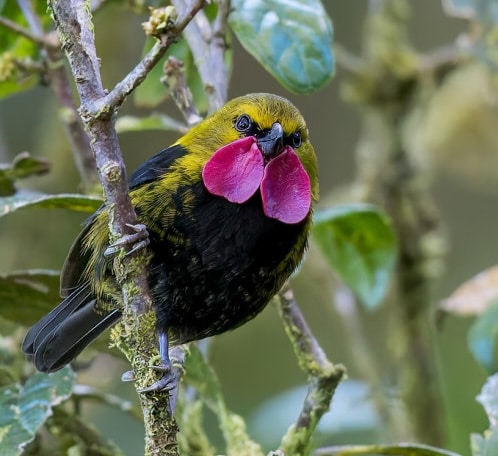
The Eulacestomatidae is a family consisting of one genus – Eulacestoma – with a single species, the Wattled Ploughbill Eulacestoma nigropectus. It is a small passerine endemic to the central mountain ranges of New Guinea. It is also known as the wattled shrike-tit or ploughshare tit.
It was formally described (1894) by the English naturalist Charles Walter De Vis, who introduced a new genus Eulacestoma and named the bird Eulacestoma nigropectus. The genus name combines the Ancient Greek eulaka meaning ‘ploughshare’ with stoma meaning ‘mouth’. The specific epithet is from the Latin ‘niger ‘meaning black and ‘pectus’ meaning breast. It was originally thought to be related to Pachycephalidae (Whistlers), and Pachycephalidae (Shriketits). Genetic studies have shown that it is more closely related to the sittellas. The one species is monotypic.
It is small, approximately fourteen centimetres long and weighs around nineteen to twenty-two grammes. They are olive-brown in colour with a strong, thick, wedge-shaped black bill, the upper mandible of which is hooked, is used to plough into dead tree branches. It is sexually dimorphic; the male having black underparts, black wings and a large circular pink wattle on the cheek, whereas the female has olive green plumage and is pale olive below. Only the adult male has wattles. Their song is a long, high, ringing whistle.
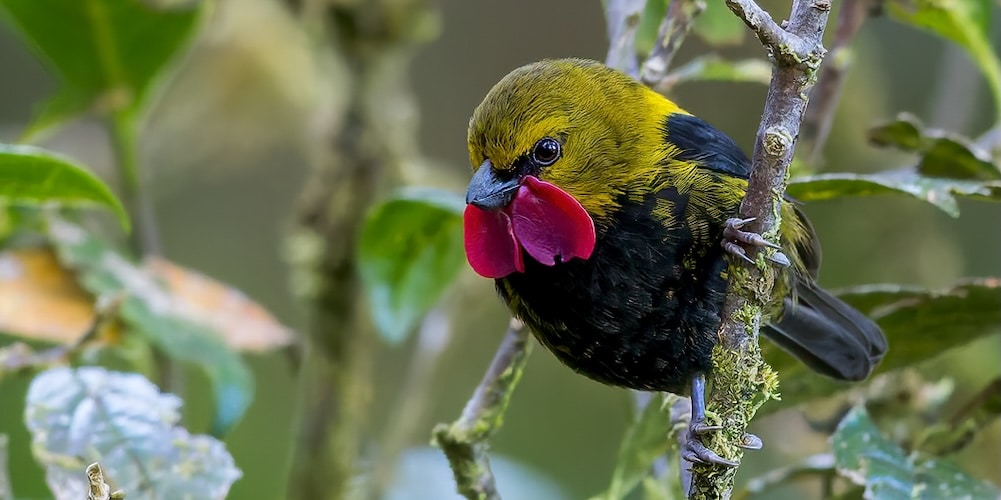
Wattled Ploughbill Eulacestoma nigropectus – ©Dubi Shapiro
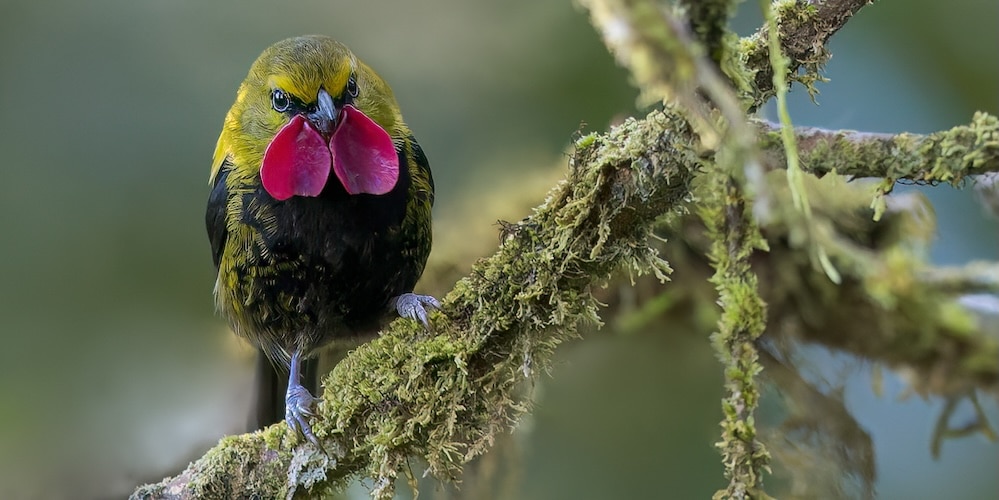
Their diet consists mainly of insects. The species feeds from the forest floor up to around thirty feet from the understory to the mid-level of the forest. It particularly favours groves of bamboo as a micro-habitat for feeding. It forages on branches and twigs, gleaning insects from the surface and prising off bark to expose prey. The species will readily join mixed-species feeding flocks.
Very little is known about the breeding biology of this species. However, it is presumed to be monogamous with biparental care; there is a single report of male incubation. Nothing is known of its clutch size, nest, or parental care.
-
Number of bird species: 1
(As at October 2025)
According to the recently (2025) amalgamated AviList, there is just one genus containing a single species in the Eulacestomatidae family. It is:
Wattled Ploughbill Eulacestoma nigropectus
-
Eulacestomidae
Family AccountThe Wattled Ploughbill Eulacestoma nigropectus, whose generic name means “ploughshare-bill,” is an enigmatic songbird from the highlands of New Guinea. -
Eulacestomidae
Family AccountIt is the only member of the monotypic genus Eulacestoma and family Eulacestomatidae.
-
Wattled Ploughbill Eulacestoma nigropectus
Species AccountA fairly small, plump bird with a unique bill shape of montane forest. Male is yellow-green with black wing, chest, and two large, pink, fleshy wattles beside... -
Wattled Ploughbill Eulacestoma nigropectus
Species AccountThe wattled ploughbill (Eulacestoma nigropectus) is a small, approximately 14 cm long, olive-brown songbird with a strong, thick, wedge-shaped black bill... -
Wattled Ploughbill Eulacestoma nigropectus
Species AccountSound archive and distribution map.