

Melampittidae – Melampittas
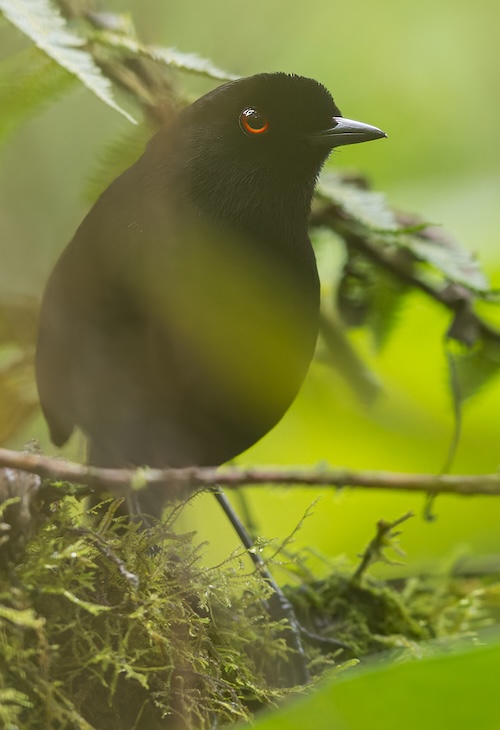
The Melampittidae are a family of New Guinean passerines containing two enigmatic species. The two species are found in two genera, the Greater Melampitta in the genus Megalampitta and the Lesser Melampitta in the genus Melampitta. They are little studied and before being established as a family (2014) their taxonomic relationships with other birds were uncertain, being considered at one time related variously to the pittas, Old World babblers and birds-of-paradise. Formerly classified as a bird-of-paradise, the little-known Greater Melampitta has an uncertain taxonomy and was sometimes believed to be affiliated to pitohuis, as it appears to be poisonous to eat. It is found in New Guinea. Its natural habitats are subtropical or tropical moist lowland forests and subtropical or tropical moist montane forests.
These are small to medium-sized birds with black plumage, strong legs and short, rounded wings, which primary feathers that are uniquely recurved and emarginated. The feathers of the forecrown are erectile. Mostly terrestrial, they live in montane forest. The Greater Melampitta has more specific habitat needs, roosting and nesting in limestone sinkholes.
Insects, other invertebrates and small vertebrates such as frogs are taken from the forest leaf litter. Little is known about their breeding behaviour, with only the nests of the Lesser Melampitta having been seen by scientists. Both species are considered to be safe from extinction.
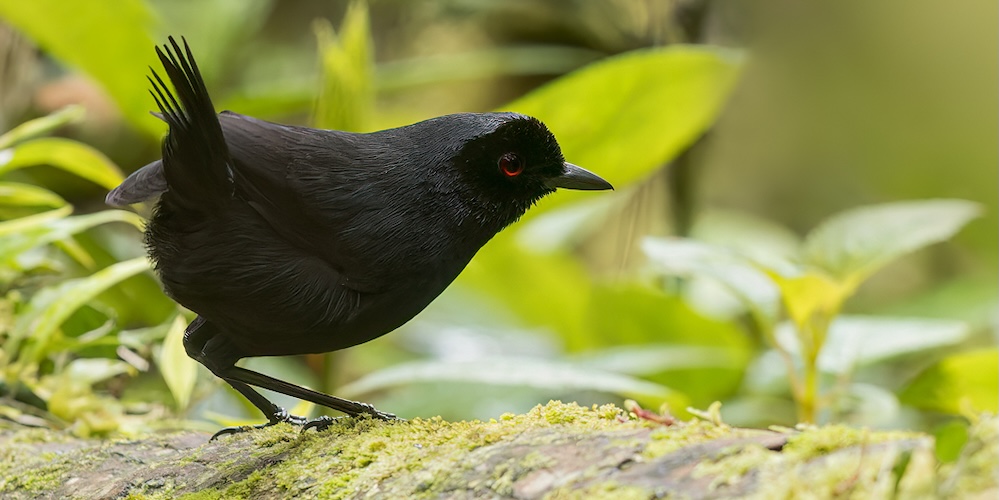
Lesser Melampitta Melampitta lugubris – ©Dubi Shapiro
They are birds of the rainforest and are generally montane species as well, with the range of the Lesser Melampitta reaching as high as 11,500 feet, with a usual range of around 6,500–9,000 feet, where it is found around watercourses and other damp areas. The Greater Melampitta is restricted to areas of rugged limestone karst with sinkholes that it apparently roosts and possibly even nests in. In the Kumawa Mountains it has been found that that species inhabited a range of 2,000–4,500 feet. Both species have a discontinuous distribution across New Guinea, with the valleys between the highland ranges creating sky islands. The Greater Melampitta in particular is seldom encountered by scientists because its karst habitat is rarely visited due to the difficult terrain.
The distribution of the Lesser Melampitta is consistent with the usual pattern of evolution in birds in New Guinea, with older species of birds inhabiting the highlands which act as refugia, a phenomenon known as taxon cycles. The distribution of the Greater Melampitta is harder to explain, as it is also an ancient species, but is found at lower altitudes. The Greater Melampitta also has much more isolated populations, but lacks the genetic differentiation between these populations that their isolation and poor dispersal ability would imply.
The Greater Melampitta is reported to be very shy and wary, but also inquisitive and may approach people sitting quietly to investigate. It is usually revealed by its calls, and can be very difficult to locate if it is not calling. The Lesser Melampitta is also described as hard to see but not shy. While hopping on the ground foraging it will frequently flutter its wings and lift its tail. Both species move around on the ground by hopping.
The calls of the two species are not similar. The call of the Greater Melampitta is a double or triple note, which is slurred and repeated monotonously, and is reminiscent of the Black Pitohui. The calls of the Lesser Melampitta are either harsh buzzy notes or chirped whistles, both of which are repeated at intervals.
The Melampittas are insectivores, although in the case of the Greater Melampitta, this statement is inference as their diet isn’t described. All that is known is that it inhabits the ground and understory. The Lesser Melampitta feeds on insects, including beetles and caterpillars, as well as worms, snails, small frogs and even small fruit. It forages on the ground, probing through leaves by probing and flipping them with its bill.
-
Number of bird species: 2
(As at October 2025)
According to the recently (2025) amalgamated AviList, there are two species in two genera in the Melampittidae family. They are:
Lesser Melampitta Melampitta lugubris
Greater Melampitta Megalampitta gigantea
-
Birds of New Guinea
| By Thane K Pratt & Bruce M Beehler | PUP | 2014 | Paperback | 528 pages, 110 plates with colour illustrations; 1 b/w illustrations, 635 colour distribution maps, 4 colour maps, 1 colour table | ISBN: 9780691095639 Buy this book from NHBS.com
-
Melampittidae
Family AccountThey are largely terrestrial birds that forage on the forest floor, hopping and running across the ground, and digging and tossing leaves aside as they go. -
Melampittidae
Family AccountThe melampittas are a family, Melampittidae, of New Guinean birds containing two enigmatic species.
Given that this is a tiny family with just two species in only two genera, Fatbirder provides active links below to both species.
-
Greater Melampitta Megalampitta gigantea
Species AccountA large, rare, ground bird from scattered areas of foothill and lower montane limestone forest. All black plumage with long legs, strong bill, long tail. -
Greater Melampitta Megalampitta gigantea
Species AccountThe greater melampitta (Megalampitta gigantea) is a species of bird in the family Melampittidae. It is the only species in the genus Megalampitta. -
Greater Melampitta Megalampitta gigantea
Species AccountSound archive and distribution maps. -
Lesser Melampitta Melampitta lugubris
Species AccountVelvety black plumage with long legs, a fairly short tail and a bulbous head. Eye color is red in male and brown in female. Hops around looking for food. -
Lesser Melampitta Melampitta lugubris
Species AccountThe lesser melampitta (Melampitta lugubris) is a medium-sized enigmatic terrestrial songbird of mountain forests of New Guinea. -
Lesser Melampitta Melampitta lugubris
Species AccountSound archive and distribution maps.