Accessible Birding
For the ‘Hard of Walking’
While some nature reserves are sensitive to the needs of some disabled people many are either inaccessible or only address some mobility or other disability issues. Very few have thought through the needs of all disabled birders. Moreover, there is still a tendency to make the assumption that disability access and wheelchair access are one and the same.
Clearly there is a need to make hides and paths accessible to people who use wheelchairs… indeed it would be a great start, but this would still not help many people whose mobility is limited, nor those who have problems with sight, hearing etc. Until quite recently no organisation existed to focus on these problems and bring some pressure and information to bear.
I have a vested interest having suffered from arthritis for 60 years. A condition that always makes walking a problem and can, at times, very severely limit the distance I can walk. A little thought at many reserves, parks and other public spaces would make a huge difference to me and, obviously, a great many other people.
The needs of the wild world must come first of course, but that aside, a little effort could make many places much more accessible than they are, to very many more, indeed the majority of, people. Such improved physical access needs to be combined with greater sensitivity by all birders to those with special needs. The last thing any disabled person wants is to feel singled out for special treatment. I know of one birder who has great pain when walking who does not take advantage of a policy at a RSPB reserve which would make his birding a much more comfortable experience. He could drive the mile between the car park and the first hide – he does not do so because he prefers the pain to the other options, which are the accusing and disapproving looks of birders who walk the mile, or the patronising smiles of most of those few who realise that it is not idleness but disability that allows someone to drive there.
Our society, particularly the commercial part of it, tends to cater for the average rather than the range of people who make it up. Such narrow perspectives make life difficult for the majority not just minorities. For example, the majority of people would benefit from ramps and wide door access into public buildings, but the average person can cope with steps and a narrow entry.
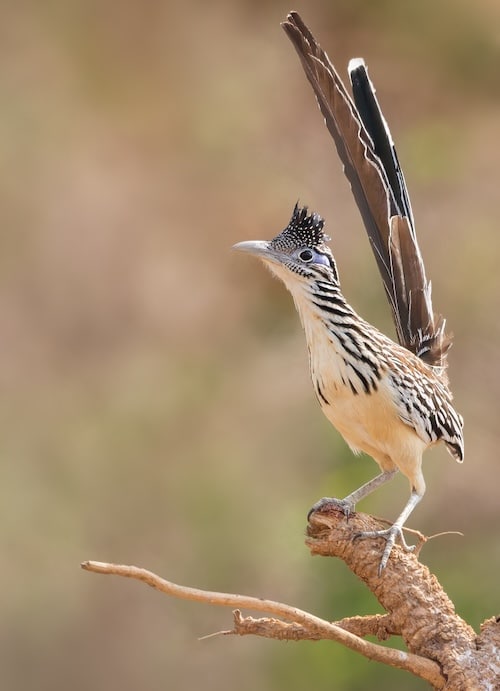
Not all birds are Lesser Roadrunners – ©Dubi Shapiro
The majority is made up of disabled people, overweight people, elderly people, young people, pram pushing parents etc. Why is it that the tall, able-bodied, slim male has everything designed for him? Could it simply be because he is most often the designer! Even now a majority of reserve staff are fit young men who are unaware of how the provision they make matches their own physique. It is some help that more able-bodied women are now reserve wardens, simply as that means that a range of heights gets better catered for.
So, disability access is an issue that calls for societal change. Society and its provision is the problem, not the person with a hearing aid, wheelchair, crutches, walking aid or a white stick. After all, if we settled for the average provision in all things most of us would look bizarre; wearing size 12 dresses and size 6 shoes, and this would be the men as well!
(Incidentally, even dress makers are behind the trend always offering more size 10 or 12 than all the rest put together whereas the average British woman is a size 14!)
Our watchwords are ‘Barrier Free Access’ and ‘Diversity’. The fact is that good design is no more or less expensive than poor design and good design allows more use of provision. Moreover, there is NOTHING that improves access to people with mobility issues, that makes access worse for fully able-bodied people!
Birding For All (see above) was set up to combat poor attitudes and provision across the board. It exists to encourage everyone to think about what can be achieved with sensitivity and good design, often for the same money as current provision, if it is thought about at the outset. It is not just about reserve paths and the design of hides and their access. Optics manufacturers need to think more about spectacle wearers, tour companies need to think about whether the hotels they use offer accessible facilities for people who need to use wheelchairs, the list goes on.
Consider, for example, (and it is a real example) the reserve manager who has laid level paths with even dry surfaces so that wheelchair users can get around and has then fitted a narrow kissing gate at the beginning of the path!
Consider that too the many hides up and down the country that have a ramp up to them but no viewing slot at a suitable height for someone using a wheelchair, let alone different height viewing slots and benches for us diverse users.
Consider, above all, the terrible standard design of hides that cause the majority of people to come away with a crick in the neck or aching back because the average has been applied to the height of viewing slots and benches rather than a range of heights.
Consider this; a baby may weigh six pounds. An adult could easily weigh 200 pounds. Would it be sensible to offer them both the ‘average’ sized pants? One size does NOT fit all! It’s just a lazy formula that suits few.
I urge everyone, disabled or able bodied to visit the Birding For All website and join up (for free). US users might want to visit the BirdAbility website and support the cause that side of the Atlantic. After all, few birders will remain as mobile in their sixties and seventies as they were in their twenties and thirties. Most of us age, get sick, have accidents or have children, our needs change throughout our lives so making provision accessible for all will help every one of us!
Help make birding truly accessible to all.
Bo Beolens – aka The Fat Birder; Founder – Birding For All
-
A Movement to Make Birding More Inclusive and Accessible
ArticleVirginia Rose found her passion for birds—and a new purpose in life—from the seat of her wheelchair. With Birdability, she's working to bring birding's benefits to others like her. -
Access All Birds - Birdwatching with Disability
ArticlePeople love birds and would love to see or hear them wherever they are, but for many of those people there are obstacles in the way of the simple joy of birdwatching. -
Access Birding
ConsultancyMy name is Freya McGregor; my pronouns are she/her. I am a disabled birder, an occupational therapist, a writer, a military spouse, an Australian living in the US, and someone who is motivated to use my knowledge, skills and passion to leave the world a little bit better than I found it. -
Birdwatching Is Forbidden by Thoughtlessness for the Disabled
ArticleHow many birdwatchers enjoy a walk in the woods or a park and never give a thought to those who are disabled and might enjoy that, too? Thoughtless is the answer, and it needs to be addressed because of its cruelty. -
How To Be an Inclusive Birder
ArticleBirding is for everybody, but not everybody can easily go birding. Here are resources that individual birders, bird outing leaders, bird clubs, and nature centers can implement to help make birding more welcoming and inclusive... -
The Disabled Birders Association
ArticleThe bulk of this article appeared a while back in Birdwatching magazine - it gives a good flavour of what The Disabled Birders Association (DBA) is and is trying to do.
-
BirdAbility
WebsiteBirdability works to ensure the birding community and the outdoors are welcoming, inclusive, safe and accessible for everybody. We focus on people with mobility challenges, blindness or low vision, chronic illness, intellectual or developmental disabilities, mental illness, and those who are neurodivergent, deaf or hard of hearing or who have other health concerns. In addition to current birders, we strive to introduce birding to people with disabilities and other health concerns who are not yet birders so they too can experience the joys of birding. -
Birding For All (formerly the Disabled Birders Association)
WebsiteThe dba started in April 2000, but that date should not lead anyone to believe that the organisation is not serious. As nothing like it seemes to have existed anywhere it is an international association and, whilst the UK chapter has most members, we invite mebership from aoll over the world and would like to see chapters getting together wherever there are birders with special needs. In 2011 we changed our name to 'Birding For All' to better carry our message of inclusivity
-
2by2 Holidays
WebpageWheelchair Accessible Safari Holidays -
Accessible Birdwatching Holidays
WebpageBelow you’ll find a great selection of holiday destinations across the UK, close to nature reserves or renowned as great places for all things ornithological. We’ve also highlighted accessible accommodation in these beautiful locations that are specifically described as being ideal for those who enjoy birdsong and birdwatching. -
NatureTrek
Tour OperatorTailormade Holidays Suitable for those with Mobility Restrictions -
Tourism For All
WebsiteWhether you are an individual or an organisation, join Tourism for All and help us to make accessible tourism and travel better! -
Waveney Stardust - adapted Norfolk
Boat TourWaveney Stardust, founded in 1988, is a registered charity. 2019 will be our 27th year operating accessible cruising facilities for people who could not otherwise enjoy the beauty and wonder of the Norfolk and Suffolk Broads.
-
England - Dorset - Holton Lee
Accommodation…empowering and resourcing people, particularly carers and those with disabilities, through creativity, environmental awareness, personal and spiritual growth. I have visited the site and there is an accessible hide overlooking Poole harbour near Arne - Fatbirder.
-
*Birding For All
WebsiteThe charity was set up in April 2000 as the Disabled Birders Association by Bo Beolens, an ordinary birder with a minor disability. Since then it has grown into an international organisation with over 1000 members. -
Bird Watching for the Disabled
ArticleBeing temporarily dependent on a wheelchair for going any distance and committed to leading a bird walk , I wondered how I would handle the situation. -
BirdAbility on Twitter
TwitterVIRGINIA ROSE, initiated #Birdability on birding and getting mobility-challenged people out into the parks and enjoying nature, by way of birding and in turn, to make birding more accessible -
Birding for All: How to Make Enjoying Birds More Accessible
ArticleFreya McGregor is adamant that anyone can be a birder. You don’t have to be able to identify the birds you see or keep lists of the rarities you’ve spotted. You don’t need binoculars — or even sight. -
Birding for Birders with Limited Mobility
ArticleEnter ‘Bird Watching’ into Google and in less than a second, there are 18 million hits. Enter ‘Bird Watching for the disabled’ and it seems there is nothing of consequence, no up- to-date organization, just a handful of specific places or holidays. -
Birding when You Have a Disability
Discussion...I can’t typically hear birds (hearing loss) so I 'bird" with Merlin. I can’t usually find them. Birders always tell me they key in on the sound so they know where to look... -
Disabled Birding Tours
ArticleHaving organized and sometimes guided disabled birding trips for well over a decade I’d like to shares a few thoughts on the problems and pitfalls and how to avoid them. -
Independent Living Research Utilization - US
WebsiteThe ILRU (Independent Living Research Utilization) program is a national center for information, training, research, and technical assistance in independent living. Its goal is to expand the body of knowledge in independent living and to improve utilization of results of research programs and demonstration projects in this field. It is a program of TIRR (The Institute for Rehabilitation and Research); a nationally recognized medical rehabilitation facility for persons with disabilities. -
Legally Blind Birding
WebsiteBirding despite disability... -
Waveney Stardust - adapted Norfolk Broads boat
WebsiteWaveney Stardust is a specially adapted broads motor cruiser designed to offer people, who would not otherwise be able to use a traditional boat, the opportunity to use the Norfolk and Suffolk waterways. We offer trips along the river Waveney from Beccles to Oulton Broad, and from Norwich, South Walsham and Stalham. See venues page for more details
-
Birdability, Making Birding More Accessible
Videoa passionate advocate for birding accessibility and inclusivity, is the driving force behind Birdability, an initiative dedicated to introducing people with access challenges to birding, making birding sites and festivals more accessible... -
Richard loves birdwatching, but he thinks more could be done to make it accessible
VideoGB Skip navigation Search Avatar image Richard loves birdwatching, but he thinks more could be done to make it accessible 🐦 | ABC Australia ABC Australia 385K subscribers Subscribe 64 Share Save Clip ABC is an Australian public broadcast service. Wikipedia 2,111 views Oct 16, 2022 #birding #birdwatching #birds When Paralympian Richard Cordukes took up birding 30 years ago, he was instantly hooked. Since then, he’s travelled Australia in search of beautiful birds. But, as a person with disability he’s come up against his fair share of challenges. -
A Brief But Spectacular take on finding independence while birdwatching
VideoVirginia Rose, who has been using a manual wheelchair for more than 40 years, knows how difficult it can be to enjoy nature as a disabled person. With her organization "Birdability," Rose finds ways to increase access to nature for people of all abilities and help others find community. She offers her Brief But Spectacular take on finding independence while birdwatching. -
Birding Without Barriers
BLOGLast entry 2016 -
Birding on Wheels
BLOGLast entry 2012 -
The OT Birder
BLOGOccupational therapist and disabled birder consulting, researching and writing at the intersection of access, inclusion, disability and birding.