

Banding or Ringing
Banding Together
Much of what we know about birds, and most especially migration, has been learnt from studies involving the catching and identification of individual birds. Banding, (in the USA) otherwise known as ringing, (in the UK) is undertaken by amateurs and professionals all over the world at bird observatories, constant effort sites and elsewhere. Love it or loath it, it has undoubtedly made a great contribution to the science of ornithology and to birding.
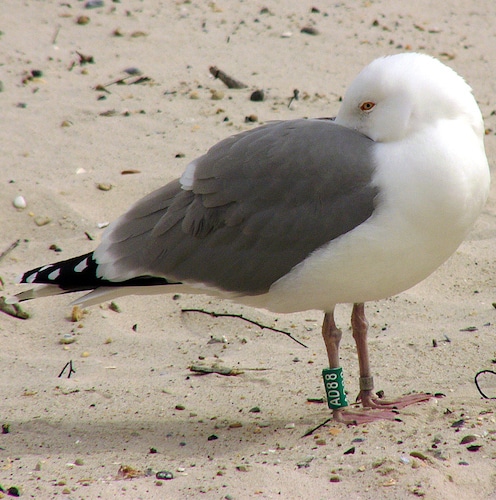
Looking out for bands can add to your hobby too and there are websites out there just dedicated to sightings of colour-ringed birds. Somewhere on this page there will be just the link you need if you spot a leg-ring and want to know more, or find a banded bird corpse and want to know what you should do next. Colour ringing is usually used by projects studying a group of birds in a particular place in order to show family structures, behaviour, distribution, etc.
For ringing in general two different conventions exist:
There is the general ringing or banding of birds, whereby a lightweight metal ring is attached to the leg of a captured bird that is then returned to the originator if the bird has been found dead or recaptured at another ringing site. This has been used to see which populations migrate where, how birds expand territory etc.
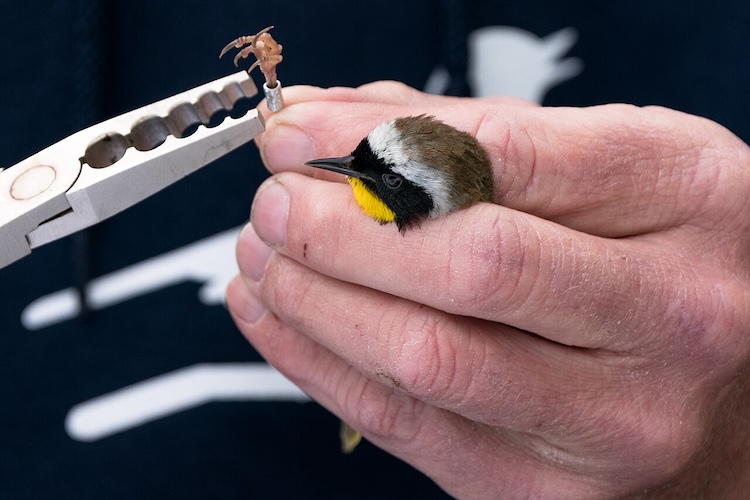
Common Yellowthroat Geothlypis trichas being banded – ©Lorie Shaull, CC BY-SA 4.0 via Wikimedia Commons
There are also banding / ringing schemes using colour bands to make it possible to identify different individuals in the field. This has been used to show, for example, that, contrary to what you may believe, you are not getting the same 4 blue-tits at your garden feeders but, over just a few days it may be 70 different individuals!
It is not just movement than that can be deduced from ringing records, but longevity, site loyalty and much more. Many local observatories offer courses where you can learn how to band and join ringing schemes. Increasingly, radio tags are used to track bird movements, particularly where there are reintroduction schemes or there is a threat of loss by human action, such as tagging Hen Harriers on English grouse moors. In the UK, many bird observatories use a system which automatically registers any tagged bird as it flies close by. This has been used, for example, to track the movements of White-tailed Eagles introduced in the Isle of Wight in southern England, and it has shown that the birds.
-
Bird Ringing - A Concise Guide
| By Dawn Balmer, Liz Coiffait, Jacquie Clark & Rob Robinson | British Trust for Ornithology | 2008 | Paperback | 75 pages, Colour photos, graphs, maps | ISBN: 9781906204457 Buy this book from NHBS.com -
Bird Ringing Station Manual
| By Przemysław Busse & Włodzimierz Meissner | De Gruyter | 2015 | Hardback | 211 pages, colour & b/w photos, b/w illustrations, tables | ISBN: 9788376560526 Buy this book from NHBS.com
-
The Ring
WebpageTHE RING is an international journal dealing with problems of bird ringing, migration and monitoring bird numbers. The main fields of interest are original papers, review articles and methodical discussions. Information, progress reports, personal comments and short notes or news are also accepted to the informative columns of the journal. Although papers are refereed, conclusions, opinions and discussion are published on the author's responsibility.
-
BTO Bird Ringing Scheme ringing scheme logo
WebpageBird ringing generates information on the survival, productivity and movements of birds, helping us to understand why populations are changing. -
Bird Banding Laboratory
WebsiteThe Bird Banding Laboratory (Est. 1920), an integrated scientific program, supports the collection, curation, archiving, and dissemination of data from banded and marked birds. -
Catalan Ringing Group (Institut Catal
WebsiteThe Catalan Ringing Group (Grup Catal -
EURING - The European Union for bird ringing
WebsiteBirds freely cross political boundaries and so international cooperation is vital for research and conservation. EURING promotes international collaboration on all aspects of scientific bird ringing, particularly in Europe and along the Eurasian African flyway. Our work includes collaborative research, data sharing and scientific meetings. -
European Colour-ring Birding
WebsiteEuropean colour-ring Birding is a platform between the field-observer and the project-leader. Therefore it can not provide any details or life-list of your sighting. To get this information, you have to go through this website, find the project-leader and contact her/him. -
Grampian Ringing Group
WebsiteWelcome to the Website and Blog of the Grampian Ringing Group. We're a very active bird ringing group covering the entire Grampian region since 1977. -
Grupo Ornitológico Zamalla
WebsiteBirds migration and banding birds in South Spain -
Powdermill Avian Research Center
WebsiteBird Banding, Bioacoustical Research, Avian Perception of Glass, and more. Powdermill Avian Research Center (PARC) is part of Carnegie Museum of Natural History’s biological research station Powdermill Nature Reserve. -
Trektellen
WebsiteMigration counts and ringing records The Netherlands, Flanders and France -
Western Bird Banding Association
WebsiteThe Western Bird Banding Association (WBBA) was founded in 1925 to provide guidance and assistance to a relatively small number of western bird banders, located then primarily in Southern California.
-
CR-Birding
Mailing GroupFind a colour-ring project
-
Bird Ringing
InformationWikipedia article -
Colour Mark Recording
WebsiteThis document describes a standard way of recording colour marks (combinations of colour rings, colour rings with enscriptions, multi-coloured rings, leg flags, neck collars, wing tags, nasal tags and saddles -
European Colour Ring Birding
WebsiteWith the help of Alain Foss -
Huddleston & Jackson Bird Ringing Partnership
WebsiteLast updated 2019 -
LaB O R I Ng - Passeriformes del Pale
WebsiteGuide to West Palearctic Passeriformes [In spanish] for ringers and other birders you can add to. -
NHBS Ringing Accessories
WebpageEverything needed to safely ring birds