

Calcariidae – Longspurs & Snow Buntings
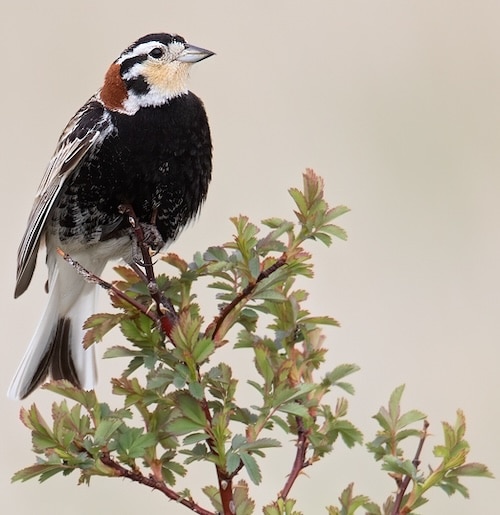
Calcariidae is a small family of passerines that includes longspurs and snow buntings. There are six species in three genera worldwide, found mainly in North America and Eurasia. They are migratory and can live in a variety of habitats including grasslands, prairies, tundra, mountains, and beaches.
Members of Calcariidae range in mass from around 20 grams (Chestnut-collared Longspur) to around 42 grams (McKay’s Bunting). Species have brown, grey, and white plumage, with dark brown or black irises. The legs of the snow bunting and McKay’s bunting are dark grey or black, while legs of other species in the family range from dull pink to brown. The diet of species in this family consists of insects, seeds, and grasses. All species are diurnal, and forage by walking and picking up food from the ground. They generally inhabit open areas, including prairies, plains, shores, farmland, and beaches. Parts of the snow bunting’s range include mountainous areas.
Calcariidae species were formerly assigned to the family Emberizidae (typically known as buntings in the Old World and sparrows in the New World). A phylogenetic study (2008) confirmed that the members of this family form a clade quite separated from the Emberizidae, with affinities instead with the Parulidae (New World Warblers),
Cardinalidae (Cardinals) or Thraupidae (Tanagers), although their exact relationships are unclear. They proposed to place them in the tribe Calcariini, but the International Ornithological Congress placed them in a separate family (2010). The cytochrome b DNA suggests that the Calcariidae diverged from a common ancestor around 4.2–6.2 million years ago, around the beginning of the Pliocene, possibly soon after the spread of grasslands in North America as the climate in the late Miocene became drier and cooler.
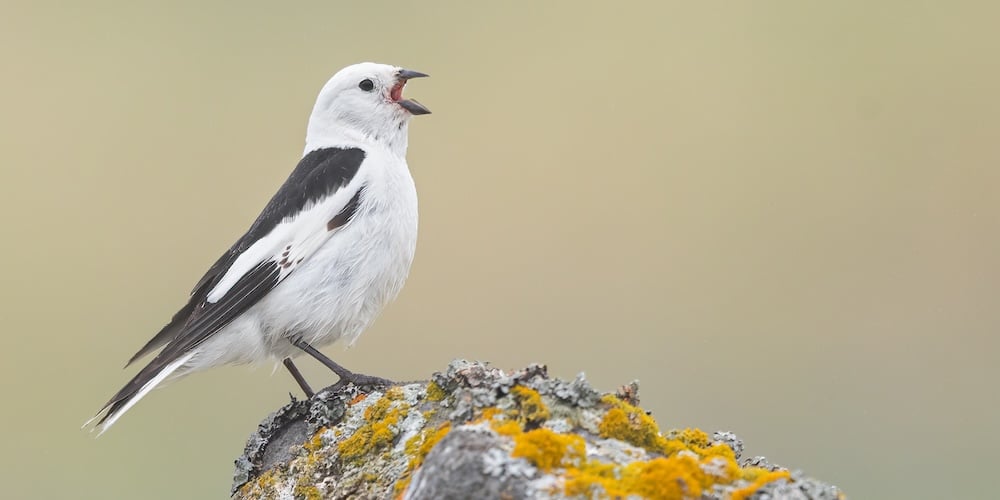
Snow Bunting Plectrophenax nivalis – ©Dubi Shapiro
Three genera; Calcarius (Longspurs), Plectrophenax (Snow Buntings), and Rhynchophanes are recognised. Genetic analysis with cytochrome b DNA showed that the thick-billed longspur was most closely related to the two snow bunting species, and the three nested within the genus Calcarius. Smith’s and the Chestnut-collared Longspur were each other’s closest relatives (sister taxa). The Lapland Longspur likely diverged from an ornatus/pictus ancestor near the beginning of the Pliocene (4.4–6.2 million years ago) and the Snow and McKay’s Buntings diverged within the last 100,000–125,000 years. Though they differ in appearance, Smith’s and the Collared Longspurs likely only diverged around 1.5–2 million years ago, around the start of the Pleistocene.
McKay’s bunting has sometimes been considered a subspecies of the snow bunting, and instances of the two species hybridizing have been reported. However, a study (2007) found substantial differences in the juvenile plumage between the two groups, supporting a species-level division. Other members of Calcariidae known to hybridize with each other are the Thick-billed Longspur and the Chestnut-collared Longspur.
The range of the family is extensive. Of the six species within the family, the snow bunting and Lapland longspur are found both in both North America and Eurasia; the other four species are found only in North America. The snow bunting breeds in northern latitudes in an extensive breeding range which consists of northern Alaska and Canada, the western and southern coasts of Greenland, and northern Scandinavia and Russia. The snow bunting winters throughout southern Canada and the northern United States in North America, and its Eurasian range includes the northern United Kingdom and a large band extending from Germany west through Poland and Ukraine to Mongolia and China.
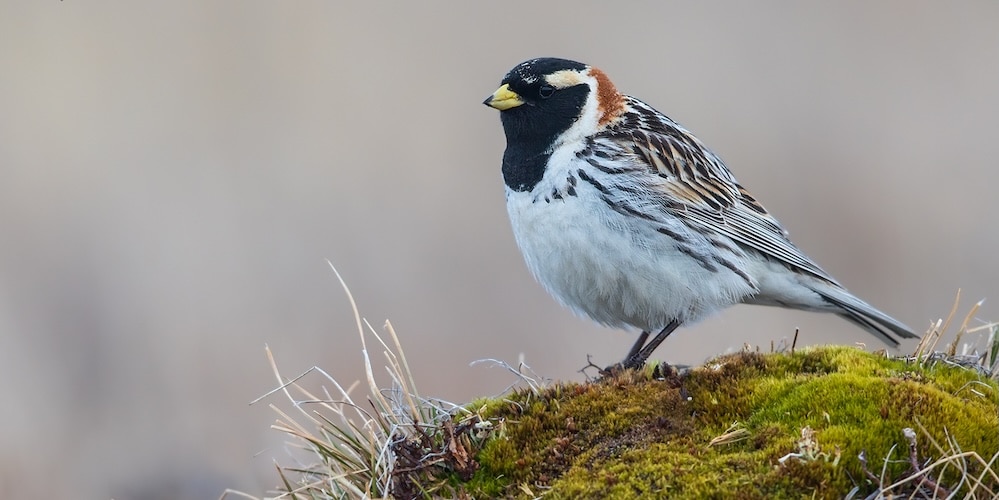
Lapland Longspur Calcarius lapponicus – ©Dubi Shapiro
Additionally, the snow bunting has been recorded as a vagrant to Algeria and Morocco in North Africa, the Balkans, Greece and Turkey, and Malta. The Lapland Longspur’s range is similar to that of the Snow Bunting, breeding in northern Canada, Scandinavia, and Siberia, and coastal Alaska and Greenland and wintering in the northern United States and Canada, and in a band between approximately 45° and 55° latitude across Russia, Kazakhstan, China, and Mongolia to the Sea of Japan.
The ranges of the other species in the family are less extensive than those of the snow Bunting and the Lapland Longspur. McKay’s Bunting breeds solely on several islands in the Bering Sea, and winters primarily on the western coast of Alaska. Additionally, it has been reported occasionally in the Aleutian Islands, and has been a vagrant in British Columbia in Canada as well as Washington and Oregon in the US. Smith’s Longspur breeds in Alaska and northern Canada, and winters in the central southern US. The Chestnut-collared Longspur’s breeding range consists solely of prairie regions in the northern Great Plains and southern Canadian Prairies, while its winter range extends from the southern US to central Mexico. The breeding range of the Thick-billed Longspur is similar to that of the Chestnut-collared Longspur, but its winter range does not extend as far south, ending in northern Mexico.
-
Number of bird species: 6
(As at October 2025)
According to the recently (2025) amalgamated AviList, there are six species, in three genera of the Calcariidae family. They are:
Thick-billed (McCown’s) Longspur Rhynchophanes mccownii
McKay’s Bunting Plectrophenax hyperboreus
Snow Bunting Plectrophenax nivalis
Lapland Longspur Calcarius lapponicus
Chestnut-collared Longspur Calcarius ornatus
Smith’s Longspur Calcarius pictus
-
Calcariidae
Family AccountThe longspurs and Plectrophenax buntings are birds of open country that move south from northern breeding areas in huge flocks during the winter. -
Calcariidae
Family AccountCalcariidae is a small family of passerine birds. It includes longspurs and snow buntings. There are six species in three genera worldwide.
-
Chestnut-collared Longspur Calcarius ornatus
Species AccountSparrowlike ground-dweller; crouches low to the ground and walks with pattering footsteps. Breeding male shows beautiful chestnut nape, black-and-white head... -
Chestnut-collared Longspur Calcarius ornatus
Species AccountThe chestnut-collared longspur (Calcarius ornatus) is a small ground-feeding bird from the family Calcariidae which also contains the longspurs. -
Chestnut-collared Longspur Calcarius ornatus
Species AccountCalcarius ornatus is listed as Vulnerable under criteria A2bc+3bc+4bc. -
Chestnut-collared Longspur Calcarius ornatus
Species AccountSound archive and distribution map. -
Lapland Longspur Calcarius lapponicus
Species AccountSparrowlike ground-dweller; crouches low to the ground and walks with pattering footsteps. Breeding male is gorgeous and unmistakable. -
Lapland Longspur Calcarius lapponicus
Species AccountThe Lapland longspur (Calcarius lapponicus), also known as the Lapland bunting, is a passerine bird in the longspur family Calcariidae, a group separated by most modern authors from the Fringillidae (Old World finches). -
Lapland Longspur Calcarius lapponicus
Species AccountSound archive and distribution map. -
McKay's Bunting Plectrophenax hyperboreus
Species AccountSound archive and distribution map. -
McKay's Bunting Plectrophenax hyperboreus
Species AccountPlectrophenax hyperboreus is listed as Least Concern. -
McKay's Bunting Plectrophenax hyperboreus
Species AccountMcKay's bunting (Plectrophenax hyperboreus) is a passerine bird in the longspur family Calcariidae. It is most closely related to the snow bunting (P. nivalis). -
Smith's Longspur Calcarius pictus
Species AccountSparrowlike ground dweller; crouches low to the ground and walks with pattering footsteps. Breeding male is a unique deep yellow-orange with black-and-white... -
Smith's Longspur Calcarius pictus
Species AccountThe Smith's longspur (Calcarius pictus) is a small ground-feeding bird from the family Calcariidae, which also contains the longspurs. -
Smith's Longspur Calcarius pictus
Species AccountSound archive and distribution map. -
Snow Bunting Plectrophenax nivalis
Species AccountBold black-and-white wing patches are distinctive in flight. Nonbreeding birds are overall white below with warm brown and orange tones on head and back. -
Snow Bunting Plectrophenax nivalis
Species AccountThe snow bunting (Plectrophenax nivalis), sometimes colloquially called a snowflake, is a passerine bird in the family Calcariidae -
Snow Bunting Plectrophenax nivalis
Species AccountSound archive and distribution map. -
Thick-billed (McCown's) Longspur Rhynchophanes mccownii
Species AccountPale buffy overall with grayer nape, thick pink bill, and plain unstreaked underparts. In flight, note mostly white tail (even more so than Chestnut-collared... -
Thick-billed (McCown's) Longspur Rhynchophanes mccownii
Species AccountThe McCown's longspur (Rhynchophanes mccownii) is a small ground-feeding bird from the family Calcariidae, which also contains the longspurs and snow buntings. -
Thick-billed (McCown's) Longspur Rhynchophanes mccownii
Species AccountSound archive and distribution map.