

Notiomystidae – Stitchbird
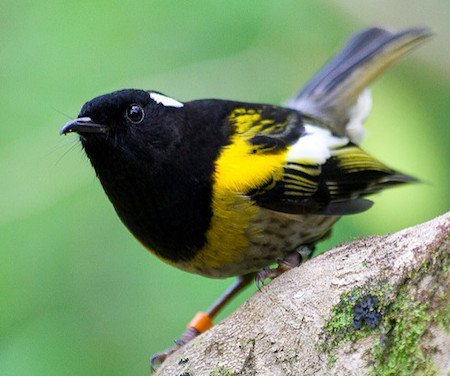
The Notiomystidae are represented by just one extant species; the Stitchbird or Hihi, which is a rare honeyeater-like bird endemic to the North Island and adjacent offshore islands of New Zealand. It became extirpated everywhere except Little Barrier Island but has been reintroduced to three other island sanctuaries and two locations on the North Island mainland. Its evolutionary relationships have long puzzled ornithologists, but it is now classed as the only member of its own family.
The Stitchbird was originally described as a member of the primarily Australian and New Guinean honeyeater family Meliphagidae. It had remained classified as such until recently (2007). Genetic analysis shows that it is not closely related to the honeyeaters and their allies and that its closest living relatives are within the endemic New Zealand Callaeidae.
The Stitchbird is a small honeyeater-like bird. Males have a dark velvety cap and short white ear-tufts, which can be raised somewhat away from the head. A yellow band across the chest separates the black head from the rest of the body, which is grey. Females and juveniles are duller than males, lacking the black head and yellow chest band. The bill is rather thin and somewhat curved, and the tongue is long with a brush at the end for collecting nectar. Thin whiskers project out and slightly forward from the base of the bill.
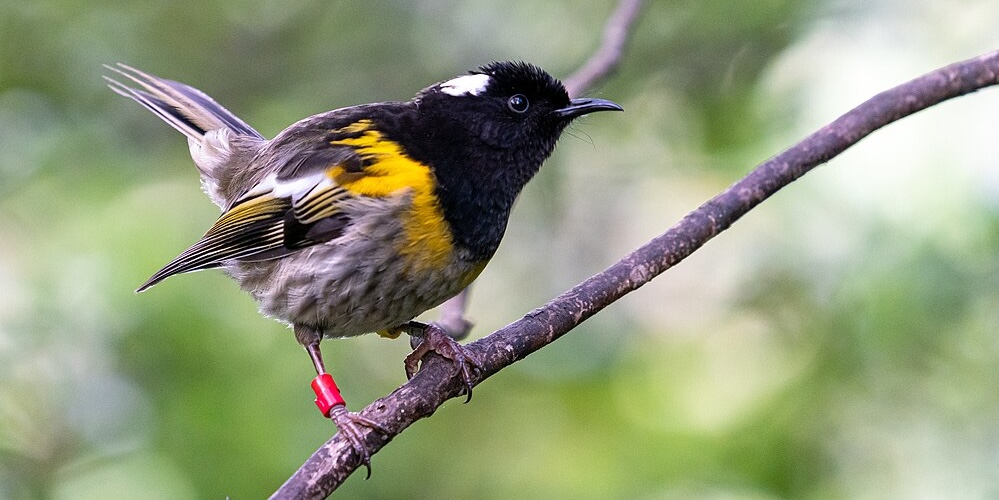
Hihi Notiomystis cincta – ©Judi Lapsley Miller CC BY 4.0 via Wikimedia Commons
Stitchbirds are very active and call frequently. Their most common call, a ‘tzit tzit’ sound, is believed to be the source of their common name, as Buller noted that it “has a fanciful resemblance to the word stitch”. They also have a high-pitched whistle and an alarm call which is a nasal ‘pek’ like a bellbird. Males give a piercing three-note whistle (often heard in spring) and a variety of other calls not given by the female.
Research has suggested that they face interspecific competition from the Tui and New Zealand Bellbird, and will feed from lower-quality food sources when these species are present. They rarely land on the ground and seldom visits flowers on the large canopy trees favoured by the Tui and Bellbird (this may simply be because of the competition from the more aggressive, larger birds).
Their main food is nectar, but the Stitchbird’s diet covers over twenty species of native flowers and thirty species of fruit and many species of introduced plants. Important natural nectar sources are haekaro, matata, puriri, rata and toropapa. Preferred fruits include Coprosma species, five finger, pate, tree fuchsia, and raukawa. It also supplements its diet with small insects.
The Stitchbird nests in holes high up in old trees. They are the only bird species that mates face to face, in comparison to the more conventional copulation style for birds where the male mounts the female’s back.
-
Number of bird species: 1
(As at August 2025)
In 2007, following DNA sequencing it was realised that the Stitchbird was in a family all of its own – Notiomystidae. It is:
Stitchbird Notiomystis cincta
-
Notiomystidae
Family AccountThis once common little songbird has been brought back from the brink of extinction. Wth a black hood and tufts of white feathers on the sides of its head. -
Notiomystidae
Family AccountThis species is classified as Vulnerable because it has a very small range (a single remnant population on 28 km 2 Hauturu/Little Barrier island)
-
Stitchbird Notiomystis cincta
Species AccountThe stitchbird or hihi (Notiomystis cincta) is a honeyeater-like bird endemic to the North Island and adjacent offshore islands of New Zealand. -
Stitchbird Notiomystis cincta
Species AccountThe stitchbird (hihi) was both rare and poorly known until the 1990s, as few people had an opportunity to visit the single remnant population on Little Barrier Island. However, thanks to successful conservation management and research, the stitchbird is now one of the better studied New Zealand bird species, and can be seen at several accessible translocation sites. -
Stitchbird Notiomystis cincta
Species AccountSound archive and distribution map.