

Stenostiridae – Fairy Flycatchers
Stenostiridae, (Fairy Flycatchers), are a family of small passerines proposed as a result of recent discoveries in molecular systematics. They are also referred to as stenostirid warblers. It unites several formerly separated flycatcher groups.
They were formerly allotted to two different flycatcher and one warbler family, but were re-assigned to this new family after DNA sequencing. This new clade is named after the Fairy Flycatcher; a distinct species placed formerly in the Old-World flycatchers. This is united with the ‘sylvioid flycatchers’: the genus Elminia (formerly placed in the Monarchinae) and the closely allied former Old World flycatcher genus Culicicapa, as well as one species formerly believed to be an aberrant fantail.
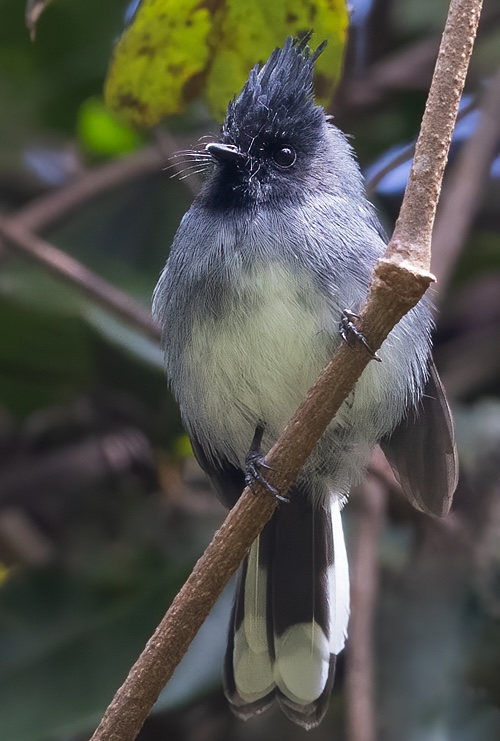
White-tailed Crested-Flycatcher Elminia albonotata – ©Dubi Shapiro
Other African or Asian species might conceivably fall into this novel clade. The tit-flycatchers (Myioparus) are apparently true flycatchers morphologically somewhat convergent to Stenostira.
The Stenostiridae as a whole are related to penduline tits, titmice and chickadees. All these appear to be closer to the Sylvioidea than to other Passerida.
The are small-bodied and rather dainty insectivores native to wooded areas of Asia and Africa. They are relatively small-billed compared to true flycatchers and have long tails. They are fast moving, flitting rapidly to and from perches from which they sally forth to catch flying insects, or flit to forage on nearby vegetation, often with frenetic wingshakes and stretches while they are perched. Despite being so active, these tiny birds are easily overlooked. There is very little known about their biology.
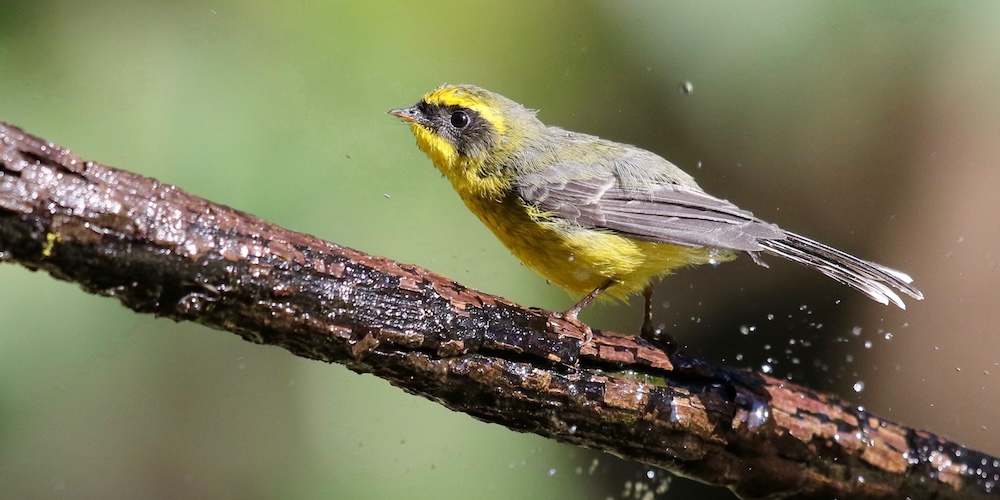
Yellow-bellied Fantail Chelidorhynx hypoxanthus – ©Nick Ludovic Green Bird-Photo-Tours ASIA
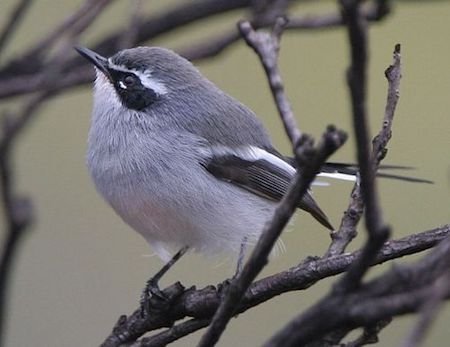
The Fairy Flycatcher Stenostira scita, is one of the commoner and better-known species in the family. It was formerly placed in the Old-World flycatcher family, Muscicapidae, but is now the only member of the genus Stenostira. It is an endemic resident breeder in southern Africa in Botswana, South Africa, Lesotho and Namibia, and a vagrant to Zimbabwe and Eswatini. It is a common seasonal migrant, breeding in karoo scrub and fynbos in the southern highlands, and migrating north in to spend the southern winter in thorn scrub at lower altitudes.
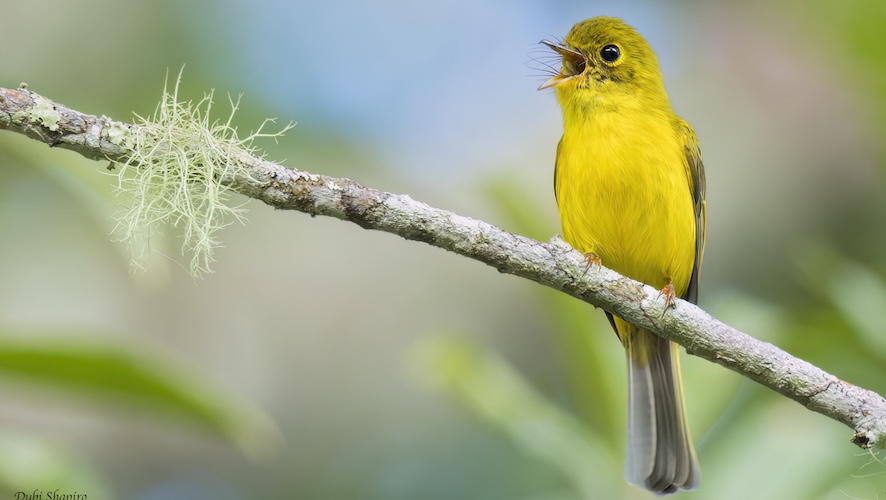
Citrine Canary-flycatcher Culicicapa helianthea – ©Dubi Shapiro
Around 12 cm in length, the adult is pale grey above with a black mask through the eye and a white supercilium. The wings are black with a long white stripe, and the long black tail has white sides. The throat is white, the breast is pale grey, and the belly is white with a pinkish-grey wash to its centre. The sexes are alike, but the juvenile is browner than the adult. The eye is brown and the bill and legs are black.
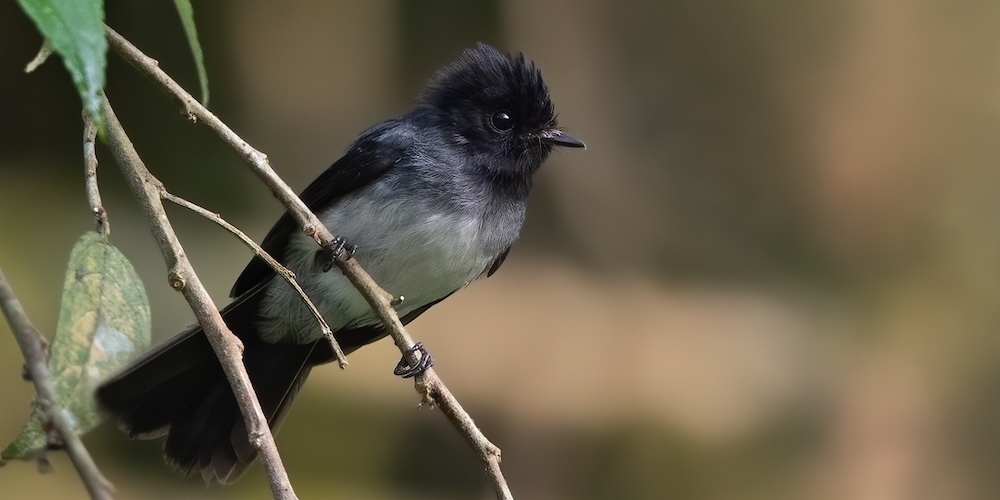
White-bellied Crested-Flycatcher Elminia albiventris – ©Dubi Shapiro
They are monogamous unless a mate dies, when it will seek a new partner. It builds an open cup nest from thin stems and other plant material and lined with plant down. It is placed in the branches of a tree or shrub but well concealed. The female lays two or three green eggs. They are usually seen alone, in pairs, or small flocks feeding on small insects and other invertebrates, foraging in the foliage like a warbler.
-
Number of bird species: 9
(As at October 2025)
According to the recently (2025) amalgamated AviList, there are nine species in four genera in the Stenostiridae family. They are:
Yellow-bellied Fantail Chelidorhynx hypoxantha
Fairy Flycatcher Stenostira scita
Grey-headed Canary-flycatcher Culicicapa ceylonensis
Citrine Canary-flycatcher Culicicapa helianthea
African Blue-Flycatcher Elminia longicauda
White-tailed Blue-Flycatcher Elminia albicauda
Dusky Crested-Flycatcher Elminia nigromitrata
White-bellied Crested-Flycatcher Elminia albiventris
White-tailed Crested-Flycatcher Elminia albonotata
-
Stenostiridae
Family AccountStenostirids are active insectivores that move with quick movements—flitting rapidly to and from their foraging perches, sallying out to snag a flying insect... -
Stenostiridae
Family AccountStenostiridae, or the fairy flycatchers, are a family of small passerine birds proposed as a result of recent discoveries in molecular systematics.
Given that this is a small family with just nine species in only four genera, Fatbirder provides active links below to all species.
-
African Blue-Flycatcher Elminia longicauda
Species AccountThe African blue flycatcher or Blue-crested flyctacher (Elminia longicauda) is a species of bird in the Stenostiridae family from western and central Sub-Saharan Africa. -
African Blue-Flycatcher Elminia longicauda
Species AccountElminia longicauda is listed as Least Concern. -
African Blue-Flycatcher Elminia longicauda
Species AccountSound archive and distribution map -
Citrine Canary-flycatcher Culicicapa helianthea
Species AccountThe citrine canary-flycatcher (Culicicapa helianthea) is a species of bird in the family Stenostiridae. The term citrine refers to its yellowish colouration. It is found in Indonesia and the Philippines. Its natural habitat is subtropical or tropical moist montane forests. -
Citrine Canary-flycatcher Culicicapa helianthea
Species AccountSound archive and distribution map -
Dusky Crested-flycatcher Elminia nigromitrata
Species AccountThe dusky crested flycatcher (Elminia nigromitrata) is a species of bird in the Stenostiridae family. It is found in Cameroon, Central African Republic, Republic of the Congo, Democratic Republic of the Congo, Ivory Coast, Equatorial Guinea, Gabon, Ghana, Guinea, Kenya, Liberia, Nigeria, Sierra Leone, South Sudan, Tanzania, and Uganda. Its natural habitats are subtropical or tropical moist lowland forests and subtropical or tropical moist montane forests. -
Dusky Crested-flycatcher Elminia nigromitrata
Species Accountlminia nigromitrata is listed as Least Concer -
Fairy Flycatcher Stenostira scita
Species AccountIt is an endemic resident breeder in southern Africa in Botswana, South Africa, Lesotho and Namibia, and a vagrant to Zimbabwe and Swaziland. -
Fairy Flycatcher Stenostira scita
Species AccountSound archive and distribution map -
Grey-headed Canary-flycatcher Culicicapa ceylonensis
Species AccountThe grey-headed canary-flycatcher sometimes known as the grey-headed flycatcher (Culicicapa ceylonensis) is a species of small flycatcher-like bird found in tropical Asia. It has a square crest, a grey hood and yellow underparts... -
Grey-headed Canary-flycatcher Culicicapa ceylonensis
Species AccountSound archive and distribution map -
White-bellied Crested-Flycatcher Elminia albiventris
Species AccountThe white-bellied crested flycatcher (Elminia albiventris) is a bird species in the family Stenostiridae; it was formerly placed with the drongos in the Dicruridae. -
White-bellied Crested-Flycatcher Elminia albiventris
Species AccountSound archive and distribution map -
White-tailed Blue-Flycatcher Elminia albicauda
Species AccountThe white-tailed blue flycatcher (Elminia albicauda) is a species of bird in the Stenostiridae family. It is found in Angola, Burundi, Democratic Republic of the Congo, Malawi, Mozambique, Rwanda, Tanzania, Uganda, and Zambia. -
White-tailed Blue-Flycatcher Elminia albicauda
Species AccountSound archive and distribution map -
White-tailed Crested-Flycatcher Elminia albonotata
Species AccountThe white-tailed crested flycatcher (Elminia albonotata) is a species of bird in the flycatcher family Stenostiridae. It has a discontinuous distribution in eastern Africa. There are three subspecies, E. a. albonotata of central Kenya, and Uganda through to south west Tanzania; E. a. subvaerulea, which ranges from southern Kenya to Malawi and E. a. swynnertoni of Zimbabwe and Mozambique. -
White-tailed Crested-Flycatcher Elminia albonotata
Species AccountSound archive and distribution map -
Yellow-bellied Fantail Chelidorhynx hypoxantha
Species AccountThe yellow-bellied fantail (Chelidorhynx hypoxantha), also known as the yellow-bellied fairy-fantail, is found in the Indian subcontinent, the Himalayas, and portions of Southeast Asia including Thailand, Vietnam, and Myanmar. -
Yellow-bellied Fantail Chelidorhynx hypoxantha
Species AccountSound archive and distribution map