

Sylviidae – Sylviid Warblers & Allies
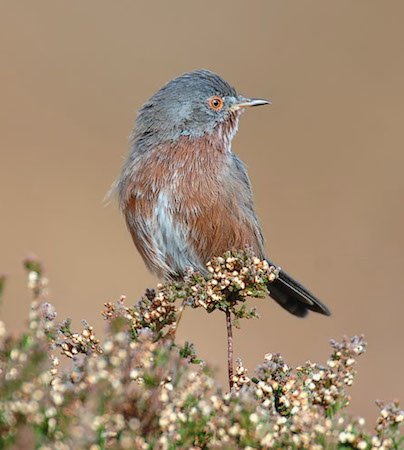
Sylviidae is a family of passerines that include the typical warblers Sylvia and the closely related genus Curruca, formerly included in Sylvia. They are found in Eurasia and Africa with the greatest diversity in the Mediterranean region. Formerly they were part of an assemblage known as the Old-World warblers. The family was a wastebin taxon with over 400 species of bird in over 70 different genera. The family was poorly defined with many characteristics shared with other families.
Advances in classification, particularly helped with molecular data from DNA research, has led to the splitting out of several new families from within this group. Today the smaller family Sylviidae includes the typical warblers and a number of babblers formerly placed within the family Timaliidae. There is now evidence that these Sylvia ‘warblers’ are more closely related to babblers Timaliidae, and thus these birds are better referred to as just sylvids.
Sylviids are small to medium-sized passerines. The bill is generally thin and pointed with bristles at the base. Sylviids have a slender shape and an inconspicuous and mostly plain plumage. Blacks and greys predominate, sometimes with dashes of white or reds. The wings have ten primaries, which are rounded and short in non-migratory species.
Most species occur in Eurasia, and to a lesser extent in Africa.
|
|
|
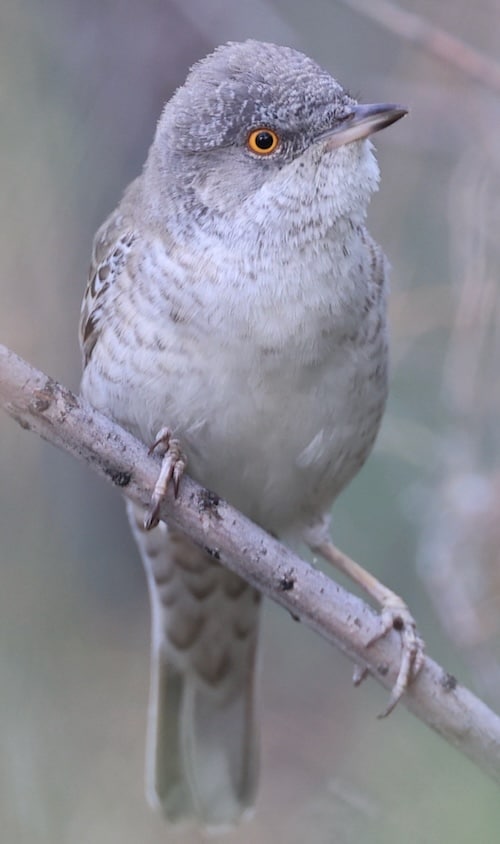
| Barred Warbler Curruca nisoria |
Common Whitethroat Curruca communis |
|
The two photos above courtesy of ©Nick Ludovic Green Bird-Photo-Tours ASIA |
|
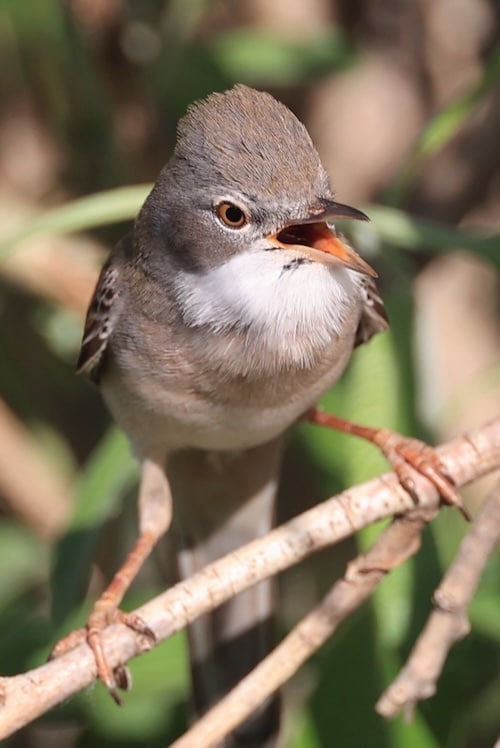
The Common Whitethroat is typical of the family. It is widespread and common throughout much of Europe and western temperate Asia. It’s strongly migratory in winters in tropical Africa, Arabia and Pakistan. Like some of the family, it’s sexually dimorphic, although the sexes are quite similar, both brown above and buff below, with chestnut fringes to the secondary remiges. The adult male has a grey head and a white throat. The female lacks the grey head and her throat is somewhat duller.
Like most of the family, its song is distinctive, although often described as somewhat fast and scratchy, or with a scalding tone, and being hoarse and slightly nasal, especially in its calls rather than its song. Having said that, many of the family do have attractive and distinctive songs, and some, such as the Blackcap, pick up phrases from other birds around their breeding areas and incorporate them in their repertoire.
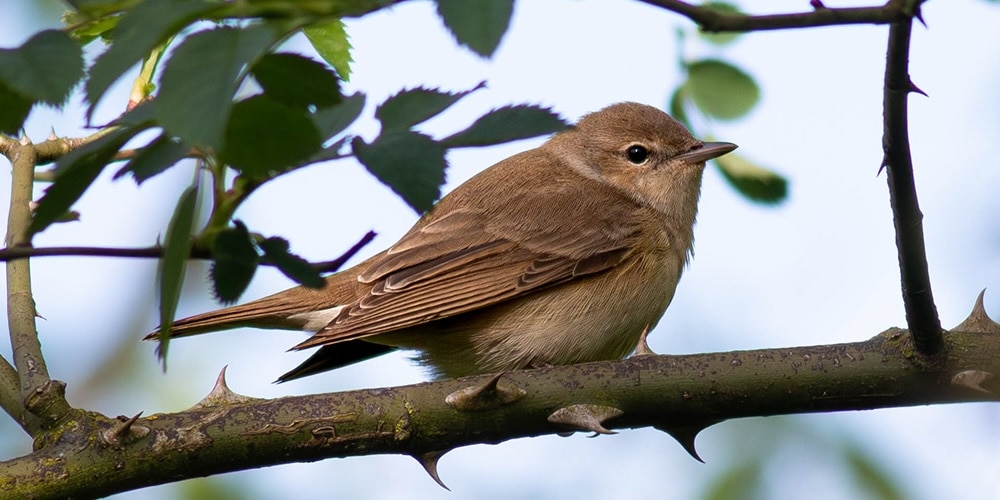
Garden Warbler Sylvia borin – ©Ashley Beolens
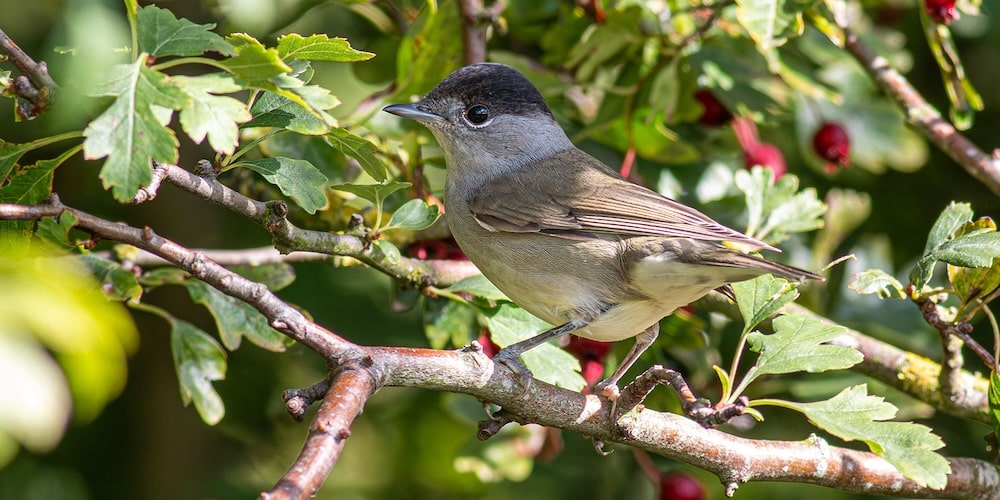
Eurasian Blackcap Sylvia atricapilla – ©Ashley Beolens
Like many of the family, it’s a bird of open country and cultivation, with bushes for nesting and vegetation to feed in or skulk in. Their nest is built in a low shrub, especially brambles, and three to seven eggs are laid. Like most warblers, it’s insectivorous, but will also eat berries and other soft fruit. In Europe, western and eastern populations of Common Whitethroats have contrasting moulting and pre-migratory fuelling strategies to capitalise on food supplies before departing to their breeding or non-breeding grounds.
In the United Kingdom, a number of species have begun to overwinter, especially with the change in weather patterns. Blackcaps, for example, and now to a lesser extent, both Common Whitethroat and Lesser Whitethroat do overwinter in the southern counties. They tend to survive the winter by eating more fruits, and some, like the Lesser Whitethroat, completely change their diet in autumn as they migrate, until arriving in the warmer areas they migrate to, where insects are again more common.
Feeding habits do, to an extent, dictate the limits to expansion of some species. For example, the Dartford Warbler stays all year in the more temperate areas of the United Kingdom. And as climate has begun to change, so has their area of occupation extended somewhat. The reason why they can survive, even though they are still insectivorous, is that they concentrate on arachnids rather than true insects and live amongst gorse and bramble, surviving on spiders and other arthropods.
-
Number of bird species: 32
(As at January 2026)
According to the recently (2025) amalgamated AviList, there are thirty-two species, in just two genera in the family. They are:
Garden Warbler Sylvia borin
Eurasian Blackcap Sylvia atricapilla
Dohrn’s Thrush-Babbler Sylvia dohrni
Abyssinian Catbird Sylvia galinieri
Bush Blackcap Sylvia nigricapillus
Ruwenzori Hill Babbler Sylvia atriceps
African Hill Babbler Sylvia abyssinica
Barred Warbler Curruca nisoria
Layard’s Warbler Curruca layardi
Banded Parisoma Curruca boehmi
Chestnut-vented Warbler Curruca subcoerulea
Lesser Whitethroat Curruca curruca
Yemen Warbler Curruca buryi
Brown Parisoma Curruca lugens
Arabian Warbler Curruca leucomelaena
Western Orphean Warbler Curruca hortensis
Eastern Orphean Warbler Curruca crassirostris
Asian Desert Warbler Curruca nana
African Desert Warbler Curruca deserti
Tristram’s Warbler Curruca deserticola
Menetries’s Warbler Curruca mystacea
Common Whitethroat Curruca communis
Spectacled Warbler Curruca conspicillata
Marmora’s Warbler Curruca sarda
Balearic Warbler Curruca balearica
Dartford Warbler Curruca undata
Rüppell’s Warbler Curruca ruppeli
Cyprus Warbler Curruca melanothorax
Sardinian Warbler Curruca melanocephala
Moltoni’s Warbler Curruca subalpine
Western Subalpine Warbler Curruca iberiae
Eastern Subalpine Warbler Curruca cantillans
-
Sylvia Warblers - Identification, Taxonomy and Phylogeny of the Genus Sylvia
| By Antoine Acker, Gabriel Gargallo & Andreas J Helbig | Helm | 2001 | Hardback | 576 pages, Col photos, illus, figs, tabs, maps | ISBN: 9780713639841 Buy this book from NHBS.com
-
Sylviidae
Family AccountThe sylviids are typically birds of dense, shrubby habitats, including arid scrub and riparian thickets, but some also use a range of forested... -
Sylviidae
Family AccountSylviidae is a family of passerine birds that includes the typical warblers Sylvia, and the closely related genus Curruca, formerly included in Sylvia.
Given the number of species in this family, Fatbirder does not provide quick links to all of them. However, the entries below do include links to representatives of both genera, those illustrated and some of the most often encountered or iconic species.
-
Barred Warbler Curruca nisoria
Species AccountThe barred warbler (Curruca nisoria) is a species of bird in the warbler family Sylviidae which breeds across temperate regions of central and eastern -
Barred Warbler Curruca nisoria
Species AccountSound archive and distribution map. -
Bush Blackcap Sylvia nigricapillus
Species AccountThe bush blackcap (Sylvia nigricapillus) is a species of bird in the family Sylviidae. It is endemic to South Africa and Eswatini. -
Bush Blackcap Sylvia nigricapillus
Species AccountSound archive and distribution map. -
Common Whitethroat Curruca communis
Species AccountThe common whitethroat (Sylvia communis) is a common and widespread typical warbler which breeds throughout Europe and across much of temperate western Asia. This small passerine bird is strongly migratory, and winters in tropical Africa, Arabia, and Pakistan. -
Common Whitethroat Curruca communis
Species AccountSound archive and distribution map. -
Dartford Warbler Curruca undata
Species AccountThe Dartford warbler (Sylvia undata) is a typical warbler from the warmer parts of western Europe and northwestern Africa. It is a small warbler with a long thin tail and a thin pointed bill. The adult male has grey-brown upperparts and is dull reddish-brown below except for the centre of the belly which has a dirty white patch. It has light speckles on the throat and a red eye-ring. The sexes are similar but the adult female is usually less grey above and paler below. -
Dartford Warbler Curruca undata
Species AccountSound archive and distribution map. -
Eurasian Blackcap Sylvia atricapilla
Species AccountThe Eurasian blackcap (Sylvia atricapilla) is a bird usually known simply as the blackcap. It is a common and widespread typical warbler. -
Eurasian Blackcap Sylvia atricapilla
Species AccountSound archive and distribution map. -
Garden Warbler Sylvia borin
Species AccountThe garden warbler (Sylvia borin) is a common and widespread small bird that breeds in most of Europe and in the Palearctic to western Siberia. -
Garden Warbler Sylvia borin
Species AccountSound archive and distribution map. -
Lesser Whitethroat Curruca curruca
Species AccountThe lesser whitethroat (Curruca curruca) is a common and widespread Old World warbler which breeds in temperate Europe, except the southwest... -
Lesser Whitethroat Curruca curruca
Species AccountSound archive and distribution map. -
Sardinian Warbler Curruca melanocephala
Species AccountThe Sardinian warbler (Curruca melanocephala) is a common and widespread Sylviidae warbler from the Mediterranean region. -
Sardinian Warbler Curruca melanocephala
Species AccountSound archive and distribution map.