

Zeledoniidae – Wrenthrush
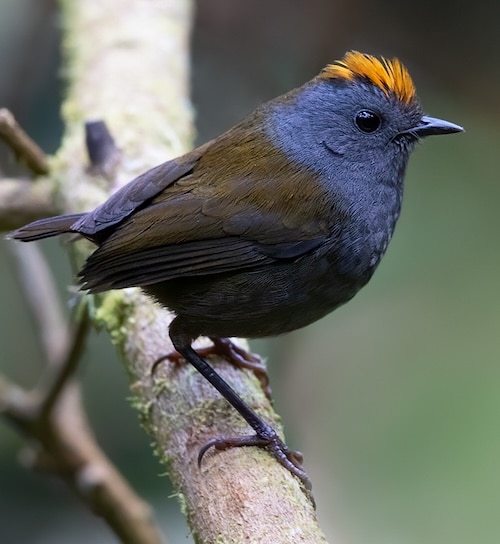
The Zeledoniidae family consists of one species. The Wrenthrush Zeledonia coronata or Zeledonia; a unique species of nine-primaried oscine, is endemic to the Talamancan montane forests.
The Wrenthrush is the only member of its genus and family. Despite its name, it is neither a wren (Troglodytidae) nor a thrush (Turdidae), and is not closely related to either of those families. Over time it has been treated as related to thrushes and Muscicapidae (Old-World flycatchers) and by the late 20th century was placed as a member of the Parulidae (New World warblers). Phylogenetic studies of nuclear and mitochondrial DNA after that date led to reassessment of several genera and (2017) the Wrenthrush was moved to its own family. The exact placement of that family is still not firmly settled, but most taxonomic systems agree that it is closely related to the Spindalidae (spindalises), Teretistridae (Cuban warblers), and several other small Caribbean families, and more distantly related to Passerellidae (New-World sparrows) and Icteridae (New-World blackbirds). BirdLife International’s Handbook of the Birds of the World places it much closer to the New-World sparrows and blackbirds than do other authorities. The Wrenthrush’s genus name commemorates José Castulo Zeledón, a Costa Rican ornithologist. It is monotypic.
The Wrenthrush is 10 to 11.5 cm long and weighs about 21 g. It is short-tailed and rather plump, with a short thin bill somewhat like that of a Parulidae warbler. The sexes are alike. Adults have a large yellow-orange patch with black borders on their crown. Their face and the sides of their neck are leaden grey. Their upperparts, tail, and flanks are dull olive bronze. Their underparts are also leaden grey with an olive tinge to the undertail coverts. Juveniles do not have the orange crown and their upperparts are more brownish than those of adults.
It is found from the Cordillera de Guanacaste in northern Costa Rica discontinuously through that country into western Panama’s Chiriquí and Veraguas provinces. It inhabits montane evergreen forest and elfin forest, landscapes characterised by constant wetness and fog. It particularly favours dense vegetation near streams, including stands of Chusquea bamboo. In elevation it ranges from about 5,000 feet up to the treeline; in Costa Rica it mostly occurs around 8,000 feet. It is essentially sedentary, with minimal elevational movement.
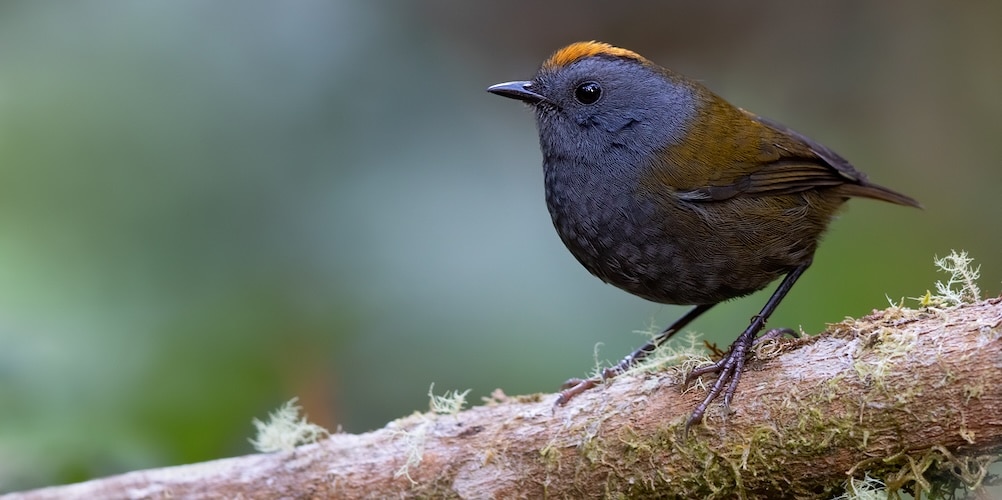
Wrenthrush Zeledonia coronata – ©Dubi Shapiro
They are weak fliers, seldom taking to the wing and then only for short distances. They have short rounded wings and a small keel to which flight muscles attach, and there was early speculation that the species is evolving towards flightlessness.
They forage by hopping among branches and along the ground searching for arthropods, especially spiders and Lepidoptera larvae. It mostly forages in dense vegetation, though it occasionally works the edges of it and also hunts as high as 30 feet above the ground in vines and epiphytes.
The Wrenthrush’s breeding season appears to span from March to early July. Few nests have been found. They were domes made of moss, twigs, and leaves with a side entrance and a lining of dried leaves, grass, and moss. They were placed in cavities in earthen banks and were partially hidden by overhanging vegetation. The clutch size in three nests was three eggs. The incubation period is not known; the time from hatch to fledging appears to be at least eighteen days. Both parents bring food to the nestlings.
Both sexes sing, and often as a duet. They are more vocal during the breeding season, and mostly sing at dawn and dusk although they can be heard throughout the day. Their primary song is described as ssee-del-deet with emphasis on the ending, deet, and it may be sung in a series for several minutes. Their primary call is a thin pseee.
This secretive skulker of cloud-forest thickets in the mountains of Costa Rica and Panama, about which very little is known, has a fiery crown that is reminiscent of a kinglet’s, as are its simple few-note sibilant calls. It forages furtively in the low branches of shrubbery, recalling a stealthy wren, and it is hard to localise in the dense misty habitats that it haunts. Future work could probably tell us much about this species’ life history, especially regarding its breeding biology.
According to the recently (2025) amalgamated AviList, there is just one species, in one genus in the Zeledoniidae family. It is:
Wrenthrush Zeledonia coronata
-
Zeledoniidae
Family AccountThis family consists solely of a secretive skulker of cloud-forest thickets in the mountains of Costa Rica and Panama, about which very little is known. -
Zeledoniidae
Family AccountThe wrenthrush (Zeledonia coronata) or zeledonia, is a unique species of nine-primaried oscine, endemic to the Talamancan montane forests.
Fatbirder offers quick links to the one species in this family:
-
Wrenthrush Zeledonia coronata
Species AccountThe wrenthrush or zeledonia is a species of nine-primaried oscine which is endemic to Costa Rica and western Panama. -
Wrenthrush Zeledonia coronata
Species AccountThe population trend appears to be stable, and hence the species does not approach the thresholds for Vulnerable under the population trend criterion (>30% decline over ten years or three generations). -
Wrenthrush Zeledonia coronata
Species AccountA strange little understory bird, unmistakable if seen well. Plump and very short-tailed, like a small antpitta or wren. -
Wrenthrush Zeledonia coronata
Species AccountThe wrenthrush (Zeledonia coronata) or zeledonia, is a unique species of nine-primaried oscine, endemic to the Talamancan montane forests. -
Wrenthrush Zeledonia coronata
Species AccountSound archive and distribution maps.