
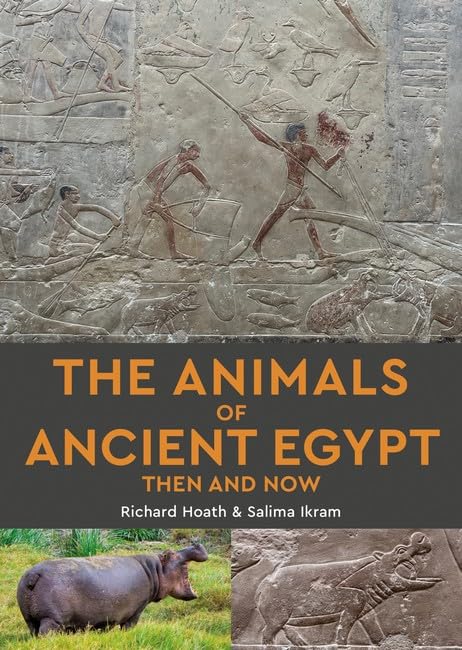
The Animals of Ancient Egypt – Then and Now | Richard Hoath & Salima Ikran | John Beaufoy Publishing | 2026 | Paperback | 160 Pages | ISBN: 9781913679822 |
The Publisher’s View:
The Animals of Ancient Egypt Then and Now provides a simultaneous guide to some 60 species of mammal, bird, reptile, amphibian, fish and invertebrate recorded in modern Egypt and also portrayed in the tombs and temples or as mummies and gods in ancient Egypt – or even earlier in the case of the cave art from the Gilf Kebir.
Accompanied by contemporary photographs of the living animals alongside tomb carvings or paintings, each species is described in terms of its current characteristics (size, habits and habitats, and range in modern Egypt) as well as the animal’s religious and practical significance to ancient Egyptians. The introduction covers biogeography, ancient Egypt and its wildlife, modern developments, a chronology of ancient Egypt, the relevant gods and goddesses of ancient Egypt and a glossary.
The Authors:
Richard Hoath is a leading naturalist based in Egypt, who has travelled extensively throughout the Middle East. He is the author and illustrator of A Field Guide to the Mammals of Egypt (paperback edition, 2009), and many other books and articles on the wildlife of the region. He is a founder member of, and serves on, the Egyptian Ornithological Rarities Committee, is a longtime member of the Ornithological Society of the Middle East (OSME) and is currently on the faculty of the American University in Cairo.
Salima Ikram is Distinguished University Professor at the American University in Cairo and has excavated in Egypt for more than 30 years. Her specialities include animals in ancient Egypt, mummification, ancient Egyptian food and drink, rock art, and the preservation and presentation of cultural heritage. She has directed the Animal Mummy Project at the Egyptian Museum (Cairo), the Amenmesse Mission KV10 and KV63, and the North Kharga Oasis Darb Ain Amur Survey. A member of the American Academy of Arts and Sciences and a Fellow of the British Academy, she has published extensively for adults and children on a variety of topics.
Fatbirder View:
One of my prized possessions is a small hard-baked clay Scarab from ancient Egypt. Therein lies the basis of this book. Ancient depictions of nature from drawings in caves 10,000 years ago to the pharaonic Egypt of 3,000 years duration ending only at the beginning of the modern era are displayed alongside photos of the real creatures themselves. Sadly, not all are extant in Egypt today. Many of them are animals familiar from the East African Plains further south, but we must remember that in ancient times the climate was quite different in Egypt and a large part of the area was Savannah, not the desert it is today.
While elephant and giraffe no longer roam here, the fertile Nile Basin is still home to many of the water associated mammals and reptiles as well as the dry country reptiles and small mammals. As for the birds, many remain with only the birds that are under pressure everywhere.
This ornithological reference is truly unique. Nowhere else recorded its own history for so long, giving us knowledge about what roamed the plains and flew above them 5,000 years ago compared with those still extant today. It also demonstrates the difference that climate change can make and should be seen as a warning against many of today’s practices which are still ramping up the temperature globally.
It really is a fascinating little book and I for one had no idea just how many images of birds and other animals were still visible in the hieroglyphs and painted tombs of ancient Egypt. Perhaps it helps that quite a lot of these creatures were regarded as holy and even some as gods. We probably have the ancient Egyptians to thank for taming many of the domestic pets kept today. We should, too, be grateful for the fact that only the living gods were allowed to hunt some of the iconic animals of the time, or they would no doubt have not survived lo0ng enough to grace their frescos.
Perhaps I shouldn’t have been surprised at the accuracy of many of these depictions. Certainly, good enough to be reliable identification of their modern equivalents, and some obviously quite beautiful too.
In short, there is much to enjoy here, to marvel at, and to be thankful for. So, it’s a recommended read even if only for the ornithological section alone.
Fatbirder