

Chongqing
Chongqing is a direct-administered municipality in Southwestern China. It is one of the four direct-administered municipalities under the Central People’s Government, along with Beijing, Shanghai, and Tianjin. It is the only directly administrated municipality located deep inland. It covers a large geographical area roughly the size of Austria, which includes several disjunct urban areas in addition to Chongqing proper. Its territory is 470 km (290 miles) from east to west at its longest, and 450 km (280 miles) from north to south at its widest. It borders Hubei and Hunan to the east, Sichuan and Shaanxi to the north, and Guizhou to the south.
Due to its classification, the municipality of Chongqing is the largest city proper in the world by population, though Chongqing is not the most populous urban area. The municipality of Chongqing is the only Chinese city with a resident population of over 30 million; however, this number includes its large rural population. However, Chongqing is more like a province than a city. It is one of China’s national central cities.
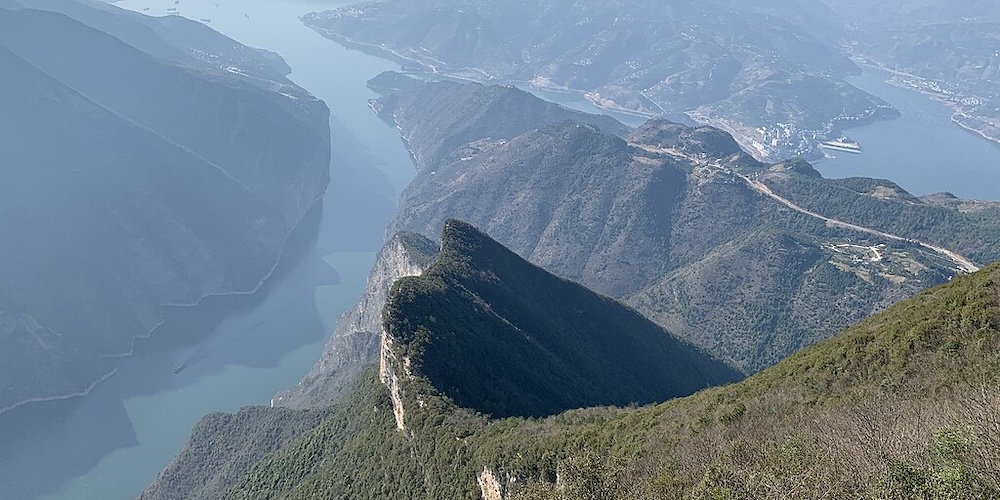
Qutang Gorge on the Yangtze – ©anonimerce @ Mapillary.com CC BY-SA 4.0 via Wikimedia Commons
It is a connection in the Yangtze River Economic Belt and a base for the country’s Belt and Road Initiative. Chongqing Jiangbei International Airport is the second-busiest airport in China, and is one of the top 50 busiest airports in the world. The city’s monorail system is the world’s longest and busiest, as well as having the greatest number of stations, with 70. Chongqing is ranked as a Beta (global second-tier) city. It is the headquarters of the Changan Automobile, one of the ‘Big Four’ car manufacturers in China. It is one of the top 40 cities globally by scientific research output; the municipality is home to several notable universities, including Chongqing University, Southwest University, and Chongqing University of Posts and Telecommunications.
The municipality is located in the subtropics, situated in the transitional area between the Sichuan Basin and the plain on the middle and lower reaches of the Yangtze. Its climate features frequent monsoon conditions, often raining at night in late spring and early summer. The city’s ‘night rain in the Ba Mountains’, features in poems throughout Chinese history.
Chongqing covers a large area crisscrossed by rivers and mountains. The Daba Mountains stand in the north, the Wu Gorge in the east, the Wuling Mountains in the southeast, and the Dalou Mountains in the south. The area slopes downward from north to south towards the Yangtze valley, and features a large massif of mountains and hills, with steep sloping areas at different heights. Karst landscape is common in this area, and stone forests, numerous collections of peaks, limestone caves and valleys can be found in many places. The Yangtze River runs through the whole area from west to east, covering a course of 665 km (413 miles), cutting through the Wu Mountains at three places and forming the well-known Three Gorges: the Qutang, Wuxia and Xiling gorges. Coming from northwest and running through ‘the Jialing Lesser Three Gorges’ of Libi, Wentang and Guanyin, the Jialing River joins the Yangtze in Chongqing.
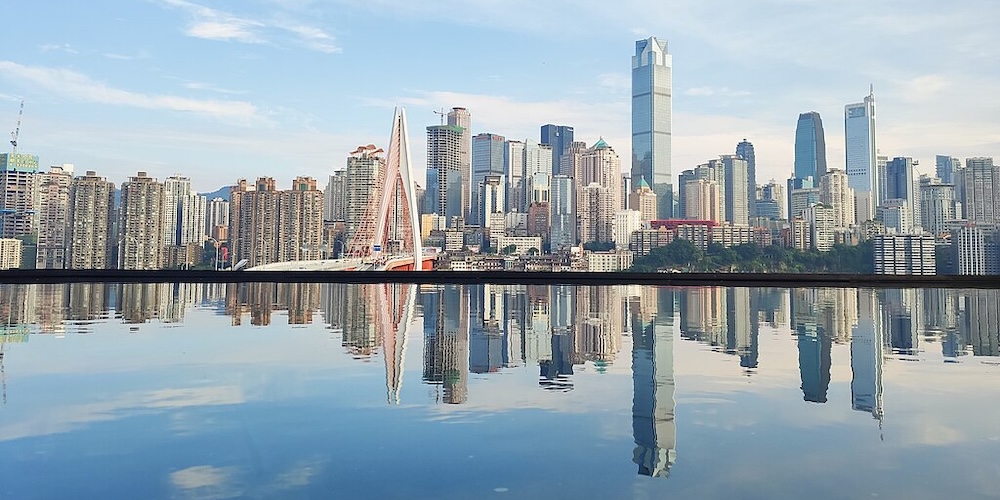
Yuzhong District, Chongqing – ©夏枫水月 CC BY-SA 4.0 via Wikimedia Commons
The central urban area of Chongqing, called Chongqing proper, is built on mountains and partially surrounded by the Yangtze and Jialing rivers. With its special topography, Chongqing’s topography includes mountains, rivers, forests, springs, waterfalls, gorges, and caves. The Zhongliang mountains roughly form the eastern and western boundaries of Chongqing’s urban area. Several high mountains are situated outside central Chongqing, including the Wugong Ling Mountain in Jiangjin.
Chongqing has a monsoonal humid subtropical climate, bordering on a humid subtropical climate and for most of the year experiences very high relative humidity, with all months above 75%. Known as one of the ‘Three Furnaces’ of the Yangtze River, along with Wuhan and Nanjing, its summers are long and among the hottest and most humid in China, with highs of 34 °C in July and August in the urban area. Winters are short and somewhat mild, but damp and overcast. The city’s location in the Sichuan Basin causes it to have one of the lowest annual sunshine totals nationally, at only 983 hours, lower than much of Northern Europe; the monthly percent possible sunshine in the city proper ranges from a mere 5% in January to 43% in August. Chongqing, with over 100 days of fog per year, is known as the ‘Fog City’; this is because in the spring and autumn, a thick layer of fog enshrouds it.
Birding Chongqing
Chongqing is mostly a mountainous region. There are a relatively small number resident bird species and a general lack of diversity in the area. Some of the more familiar species include thrushes, laughingthrushes, warblers and flycatchers. Qijiang River is one of the good places to see Scaly-sided Merganser. Nevertheless, there are some excellent birding localities, and interesting and attractive species.
For example, Changshou Lake, a man-made reservoir wetland and the largest freshwater lake in Chongqing, covers 63 km2 and has more than a thousand islands. Every winter, those deserted islands become populated with many over-wintering birds. Target species include: Falcated Duck, Ferruginous Duck, Speckled Piculet, Long-tailed Shrike, Red-billed Blue Magpie, Yellow-bellied Tit, Rufous-faced Warbler, Brownish-flanked Bush Warbler and Vinous-throated Parrotbill, among others.
Three Gorge Reservoir is west of the Banan district of Chongqing city, east of Wushan Mountain, the distribution of birds is vertical. The vegetation in the reservoir area is subtropical evergreen broad-leaved forest. Around 220+ species can be found in the reservoir area at various times. Nearly fifty bird families are represented. There are five different ecological communities depending on the vegetation: The natural forest is home to over 70 species. Forest plantation has over 100 species, while shrubland is home to about 130 species. The wetland also has about 70 species of birds. The surrounding farmland is surprisingly rich with more than 120 species of birds. Target species here include: Mandarin Duck, Northern Goshawk, Speckled Piculet, Collared Finchbill, Mountain Bulbul, Crimson-breasted Woodpecker, Red-billed Blue Magpie, Spotted Nutcracker, Streak-breasted Scimitar Babbler, Chinese Babax, Hwamei, Elliot’s Laughingthrush, Spectacled Fulvetta, Grey-hooded Fulvetta, Rufous-breasted Accentor and Vinaceous Rosefinch, etc.
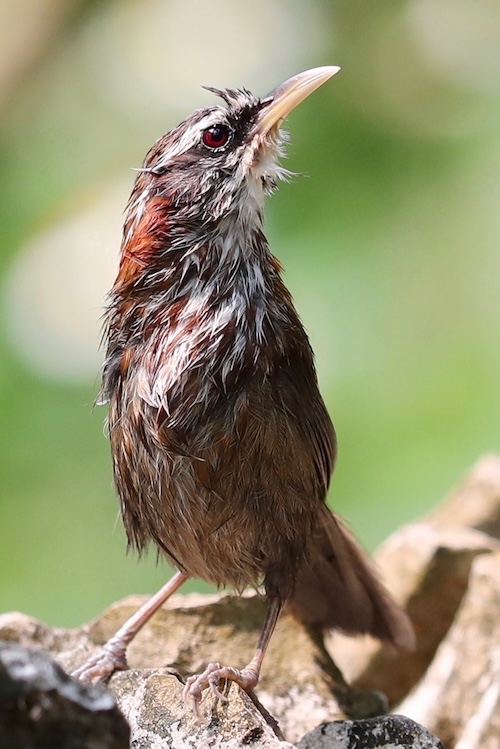
Streak-breasted Scimitar Babbler Pomatorhinus ruficollis – ©Bird-Photo-Tour ASIA
One of the best birding areas, with around 300 species recorded is Wulipo Nature Reserve. It is located in the northeast of Wushan County, the typical transitional climatic zone from the middle subtropical zone to the northern subtropical zone, forming a cool and humid climate. Adjacent to Qinling and Daba mountain in the north, coupled with the difference of altitude, it forms a complex environment with natural vegetation favouring evergreen broad-leaved forest, mixed evergreen, and deciduous broad-leaved forest, subalpine coniferous forest, etc. Top targets here include: Northern Goshawk, Speckled Piculet, Collared Finchbill, Mountain Bulbul, Crimson-breasted Woodpecker, Red-billed Blue Magpie, Spotted Nutcracker, Streak-breasted Scimitar Babbler, Chinese Babax, Hwamei, Elliot’s Laughingthrush, Spectacled Fulvetta, Grey-hooded Fulvetta, Rufous-breasted Accentor and Vinaceous Rosefinch, and more.
Jinfoshan is the highest peak of the Dalou Mountains, located in the upper reach of the Yangtze River, and situated in Nanchuan District of Chongqing. It is an isolated mountain with cliffs up to 300 metres surrounding its relatively flat top. Its major vegetation types include subtropical broadleaf forest, coniferous forests and subalpine meadow. Besides typical karst topography of gorges, stone forests and cave systems, Jinfoshan is well known for its exceptional plant diversity. It is also a refuge of endangered animals confined to karst regions such as Francois Langur.
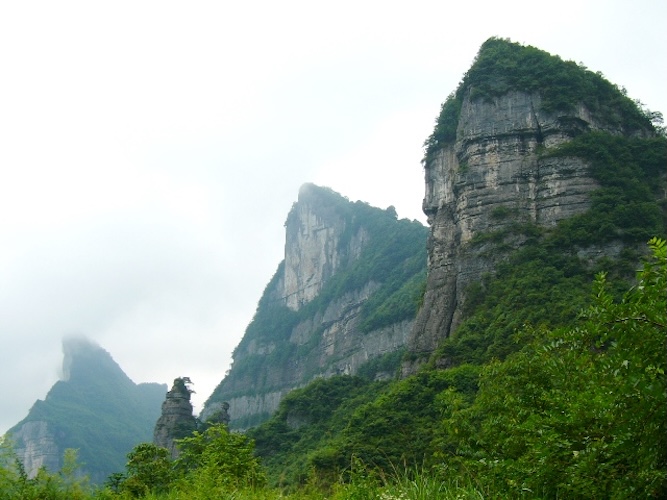
Jinfoshan – ©Wenchi Jin CC BY-SA 4.0 via Wikimedia Commons
With its outstanding karst features and superb biodiversity, Jinfo Shan has been listed as a potential World Heritage site. There were around 180 species of birds recorded there including: Golden Pheasant, Temminck’s Tragopan, Chinese Bamboo Partridge, Chinese Babax, White-browed Laughingthrush, Elliot’s Laughingthrush, Spotted Laughingthrush, Red-billed Leiothrix, Grey-hooded Fulvetta, Red-tailed Minla, Collared Finchbill, Brown-breasted Bulbul, Large-billed Leaf Warbler, White-collared Yuhina, Black-headed Sibia, Vinaceous Rosefinch, Plumbeous Water Redstart, White-capped Water Redstart, Brown Dipper, Grey-capped Greenfinch, and so forth.
Lastly, Zhaomushan Botanical Park, located in the north of Chongqing, is the third largest botanical garden in the main city. Around 150 species of birds have been recorded there. Targets include: Chinese Bamboo Partridge, Black Bulbul, Crested Goshawk, Chinese Sparrowhawk, Eastern Buzzard, Asian Koel, Large Hawk-Cuckoo, Himalayan Cuckoo, Great Barbet, Speckled Piculet, Swinhoe’s Minivet, Tiger Shrike, Black-naped Oriole, Red-billed Blue Magpie, Mountain Bulbul, Light-vented Bulbul, Rufous-faced Warbler, Black-throated Bushtit, Sulphur-breasted Warbler, Yellow-browed Warbler, Blue-winged Minla, Ashy-throated Parrotbill, Fork-tailed Sunbird, Taiga Flycatcher and Black-faced Bunting.
This page is sponsored by Bird-Photo-Tours ASIA
This page is sponsored by Alpine Birding
-
Wikipedia
GNU Free Documentation License
https://en.wikipedia.org/wiki/Chongqing -
Philip He
http://www.alpinebirding.com/Resource/bird-info/city/41.html#:~:text=Such%20as%20Grey%20Heron%2C%20Falcated,Vinous-throated%20Parrotbill%2C%20etc.
-
Number of bird species: 524
(As at May 2025)
-
Avibase
PDF ChecklistThis checklist includes all bird species found in Chongqing , based on the best information available at this time. It is based on a wide variety of sources that I collated over many years. I am pleased to offer these checklists as a service to birdwatchers. If you find any error, please do not hesitate to report them. -
E-Bird
PDF ChecklistThis checklist is generated with data from eBird (ebird.org), a global database of bird sightings from birders like you. If you enjoy this checklist, please consider contributing your sightings to eBird. It is 100% free to take part, and your observations will help support birders, researchers, and conservationists worldwide.

-
Birds of China
| By Liu Yang & Chen Shuihua | Princeton University Press | 2023 | Flexibound | 672 pages, plates with 4000 colour illustrations, colour distribution maps | ISBN: 9780691237527 Buy this book from NHBS.com -
Guide to the Birds of China
| By John MacKinnon | OUP | 2022 | Edition 2 | Paperback | 513 pages, 164 plates with colour illustrations; colour distribution maps | ISBN: 9780192893673 Buy this book from NHBS.com -
HKBWS Field Guide to the Birds of Hong Kong and South China [English / Chinese]
| By Hong Kong Birdwatching Society | HKBS | 2022 | Edition 9 | Paperback | 372 pages, plates with colour illustrations | ISBN: 9789627508342 Buy this book from NHBS.com
-
Chongqing Bird Watching Society
WebsiteThe bird watching and wildlife community of Chongqing City
-
NNR Jinfoshan National Nature Reserve
InformationSatellite ViewChongqing Jinfoshan National Nature Reserve (Jinfoshan NNR) is the first national nature reserve in Chongqing, which was founded in 1979 and approved as a national level by the State Council in 2000. The reserve is located in Nanchuan District of Chongqing, at the junction of Chongqing and Guizhou, bordering Wulong District of Chongqing and Daozhen County of Guizhou Province in the east, Zhengan County and Tongzi County of Guizhou Province in the south, Wansheng Economic Development Zone of Chongqing in the west and Nanchuan City in the north. -
NNR Jinyun Shan
InformationSatellite ViewIt’s only 20KM away from central area of Chongqing and there are 1605 animals: 239 vertebrate, 1249 invertebrate, 52 mollusc and 65 annelid, including small civet cat, adjutant bird…
-
eBird
SightingseBirding This Month
-
Alpine Birding
Tour OperatorBirding trips here are made for avid birders including yearly-run trips and new China birding trips developed by AlpineBirding team and guided by our bird experts in the best
-
2018 [08 August] - Philip He
Report...The noisy White-browed Laughingthrush and Chinese Bulbul show their strong presence from the trees. We spotted them without much difficulty and walked toward the big parking lot in search of other birds. In distance, we saw a small bird perching on the top of post of power lines. We quietly walked closer and found it was Large Hawk Cuckoo... -
2019 [06 June] - Dev
ReportThe Tragopan Stake out is in the Miaoba village, it took about solid 4 hour drive from ChongQing airport...
-
Birding In Chongqing Municipality
WebpageChongqing city belongs to subtropical humid monsoon climate zone with hot summer and warm winter, light and heat in the same season, a long frost-free period and plenty rain, so the city is known as one of the four stove cities in China.Chongqing city is located in southwest of China's interior and the upper reach of Yangtze River which is at the eastern edge of the Sichuan Basin and on the transition zone from Qinghai-Tibet Plateau to the Yangtze River.