

Malaysia
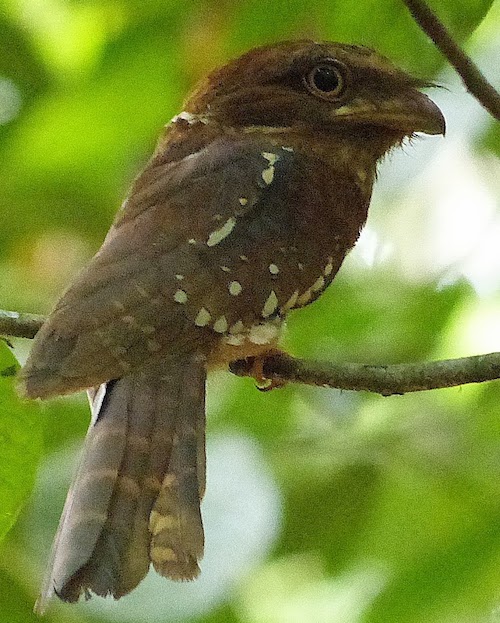
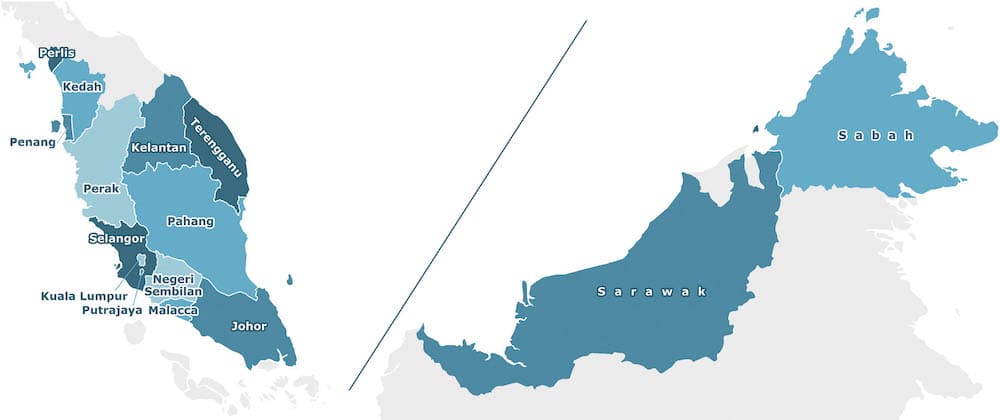
Malaysia is a country in Southeast Asia with a population of nearly 35 million people. It covers a total land area of nearly 331,000 km2 (c. 128,000 square miles). The country consists of 13 states and three federal territories, separated by the South China Sea into two regions: Peninsular Malaysia and Borneo’s East Malaysia. Peninsular Malaysia shares a land and maritime border with Thailand and maritime borders with Singapore (via a narrow causeway and bridge), Vietnam, and Indonesia. East Malaysia shares land and maritime borders with Brunei and Indonesia, as well as a maritime border with the Philippines and Vietnam. Kuala Lumpur is the national capital, the country’s largest city, with nearly nine million inhabitants. It is the seat of the legislative branch of the federal government. Putrajaya was designed to be the administrative centre of the federal government.
The two parts of Malaysia, separated from each other by the South China Sea, share a largely similar landscape in that both Peninsular and East Malaysia feature coastal plains rising to hills and mountains. Peninsular Malaysia is 40 per cent of Malaysia’s land area, extending 740 km (460 miles) from north to south with maximum width of 322 km (200 mi). It is divided between its east and west coasts by the Titiwangsa Mountains, rising to a peak elevation of 2,183 metres (7,162 ft) at Mount Korbu, part of a series of heavily forested mountain ranges running down the centre of the peninsula. The range is the origin of some of Peninsular Malaysia’s river systems. The coastal plains surrounding the peninsula reach a maximum width of 50 kilometres (31 miles), and the peninsula’s coastline is nearly 1,931 km (1,200 mi) long, although harbours are only available on the western side.
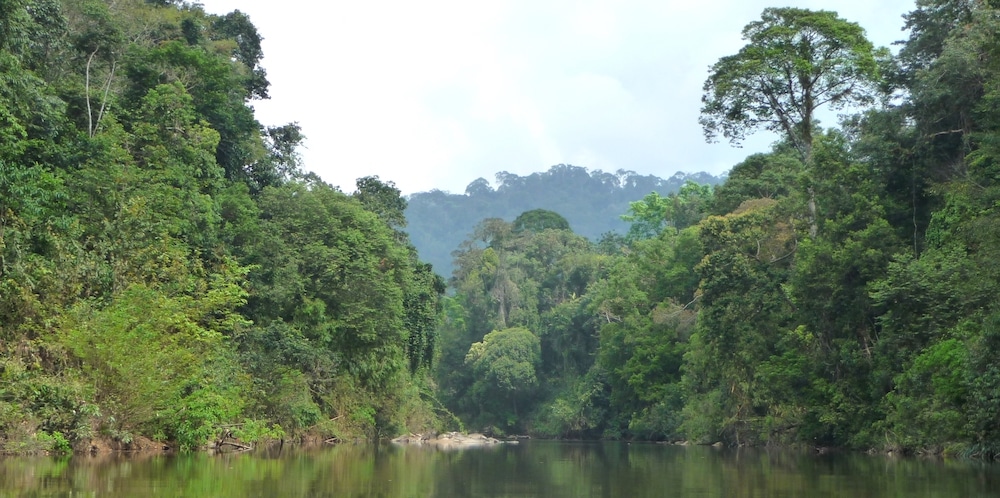
Endau-Rompin National Park – ©I Ondřej Žváček CC BY-SA 3.0 via Wikimedia Commons
East Malaysia, on the island of Borneo, has a coastline of 2,607 km (1,620 miles). It is divided between coastal regions, hills and valleys, and a mountainous interior. The Crocker Range extends northwards from Sarawak, dividing the state of Sabah. It is the location of Mount Kinabalu, the tallest mountain in Malaysia (4,095 m) located in the Kinabalu National Park. These mountain ranges form the border between Malaysia and Indonesia. Sarawak contains the Mulu Caves, the largest cave system in the world, in the Gunung Mulu National Park. The largest river in Malaysia is the Rajang. Around these two halves of Malaysia are numerous islands, the largest of which is Banggi.
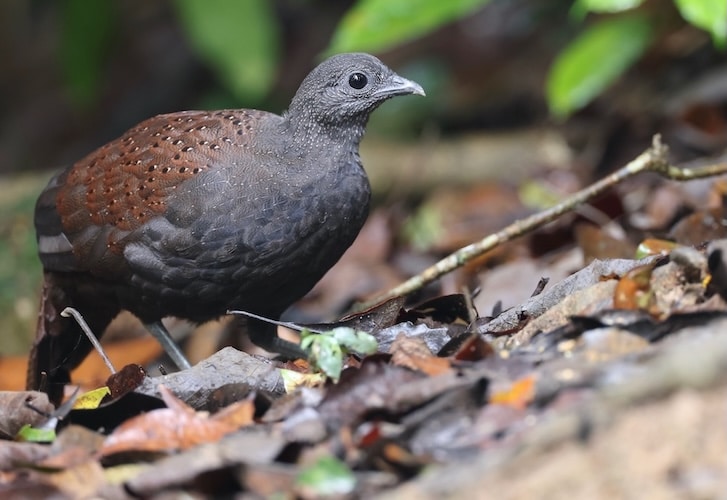
Mountain Peacock Pheasant Polyplectron inopinatum – ©Bird-Photo-Tours ASIA
The local climate is equatorial and characterised by the annual southwest (April to October) and northeast (October to February) monsoons. The temperature is moderated by the presence of the surrounding oceans. Humidity is usually high, and the average annual rainfall is 250 cm. The climates of the Peninsula and the East differ, as the climate on the peninsula is directly affected by wind from the mainland, as opposed to the more maritime weather of the East. Local climates can be divided into three regions, highland, lowland, and coastal.
Malaysia is tropical and is one of 17 megadiverse countries; it is home to numerous endemic species. It is estimated to contain 20 per cent of the world’s animal species. High levels of endemism are found on the diverse forests of Borneo’s mountains, as species are isolated from each other by lowland forest. There are about 210 mammal species, 250 reptiles including about 150 species of snakes and 80 species of lizards. Rich herpetofauna also includes about 150 species of frogs. Bordering East Malaysia, the Sulu Sea is a biodiversity hotspot, with around 600 coral species and 1200 fish species. There are more than 850 bird species!
Birding Malaysia
Malaysia has a well-deserved reputation as one of the world’s major birding destinations. Over 850 species of birds have been recorded in Peninsular and Bornean Malaysia. This richness of birds combined with the wonderful scenery and friendly people makes any visit an unforgettable experience for the birder, whether first timer or veteran. Moreover, the mainland infrastructure is modern so transport across country is trouble free. For the intrepid, there are many endemic species to go after (most in Borneo and just a few in the Peninsular). This entails a visit combining sites in Peninsular Malaysia and the East Malaysian states of Sabah and Sarawak.
There are separate pages for the Peninsular and for Borneo and one for the Kuala Lumpur area for those who are passing through and only have a day or two to spend there. A typical itinerary covers two-three weeks and usually takes in the montane forest species of Fraser’s Hill and the lowland forest species of Taman Negara National Park and Gombak before jetting across to Borneo for the mossy forest species in Kinabalu National park and the lowland forest species of Danum Valley or Kinabatangan River.
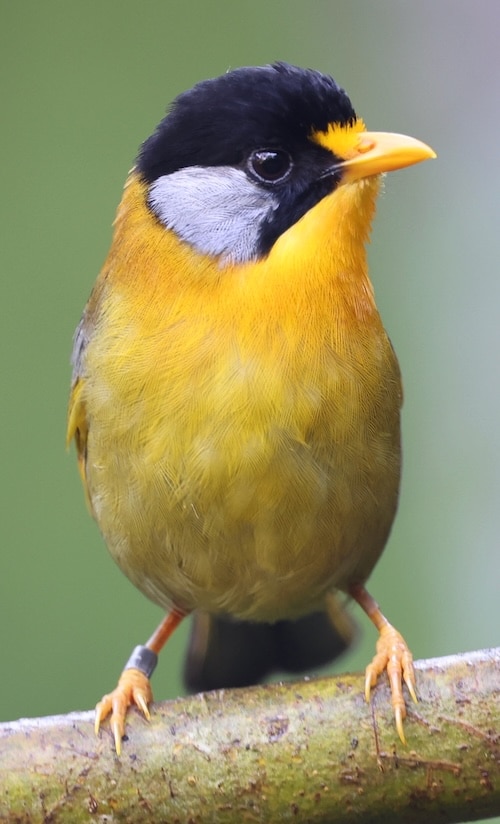
Silver-eared Mesia Leiothrix argentauris -©Bird-Photo-Tours ASIA
Over 300 species can be seen if taking this option and commonly encountered birds include such gems as Rhinoceros Hornbill, Red-naped Trogon, Great Slaty Woodpecker, Gold-whiskered Barbet, Garnet and Banded Pittas and several babbler, bulbul and sunbird species. In Borneo, savour the endemics like Crimson-headed Partridge, Bornean Barbet, White-fronted Falconet, Whitehead’s Broadbill, Bornean Bristlehead, Blue-headed Pitta and Whitehead’s Spiderhunter.
For those with only a couple of days to spare, there are accessible sights near Kuala Lumpur (Gombak); Malaysia’s Capital City, and Singapore (Panti Forest Reserve). And don’t forget the cultural and food attractions!
I have found it hard to get a definitive list of Malaysian endemics – numbers ranging from 4 to 60! The confusion arises from Borneo. The Malaysian mainland does have as few as two endemics… although there is no agreement on this and Borneo as a whole as many as 58 but the Malaysian parts of Borneo alone (Sarawak and Sabah) have far fewer.
This page is sponsored by Bird-Photo-Tours ASIA

-
Lim Kim Seng and Lim Seng Chuah
| ibisbill@yahoo.com
Website
-
Number of bird species: 864
(As at May 2024)
Number of endemics: 11
These are thought to be found only on Malaysian territory.Malay Partridge Arborophila campbelli
Sabah Partridge Arborophila graydoni
Dulit Partridge Rhizothera dulitensis
Malay Peacock-pheasant Polyplectron malacense
Mountain Peacock-pheasant Polyplectron inopinatum
Malaysian Crested Argus Rheinardia nigrescens
Black-crowned Pitta Erythropitta ussheri
Friendly Grasshopper-warbler Locustella accentor
Everett's Thrush Zoothera everetti
Malay Whistling-thrush Myophonus robinsoni
Malay Bullfinch Pyrrhula waterstradti
-
Avibase
PDF ChecklistThis checklist includes all bird species found in Malaysia , based on the best information available at this time. It is based on a wide variety of sources that I collated over many years. I am pleased to offer these checklists as a service to birdwatchers. If you find any error, please do not hesitate to report them. -
Wikipedia
Annotated ListThis is a list of the bird species recorded in Malaysia. The avifauna of Malaysia include a total of 855 species, of which 17 are endemic, and 19 have been introduced by humans. 63 species are globally threatened. -
eBird
PDF Checklist864 species (+195 other taxa) - Year-round, All years

-
A Checklist of the Birds of Peninsular Malaysia
| By MNS Bird Conservation Council | Malaysian Nature Society | 2010 | Edition 2 | Paperback | 60 pages, 1 b/w map, tables | ISBN: 9789839681482 Buy this book from NHBS.com -
A Field Guide to the Birds of Malaysia
| Including Sabah and Sarawak | By Lim Kim Seng, Yong Ding Li & Lim Kim Chuah | John Beaufoy Publishing | 2024 | Paperback | 396 pages, 170 plates with colour illustrations; colour photos, 2 colour maps | ISBN: 9781913679712 Buy this book from NHBS.com -
A Field Guide to the Birds of Peninsular Malaysia and Singapore
| By Allen Jeyarajasingam & Alan Pearson | Oxford University Press | 2012 | Edition 2 | Paperback | ISBN: 9780199639434 Buy this book from NHBS.com -
A Handbook of Important Bird Areas in Malaysia
| By Yeap Chin Aik, Anthony C Sebastian & GWH Davison | Malaysian Nature Society | 2005 | Paperback | 94 pages, Coour photos, tables, maps | ISBN: 9789839681239 Buy this book from NHBS.com -
A Naturalist's Guide to the Birds of Fraser's Hill and the Highlands of Peninsular Malaysia
| By Geoffrey Davison | John Beaufoy Publishing | 2019 | Paperback | 176 pages, ~300 colour photos, 2 colour maps | ISBN: 9781912081547 Buy this book from NHBS.com -
A Naturalist's Guide to the Birds of Malaysia Including Sabah and Sarawak
| By Geoffrey WH Davidson & Yeap Chin Aik | John Beaufoy Books | 2018 | Edition 3 | Paperback | 176 pages, 300 colour photos, 2 colour maps | ISBN: 9781912081639 Buy this book from NHBS.com -
Birds of Malaysia
| Covering Peninsular Malaysia, Malaysian Borneo and Singapore | By Chong Leong Puan, Geoffrey Davison & Kim Chye Lim | Lynx Edicions | 2020 | Hardback | 413 pages, colour illustrations, colour distribution maps | ISBN: 9788416728299 Buy this book from NHBS.com
-
Malaysian Nature Society
WebsiteFor Malaysia’s natural heritage and rich biological diversity to be effectively protected, managed and conserved for the benefit and appreciation of all Malaysians.
-
BS Kuala Gula Bird Sanctuary
Facebook PageSatellite ViewKuala Gula Bird Sanctuary is located at Perak, Malaysia and is managed by the Department of Wildlife and National Parks -
Malaysias National Parks & Preserves
WebsiteSatellite ViewIt would be difficult to overstate the attraction of Malaysia for anyone who appreciates the natural world. Its primal forests, ranging from shoreline mangrove to mountaintop oak, are of the sort that most of the world now knows only in myth. Although Malaysia`s size is similar to that of Norway, natural trees and forests cover almost three quarters of the land, an area equivalent to almost the entire United Kingdom. One can walk for hundreds of miles in Malaysia under a continuous canopy of green, marveling at an abundance of plant and animal species equaled by no other location in the entire world. -
NP Bako
WebpageSatellite ViewThe Bako National Park covers 2,742 hectares of a rugged sand stone peninsula to the east of the Bako River near Kuching, the capital of Sarawak. Millions of years of erosion have created a coastline of steep cliffs, rocky headlands and stretches of white, sandy bays. Wave erosion at the base of the cliffs has carved many of the rocks into fantastically shaped sea arches and seastacks. Coloured patterns formed by iron deposition have also dominated the rocky headlands. -
NP Gunung Mulu
WebsiteSatellite ViewThis spectacular rainforest took 60 million years to create. It is one of the most important natural sites in South East Asia and will leave you in awe of its beauty. Discover the difference. Understand the importance. -
NP Niah Great Cave
WebpageSatellite ViewNiah Great Cave is alive with 40,000 years of unwritten history, because it was inhabited by humans at at least 40 millennia ago. The caves are the site of some of the oldest human remains discovered in Southeast Asia. -
NP Taman Negara
InformationSatellite ViewTaman Negara is a national park in Peninsular Malaysia. It was established in 1938/1939 as the King George V National Park after Theodore Hubback lobbied the sultans of Pahang, Terengganu and Kelantan to set aside a piece of land that covers the three states for the creation of a protected area. -
SP Crocker Range Park
WebpageSatellite ViewCrocker Range Park is located in the west coast of Sabah. -
SP Kenong Rimba Park
InformationSatellite ViewKenong Rimba Park is a protected rainforest area in Kuala Lipis, Pahang, Malaysia, which borders on Taman Negara. The park covers 128 km2. Available activities include caving, jungle trekking, night walking, hill climbing, bird and animal observation -
SP Kinabalu
WebpageSatellite ViewKinabalu Park, the World Heritage Site covers an area of 754 sq km was gazetted as a park in 1964. -
SP Rompin
WebpageSatellite ViewRompin State Park, or Taman Negeri Rompin (TNR) is located in the district of Rompin, Pahang. It was gazetted by the Pahang State Government as Permanent Reserved Forest, under functional class of State Park Forest in the year 2000. Covering an area of 31,797 hectares, this protected forest is sustainably managed by Pahang State Forestry Department. -
SP Sungai Tekala Recreational Park
WebpageSatellite ViewSungai Tekala Recreation Forest is a charming picnic spot located at the southern most end of the Park, near the Semenyih Dam, in Hulu Langat. The site is famous for the lovely river, Sungai Tekala, that flows through the site, and for the magnificent forest that surrounds it. -
SP Tawau Hills Park
WebpageSatellite ViewTawau Hills Park lies 24 km NW of Tawau and was gazetted to protect water catchment resources for Tawau Town and the Semporna Peninsula -
SP Tunku Abdul Rahman Park
WebpageSatellite ViewTunku Abdul Rahman Park is a state park located in Gaya Bay, 3 kilometers offshore from Kota Kinabalu. Named after Malaysia’s first Prime Minister, Tunku Abdul Rahman, it was gazetted in 1974 as Sabah’s second national park. The Park covers an area of 50 sq kilometers comprising 5 islands, their surrounding reefs, and sea. Its main objective is to protect their fauna, flora, and marine eco-systems. Geologically, the islands are part of the Crocker Range but became isolated from the massif when sea levels rose after the last ice age. -
Sepilok Forest Reserve
WebpageSatellite ViewLocated some 25 kilometres west of the town of Sandakan, on the northeast coast of Sabah, Sepilok Rehabilitation Centre was founded in 1964 with the aim of rehabilitating orphaned and confiscated orangutans. -
Wetlands
WebsiteSatellite ViewMalaysia presently has 7 sites designated as a Wetland of International Importance…
-
Bird Malaysia
Tour OperatorWith over 20 years experience, Bird Malaysia offers the best spots and time for birds and the best accommodation for our fellow birders… -
Bird-Photo-Tours ASIA
Tour OperatorMalaysia is located in South East Asia, bordered by Thailand to the north and by Singapore and Indonesia to the south and with a high diversity of over 700 bird species, Malaysia is a popular destination for the bird photographer. -
Birding Ecotours
Tour OperatorPeninsular Malaysia – with over 700 bird species and home to amazingly rich Dipterocarp forests, among the world's oldest, most fascinating and most diverse. Walk along gently graded forest trails among towering rainforest trees, take boat rides along shaded waterways, and relax in cool montane surroundings. -
Jungle Walla
Tour OperatorMalaysia Birdwatching & Wildlife Holidays - Northern Malay Peninsula is one of the most diverse bio-geographical regions on earth. Some 640species of resident avifauna, including 120 common migrant, birds to be found in Peninsular Malaysia. -
Rockjumper Birding Tours
Tour OperatorOur tour visits some of the world’s most famous birding sites, including Fraser’s Hill, the grand Taman Negara National Park, Danum Valley and the fabled Mt. Kinabalu. A rich mix of typical Southeast Asian birds, peninsular Malaysian specialties and Bornean endemics combine to make this a truly fantastic birding adventure.
-
2015 [03 March] - Bruce Wedderburn - Peninsular Malaysia & Central Thailand
ReportSaw many interesting birds including brief views of Crestless Fireback, six Crested Partridge, Rusty-breasted Cuckoo, Square-tailed Drongo-cuckoo, Rhinoceros Hornbill, Greater Racket-tailed Drongo, Banded Woodpecker, Maroon Woodpecker, Buff-necked Woodpecker, Great Slaty Woodpecker, Black-and-red Broadbill, Rufous-winged Philentoma, Lesser Green Leafbird, Ochraceous Bulbul, Chestnut-winged Babbler, Rufous-crowned Babbler and Asian Fairy-bluebird. -
2015 [07 July] - Rob Gordjin
PDF Report...Birding along the roads is perfect for flock birding, especially a full day along the old road was good. We found thetrails easy but very quiet, especially Hemnant. We started every morning before dawn to try for the whistling thrush. Two times at the spot mentioned by Collaerts and once at the old gate. No Whistling Trush but these early light moments were good for species like Pygmy Wren-babbler, Rufous-browed Flycatcher and Large Niltava. Spotcollaerts: between Shazan inn & paddock: around the middle picnic area with some small streams on the right-hand side of the road. -
2016 [06 June] - Rich Lindie
PDF Report…We then left the wetland and drove directly to the town of Kuala Selangor, where our first stop was Taman Alam. There, among the mangroves and coastal forest, we picked up a Lineated Barbet without much trouble, several Olive-winged Bulbuls, Ruby-cheeked Sunbird, Brown-throated Sunbird, Coppersmith Barbet, Mangrove Blue Flycatcher, Malaysian Pied Fantail and Common Flameback, among others. We then checked into our hotel before popping to town for a riverside lunch in the company of our first Pacific Swallows.… -
2018 [06 June] - Mark S,miles
PDF ReportWith the end of Ramadan bringing the possibility of an extended weekend in Dubai, where I am based, this was a short solo trip aimed at targeting a few (usually elusive) species at well-known stakeouts as well as an opportunity to enjoy some excellent and easy SE Asian birding and escape the extreme summer heat of the UAE. On the latter score, it really was a case of out of the frying pan and into the steamer... -
2018 [07 July] - Ken Behrens - Borneo
PDF ReportBorneo lies in one of the biologically richest areas on Earth – the Asian equivalent of Costa Rica or Ecuador. It holds many widespread Asian birds, plus a diverse set of birds that are restricted to the Sunda region (southern Thailand, peninsular Malaysia, Sumatra, Java, and Borneo), and dozens of its own endemic birds and mammals. -
2018 [07 July] - Wilbur Goh - Peninsular Malaysia
PDF ReportWe started the tour with some birding in Kuala Selangor Nature Park and its surroundings for the common birds of the parks and gardens before making our way up to the hills, firstly in Bukit Tinggi followed by Bukit Fraser for the montane species and finally to the steamy lowlands of Malaysia’s largest national park, Taman Negara where some of the best Sundaic species are found. -
2018 [08 August] - Wilbur Goh - Peninsular Malaysia
PDF ReportThis two-week tour was designed to discover some new bird families and to see as many species as possible at a leisurely pace. We started off down the south of the Peninsular in Panti and its nearby peat-swamp forest where we scored Rail-babbler, Scarlet-breasted Flowerpecker and Cinnamon-headed Green Pigeon before a drive north to Bukit Tinggi for their now famous feeding site that attracts a Mountain Peacock Pheasant, then to the cool highlands of Bukit Fraser... -
2018 [11 November] - Wilbur Goh - Peninsular Malaysia
PDF ReportThe tour started in the south, visiting Panti Forest and the last few remaining peat-swamp forest in the mainland, followed by a short stay in Kuala Selangor Nature Park on the west coast, then continued to the massive Taman Negara National Park... -
2019 [02 February] - Wilbur Goh - Peninsular Malaysia
PDF ReportOur first Peninsular Malaysia tour of 2019, this was a similar set up to last year’s itinerary, focusing heavily on the two main sites, birding the cool forested roads of Fraser’s Hill and the hot-and-humid closed-canopy forest trails of Taman Negara, adding a few stops along the route to pick up additional species (and an exciting last minute twitch!).... -
2019 [05 May] - Wilbur Goh - Peninsular Malaysia
PDF ReportThis tour took us to three main sites, firstly to the hills of Bukit Tinggi for its now famous stakeout, secondly to Taman Negara for the lowland gems of the rainforest and finally ending in Fraser’s Hill for the montane species. The weather was generally wetter than usual though it didn’t eat too much into our birding time. Highlights were many and included Mountain Peacock Pheasant, Malayan (Crested) Fireback, Large Green Pigeon, Bock’s Hawk Cuckoo, Large and Gould’s Frogmouths, four species of trogons, White-crowned and Wrinkled Hornbills, Fire-tufted Barbet, Rufous-collared and Blue-banded Kingfishers, all but one of the broadbills that occur here, Malayan Banded and Garnet Pittas, Straw-headed Bulbul, White-necked Babbler, Blue Nuthatch, Malayan Whistling-thrush and Chestnut-naped Forktail, to name a few. In total, we recorded 212 species of birds with 10 species heard only. -
2019 [06 June] - Phil Chaon
PDF ReportPerhaps the quintessential birding destination in South-east Asia, Peninsular Malaysia has something to offer for everyone. With a good variety of classic South-east Asian avifauna and a good slice of Sundaic and Peninsular endemics, there are new and exciting species for first timers and veterans alike. The itinerary offers a great balance of the mind-boggling diversity of the lowlands and the non-stop mixed flock action of the mountainous regions. -
2019 [08 August] - Sam Woods
PDF ReportBorneo. This large, Southeast Asian island has a kudos all of its own. It maintains a huge, longstanding appeal for both first time visitors to the region, and experienced birding travelers too, making it one of the most popular choices of Asian birding destinations. -
2019 [08 August] - Wilbur Goh - Peninsular Malaysia
PDF ReportWe first visited a patch of mangroves close to the northern city of Penang where we found Streak-breasted Woodpecker without much difficulty, then proceeded to the forests on the northwestern tip of Peninsular Malaysia bordering Thailand, with the highlight of seeing 764 Plain-pouched Hornbills flying back to their roosting sites, plus Chestnut-necklaced Partridge, Large Wren Babbler, White-necked Babbler, and two tricky owls; White-fronted and Reddish. Scops Owls. -
2022 [09 September] - Chris Lotz
PDF ReportThe trip was really successful, not only did we obtain multiple close-up views of three Bulwer’s Pheasants (a pair and a single male), one of the most enigmatic birds in Asia, but we also saw close-up Crested Partridges (Roul-rouls) and Great Argus too, along with splendid views of Bornean Banded Pitta and the more elusive, Blue-banded Pitta. There were plenty of other star Bornean endemic birds seen too, like White-crowned Shama, Dayak Blue Flycatcher, and Bornean Leafbird. Mammals were also good, with several species seen in a very short time. We plan to add this trip to our set departure tour repertoire so watch this space for details. We may also include Bornean Peacock-Pheasant which is currently (2022) showing quite reliably in a different part of Sabah. Combine this with our Sarawak restricted range bird species tour and our classic Sabah birding tour and you’ll be able to see the bulk of Malaysian Borneo’s star birds. -
2023 [03 March] - Bill Simpson
PDF ReportI always wanted to do a slow, winter South East Asia trip when I retired and this was the ideal time to do one with gas and electricity prices soaring at home. Add to that a potentially once-in-a-lifetime chance of Bulwer’s Pheasant and Bornean Peacock-Pheasant and it was all too good to miss -
2023 [11 November] - Jules Eden
PDF ReportShort-tailed Babbler, Malaysian Black-Capped Babbler, Black-throated Babbs, Sooty-Capped Bobs and a singing Large Wren-Babber as well. A true BabbleFest, but no trogon...
-
Bird Watching Asia
BLOGBird Watching Asia is an independent and private website and blog created to share news and information about bird watching around Malaysia and Asia. I am based in Kuala Lumpur, Malaysia, and I am not a bird watching tour company or bird guide. -
Dig Deep
BLOGTerrific photos and info… but I wish he would give his location and contact details! -
Kamal Muda - Malayan Paradise
BLOGMalayan Paradise bird photography blog. I am blessed to see a large variety of birds year round in my country, Malaysia. With its rich bio-diversity, there are more than 741 species of birds in Malaysia… -
Mike Birder
BLOGMike is the name Birding is the game (Malaysian birds in photos) - Welcome to my Malaysian Birding Blog. My blog showcases my sightings of Malaysian bird in my lifetime - countdown to 668 species and beyond… -
Sulaiman Salikan - Birds of Malaysia
BLOGEnjoy the a large variety of colorful birds images from Malaysia all year round…