

Republic of Korea
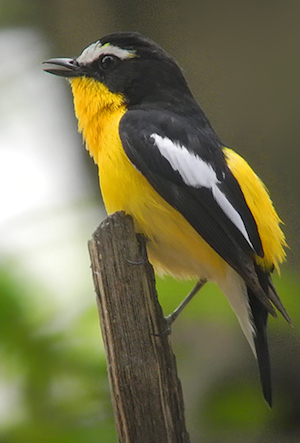
South Korea is a country in East Asia. It constitutes the southern half of the Korean Peninsula and borders North Korea along the Korean Demilitarised Zone. The country’s western border is formed by the Yellow Sea, while its eastern border is defined by the Sea of Japan. Like North Korea, South Korea claims to be the sole legitimate government of the entire peninsula and adjacent islands. It has around 52 million residents distributed over more than 100,000 km2 (38,750 square miles). About three thousand islands, mostly small and uninhabited, lie off the western and southern coasts of South Korea. The capital and largest city is Seoul, with a population of over 10 million people, but the metropolitan area has almost half of the entire population of South Korea! Other major cities include Busan, Daegu, and Incheon.
It lies in the north temperate zone and has a predominantly mountainous terrain. It can be divided into four general regions: an eastern region of high mountain ranges and narrow coastal plains; a western region of broad coastal plains, river basins, and rolling hills; a southwestern region of mountains and valleys; and a southeastern region dominated by the broad basin of the Nakdong River.
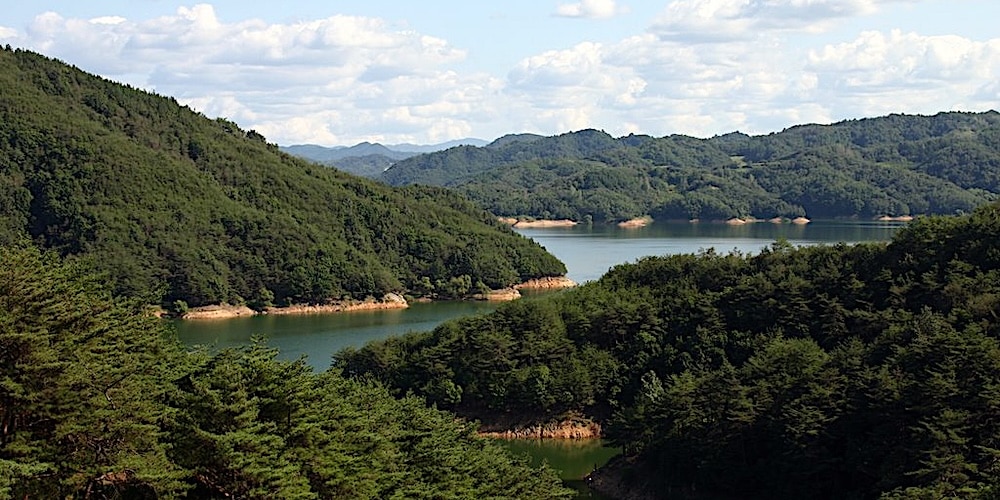
Nakdong River – ©Robert at w:Picasa CC BY 3.0 via Wikimedia Commons
About 3,000 islands, mostly small and uninhabited, lie off the western and southern coasts of South Korea. Jeju Province is about 100 kilometres off the southern coast. It is the country’s largest island, with an area of 1,845 km2). Jeju is also the site of South Korea’s highest point: Hallasan, an extinct volcano, reaches 1,950 meters (6,400 feet) above sea level. The easternmost islands of South Korea include Ulleungdo and Liancourt Rocks (Dokdo/Takeshima), while Marado and Socotra Rock are the southernmost islands of South Korea.
South Korea tends to have a humid continental climate and a humid subtropical climate, and is affected by the East Asian monsoon, with precipitation heavier in summer during a short rainy season called ‘jangma’, which begins end of June through the end of July. Summers can be uncomfortably hot and humid with temperatures over 30 °C. Winters can be extremely cold with the minimum temperature dropping below −20 °C in the inland regions.
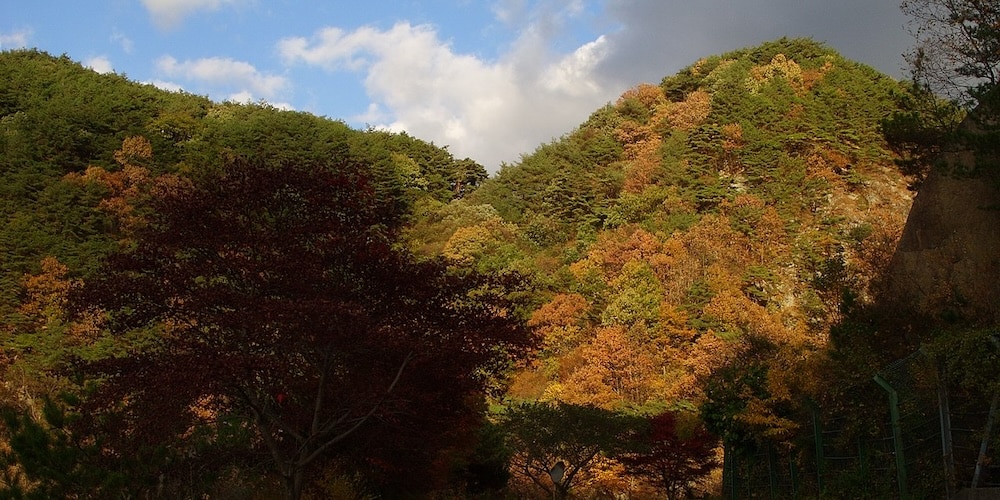
Jirisan National Park – ©Shamus7792003 Public domain, via Wikimedia Commons
There are 20 national parks and popular nature places like the Boseong Tea Fields, Suncheon Bay Ecological Park, and the first national park of Jirisan.
Birding South Korea
South Korea is one of Asia’s Top New Birding Destinations… 600 species have been recorded so far in South Korea (with a new species added almost every month in the last few years). Global birding highlights include the world’s highest concentrations of Baikal Teal Anas formosa, Spoon-billed Sandpiper Calidris pygmaea and Nordmann’s Greenshank Tringa guttifer; breeding Chinese Egret Egretta eulophotes and Black-faced Spoonbill Platalea minor; the world’s most accessible wintering Red-crowned Cranes Grus japonensis, Saunders’s Gull Larus saundersi and Relict Gulls Larus relictus. It also has some of the biggest concentrations of spring and autumn migrants, with peak counts of 50,000 Great Knot Calidris tenuirostris, 3,000 Olive-backed Pipits Anthus hodgsoni in a day, as well as hundreds of warblers and buntings.
Lacking real endemics, but high in star quality and numbers (how about a single swarm of 300,000 Baikal Teal); South Korea is a great country for visiting birders. Safe, friendly, only 450km north to south and roughly the same west to east, the country’s best areas are now linked up by good infrastructure, and nowhere, with some good planning, is more than a day away. Much of the best habitat is concentrated along the coasts (either western tidal-flats and reclamation lakes for water birds and offshore islands for passerines; or the rocky eastern coast and headlands for seabirds); with a few extra species also found on rivers (Scaly-sided Merganser Mergus squamatus and Mandarin Duck Aix galericulata); in forests or scrub (Siberian Accentor Prunella montanella and Pallas’s Rosefinch Carpodacus roseus); or more open country (Cinereous Vulture Aegypius monachus and Steller’s Sea Eagle Haliaetus pelagicus). South Korea: a great birding destination!
The Korean Birdwatcher’s Year
Throughout the Year – South Korea has a temperate/continental climate, with generally hot summers and cold winters. Rainfall tends to be concentrated in the summer monsoon or is associated with typhoons (late July to mid-September). Winters are often very dry.
Usually the first bird that visitors see is the extraordinarily common Oriental Magpie. Most tidal-flats or rivers support Black-tailed Gull, Grey Heron and Great Egret, along with Spot-billed Ducks, which breed widely in rice-fields and reedy wetlands. In even small town parks Eurasian Tree Sparrows and Oriental Turtle Doves are very common, while larger areas will also hold flocks of Vinous-throated Parrotbills, the striking Daurian Redstart, and genuine Ring-necked Pheasant. Taller trees inevitably contain Brown-eared Bulbuls and Great Tits, while Oriental Greenfinches prefer allotments and overgrown riverbanks, which often also conceal Black-crowned Night Herons. More extensive mature woodland, like Gwangeung Arboretum, can hold Great Spotted, White-backed and Japanese Pygmy Woodpeckers plus the regionally endemic Varied Tit. Gravelly rivers in the south and east support Long-billed Plover and Japanese Wagtail. Large-billed Crows and Azure-winged Magpies are resident and visible in mountainous areas and along the south coast. These representative species are joined seasonally by a very wide number of migrants: of the 600 species of bird recorded in Korea, less than 50 can be considered truly resident.
December and January – In occasional periods of extreme cold many smaller rivers and reservoirs freeze over. Temperatures often drop to –5 C at night, and stay near freezing in the day. Periods of light snow and severe cold are usually followed by milder temperatures, and then severe cold again.
An organised winter tour can expect about 160 species in 12 days if all the best areas are visited, and winter specialities include Baikal Teal and Scaly-sided Merganser, Swan and Lesser White-fronted Goose, Steller’s Sea and Eastern Imperial Eagle, Relict and Saunders’s Gull and Solitary Snipe! Red-crowned Cranes stand out on tidal-flats at Ganghwa in the northwest, while White-naped and Hooded Cranes can be found in the south. Huge numbers of ducks and geese fill west coast sites like Haenam and Seosan’s Cheonsu Bay. Siberian Accentors can be common. On the southern island of Jeju milder conditions allow White’s and Pale Thrushes, Olive-backed Pipits, and Red-flanked Bluetails to overwinter along with Korea’s only regular winter Black-faced Spoonbills, and several thousand Mandarin Duck.
February – Cold winters mean both temperatures and birding are similar to January, while mild winters are marked by brief spells of rain or sleet, often followed by warmer sunshine, with maximum temperatures rising to 15 C in the southeast.
Many wildfowl are on the move by mid-month, including one or two Baer’s Pochard. Tundra Bean, Greater White-fronted and usually Swan Geese can be found at the Han-Imjin near Seoul. Most Baikal Teal start to depart and can be difficult to find in southern locations. Rooks and Daurian Jackdaws begin to move back into the Nakdong valley and near Gunsan. February sees the start of crane migration, with Hooded and White-naped moving into South Korea from Japan. Relict and Saunders’s Gull peak at several sites. In the right weather conditions large numbers of Ancient Murrelets and a few Rhinoceros Auklets move north off Guryongpo on the east coast. At the end of the month the first migrants, such as Far Eastern Curlews, Hoopoes and Japanese Lesser Sparrowhawks, arrive.
March – March often contains a mixture of dry, cold days (with night temperatures down to 3-4 C, and highs between 10 and 15 C) and occasional milder showery, windy weather.
In March Falcated Duck regularly display on reservoirs and ponds. Most wintering species are still present, but in progressively reduced numbers. Small numbers of shorebirds, including early Great Knot arrive, plus Siberian Buff-bellied Pipits and the first leucopsis White Wagtails. Hundreds of Rustic Buntings, Dusky and Naumann’s Thrushes move north-east out of China into Korea. Bramblings and Siskins also often form large flocks at key migration points. Sunny days tempt Rustic, Meadow, and Yellow-throated Buntings into song.
April – One of the very best birdwatching months! Cold days and nights (lowest day maxima of ca 12 C) gradually warm through the month (reaching the low 20s C by month’s end); and dry spells interspersed with 1-2 days of heavy rain and stormy conditions produce great birding towards month’s end.
The cranes, winter raptors, and Relict Gulls have gone, but large numbers of shorebirds have arrived. Peaks of c.100,000 shorebirds at the west coast Saemankeum are higher than anywhere else in the Yellow Sea, including up to 50,000 Great Knot, and small numbers of the globally-endangered Nordmann’s Greenshank and Spoon-billed Sandpiper. Other Korean specialities include Chinese Egret from mid-month, and Black-faced Spoonbill in small groups along the coast. This latter species has a world population of approximately 850! Passerine migration peaks towards the end of the month, with the first leaf warblers, up to 100 Blue-and-white, 30 Narcissus and 20 Yellow-rumped Flycatchers a day at the best sites, and flocks of Tristram’s and Yellow-browed Buntings. Japanese Yellow Bunting is regular too, along with other Japanese migrants, including small numbers of Japanese Robin and Brown Thrush in the far southeast or the far southwest. Up to 100 species a day is possible on Eocheong and Gageo Island off the west coast from April 25 onward (with a record-breaking 122 recorded on April 30 2002).
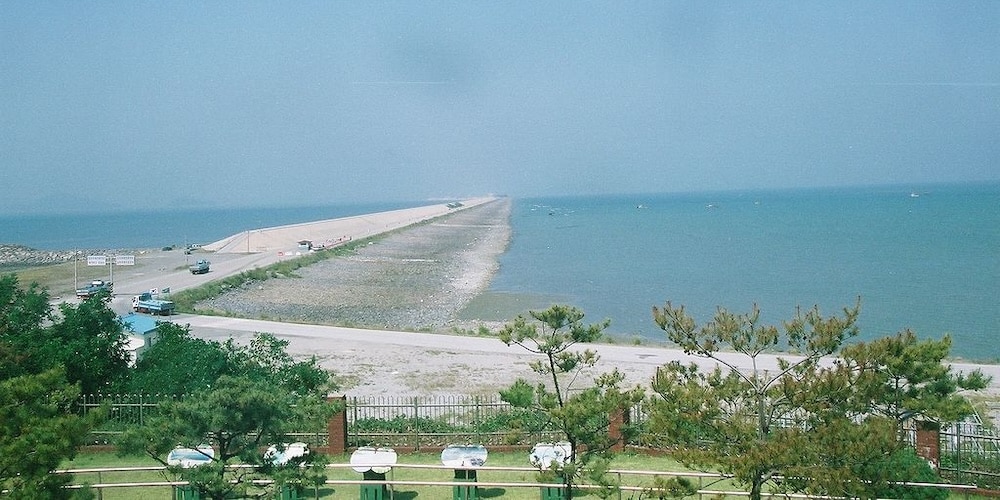
Saemankeum Sea Wall – ©Kussy CC BY-SA 2.1 JP via Wikimedia Commons
May – Like April, a great birding month. Temperatures begin to climb with day maxima often reaching 25 C by the end of the month, though feeling cooler on offshore islands due to low sea temperatures and wind. Fog can temporarily limit birding, while also causing spectacular falls of migrants.
Migration continues. Especially in the first week, diversity can be exceptional. Lesser Sandplovers, Red-necked Stints, Broad-billed and Spoon-billed Sandpipers peak at Saemankeum and other key areas, while Chestnut and Little Buntings begin to outnumber Yellow-throated and the very common Black-faced Bunting. Mugimakis, Dark-sided and Grey-streaked Flycatchers also start to arrive. Brown and Tiger Shrikes, Siberian Rubythroats and Broad-billed Rollers add colour and quality to the birding mix. By late May locustella warblers (Gray’s, Pallas’s, Middendorf’s, Styann’s Grasshopper and Lanceolated) arrive on western islands. In forests Ruddy Kingfisher and Fairy Pitta are in territory and vocal, though still elusive and easily disturbed. Korean breeding Chinese Egrets and Black-faced Spoonbills remain widespread at the best sites in the northwest, and Saunders’s Gull also sometimes nest.
June – Often hot (temperatures up to 30C inland) and humid, with very heavy rains some years by mid-month.
By early June, Yellow and the rare Shrenk’s Bittern are breeding in reed-beds, and Watercock give their (slightly comical) gulping calls in the best rice-field areas, such as Seosan. Nesting activity in Black-faced Spoonbill and Chinese Egret colonies reaches its peak, and forest nesters are still vocal, especially in the first half of the month. At Gwangneung, northeast of Seoul, typical species include 4 species of woodpecker, Ruddy Kingfisher, Yellow-rumped Flycatcher and Mandarin Duck, while on the south coast at Goje Island Pale Thrush, Blue-and-white Flycatcher and Yellow-throated Bunting predominate. Black Woodpigeon nest on Gageo and other islands and Styann’s Grasshopper Warbler are widespread on small islets: both species, plus the very local Russet Sparrow, can be seen well on Eullung Do in the East Sea.
July – Hot (typically above 25C, sometimes reaching 30 C) and humid, with occasional storms and heavy rains associated with southern-tracking typhoons.
Young Japanese and White-faced Wagtails can be found begging food on streams and rivers in the southeast. Juvenile Chinese Egrets and Eastern Oystercatchers are on northwest tidal-flats, Chinese Goshawks on telegraph poles in rice-fields throughout the country. Black-naped Orioles, Vinous-throated Parrotbills and parties of tits, are found in almost all woodland areas. By the end of July the first returning shorebirds arrive, with large numbers of Far Eastern and Eurasian Curlews at Ganghwa and the Geum estuary.
August – Often hot and humid (sometimes up to 30C); with occasional heavy rains and strong winds, associated either with southern typhoons or the mix of humidity and heat.
Chinese Egrets become widespread along the west coast. Shorebirds (including a very small number of Spoon-billed Sandpiper) begin to build up at many of the best sites. Numbers tend to be rather lower than in spring except at Saemankeum, though Kentish Plover and Terek Sandpiper often number in the thousands in the southwest. Parties of Black-naped Orioles, the appearance of returning leaf warblers (especially Eastern Crowned and Arctic Warblers) and Grey-streaked and Brown Flycatchers also hint at the start of passerine migration, while Hobby
September – Temperatures begin to cool, especially towards the end of the month, with maxima often falling from 28C to 20c. Sunny, dry weather predominates, though often punctuated by occasional heavy rain and very strong winds associated with typhoons.
The autumn is the start of excellent birding, which goes right through into the winter. Shorebirds are widespread and numerous: highlights include the world’s largest concentration of Spoon-billed Sandpipers (which have peaked in recent years at 200, possibly 10% of the total world population!); Nordmann’s Greenshank, and up to 170 Black-faced Spoonbills at Ganghwa. The scarce White-winged Black and Whiskered Tern become rather more widespread, along with the first returning Siberian and Mongolian Gulls. Raptor migration includes large concentrations of Chinese Goshawk making their way towards Japan, where 350 000 have been recorded in one day at Tsushima, only 40 km south of Busan in the far southeast along with smaller flocks of Grey-faced and Oriental Honey Buzzards. Passerines become rather more numerous, including good numbers of Yellow Wagtails and Pechora Pipits and the first returning buntings towards the month’s end.
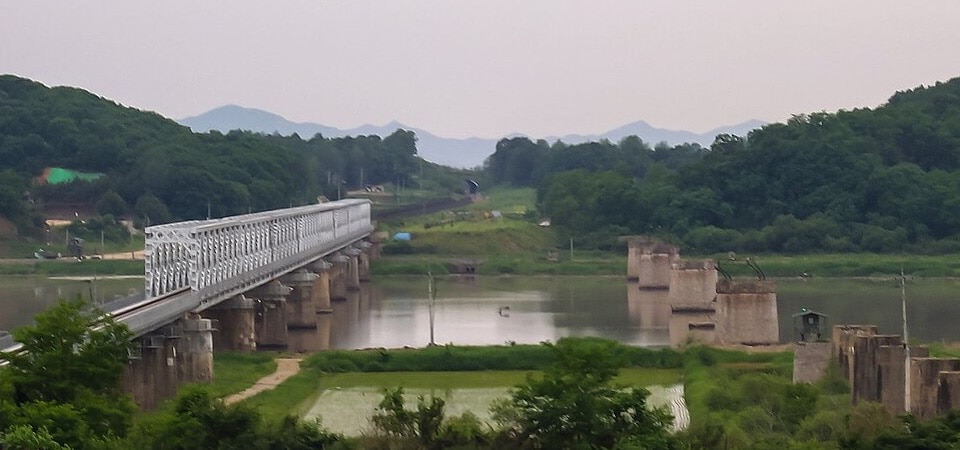
Han-Imjin – ©InSapphoWeTrust CC BY-SA 2.0 via Wikimedia Commons
October – Warm (typically between 15-20 C mid-month); with often excellent birding weather: dry, sunny, and relatively calm. Occasional rain, although uncomfortable for birdwatchers, can produce excellent falls.
One of the best times to be birding in Korea! Autumn migration is in full swing, and anything is possible! Black-faced Spoonbill and Chinese Egret are still reasonably widespread. Hooded and White-naped Cranes start moving south into Korea, with several thousand in the DMZ. Huge concentrations of Thick-billed Beans and Greater White-fronted Geese form at the Han-Imjin and Seosan. The charismatic Baikal Teal arrives in force mid-month, with up to 200 000 at Seosan! Raptor migration is often strong, with Grey-faced Buzzards, Oriental Honey Buzzards, the occasional eagle, Hobby and the odd Amur Falcon. Shorebirds are still present in good numbers and diversity, with a peak in Nordmann’s Greenshank. Visible migration peaks with Olive-backed Pipits becoming very numerous by mid-month along the west coast, plus good numbers of buntings and flycatchers. Pale, White’s, and small numbers of Dusky Thrushes are also on the move, along with the first of the typical winter passerines, Brambling and Siskin.
November – Waves of colder air cause a sharp drop in temperature, especially from mid-month onwards, when maxima can be as low as 8-10C: the last of the autumn migrants are joined by huge numbers of wintering water birds.
Numbers of Baikal Teal continue to build, along with geese (many of which move on into China). Swan Geese peak at the Han-Imjin (with 1000-1500 in recent autumns). Buzzards and Cinereous Vultures start to arrive for the winter, along with gulls (Saunders’s, Siberian, Vega, Mongolian and Slaty-backed are all widespread); cranes. and passerines, including Siberian Accentor. Movements of alcids, most especially Ancient Murrelet, can be impressive. Passerines include many late summer visitors until the second week of the month, when winter species, such as Chinese Penduline Tit and Pallas’s Reed Bunting start to predominate.
And from here, it’s back into the winter, and some of northern Asia’s best birding…
-
Chollabuk-Do; Mankyong River Estuary, Dongjin River Estuary, Komso BayYoungsan, Young-am lake, Kumho lake, Kocheon-am lake
These areas are good wintering sites for wildfowl. When the lakes in Seosan AB area are frozen, many Baikal Teal come to the south seeking open water; they stay in this area. -
Chollanam-Do ; Sooncheon Bay
There are many Hooded Crane here in winter. If you have lucky, you can see Black Stork and many wildfowl too. -
Chungchongnam Do ; Daeho lake
In Spring, there are many breeding birds, for example, Moorhen, Little Grebe, bittern, Great Reed Warbler and so on. Great Crested Grebe breed only in this area in the whole of Korea. In winter there are lots of wildfowl including swans, Baikal Teal and so on. -
Chungchongnam Do ; Kum River Estuary
There are many wildfowl including swans, Swan Goose, and gulls including Saunder's Gull in winter. -
Chungchongnam Do ; Seosan A.B reclaimed area
In my opinion, this area is the very best birdwatching site in Korea. You can see very many breeding birds, for example, Kentish Plover, Little tern, Skylark, bittern, Crested Lark and so on in spring & Summer, as well as Black-winged Stilt, which only breeds in this area of Korea. Many waders pass through and many stay in Spring and Autumn. Many wildfowl, such as 200,000 Baikal Teal, Oriental White Stork, Raptors, Hooded Crane, Spoonbill, gulls, buntings and so on winter in this area. -
Kangwon Do ; Chulwon
This area was formed by extrusion. So it is a typical plateau. Some parts of this area were included in the DMZ (De-militarised Zone)). In winter, many cranes over-winter here. It is a fantastic spectacle - Red Crowned & White-naped Cranes can be seen in rice fields that are covered in snow. -
Kangwon Do; Hwajinpo Lake, Songji Lake, Chungcho Lake, Kyongpo Lake
These lakes were created by indentation. In winter, there are many eagles, wildfowl, gulls and other diverse species. If you are lucky, you will see Oriental white stork and many warblers, bitterns, egrets, etc. in summer. -
Kyonggi Do (including Seoul & Inchon); Kanghwa Island & Han River Estuary
In spring and autumn, many waders migrate and stay here. They rest and feed in the silt. In Summer & autumn, you can see many warblers in the reed beds and many other passerines in the interior of the island. In Autumn & winter, you can observe many kinds of gulls, for example, Herring Gull, Black-tailed Gull and so on. -
Kyonggi Do (including Seoul & Inchon); Kwangnung
There is a well preserved primeval forest here. Until some years ago, some pairs of White-belled Black Woodpeckers bred here, but it is not known whether they are still breeding or not. You can, however, see many passerines, woodpeckers, Mandarin Duck and so on. -
Kyonggi Do (including Seoul & Inchon); Namyang Bay
In spring and fall, very many waders pass through and stay here. They rest and feed on the mudflats. -
Kyonggi Do (including Seoul & Inchon); Sihwa Lake
In spring, several pairs of Saunder's Gull breed on the sandy field, also good numbers of wildfowl over-winter here. -
Kyongsangbuk-Do ; Dokdo Island
This island is located in the East-sea. There are breeding sites of Black-tailed Gull and it too is a designated Natural monument (No.336). You can observe many seabirds, for example, Japanese Murrelet, Streaked Shearwater, Swineho's fork-tailed Petral and so on. -
Kyongsangbuk-Do ; Ullung Island
This island is located in the East-sea and was formed by volcanic activity. Sadong is a breeding site of Japanese Wood Pigeon and has been designated a Natural Mounment (No.237). You can see many seabirds there too. -
Kyongsangnam-Do ; Junam Reservoir and Upo
There are many breeding birds here, including, Moorhen, Little Grebe, Coot, bittern, Great Reed Warbler and so on. In winter, there are diverse wildfowl including swans, Baikal Teal and so on. Sometimes you can see Oriental White Stork. Upo has been designated a RAMSA site.
-
Dr. Cho, Sam-Rae
Top Sites | srcho@knu.kongju.ac.kr
-
Dr Nial Moores
| n.moores@birdskorea.org
https://www.birdskoreablog.org
-
Number of bird species: 600
(As at January 2025)National Bird: Oriental magpie Pica sericea
-
Avibase
PDF ChecklistThis checklist includes all bird species found in South Korea , based on the best information available at this time. It is based on a wide variety of sources that I collated over many years. I am pleased to offer these checklists as a service to birdwatchers. If you find any error, please do not hesitate to report them. -
Birds Korea
PDF Annotated ListThe Birds Korea Checklist for the Republic of Korea: April 2014 -
Birds Korea Blog
Annotated ListAn annotated list of all bird taxa recorded in the Republic of Korea N Moores, -
Wikipedia
Annotated ListThis is a list of the bird species recorded in South Korea. The avifauna of South Korea include a total of 593 species, of which 3 have been introduced by humans. One species listed is extirpated in South Korea. 42 species are globally threatened. -
eBird
PDF ChecklistThis checklist is generated with data from eBird (ebird.org), a global database of bird sightings from birders like you. If you enjoy this checklist, please consider contributing your sightings to eBird. It is 100% free to take part, and your observations will help support birders, researchers, and conservationists worldwide.

-
Birds of East Asia
(Eastern China, Taiwan, Korea, Japan, Eastern Russia) | By Mark Brazil | Christopher Helm | 2009 | Paperback | 528 pages, 234 colour plates, colour distribution maps, b/w illustrations | ISBN: 9780713670400 Buy this book from NHBS.com -
Korea Through her Birds
(Windows into a World) | By Robert Newlin | Seoul Selection | 2014 | Paperback | 243 pages, colour photos | Out of Print | ISBN: 9781624120060 Buy this book from NHBS.com

Birds of Korea Pro
Android| Paintings and photographs; 450 species | LGEvergreen | Requires Android 3.0 and up | The most popular printed field guide to Korean birds is now available in its entirety on the Android!Festivals & Bird Fairs-
Asian Bird Festival
WebsiteThe Asian Bird Fair will be held in Seosan, South Korea from October 31–November 3, 2025. The festival will take place at Seosan Birdland and Seosan Cheonsu Bay. -
Gunsan International Migratory Bird Festival
WebpageGunsan International Migratory Bird Festival will be taking place for a period of five days in the Gunsan-si region. Visitors will have the pleasure of watching Baikal Teal flocks, the most representative migratory birds of Geumgang, fly through the air. This is also a popular festival for families as it boasts a great experience in the natural environment of the wild.
Organisations-
Birds Korea
WebsiteBirds Korea has been dedicated to the conservation of birds and their habitats in Korea and the wider Yellow Sea Eco-region for more than a decade, conducting research, education programs and science-driven advocacy for some of the world's most threatened species and habitats. -
Korea Wild Bird Society
WebsiteIn Korean…
Reserves-
*Protected areas of South Korea
InformationSatellite ViewIosphere reserves, wetlands etc. -
BR WII Shinan Dadohae
InformationSatellite ViewThe Shinan Dadohae biosphere reserve is located in the southwest of the Republic of Korea and consists of 1,000 islands including Heuksando, Hongdo, Bigeumdo, Dochodo and Jeungdo. The total area consists of five hundreds islands, with more than 1,000km of coastline. A large tidal flat, an important habitat for marine animals and rare migratory birds, also supports fishing and salt production for local people. -
NP BR Hallasan
InformationSatellite ViewIt features the highest mountain in South Korea, the shield volcano Hallasan on Jeju Island. It was designated a UNESCO Biosphere Reserve in 2002, -
NP Seoraksan
InformationSatellite ViewThe reserve has an area of 163.6 square kilometres (63.2 sq mi) and includes many mountain peaks measuring over 1,200 metres above sea level, the tallest being Daecheongbong, at an altitude of 1,708 metres (5,604 ft). 1,562 animal species have been classified so far. Local fauna include the Asian black bear, otters, Siberian flying squirrel, kestrel, Chinese sparrowhawk, lenok, Chinese minnow, and spotted barbel. Endangered animal taxa include Tristram's woodpecker, Korean goral, and Korean musk deer. -
NP WII Odaesan
InformationSatellite ViewOdaesan National Park Wetlands has an area of 1.7 hectares and consists of three small fens: Jilmoeneup, Sohwangbyeongsanneup, and Jogaedongneup. This site was registered as a Ramsar Wetlands on October 13, 2008, at the 10th Ramsar Convention. -
WII Dongbaekdongsan Wetland
InformationSatellite ViewDongbaekdongsan wetland, located in a Gotjawal forest, shows excellence in preservation of the natural condition of grassland, natural cave, and natural wetland etc. It further reveals its significance since it protects wild life and is the habitat of the national and world’s important species. Donbaekdongsan wetland supports the nationally endangered species first level including falco peregrinus. It is also the habitat of ten species that are rated to be the second level endangered species and six species of Korean natural monument such as the mandarin duck (Aix galericulata). Furthermore, it world’s endangered species listed in IUCN Red List such as Isoetes sinensis Palmer inhabit in Dongbaekdongsan wetland. -
Wetlands
WebsiteSatellite ViewThe Republic of Korea presently has 2 sites designated as Wetlands of International Importance, with a surface area of 960 hectares
Guides & Tour Operators-
Birding Korea
Local Tour Operator(EBT) Birding Korea is the first birding ecotourism company in Korea and located in Seoul. EBT means eco bird tour. Korea is one of the blessed country to see more than 500 kinds of birds. Especially, East Asian endemics. Red-crowned Crane, Spoon-billed sandpiper, Black-faced Spoonbill, Steller's Sea Eagle, Black Woodpigeon and Korean flycatcher. We offer meaningful guided birding trips with experienced guide and local birders. EBT Birding Korea is aiming for the natural-emotional travel to watch birds as quiet tourist. Also see the Facebook page. -
Calidris Birding Tours
Tour OperatorSouth Korea winter birding highlights include Steller’s Sea Eagle, Red-crowned Crane, Baikal Teal, Relict Gull, Asian Rosy Finch, White-naped Crane, Varied Tit... -
HeatherLea
Tour OperatorExciting winter birding for Steller's Sea Eagle and Scaly-breasted Merganser at a recently-available Asian hotspot... -
Kaiyote Tours
Tour OperatorThis trip is designed to focus on Far East Asia Endemics in winter and will cover the most important wintering habitats in South Korea -
Rockjumper
Tour OperatorSouth Korea - Winter Specialities
Trip Reports-
2016 [01 January] - Zoothera Birding
PDF Report -
2017 [01 January] - Nick'Upton
PDF ReportBeginning near Seoul we began with woodland birding at the National Arboretum where the undoubted highlight was Solitary Snipe. Although cold the dawn flypast of Red0crowned and White0naped Cranes at Cheorwon was superb and from here we went south of Seoul to the forest at Namhansanseong for Hazel Grouse followed up with the Han River for Steller’s Sea Eagle. From here we headed to the northeast coast and enjoyed birding along the harbours, headlands and beaches, as well as a boat trip, for Gulls, Alcids, Divers and Sea Ducks... -
2019 [03 March] - Richard Webb
PDF ReportThis was not an attempt to clean up but an attempt to see particular target species including Steller’s Sea Eagle, White-naped and Hooded Crane, Scaly-sided Merganser, Swan Goose and Solitary Snipe. The only targets I missed were Siberian Crane which unfortunately had not overwintered this year and Oriental Stork which I could not find despite a lot of searching... -
2023 [01 January] - Nial Moores
ReportHighlights included watching ‘The Flight of the Cranes” on the South/North Korea border, most of the world population of Baikal Teal in a single flock of half a million birds on the Geum River, Steller’s Sea Eagle feeding alongside White-tailed Eagles, being surrounded by a mass of calling Hooded Cranes at Suncheon Bay... -
2023 [02 February] - Oscar Campbell
PDF ReportA week was definitely not long enough to comprehensively sample the excellent Korean birding on offer, especially given that, for a few days, birding was not the main objective. Even so, the trip was well worthwhile and it was possible, with some fore-planning, to sample three major and varied sites (Season Lakes and the Geum river barrage, halfway down the west coast, Sokcho to Deojin on the far northeast coast and the Cheorwan basin and nearby CCZ/DMZ area to the north of Seoul, each for more or less a full day). -
2023 [02 February] - Richard Thomas
PDF ReportThis report covers a two week trip myself and my wife Sarah undertook to South Korea from 14–28th February 2023. It followed a hugely successful winter trip to Japan in 2019 where we had seen the majority of the regional specialities available during that season. Our South Korea trip was heavily focused on nine “missing” regional target species, namely: Swan Goose, Scaly-sided Merganser, Baikal Teal, Oriental Stork, Relict Gull, Chinese Grey Shrike, Pallas's Rosefinch, Ochre-rumped Bunting, and Pallas's Reed Bunting. O
BlogsPhotographers & Artists-
Aves Korea
GalleryBirds of South Korea
-
Fatbirder - linking birders worldwide...
Skip to content