

Isle of Man
The recording area of the Isle of Man (area 71 in the Watsonian system) is co-terminus with the Island of the same name. The Isle of Man also known as Mann is a self-governing British Crown Dependency in the Irish Sea between Great Britain and Ireland. As head of state, Charles III holds the title Lord of Mann and is represented by a Lieutenant Governor. The government of the United Kingdom is responsible for the isle’s military defence and represents it abroad. The island’s parliament, Tynwald, is claimed to have been in continuous existence since 979 or earlier, purportedly making it the oldest continuously governing body in the world, though evidence supports a much later date. Tynwald is a bicameral or tricameral legislature, comprising the House of Keys (directly elected by universal suffrage with a voting age of 16 years) and the Legislative Council (consisting of indirectly elected and ex-officio members). These two bodies also meet together in joint session as Tynwald Court. Agriculture, fishing and the tourism industry are second to financial services because the Isle of Man is a tax haven and charges 0% Corporation Tax.
It is an island located in the middle of the northern Irish Sea, almost equidistant from England to the east, Northern Ireland to the west, and Scotland (closest) to the north, while Wales to the south is almost the distance of the Republic of Ireland to the southwest. It is 52 kilometres (32 miles) long and, at its widest point, 22 kilometres (14 miles) wide. It has an area of around 572 square kilometres (221 square miles). The population is less than 85,000. Besides the island of Mann itself, the political unit of the Isle of Man includes some nearby small islands: the seasonally inhabited Calf of Man, Chicken Rock (on which stands an unstaffed lighthouse), St Patrick’s Isle and St Michael’s Isle. The last two of these are connected to the main island by permanent roads/causeways.
The Isle of Man can be reached by boat (from Liverpool and Heysham year-round, and from Belfast and Dublin during the summer only). The operator is the Isle of Man Steam Packet Company. Scheduled air services to Ronaldsway Airport, just outside Castletown in the south of the Isle of Man, are provided by a number of companies from airports around Britain and Ireland.
Birding the Isle of Man
The Isle of Man is a place known of by many, but visited by comparatively few – yet by plane (35mins from Liverpool) or fast Seacat (2hrs from Heysham); the island is easier to get to than many people may think.
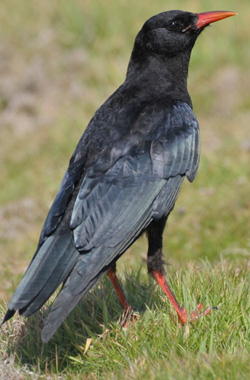
Considering its size, there is a remarkable variety of habitats bringing with it a rich and diverse range of bird species. Specialities of the Isle of Man are the Chough (with a population of c.250 birds); a stable breeding population of Hen Harrier and a healthy population of Peregrine Falcon. The eponymous Manx Shearwater once bred in huge numbers on the Calf of Man, before being wiped out by rats. An extensive pest control programme has now resulted in smaller but growing numbers of Manx Shearwaters breeding on the Calf once more (in 2024 thought to be around 300 pairs).
The Island is dominated by two ranges of hills, clad in heather or grass moorland which rise to 621m at Snaefell in the north and to 483m at South Barrule in the south. The northern plain, by contrast, is relatively flat, consisting mainly of deposits from glacial advances from western Scotland during colder times. There are more recently deposited shingle beaches at the northernmost point, the Point of Ayre. It may be flat, but ornithologically they are valuable lowlands in the north (which include the Ayres and Ballaugh Curragh) and the south-east with the Langness peninsula. The coastline is mostly composed of slate cliffs, interrupted here and there by sandy bays and tiny shingle coves. In the north there are sand dunes which separate the lowland heath of the Ayres from the sea, while across the narrow Sound off the south-west point of the main island is the hilly islet of the Calf of Man, site of an important Bird Observatory administered by Manx National Heritage (MNH).
Well-marked long-distance footpaths explore almost the entire coast, providing frequent opportunities of seeing such Manx specialities as Peregrine, Chough and Raven. Fulmar and Shag are widely distributed but there are only four small Cormorant colonies.
A few of the more spectacular cliffs have Kittiwake and Guillemot colonies, while there is a good scatter of places where Black Guillemots nest. Stonechats are common on the gorse and bramble scrub which is such a typical feature of the steep coastal brooghs – a Gaelic word for the grassy slopes which lead down to the sea. Except for the height of the summer, parties of Purple Sandpiper can be found at several well-established sites on the rocky coast. Little Tern, with as many as seventy pairs in some years, are the most important breeding birds of the Ayres shore.
The road network enables the serious birder to get to all the main sites with ease. Cars may be hired from the airport or sea terminal, otherwise the bus service is excellent – allowing many good birding sites to be reached easily, alternatively there are taxis. There is also an historic network of steam railway and electric tramways. There are many good places on the Island to see birds. Some of the very best are listed below.
-
Ballaugh Curraghs
InformationSatellite ViewThe Island's most extensive area of marshland with a rich growth of willow and birch and scattered rushy meadows. Minor sign-posted roads lead into the Curragh from A14 N of Sulby and A10 N of Ballaugh. Park at SC363951 by the Killane River or at SC359957 and follow the boardwalk SE to the Manx Wildlife Trust hide. Greylag Goose, Teal, Woodcock, Raven (all year). Grasshopper Warbler, Blackcap, Siskin, Redpoll (summer). Sadly the Hen Harrier roost, which was the largest in Western Europe has all but disappeared due to a colony of feral wallabies! -
Calf of Man
InformationSatellite ViewDuring the holiday season (usually late May to mid September) boats from Port Erin land day visitors on the Calf. Trips also go right round the Calf. For details contact Mr Ray Buchan (01624 832339). Alternatively the boatman who makes weekly supply trips to the Observatory, Steve Clague (01624 834307) may be able to take parties over from Port St Mary if arranged in advance https://www.facebook.com/calfofmanboat. Access to the Calf is always subject to the vagaries of the weather - it may prevent landing and (equally important); it may prevent parties from being picked up again! -
Castletown Bay, Langness and Derbyhaven
InformationSatellite ViewThe Langness peninsular in the south is probably the best birding site in the Isle of Man. The area consists of sandy bays, weed-covered rocks, saltmarsh, low cliffs, golf course, rocky islet and intertidal mud. It is adjacent to Ronaldsway Airport. The entire area from Scarlett Quarry in the west to the flying club north of Derbyhaven and as far as the Langness car park at SC284660 is well served by roads. Best areas are around the isthmus to Langness and include Sandwick - the eastern extremity of sand in Castletown Bay - south past the Pool to the car park and the intertidal mud separating Derbyhaven from its breakwater. During winter this is one of the best places to see a Chough flock at close range, as the birds forage through the high-tide wrack. Just south of Derbyhaven take the right-hand fork for Langness and almost at once when the road turns left, keep straight ahead along a sandy, motorable track which follows the coast closely from Sandwick southwards for about a quarter of a mile before re-joining the lighthouse road. Watching from a car can be very rewarding, particularly at high tide. Grey Plover, Knot, Little Stint, Curlew Sandpiper, Ruff, both godwits, Whimbrel, Greenshank, Sandwich Tern (passage). Wildfowl (Brent Goose now annual); Golden Plover, Short-eared Owl, Chough and in Derbyhaven divers and grebes (winter). Rarities have included Great White Egret, Buff-breasted Sandpiper, Sharp-tailed Sandpiper (Langness) and American Wigeon (Derbyhaven). A Peregrine may often be seen resting on the rocks between meals. The end of Langness by the lighthouse makes a fine sea-watching spot. -
Maughold Head & Brooghs
InformationSatellite ViewSlate cliffs with grass and gorse above. Take A15 to Maughold village and follow single-track lane for lighthouse which skirts north side of churchyard. Rough track north to large car park and another small car park to west of lighthouse. From main car park follow path to St. Maughold's Well and then follow path along coast to west (easy) and east with great care (dangerous). Island's largest Cormorant colony (50+ nests) to west. To east Kittiwake and Guillemot colonies, Black Guillemot, Puffin (summer). Peregrine, Raven, Chough (all year). Grey Seals on rocks to west (winter). -
Pooilvaaish to Strandhall
Satellite View...this stretch of the south coast can yield similar variety of wildfowl and waders to Langness/Derbyhaven though generally lower numbers - however there is a contrast with inland habitat; arable fields surrounding Pooilvaaish Farm see some of the largest counts of Lapwing and Twite in winter, and have also been noted to attract occasional Lesser Redpoll, Brambling and Tree Sparrow. -
The Ayres
InformationSatellite ViewA 9km sand and shingle beach with dunes, maritime heath, gravel pits and freshwater pools. This site extends from The Lhen (NX378016) to the Point of Ayre (the northern tip of the Isle of Man) and can be reached from several roads from A10 and by A16. Little Tern (up to 40 pairs); Arctic and non-breeding Sandwich Terns (summer). Sanderling, Curlew Sandpiper, Whimbrel, skuas (passage). Divers, Golden Plover, Short-eared Owl and Raven flock, Twite (winter). Manx Birdlife Point of Ayre Reserve (Gravel Pits) has floated Tern rafts which have had a Common Tern pair present. -
The Chasms & Sugarloaf
InformationSatellite ViewVertical slate cliffs and stack. Arguably the Island's finest cliff scenery - a lane south at Cregneash village climbs to a car park whence one can walk down to the Chasms (dangerous fissures - take care). There is also limited parking at Fistard (SC200644) - then follow the coast for about 1km. Stonechat, Chough, Raven (all year). Kittiwake, Guillemot, Black Guillemot (just S of Fistard) and Wheatear (summer). Though the seabirds can be viewed from the path at the top of the cliffs, undoubtedly the best view is from the sea. During the summer it may be possible to arrange a trip from Port St Mary. The Kittiwakes on the Sugarloaf are stunning!
-
David Kelly
National Recorder
-
Manx Bird Records Committee (MBRC)
The Manx Bird Records Committee (MBRC) is the official adjudicator of rare and scarce bird records in the Isle of Man, including rare breeding species.
http://manxbirdlife.im/manx-ornithological-society/manx-bird-records-committee-mbrc/
-
Number of bird species: 336
as of March 2024 ...with two records pending.
-
Manx BirdLife
ChecklistThe official Manx List of wild birds is maintained by the Manx Bird Records Committee (MBRC), a sub-committee of the Manx Ornithological Society (MOS). The list documents all species deemed to have occurred in a wild state in the Isle of Man.

-
Birds of the Isle of Man
| By J P Cullen & P P Jennings | Bridgeen Publications | 1986 | Hardback | 364 pages, 1 colour plate, b/w photos, line drawings, maps, tables | ISBN: 9780951149904 Buy this book from NHBS.com -
Isle of Man Wildlife
| A Unique and Comprehensive Guide to Flora and Fauna on Land, In The Air, In The Sea, In Rivers & Streams | By Trevor Barrett | Lily Publications | 2012 | Paperback | 96 pages, colour photos | ISBN: 9781907945120 Buy this book from NHBS.com -
Manx Bird Atlas
| (An Atlas of Breeding and Wintering Birds on the Isle of Man) | Edited by Chris Sharpe | Liverpool University Press | 2007 | Hardback | 389 pages, 20 colour plates, 158 line drawings, 555 maps | Out of Print | ISBN: 9781846310393 Buy this book from NHBS.com -
Where to Watch Birds in North West England & the Isle of Man
| By Allan Conlin, Dr J P Cullen, Pete Marsh, Tristan Reid, Chris Sharpe, Judith Smith & Stephen Williams | Christopher Helm | 2008 | Paperback | 287 pages, 30 line illustrations, 50 maps | Out of Print | ISBN: 9780713664218 Buy this book from NHBS.com
-
The Manx Ringing Group (MRG)
WebpageThe Manx Ringing Group operates under licence by the Manx Government’s Department of Environment, Food & Agriculture and its ringers hold a current permit issued by the British Trust for Ornithology. -
Visiting the Calf of Man
During the holiday season (usually late May to mid September) boats from Port Erin land day visitors on the Calf. Trips also go right round the Calf. For details contact Mr Ray Buchan (01624 832339). Alternatively the boatman who makes weekly supply trips to the Observatory, Mr Juan Clague (01624 834307) may be able to take parties over from Port St Mary if arranged in advance. Access to the Calf is always subject to the vagaries of the weather - it may prevent landing and (equally important); it may prevent parties from being picked up again!
-
Calf of Man Bird Observatory
Twitter PageSatellite ViewThe @manxheritage Bird Observatory | Internationally renowned & accredited since 1959 | Managed in partnership with @manxnature | A jewel of #ManxNature -
Calf of Man Bird Observatory
Facebook PageSatellite ViewMission: To monitor and record the breeding and migratory birds of the Calf of Man. The Observatory is usually open from March to early December. Self-catering accommodation is available in the Observatory (the old farmhouse); for more details contact: The Group Permit Officer, Manx National Heritage, Manx Museum, Douglas, Isle of Man IM1 3LY (01624 648000). The Calf of Man Bird Observatory Annual Report is obtainable from the Manx Museum. -
Calf of Man Bird Observatory
Observatory WebsiteSatellite Viewhe Bird Observatory houses a team of Manx Wildlife Trust wardens and volunteers who run a number of projects to record and help a range of native wildlife.
-
MOS Manx Ornithological Society
WebpageThe Manx Ornithological Society (MOS, aka Manx Bird Club) welcomes birdwatchers of all ages to its meetings held at the Union Mills Methodist Church (usually from 7.30pm) and at different outdoor venues in the summer. -
Manx BirdLife
WebsiteManx BirdLife is a conservation charity based in the Isle of Man working to protect the island's wild birds and the habitats on which they depend. Since 1997, we have monitored the abundance and diversity of the island's wild birds. We use this data to inform conservation action that creates a better future for birds and people. Our goal is to ensure that future generations can continue to enjoy and cherish the island's wonderful natural heritage. By continuing to undertake surveys and censuses, and through best practice conservation projects and education initiatives, we believe the future can be bright. -
Manx Wildlife Trust
WebsiteWe work to protect the island's wildlife and habitats. As the island's leading nature conservation charity, we work hard to protection of our island's precious, unique environment, both on the land and in the seas that surround us.
-
*MWT Manx Wildlife Trust Reserves
WebpageSatellite ViewWe look after 28 nature reserves across the Island with the help of a dedicated band of volunteers! -
*Marine Nature Reserves
WebpageSatellite ViewThe new designations take the number of MNRs to 10 (details here), which cover 10.8% of the entire territorial sea and 51.8% of the inshore (0-3 nautical mile area). -
LNR Barnell Reservoir
WebpageSatellite ViewThis small nature reserve features broadleaved woodland and ferns surrounding a redundant reservoir. An area rich in birds, bats and invertebrates. -
LNR Creg y Cowin
WebpageSatellite ViewA new temperate rainforest. MWT’s largest nature reserve purchased in April 2023 with funding by Aviva and in partnership with the Isle of Man Woodland Trust. -
LNR Cronk y Bing
WebpageSatellite ViewThe adjacent shoreline is a favoured breeding ground for oystercatcher and ringed plover. During the autumn divers, grebes, sea duck, skuas, a variety of gulls and waders are often seen. Off the coast seals and diving gannets may also be seen. -
LNR Dalby Mountain
WebpageSatellite ViewTraditional heather moorland with western gorse and plenty of birds. -
LNR Earystane
WebpageSatellite ViewA boardwalk runs through the willow scrub, there's an abundance of mosses and lichens and a bird hide too within this small nature reserve. -
LNR Lough Cranstal
WebpageSatellite ViewOnce a salt-water lagoon, this slowly drying-out closed reserve is rich with invertebrates and attracts many bird species. -
LNR MBL Point of Ayre National Reserve
WebpageSatellite ViewManx Birdlife have taken on a long-term lease from Island Aggregates to manage the former quarry workings as a reserve, with a view to take on future phases as gravel extraction completes. The reserve is not currently open to the public - however I believe the intention is for limited opening some time in 2024. It is the best site on the island for wintering wildfowl with Tufted Duck, Wigeon, Teal, Pochard, Goldeneye, Shoveler and Gadwall regular, and occasional Goosander, Long-tailed Duck and Pintail. The site is also good for passage wader: Black-tailed Godwit, Lapwing, Common Sandpiper and Redshank regular, with occasional Greenshank and Little Ringed Plover among others. Rarer passerines do occur, with the islands first Red-flanked Bluetail and Blyth's Reed Warbler being found here. -
LNR MWT Ballachurry
WebpageSatellite ViewAlthough it is a small reserve it's reedbeds are some of the islands richest. Probably the best site on the island for seeing Sedge Warbler and Reed Warbler in summer, and Water Rail and Woodcock in winter. -
LNR MWT Ballachurry Reserve
Observatory WebsiteSatellite View -
LNR Scarlett Nature Discovery Centre
WebpageSatellite ViewIn addition to the many and varied seabirds of Castletown Bay, wheatears, stonechats and meadow pipits dart among the rocks in summer and the disused quarry lake attracts hawking swallows and martins. -
MWT The Calf of Man
InformationSatellite ViewThe islet to the south of the Isle of Man, may be small but provides a home for many species of birds and other wildlife. It was farmed for many years before becoming a Bird Observatory in 1959. It is home to around 33 species of breeding birds many of which are seabirds. The Calf is also used as a resting point for many other species on their annual migration. -
NNR Ayres Nature Discovery Centre
WebpageSatellite ViewAn important stretch of low-lying sand dune coastline, great for walking and bird watching
-
Manx BirdLife
Latest SightingsThese reports have not been verified by Manx BirdLife. Records of scarce and rare birds (denoted by * after the species/sub-species name) are subject to ratification by the Manx Bird Records Committee (MRBC). -
eBird
Sightings
-
Roy Cottage
WebsiteOur beautiful three-storey traditional Manx fisherman’s cottage is situated in a superb position for exploring the beautiful Isle of Man.
-
A Guide to Birdwatching on the Isle of Man
WebpageThe Isle of Man is blessed with an enviable diversity of wild birds that can be easily seen in their spectacular Island surroundings... -
Isle of Man Birding
Facebook PagePrimarily about photographing the birds of the Isle of Man but also throwing in a few macro (bugs) shots and the odd controversial comment.
-
MWT Blogs
BLOGA collective effort indexed by year and month... -
Manx Birds from my window
Group BLOG
-
Artist - Jeremy Paul
GalleryBorn in Accrington, Lancashire, UK in 1954, Jeremy Paul had a successful career in marine biology before becoming a professional Wildlife Artist. After receiving a Doctorate for research, his work took him to live in Spain and some of the most beautiful and remote areas of the British Isles, particularly the west coast of Scotland including a period on a small island with a total population of 6 -
Photographer - Peter Hadfield
GalleryMy name is Peter Hadfield I live in the Isle of Man (British Isles) and I have been birding on and off for nearly 20 years. (Mainly in the IOM but once or twice in the Uk). Within the last 2 years I have extended this into Bird Photography. I started on a Digiscoping setup then at the beginning of 2004 I moved onto a DigiSlr setup. On this website I intend to show a selection of images I have managed to take so far