

Migration
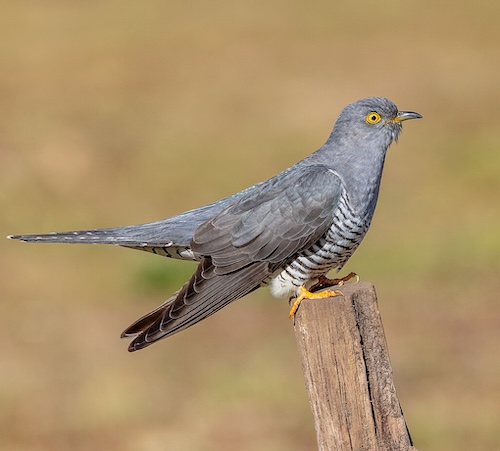
Fly away home…
Bird migration has fascinated humanity since historical times, although in earlier times it was believed that birds such as swallows, which disappeared in the summer, were hibernating at the bottom of ponds until the next spring. In northern Europe, the return of then Cuckoo still heralds spring. It became clear to science that birds were making the most of their opportunities by moving away from the cold and wet season when food would be hard to find. It was also part of the strategy to return to cooler climates in order to make use of the breeding possibilities when they were experiencing better summer weather. Some birds stay in the tropics. Other species stay resident, the cooler parts of the world, while some migrate to get the best of both worlds.
Because cooler climates can sustain fewer birds, it makes sense as a strategy to fill those gaps as those areas warm, and that warmth brings forth more food options, such as flying insects. Once advantage is taken of the food source allowing the birds to breed and raise young, the cooler air signals the time to once more migrate to the tropics. Some species only partially migrate, moving away from the most severe weather, but not going the whole hog and moving to the tropics. Once more, this makes sense as a strategy in that they are closer to the breeding grounds for their return when the weather improves than those who migrate further.
It is not unusual for some individuals to take a chance either on staying where they are rather than migrating to the tropics or staying in the tropics rather than moving north again or south in the case of the Southern Hemisphere.
These mass movements usually occur along distinct flyways. Sometimes there is safety in numbers and at other times that is actually a disadvantage. But geography and climate work together to make certain routes most viable. Moving across oceans or desert is clearly a risky strategy as there is nowhere to rest or to feed up. Nevertheless, hundreds of millions of birds do this every year. Science has not only researched this phenomenon en masse, but also looking at how individual birds manage to navigate, a process that has revealed some quite remarkable senses that birds possess that we as humans do not, such as an awareness of gravity. Initial studies were pure observation, but latterly, programs of ringing or banding birds was undertaken so that start and end points could be seen, and even routes taken by virtue of birds found that are ringed that did not survive the full journey.
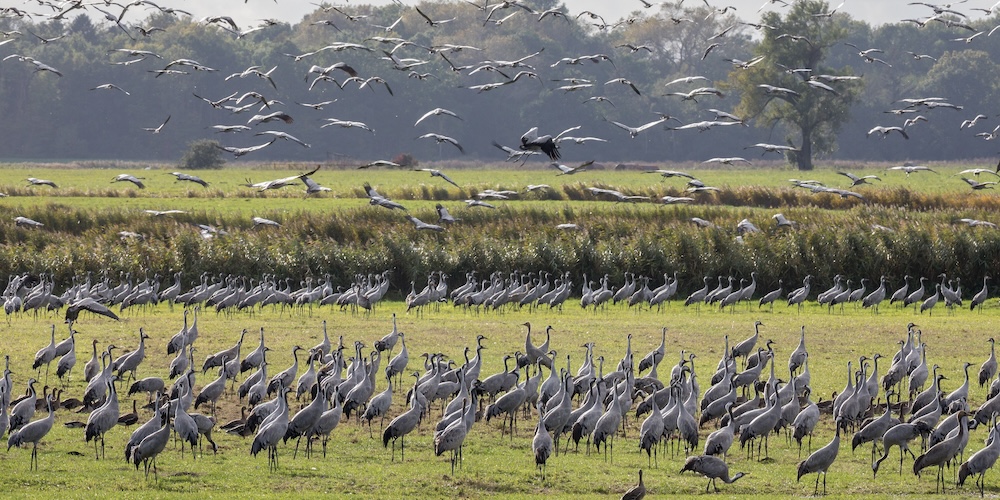
Common Cranes Grus grus congregating in Germany before flying south – ©Andreas Weith, CC BY-SA 4.0 via Wikimedia Commons
Many migration studies now use modern techniques combining radio transmitters with satellite tracking. The studies involve both very scare and quite common species and have recently uncovered a great deal of information regarding both routes and en route feeding stations and hidden wintering grounds etc.
Birders gather to watch “viz mig” – visible migration. It really is a joy to see and can be a treat in an unlikely circumstance. For example, I was once waiting in a town centre in SE England while my wife shopped. Looking up (this was late September) I saw a few swallows passing south over the high street. 20 minutes later I was up to 800 – that afternoon others reported many thousands of swallows on the move. A joy to marvel at. Migration can be truly spectacular or more mundane. Watching in the spring may bring in early migrants and unusual birds blown off course, and viewing in the autumn can see mass congregations as birds ready themselves to fly, such as swallows occupying miles of telegraph wires. and rarity oriented. In the UK, many bird observatories are sighted along these migration flyways so that staff and volunteers can monitor movements.
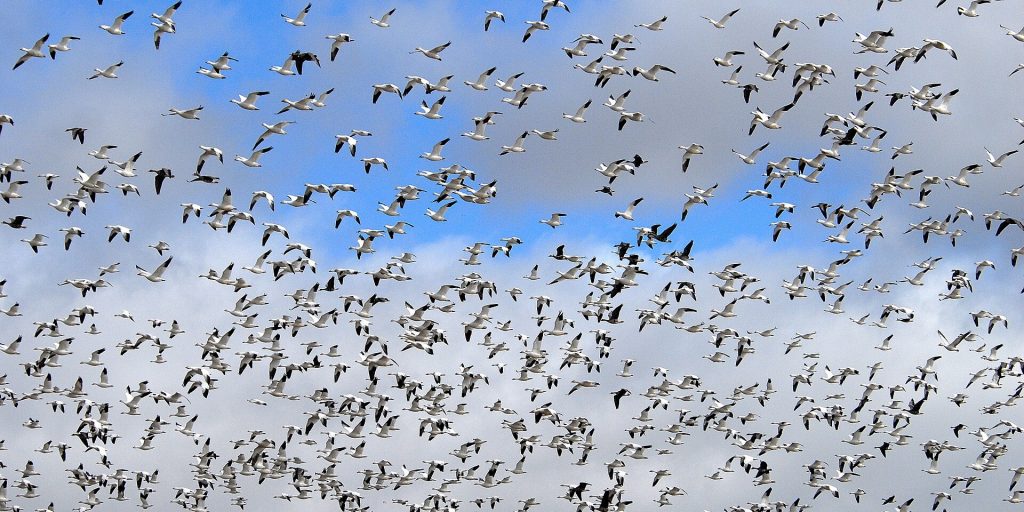
Snow Geese Anser caerulescens Migration – Pacific Southwest Region USFWS Public domain, via Wikimedia Commons
For most birders, although spring migration can be exciting, it is during the autumn that we are most likely to be able to catch up with unusual migrants. Birds blown off course by bad weather or who have somehow become disoriented or have, by virtue of the way their brains are wired, migrated in the wrong direction, tend to have to make landfall en route in order to feed up before, for example, crossing water. In spring, many migrants will fly direct to their breeding grounds, high overhead and often at night. Bad weather may bring falls of birds, but in autumn, birds tend to begin their migration more slowly and therefore hang around, particularly at coastal sites where they spend time feeding to ensure they have enough fuel on board to make crossings of water, such as the English Channel or either end of the Mediterranean or across the vast expanse of the Sahara Desert.
Such spectacles of birds en masse are of course one of the reasons that people become attracted to bird watching. Migration is a wonder whichever way you look at it.
-
Bird Display
| (An Introduction to the Study of Bird Psychology) | By Edward A Armstrong | Cambridge University Press | 2015 | Paperback | ISBN: 9781107511576 Buy this book from NHBS.com -
Bird Migration
| By Ian Newton | HarperCollins | 2020 | Paperback | 598 pages, b/w photos, b/w illustrations, b/w maps, tables | ISBN: 9780008398545 Buy this book from NHBS.com -
Bird Migration
| By Thomas Alerstram | CUP | 1993 | Paperback | 420 pages, 2 b/w photos, 137 figs, maps, line illus | ISBN: 9780521448222 Buy this book from NHBS.com -
Bird Migration - A General Survey
| by Peter Berthold | OUP | 2001 | Second Edition | 2001 | Paperback | 253 pages, figs, tabs, maps | ISBN: 9780198507871 Buy this book from NHBS.com -
Bird Migration - A New Understanding
| | By John H Rappole | Johns Hopkins UP | 2022 | Hardback | 323 pages, 12 b/w photos, 24 b/w illustrations and b/w maps | ISBN: 9781421442389 Buy this book from NHBS.com -
Flight Paths - How the Mystery of Bird Migration Was Solved
| By Rebecca Heisman | Swift Press | 2024 | Paperback | 264 pages, no illustrations | ISBN: 9781800752948 Buy this book from NHBS.com -
Living on the Wind: Across the Hemisphere with Migratory Birds
| by Scott Weidensaul | North Point Press | 2000 | Paperback | 420 pages | ISBN: 9780865475915 Buy this book from NHBS.com -
Monitoring Bird Populations Using Mist Nets
| By CJ Ralph & EH Dunn | Cooper Ornithological Society | 2004 | Paperback | 211 pages, diagrams, tables | ISBN: 9780943610610 Buy this book from NHBS.com -
Phenological Synchrony and Bird Migration
| (Changing Climate and Seasonal Resources in North America) | Edited by Matthew Wood & Jherime L Kellermann | Apple Academic Press | 2017 | Paperback | 232 pages, 4 plates with 8 colour photos; 53 b/w illustrations and b/w maps, 29 tables | ISBN: 9781138575783 Buy this book from NHBS.com -
Studies in Bird Migration, Volume 1
| By William Eagle Clarke | Cambridge University Press | 2014 | Paperback | 323 pages, 2 b/w illustrations, 7 b/w maps | ISBN: 9781108066976 Buy this book from NHBS.com -
Studies in Bird Migration, Volume 2
| By William Eagle Clarke | Cambridge University Press | 2014 | Paperback | 346 pages, 16 b/w illustrations, 1 b/w map | ISBN: 9781108066983 Buy this book from NHBS.com -
The Avian Migrant
| (The Biology of Bird Migration) | by John H Rappole | Columbia University Press | 2013 | Hardback | 512 pages, 109 figures | ISBN: 9780231146784 Buy this book from NHBS.com -
The Migration Ecology of Birds
| by Ian Newton | Academic Press | 2023 | Edition 2 | Hardback | 707 pages, 200 two-tone and b/w illustrations, two-tone tables | ISBN: 9780128237519 Buy this book from NHBS.com -
Time to Fly - Exploring Bird Migration
| By Jim Flegg | BTO | 2004 | Edition 3 | Paperback | 184 pages, Col photos, maps | ISBN: 9781904870081 Buy this book from NHBS.com
-
Euro Bird Portal
WebsiteDuring the last ten years, the number and diversity of web portals dedicated to the collection of bird observations has increased rapidly and most of Europe is now covered by at least one of them. Some portals are based on very specific systems and cover a limited geographical area (e.g. a region or country) while others function across several countries using the same basic package. While there is substantial variation in the scope and volumes of data gathered by different portals, the advent of online data collection has produced a vast amount of data that would previously have been impossible to amass.
-
Oxford Navigation Group
WebsiteBased in Oxford's Biology Department, we carry out diverse research falling within the Behaviour & Biomechanics section. The group consists of several PI's, Independent Research Fellows, Post-Docs and Research Assistants, and a vibrant community of graduate and undergraduate students. Many of our alumni are still actively engaged in collaboration with current members too.
-
Audubon - Flyways
WebpageSelect a bird to learn more about its journey along the flyways. -
BTO - Birdtrack
WebpageThe online bird recording scheme to increase the personal, local and national value of your sightings -
BirdLife - Migration Marathons
WebpageAround one in five of all the world’s bird species migrate. And while every migration is an epic and often perilous feat of endurance, here’s a selection of species that we feel go the extra mile. -
Convention on the Conservation of Migratory Species
WebsiteThe Convention on the Conservation of Migratory Species of Wild Animals (Bonn Convention or CMS) was adopted in Bonn, Germany in 1979 and came into force in 1983. -
National Geographic - Billions of Birds Migrate
WebpageMigratory birds have made their thousand-mile flights for millennia, but we are just now learning to map their mesmerizing journeys. -
RSPB - Migration
WebpageBird migration is one of the wonders of the natural world. Find out what makes birds fly thousands of miles and how they find their way. -
Smithsonian Migratory Bird Center
WebpageThe Smithsonian Migratory Bird Center is dedicated to fostering greater understanding, appreciation, and protection of the grand phenomenon of bird migration -
The Wildlife Trusts - Where to watch migrating birds
WebpageWhether flying from the south to breed in the spring, or from the north in the winter in search of food and milder climes, or simply passing through on their journey, bird migration is one of the UK’s most impressive natural events. -
Trektellen
WebsiteMigration counts and ringing records The Netherlands, Flanders and France -
eBird - real-time migration information
WebpageThe Cornell Lab’s BirdCast project has two incredible new features: a 3-day migration forecast for the entire continental US and a live migration map for the same region. Check out how these new features allow you to discover migration like never before!
-
ARRCN Asian Raptor Migration WebPage
WebsiteThis web site is consisted by information of Asian raptor migration. Therfore, if you have some information on Asian raptor migration, please send me the data.We ask that the following raptor migration data be provided, at least. -
Bird Monitoring in North America
WebsiteThe monitoring programs highlighted on these pages can be used to track changes in North American bird populations. These trends give conservationists, managers, citizens, and policy makers a window into the natural world and the health of environment. The patterns of increase and decrease are quantifications that can be tested against and compared to the subjective feelings we have on the status of birds in North America. Are more species increasing than decreasing? Are Eastern Bluebirds doing well or poorly? What do we know about shorebirds? Learn about these programs, use their data, participate in the counts, and write about the changes. -
BirdTrack
WebpageBirdTrack is an exciting project, through a partnership between the BTO, the RSPB, Birdwatch Ireland and the Scottish Ornithologists' Club, that looks at migration movements and distributions of birds throughout Britain and Ireland. BirdTrack provides facilities for observers to store and manage their own personal records as well as using these to support species conservation at local, regional, national and international scales -
Friends of Operation Migration
Facebook PageTo educate all ages about Whooping cranes and the wetlands they rely upon. -
Hawk Migration Network of Japan
WebsiteHawk Migration Monitoring Throughout Japan - including Links to other Hawk Migration websites in Japan and beyond. -
Hummingbird Migration
WebpageGet involved with hummingbird migration with the Perky-Pet® Hummingbird Migration Map! This interactive tool uses Google's map application right from inside our own Birdfeeders.com! -
Journey North
WebsiteTracking migrations, season by season. -
Lesser Golden Plover Migration
WebsiteShorebirds, like most of our waterfowl, nest on th arctic tundra and migrate to southern wintering grounds. Yet unlike waterfowl, many shorebirds -- sandpipers, plovers, godwits, curlews --- migrate beyond the confines of the North American continent -
Light Pollution - FLAP [Fatal Light Awareness Program]
WebsiteWe protect birds from a deadly leading threat: collisions with buildings. -
Satellite Tracking of Endangered Birds
WebsiteThe Patuxent Wildlife Research Centre, and the Direct Readout group of the Applied Information Sciences Branch (Code 935) at NASA's Goddard Space Flight Centre are working together on a project to monitor the migration routes of several endangered species using satellite tracking