

Anhingidae – Darters
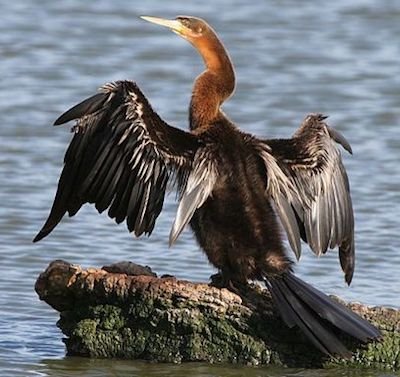
The darters, or snakebirds are mainly tropical waterbirds in the family Anhingidae. There are four living species (or just two according to some authorities or as many as five according to others who split off the Madagascan form vulsini), three of which are very common and widespread while the fourth (and fifth) is rarer and classified as near-threatened by the IUCN.
The term ‘snakebird’ is usually used without any additions to signify whichever of the completely allopatric species occurs in any one region. It refers to their long thin neck, which has a snake-like appearance when they swim with their bodies submerged, or when mated pairs twist it during their bonding displays. ‘Darter’ is used with a geographical term when referring to particular species. It alludes to their manner of procuring food, as they impale fishes with their thin, pointed beak. The American Darter Anhinga anhinga is more commonly known as the Anhinga.
Anhingidae are large birds with sexually dimorphic plumage. They measure about 80 to 100 cm (2.6 to 3.3 ft) in length, with a wingspan around 120 cm (3.9 ft), and weigh some 1,050 to 1,350 grams (37 to 48 oz). The males have black and dark-brown plumage, a short erectile crest on the nape and a larger bill than the female. The females have much paler plumage, especially on the neck and underparts, and are a bit larger overall. Both have grey stippling on long scapulars and upper wing coverts. The sharply pointed bill has serrated edges, a desmognathous palate and no external nostrils. The darters have completely webbed feet, and their legs are short and set far back on the body.
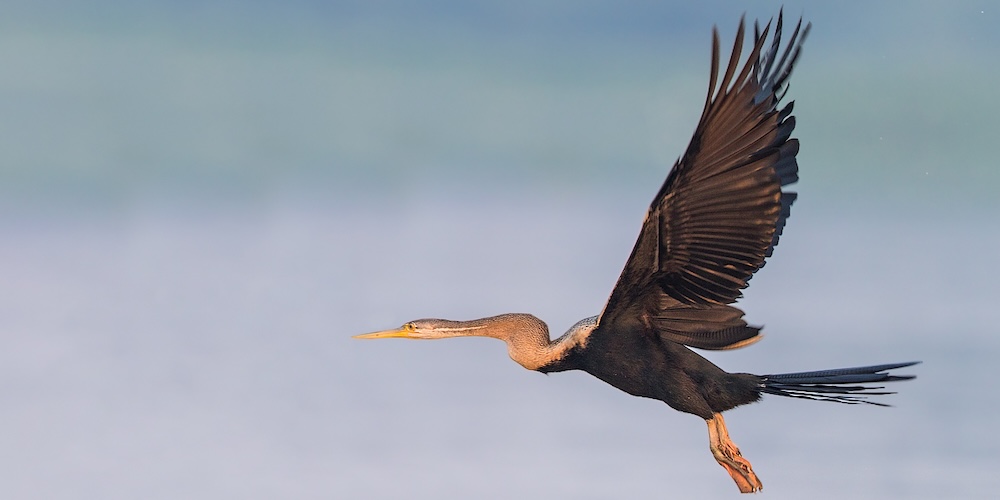
Oriental Darter Anhinga melanogaster – ©Dubi Shapiro
There is no eclipse plumage, but the bare parts vary in colour around the year. During breeding, however, their small gular sac changes from pink or yellow to black, and the bare facial skin, otherwise yellow or yellow-green, turns turquoise. The iris changes in colour between yellow, red or brown seasonally. The young hatch naked, but soon grow white or tan down.
Darter vocalizations include a clicking or rattling when flying or perching. In the nesting colonies, adults communicate with croaks, grunts or rattles. During breeding, adults sometimes give a caw or sighing or hissing calls. Nestlings communicate with squealing or squawking calls.
Darters are mostly tropical in distribution, ranging into subtropical and barely into warm temperate regions. They typically inhabit fresh water lakes, rivers, marshes, swamps, and are less often found along the seashore in brackish estuaries, bays, lagoons and mangrove. Most are sedentary and do not migrate; the populations in the coolest parts of the range may migrate however. Their preferred mode of flight is soaring and gliding; in flapping flight they are rather cumbersome. On dry land, darters walk with a high-stepped gait, wings often spread for balance, just like pelicans do.
They tend to gather in flocks – sometimes up to about 100 birds – and frequently associate with storks, herons or ibises, but are highly territorial on the nest: despite being a colonial nester, breeding pairs – especially males – will stab at any other bird that ventures within reach of their long neck and bill. The Oriental Darter is a Near Threatened species. Habitat destruction along with other human interferences (such as egg collection and pesticide overuse) are the main reasons for declining darter populations.
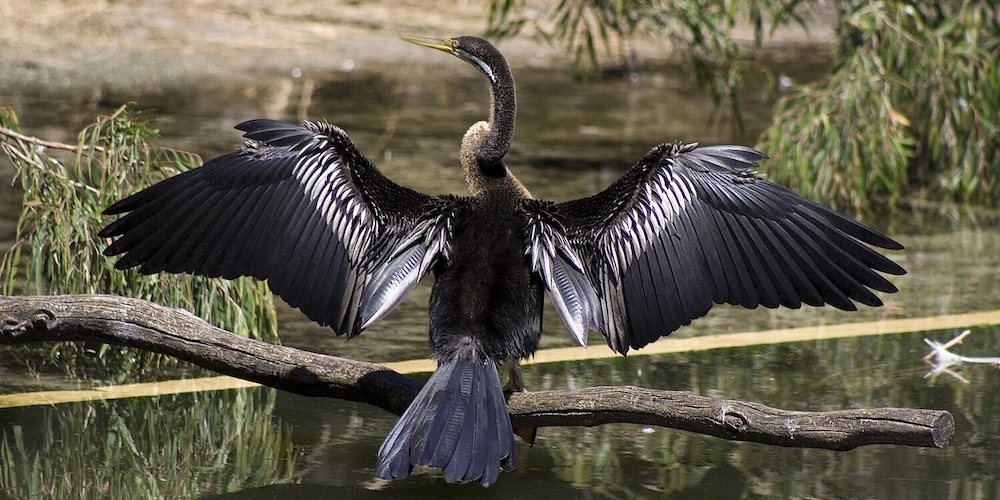
Australian Darter Anhinga novaehollandiae – ©Scarlet23 CC BY 3.0 via Wikimedia Commons
Anhingas nest colonially in tree limbs that hang over water. As many as 400 Anhinga nests may occur in a single colony, though usually there are only a few dozen. They sometimes share their nesting colonies with wading birds such as herons, ibises, and spoonbills. The nests are made of twigs and lined with leaves; they are built in trees or reeds, usually near water. Typically, the male gathers nesting material and brings it to the female, which does most of the actual construction work. Nest construction takes only a few days (about three at most), and the pairs copulate at the nest site. The clutch size is two to six eggs (usually about four) which have a pale green colour. The eggs are laid within 24–48 hours and incubated for 25 to 30 days, starting after the first has been laid; they hatch asynchronously. To provide warmth to the eggs, the parents will cover them with their large webbed feet, because like their relatives they lack a brood patch. The last young to hatch will usually starve in years with little food available. Bi-parental care is given and the young are considered altricial. They are fed by regurgitation of partly digested food when young, switching to entire food items as they grow older. After fledging, the young are fed for about two more weeks while they learn to hunt for themselves.
-
Number of bird species: 4
(As at July 2025)
According to the IOC there are just four species in the Anhingidae family, part of the order of Suliformes along with Fregaridae (Frigatebirds), Sulidae (Boobies & Gannets) and Phalacrocoracidae (Cormorants & Shags) – they are:
Anhinga (American Darter) Anhinga anhinga
Australian Darter Anhinga novaehollandiae
Oriental Darter Anhinga melanogaster
African Darter Anhinga rufa
-
Anhingidae
Family AccopuntThe darters, anhingas, or snakebirds are mainly tropical waterbirds in the family Anhingidae, which contains a single genus, Anhinga...
Fatbirder provides quick links to all four species below:
-
African Darter Anhinga rufa
Species AccountBirdLife species profile and status -
African Darter Anhinga rufa
Species AccountThe African darter (Anhinga rufa), sometimes called the snakebird, is a water bird of sub-Saharan Africa and Iraq. -
African Darter Anhinga rufa
Species AccountSound archive and distribution map. -
Anhinga (American Darter) Anhinga anhinga
Species AccountThe anhinga (/ænˈhɪŋɡə/; Anhinga anhinga), sometimes called snakebird, darter, American darter, or water turkey, is a water bird of the warmer parts of the Americas. The word anhinga comes from the Brazilian Tupi language and means devil bird or snake bird. When swimming the origin of the name snakebird is apparent: only the colored neck appears above water so the bird looks like a snake ready to strike. They do not have external nares (nostrils) and breathe solely through their epiglottis. -
Anhinga (American Darter) Anhinga anhinga
Species AccountSound archive and distribution map. -
Anhinga (American Darter) Anhinga anhinga
Species AccountA bird of southern swamps, the Anhinga is known as the Water-Turkey for its swimming habits and broad tail, and also as the Snake-Bird for its habit of swimming with just its long head and neck sticking out of the water. -
Australasian Darter Anhinga novaehollandiae
Species AccountSpecies profile and status -
Australasian Darter Anhinga novaehollandiae
Species AccountThe Australasian darter or Australian darter (Anhinga novaehollandiae) is a species of bird in the darter family, Anhingidae. It is found in Australia, Indonesia, and Papua New Guinea. It weighs around 2.6 kg and spans 86–94 cm (34–37 in) in length. -
Australasian Darter Anhinga novaehollandiae
Species AccountIUCN species status and profile -
Australasian Darter Anhinga novaehollandiae
Species AccountSound archive and distribution map. -
Australian Darter Anhinga novaehollandiae
Species AccountFull species account… -
Oriental Darter Anhinga melanogaster
BirdLife Species AccountBirdLife species profile and status -
Oriental Darter Anhinga melanogaster
Species AccountThe Oriental darter or Indian darter (Anhinga melanogaster) is a water bird of tropical South Asia and Southeast Asia. It has a long and slender neck with a straight, pointed bill and, like the cormorant, it hunts for fish while its body submerged is in water. It spears a fish underwater, bringing it above the surface, tossing and juggling it before swallowing the fish head first. The body remains submerged as it swims, and the slender neck alone is visible above the water, which accounts for the colloquial name of snakebird. Like the cormorants, it has wettable feathers and it is often found perched on a rock or branch with its wings held open to dry. -
Oriental Darter Anhinga melanogaster
BirdLife Species AccountDistribution map -
Oriental Darter Anhinga melanogaster
Species AccountSound archive and distribution map.